
“What A Wonderful World” is a classic jazz standard and an essential piece of American musical history! In this article, we will learn the “What A Wonderful World Chords” and discover why this song is so timeless.
We’ll provide a harmonic analysis and show you how to play each chord in this song!
If you love this classic Louis Armstrong tune, you’ll probably love learning how to play other amazing jazz standards.
The Learn Jazz Standards Inner Circle is an incredible resource that teaches you how to play classic jazz songs and improvise like a jazz master, no matter your instrument.
Take your musical chops to the next level and improve in 30 days or less.
Table of Contents
What A Wonderful World Chords and Analysis
Let’s play “It’s A Wonderful World.” We’ll go section by section and learn the chords. Don’t worry! I’ll provide guitar chord charts for the chords listed in the analysis! Many of these are open chords, so you’ll be playing this tune in no time.
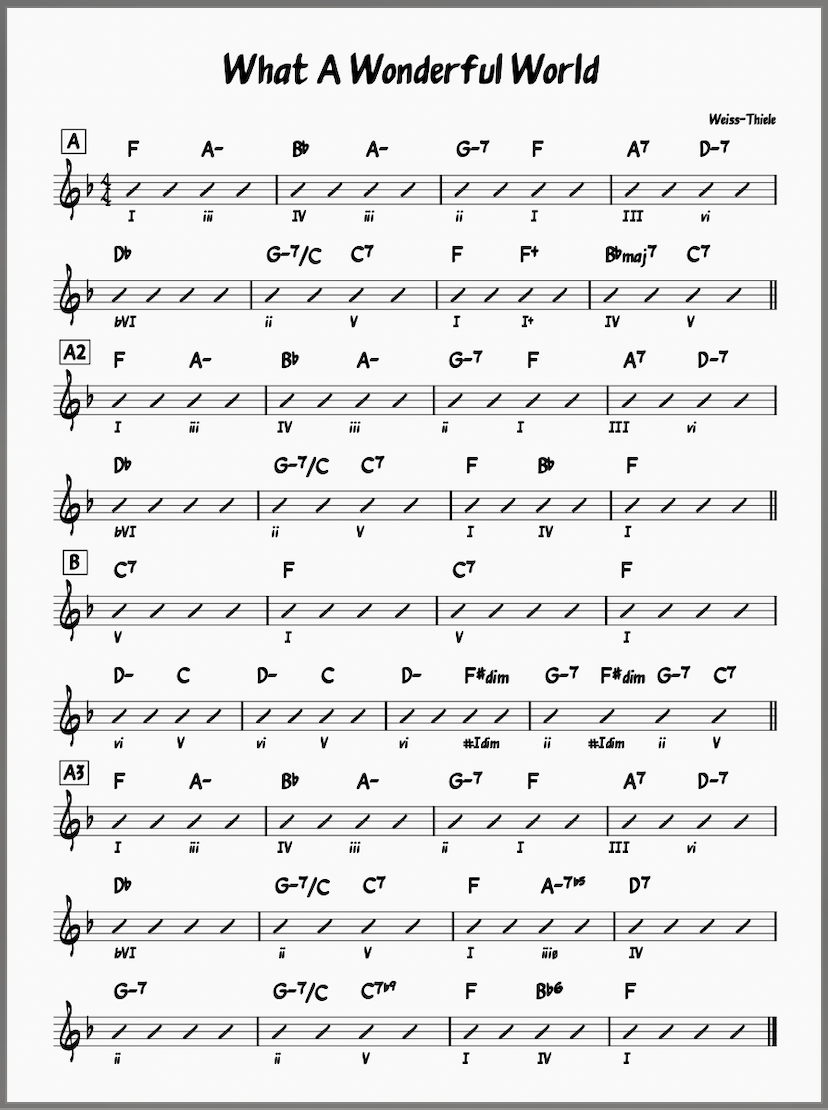
Before getting specific about this song’s harmonic analysis, here are a few things to know (especially if you are new to harmonic analysis).
Many of these chords are diatonic chords, which means they are all derived from the notes in a major scale. In the case of this song, it’s an F major scale. That’s why we say this song is in the key of F Major—most of the chords are built from the notes in that scale.
When they aren’t derived from the key of F, they are slightly changed to fit a particular function (secondary dominants) or borrowed from other keys. We’ll discuss these concepts more as we encounter them.
However, check out this post if you want to learn more about different types of chord substitutions and this post if you want to explore diatonic chords.
Besides the occasional borrowed chord, most of the chords in this tune come from the F major scale.
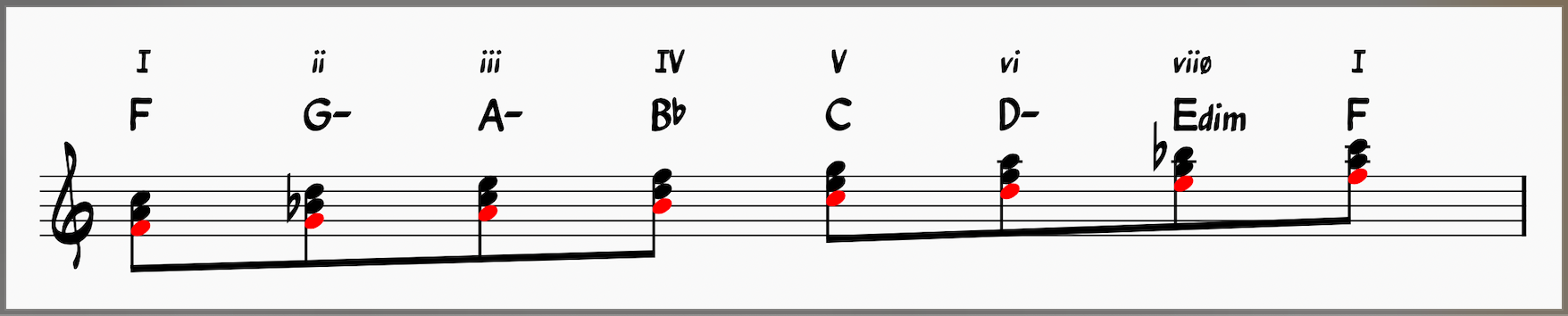
The Roman numerals refer to the chord’s relationship to the scale it’s built from. The F chord is the first scale degree in an F major scale, hence the I. The G- chord is built from the second scale degree, thus the ii. Also, uppercase numerals refer to major chords, and lowercase numerals refer to minor chords.
The First Verse
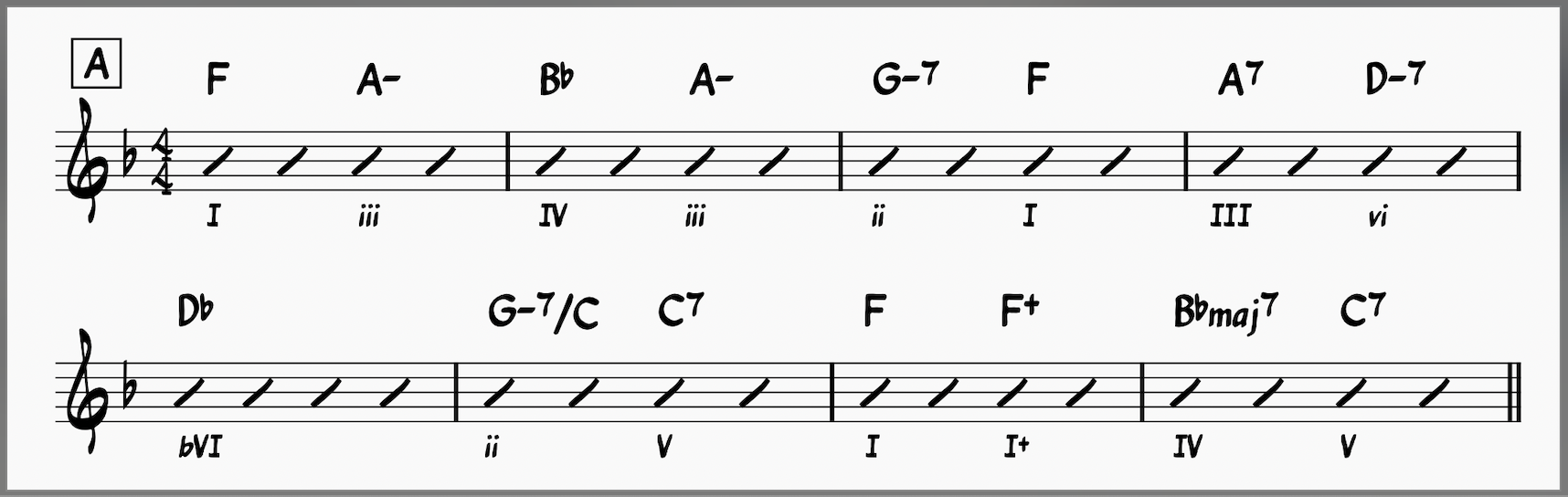
Most of the chords in the first verse are diatonic. The exceptions are the Db major and the A7 (and F+, but this is more of a product of voice leading). The Db major and A7 represent two types of chord substitutions composers use to spice up a chord progression.
Borrowed Harmony: Db Chord
The Db chord is borrowed from the parallel minor key of F minor. In the key of F minor, a Db chord is a VI chord or a major chord built from the minor sixth scale degree.
- F-G-Ab-Bb-C-Db-Eb-F
For more on borrowed harmony, check out this post on modal interchange.
Secondary Dominants: A7 (and D7 in later sections)
Secondary dominants are used in progressions where one chord resolves to another a perfect fourth away. In diatonic harmony, the only dominant chord is the V chord, but this kind of chord resolution happens from different scale degrees all the time, like iii-vi or ii-V.
Secondary dominants turn that first chord in the two-chord progression into a dominant chord, even though a dominant chord from a scale degree other than the V would be non-diatonoic.

Usually, the vi chord is minor, but here, it’s played as a dominant chord to better lead to the D-7. The A7 is a secondary dominant or “V of vi” because the A7 creates a V-I cadence between the III and the vi chord.
Chords You’ll Need:
- F
- Am
- Bb
- G-7
- A7
- Dm
- Db
- G-7/C
- C7
- F+
- Bbmaj7
First Four Bars With Guitar Chord Diagrams:
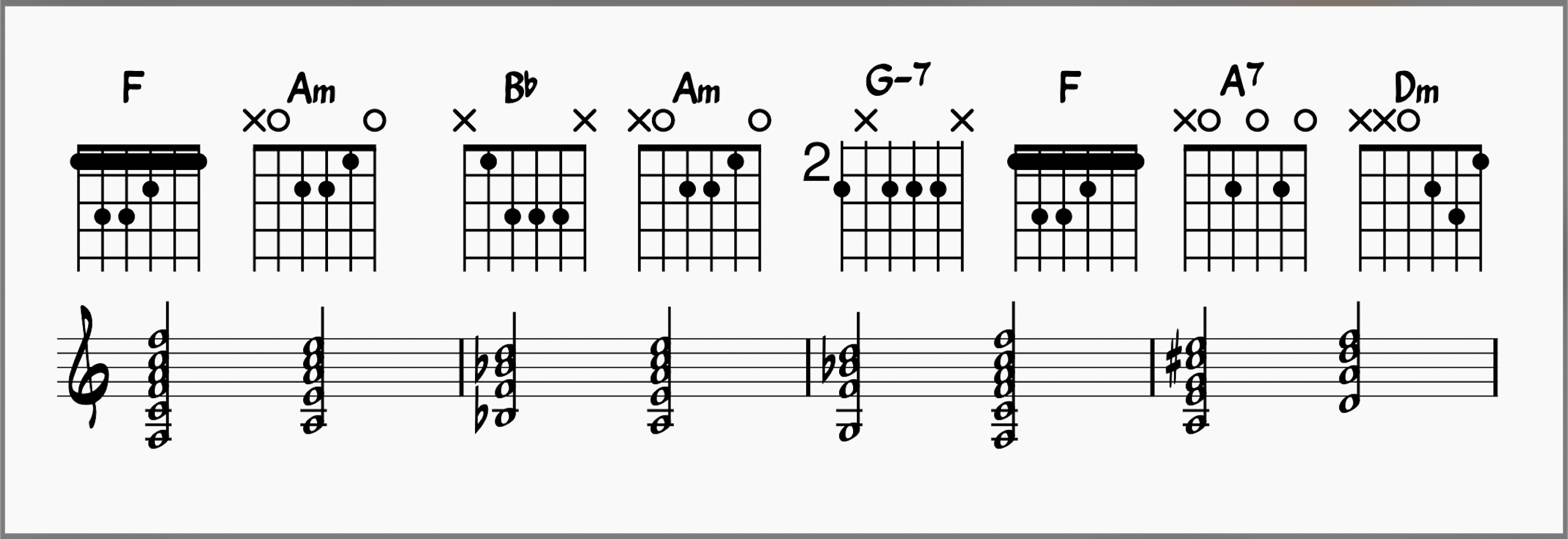
Bars 5-8 With Guitar Chord Diagrams:
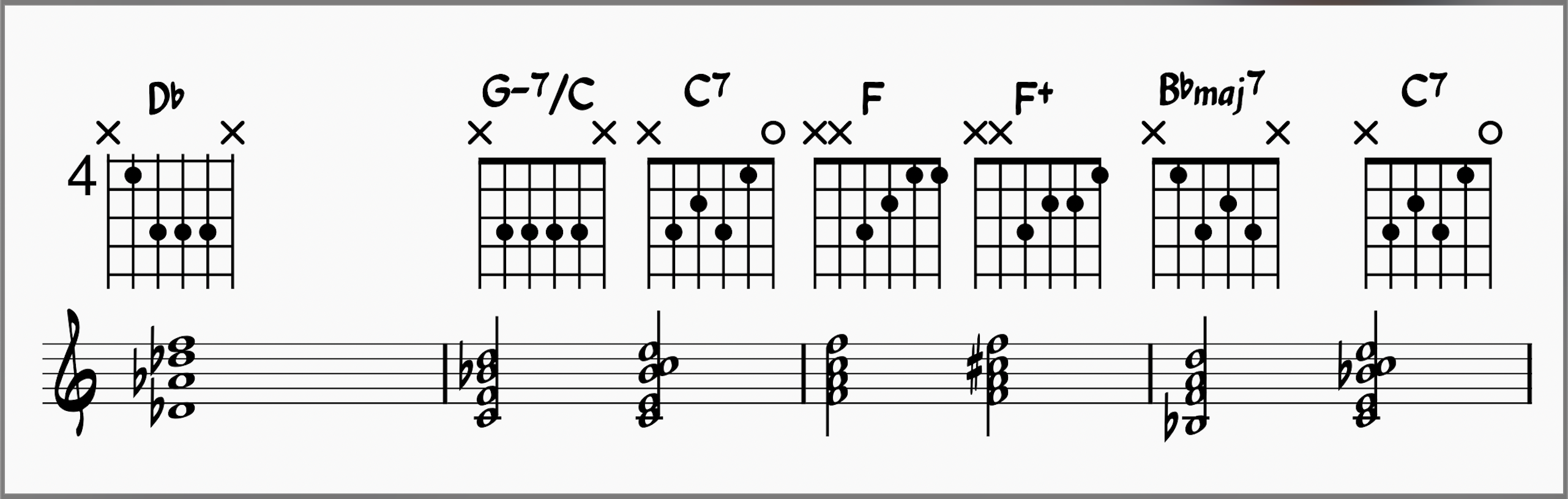
Note the Db major chord!
The Second Verse
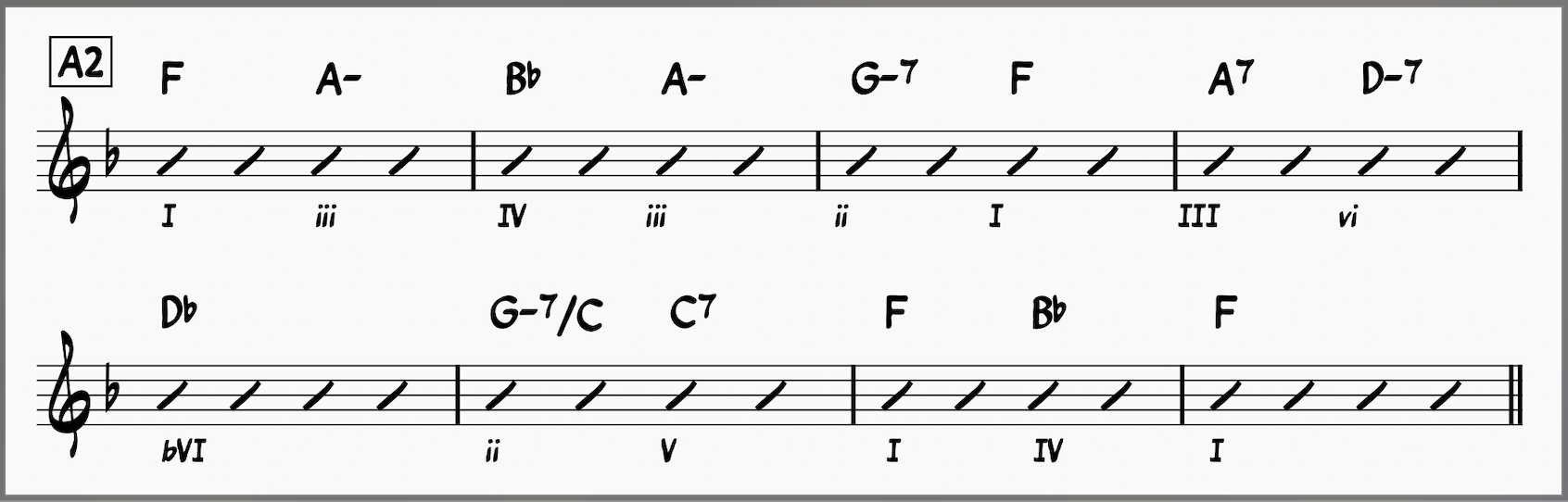
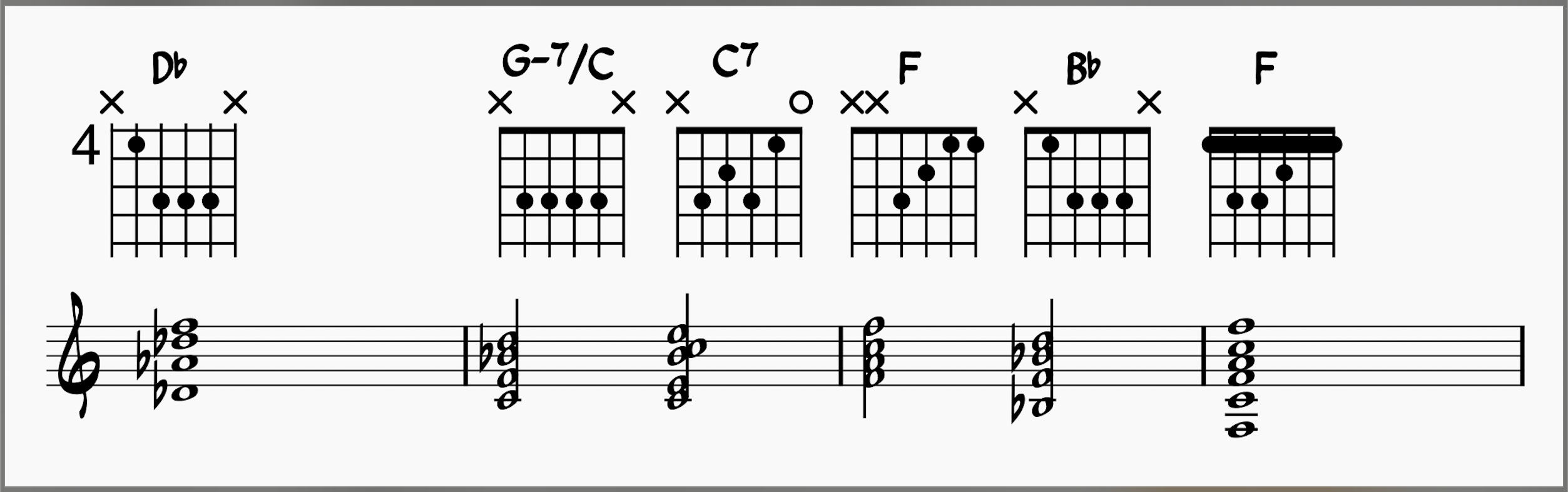
The second verse is nearly identical to the first verse. The only differences lie in the last two bars of this section. Instead of | F F+ | Bbmaj7 C7 |, we have a simple plagal cadence of I-IV-I, or | F Bb | F |
Bars 13 – 16 With Guitar Chord Diagrams:
The Bridge
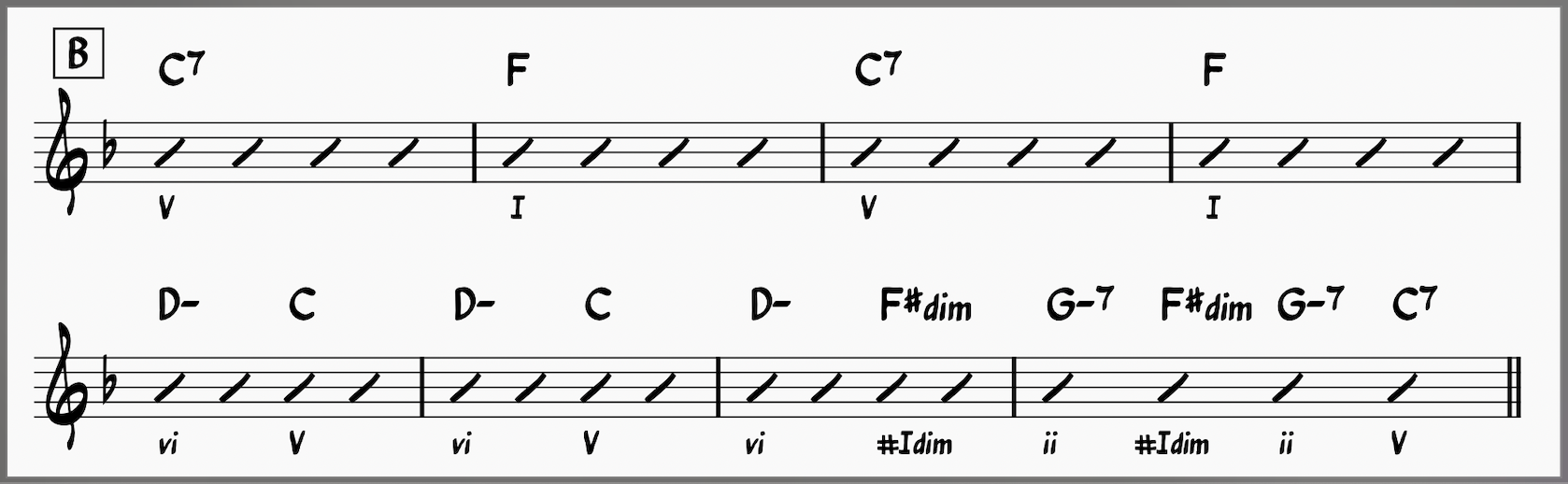
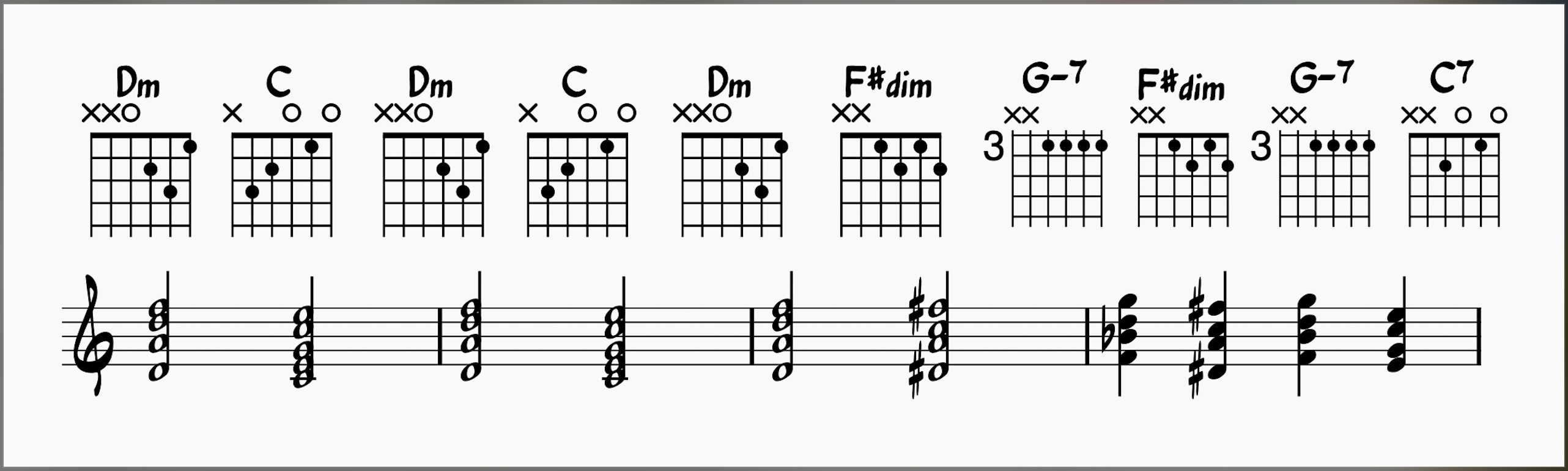
The bridge is also mostly diatonic. The only non-diatonic chord is the F# diminished chord, which is actually a sneaky secondary dominant. Here, the F# diminished chord functions as a D7 chord, or “V of ii.”
D7 and F# diminished share many of the same chord tones.
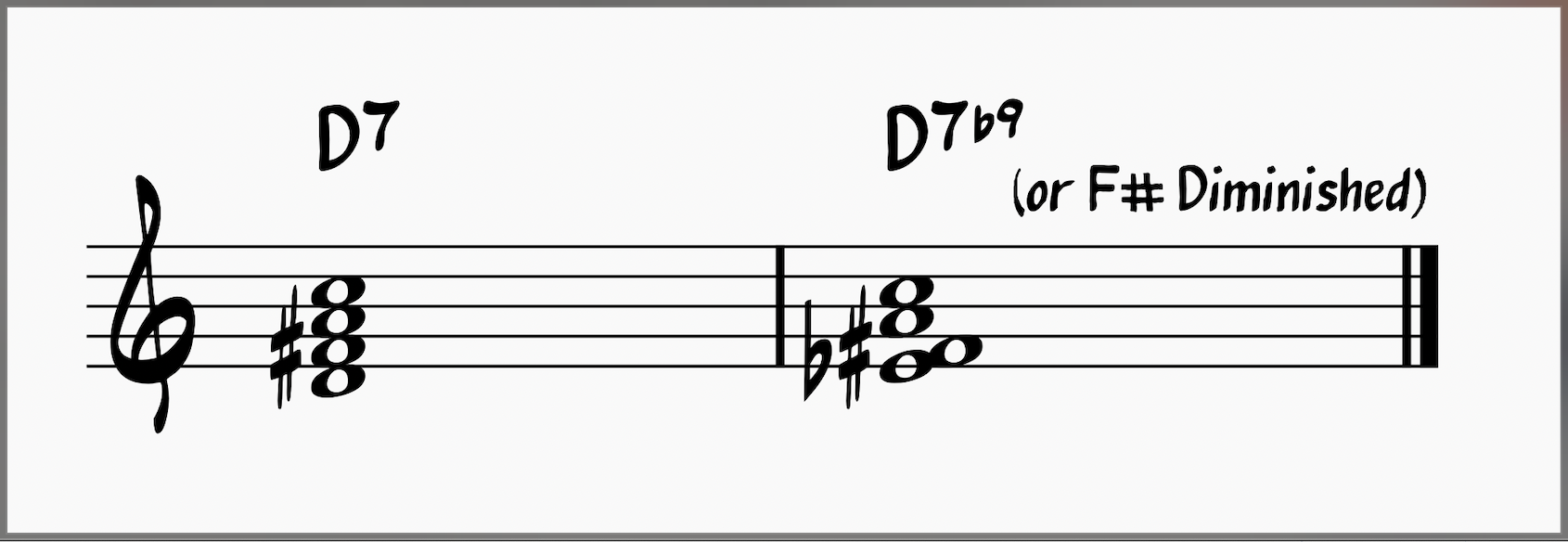
- D7: D, F#, A, C
- F#dim: F#, A, C, Eb (b9 in D7)
New Chords For This Section:
- D-
- C
- F#dim
First Four Bars of the Bridge:
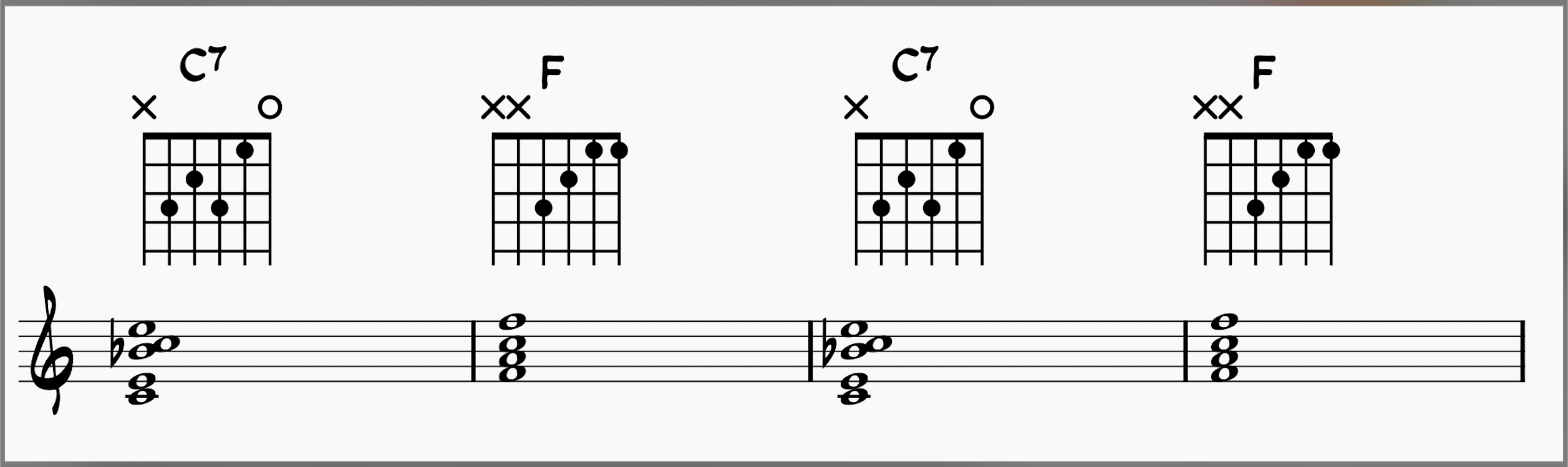
Last Four Bars of the Bridge:
The Third Verse
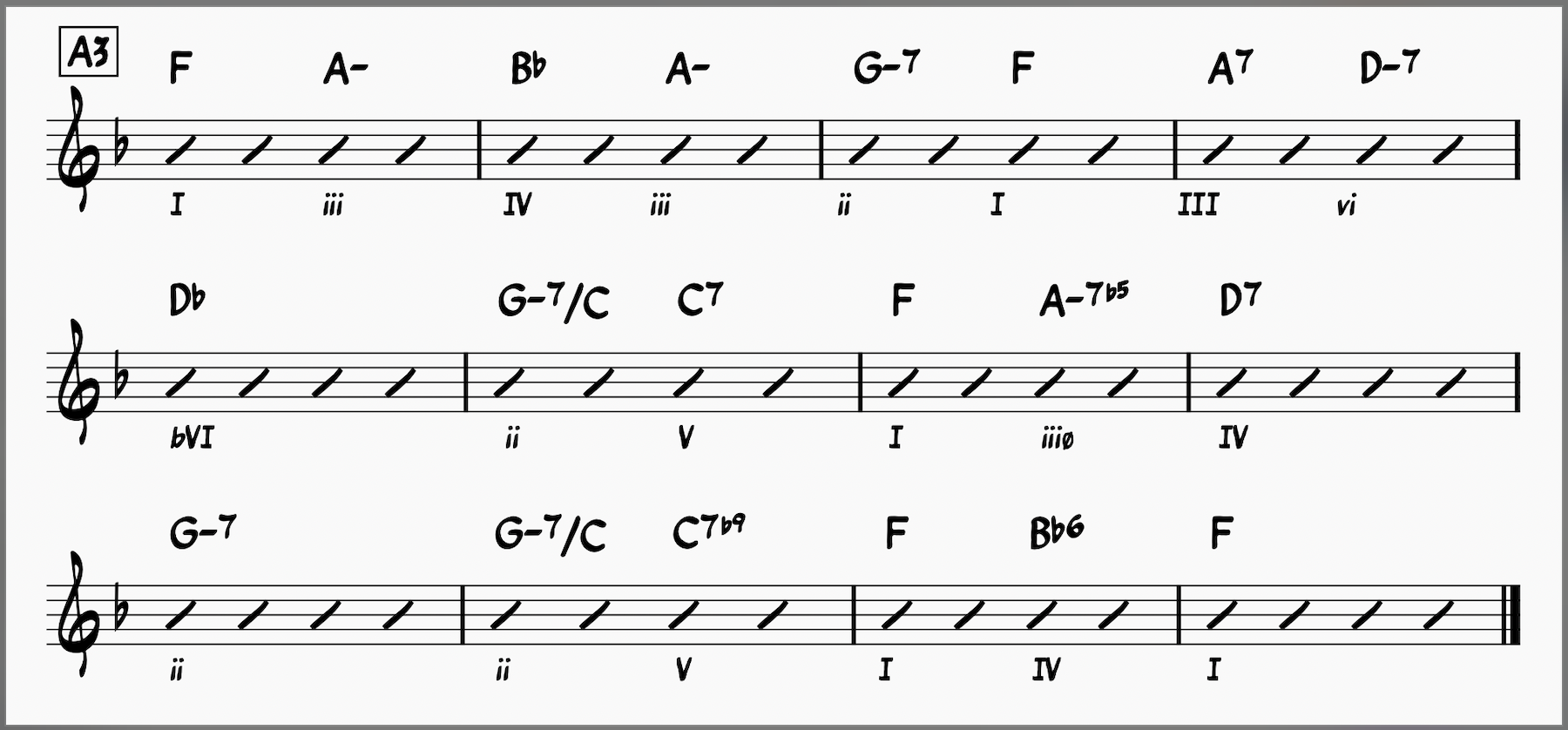
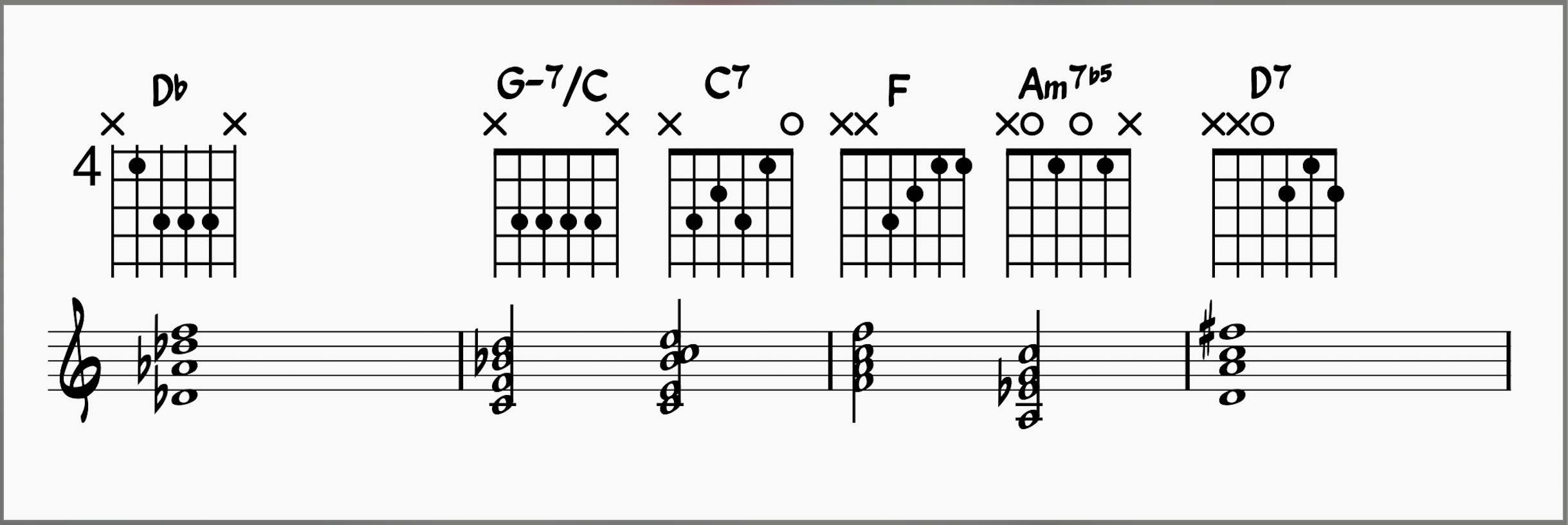
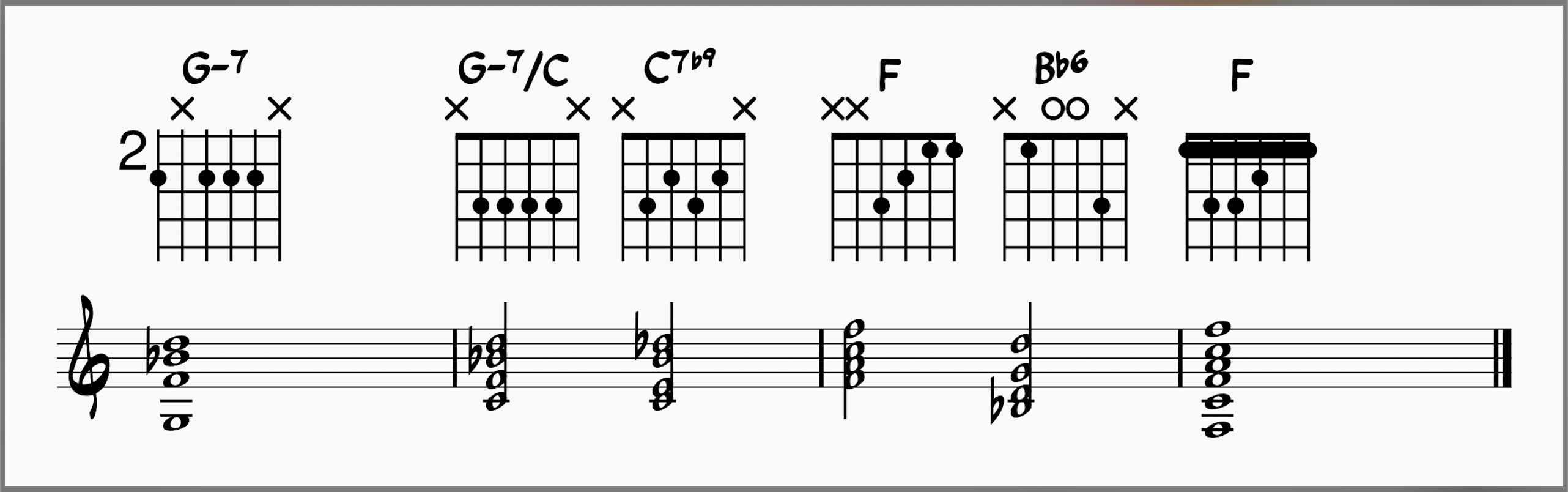
The third verse starts like all the other verses but has some new chords. It is also a full four bars longer than the other verses, with an added tag written into the form. The A-7b5 makes this “ii-V-i” to the ii chord a proper minor ii-V progression.
We’ve encountered ii-V progressions all throughout this tune! These progressions are one of the most important progressions in jazz! This progression deserves a whole article to itself! Check out this post to learn more about the ii-V-I progression and all its variations.
New Chords For This Section:
- A-7b5
- D7
- C7b9
- Bb6
Bars 29 – 32 With Guitar Chords:
Last Four Bars of the Tune:
What A Wonderful World: The Original Version
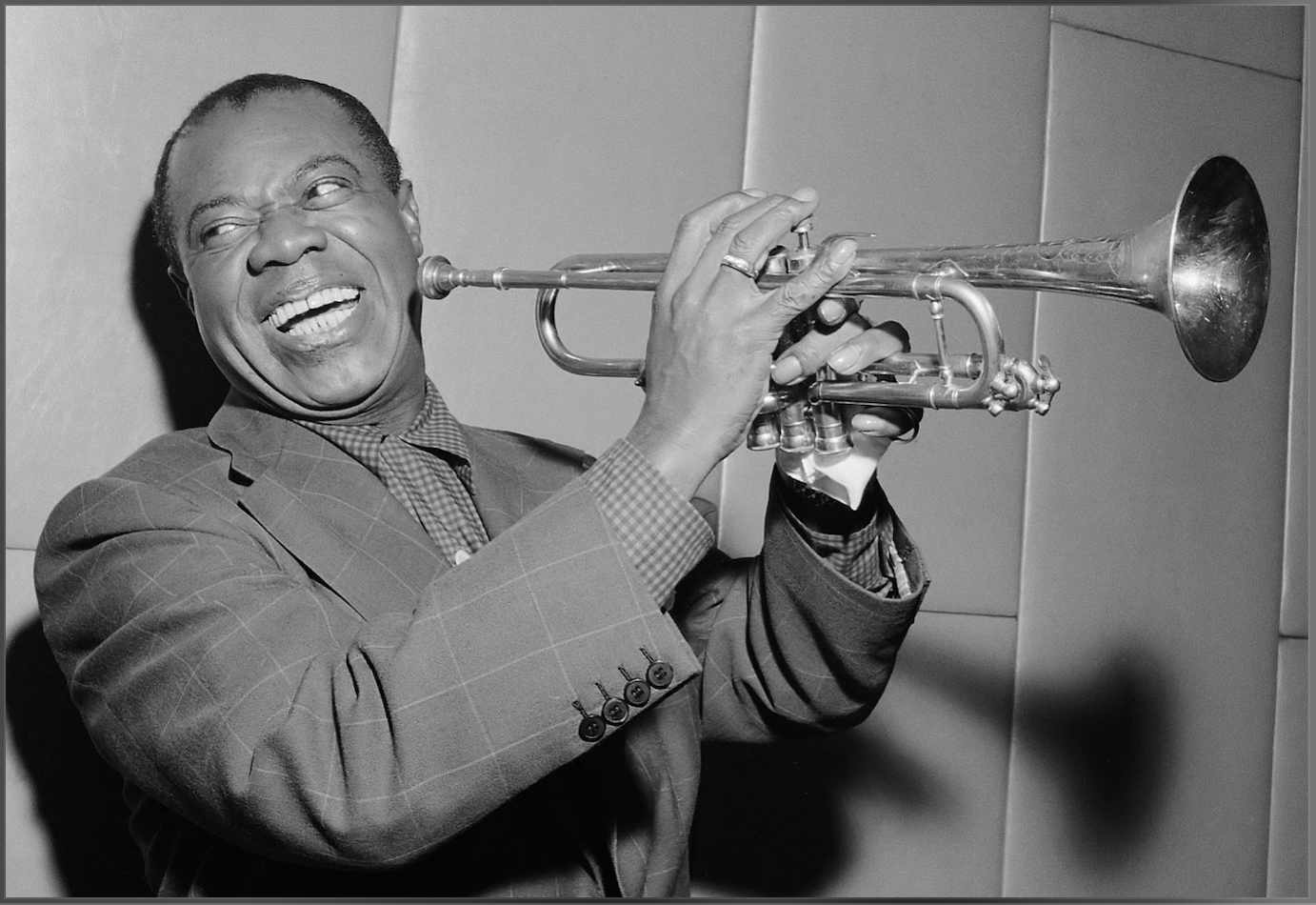
image source: Wikimedia Commons
“What a Wonderful World” was written by Bob Thiele and George David Weiss and was first recorded by Louis Armstrong in 1967. This was rather late in Louis Armstrong’s long-lived career, and it would be simply another reason why he is one of the greatest jazz artists ever to live.
From the intro to the close, this song is a pop masterpiece. Check out this video of the original version of the song. Now, you can even play along with it!
Here are the lyrics so you can follow along!
I see trees of green
Red roses too
I see them bloom
For me and you
And I think to myself
What a wonderful world
I see skies of blue
And clouds of white
The bright blessed day
The dark sacred night
And I think to myself
What a wonderful world
The colors of the rainbow
So pretty in the sky
Are also on the faces
Of people going by
I see friends shaking hands
Saying, “How do you do?”
They’re really saying
I love you
I hear babies cry
I watch them grow
They’ll learn much more
Than I’ll ever know
And I think to myself
What a wonderful world
Yes, I think to myself
What a wonderful world
Ooh, yes
If you liked this article, check out our other deep dives into classic jazz songs like Fly Me To The Moon, Autumn Leaves, Blue Bossa, and Moon River.
Want to Learn Other Tunes Like What A Wonderful World? Join The Learn Jazz Standards Inner Circle
Want to take your jazz playing to the next level and expand your jazz repertoire? Check out the Learn Jazz Standards Inner Circle.
We have what you need to seriously improve your jazz chops and master all your favorite jazz standards.
Improve in 30 days or Less. Join The Inner Circle.