When it comes to music theory, few concepts are as essential as time signatures. Time signatures are the scaffolding that organizes beats per measure, shaping how you feel rhythm and phrasing.
Most people who learn to read music notation are familiar with the basics of time signatures. They learn to count quarter notes, eighth notes, and half notes, but they never go deeper. Jazz musicians have to learn to express music effectively across a variety of time signatures and feels.
We’re going to go over everything you need to know about time signatures—from simple to compound time, and even odd meter!
If you want to take your jazz playing to the next level, check out the Learn Jazz Inner Circle. The Inner Circle has everything you need to take your jazz chops to the next level.
Improve in 30 days or less. Join the Inner Circle.
Time Signatures Explained: What They Are and How They Work
First, let’s go over the basics. In Western music, time signatures determine how many beats go into a measure, what note value equals one beat, and how those beats are grouped.
Every measure you see in sheet music tells your musical mind how the music moves through time.
Let’s take a minute to talk about the structure of time signatures. Every time signature has two numbers stacked vertically, like a fraction.
- The top number tells you how many beats are in a measure.
- The bottom number tells you what type of note gets one beat.
For example:
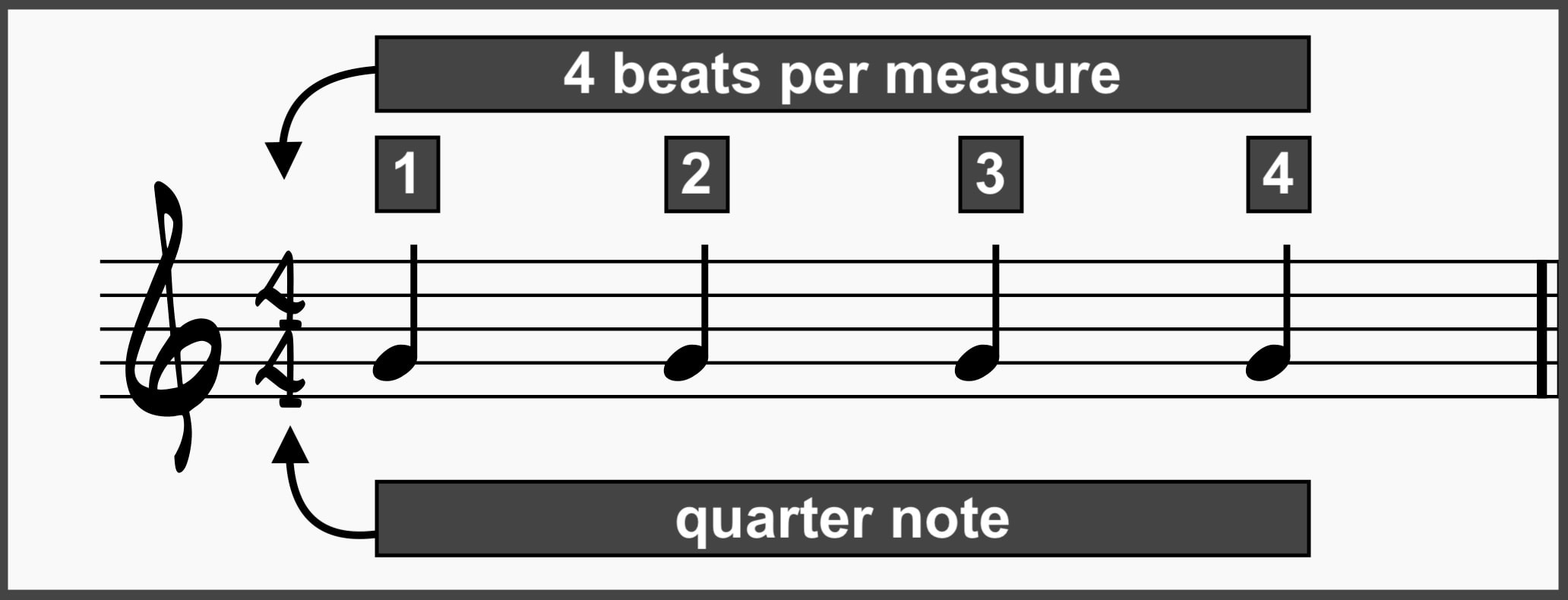
In 4/4, there are four beats per measure, and a quarter note equals one beat.
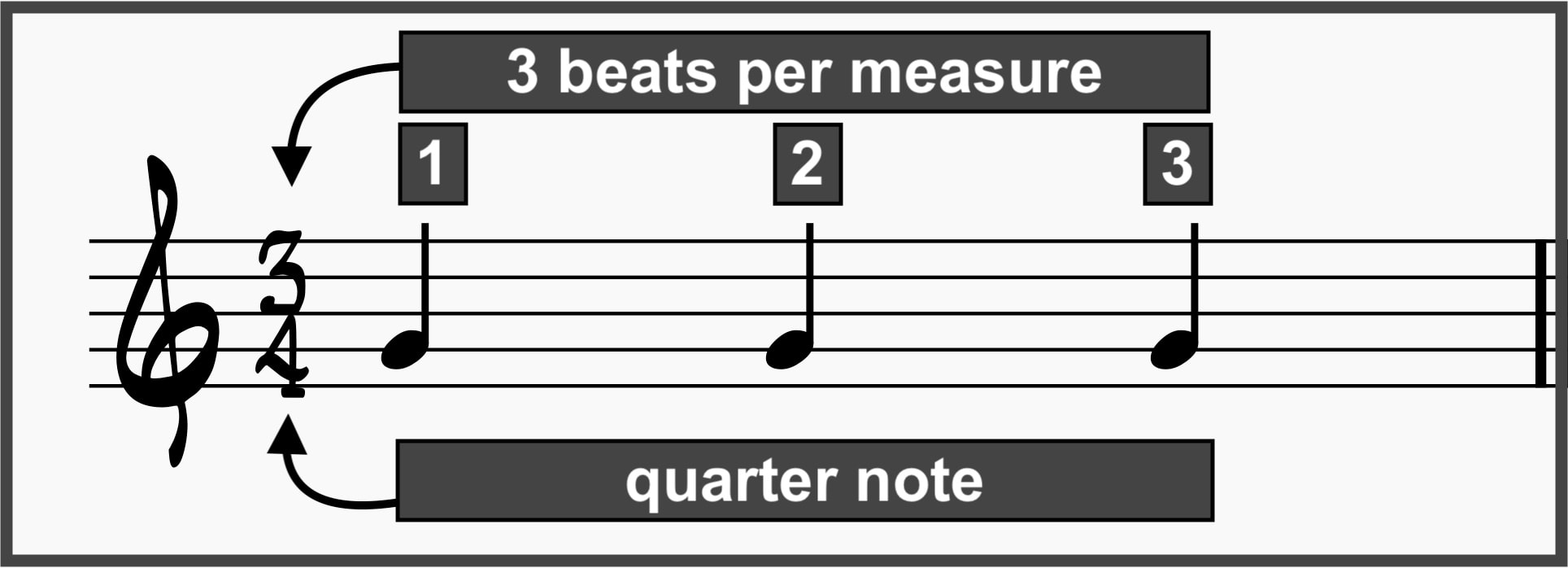
In 3/4, there are three beats, with the quarter note again receiving one beat.
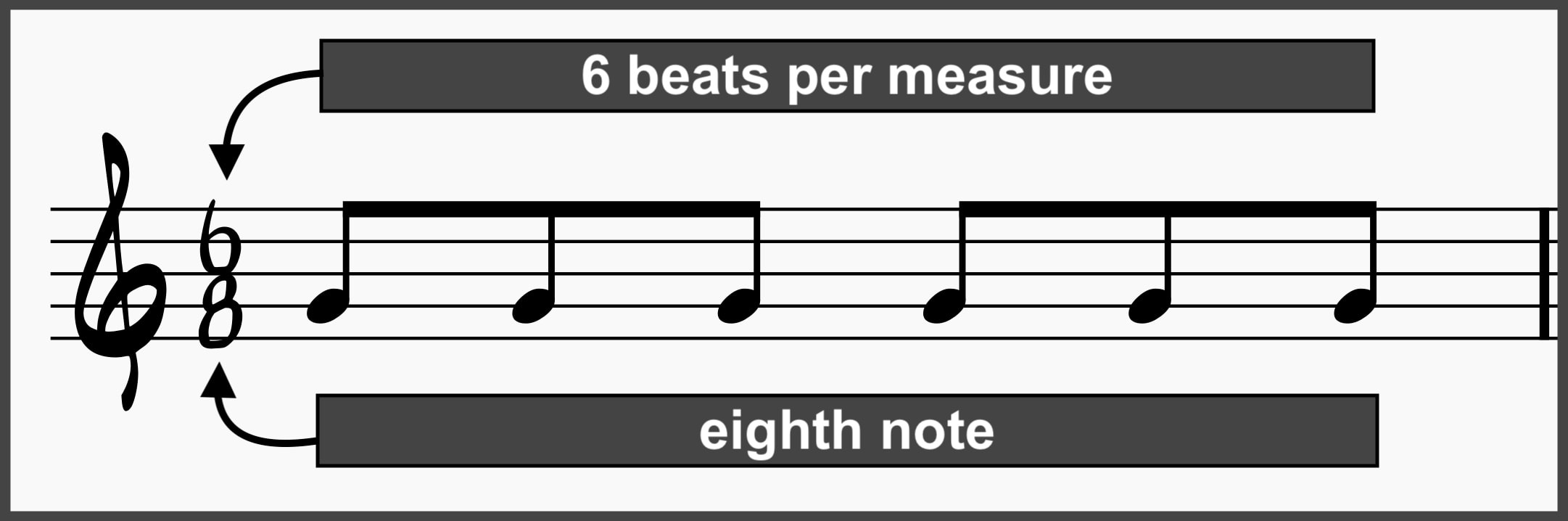
In 6/8, there are six eighth notes per measure, typically grouped into two beats of three eighth notes.
The upper number and bottom number work together to define your rhythmic environment—one that tells you how to interpret the note lengths, bar lines, and phrasing patterns that follow.
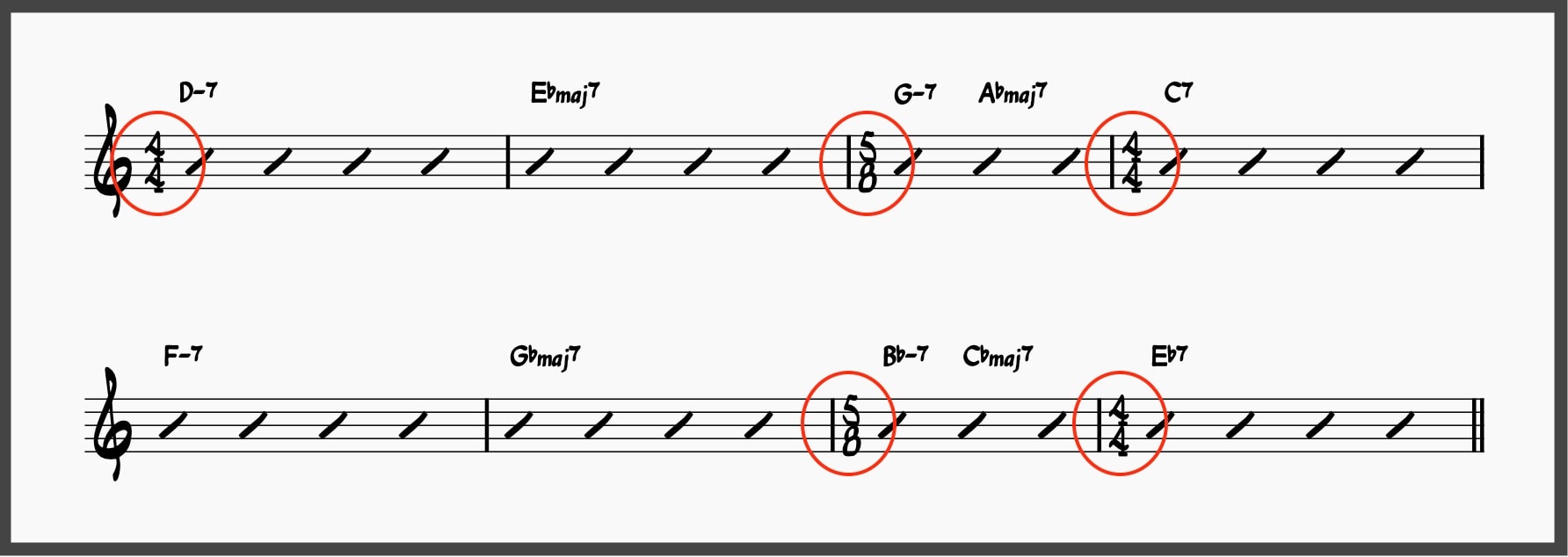
You’ll see the time signature at the beginning of a piece, after the clef and key signature. Changing time signatures later signals a different meter, which might also indicate a new groove, tempo, or measure structure.
Common Time Signatures in Music
Most time signatures you’ll encounter in pop songs, jazz standards, or classical scores fall into a handful of categories. The most common time signatures in Western music are 4/4, 3/4, 2/4, and 6/8.
- 4/4 (Common Time): The foundation of most jazz and pop songs. You’ll often see a “C” symbol for common time in sheet music.
- 3/4: A graceful waltz feel, felt in three beats per measure
- 2/4 (Cut Common Time): A brisk, marching feel where you count two beats per measure
- 6/8: A compound meter where each beat divides into three eighth notes.
Common Time (4/4): The Foundation of Most Jazz Tunes
In common time, each measure has four quarter notes, which adds up to one whole note or two half notes. This is often called “four on the floor,” and describes most American music.
Out of these four beats, the first beat typically feels strongest, giving jazz its sense of “grounded swing.” The classic jazz standards “All The Things You Are,” “Autumn Leaves,” and “Blue Bossa” all use this simple time signature, demonstrating how universal 4/4 really is.
Check out Chet Baker’s version of “Autumn Leaves” and listen for that classic “four on the floor” sound:
Waltz (3/4)
The 3/4 time signature is built around three beats per measure, with the quarter note being our basic beat. It’s one of the most recognizable simple time signatures and creates a gentle, cyclical motion often associated with waltzes and lyrical ballads.
In music notation, you’ll see 3/4 written at the beginning of a piece just like any other measure signature. Each bar has the equivalent of three quarter notes—or one dotted half note—per measure.
The rhythmic emphasis typically falls on the first beat, giving a strong-weak-weak pattern that propels the music forward. In jazz, 3/4 is found in pieces like Bill Evans’ “Waltz for Debby” or John Coltrane’s version of “My Favorite Things.”
These tunes show how waltz time can feel both swinging and fluid, rather than rigid or classical. Check out John Coltrane’s rendition of “My Favorite Things.”
Cut Time (2/2)
Cut time, also called alla breve or cut common time, means there are two half notes per measure instead of four quarter notes. The pulse feels like one-half note equals a single beat.
Counting a fast tune in cut time is way easier than keeping track in 4/4. Instead of “1-2-3-4,” you feel “1-2”—each representing one half note. This helps keep uptempo tunes readable without overloading the page with sixteenth notes or small subdivisions.
Here is a classic recording of “Cherokee” by Max Roach and Clifford Brown. It’s easier to count this in 2 rather than 4!
Check out these and more jazz standards in this article on 50 must-know jazz standards.
Simple vs. Compound Time Signatures in Music Theory
In music theory, we classify time signatures as either simple or compound depending on whether the beat divides into two or three smaller beats.
Simple time signatures divide each beat into two equal parts (e.g., 2/4, 3/4, 4/4).
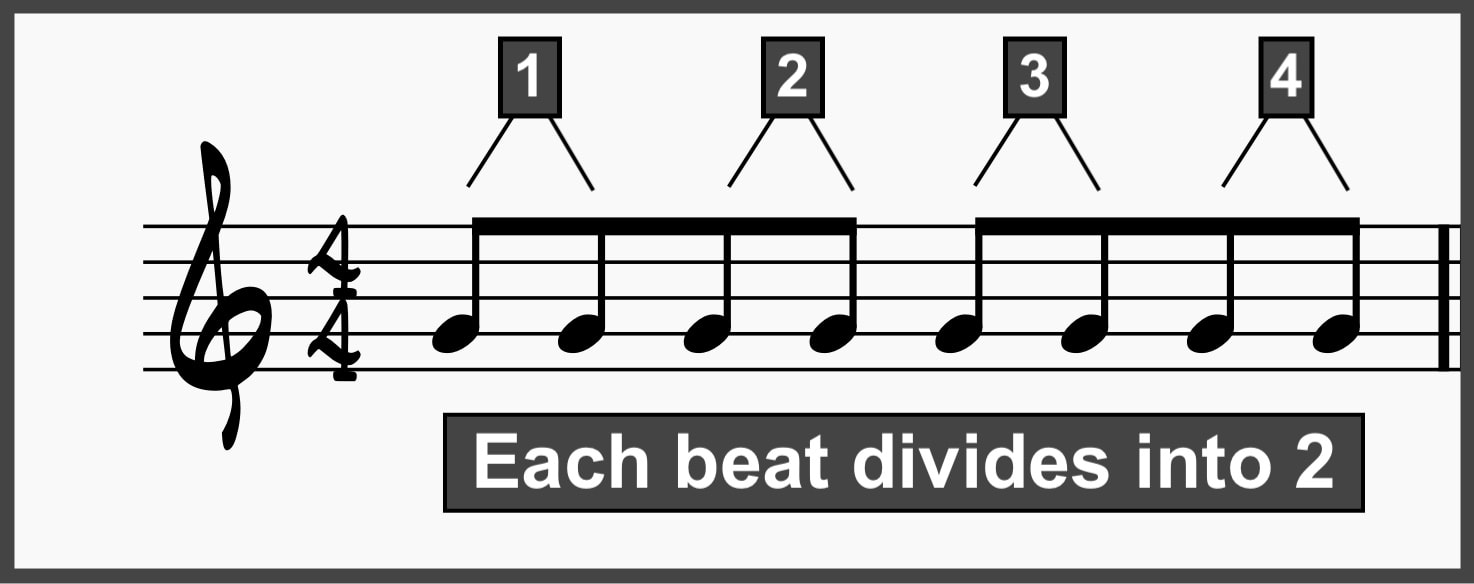
Compound time signatures divide each beat into three equal parts (e.g., 6/8, 9/8, 12/8).
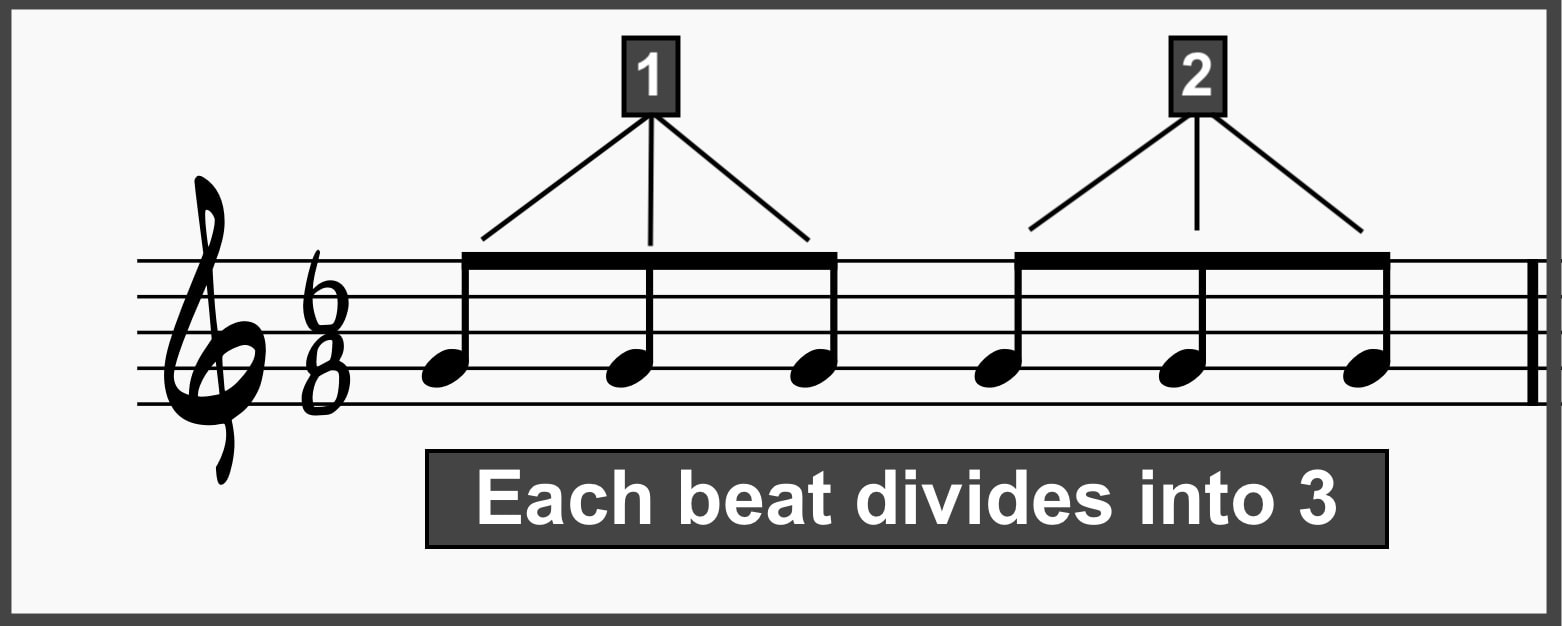
To tell them apart, look at the top number. If it’s a multiple of 3 (except 3 itself), it’s likely compound time. The beat is usually felt in two or three groups of three eighth notes each.
For example:
- 6/8 = two beats per measure, each containing three eighth notes.
- 9/8 = three beats, each divided into three eighth notes.
- 12/8 = four beats, grouped into four dotted quarter notes.
Compound time gives a rolling, triplet-based motion common in Afro-Cuban, gospel, and 12/8 blues grooves.
Feeling the Eighth Note Pulse in Compound Time
In compound meter, each dotted quarter note equals one beat, and that beat divides into three eighth notes. So in 6/8, you’d count [ 1-2-3 | 4-5-6 ], feeling two beats per bar. To internalize this:
- Tap the first beat of each group.
- Hear how the pulse flows naturally in two measures or long phrases.
- Practice subdividing with a metronome set to click on the dotted quarter.
Here is Pat Metheny’s “Minuano (6/8),” which is in 6/8 if you couldn’t guess! Try counting along with this one.
Irregular Time Signatures: Beyond the Basics
Irregular time signatures, sometimes called odd meter or irregular meters, are those that don’t divide evenly into two or three beats per measure. Examples include 5/4, 7/8, 11/8, or even more exotic ratios.
The time signature tells you the grouping, but the number indicates asymmetry: for instance, five beats per measure could be grouped as 3+2 or 2+3.
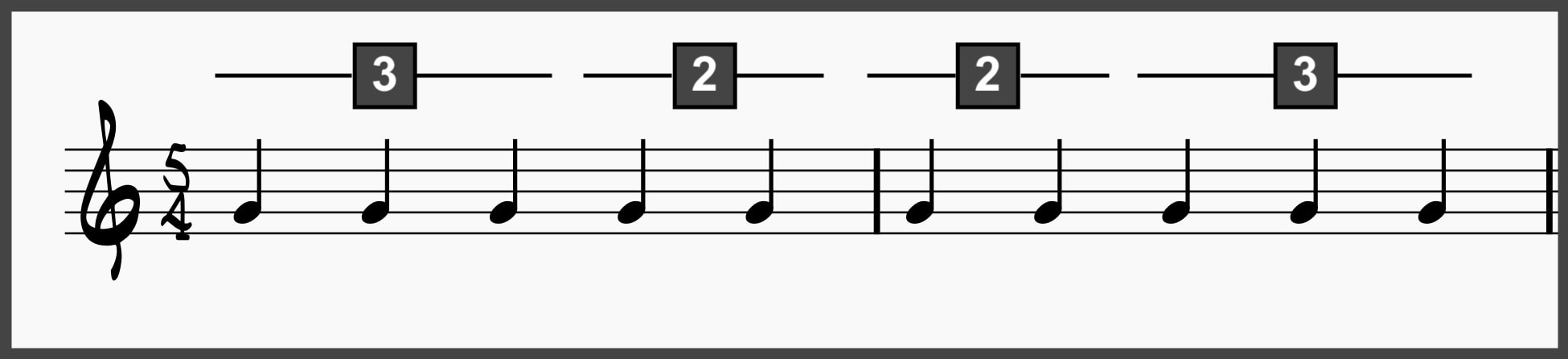
The Dave Brubeck Quartet’s “Take Five” (in 5/4) is the most famous jazz example. Its distinctive groove divides five beats into three + two, giving it that hypnotic, forward-leaning motion.
Irregular time signatures push you to feel the pulse in ways that are uncommon in Western music. These meters challenge phrasing, coordination, and improvisation, but mastering them unlocks enormous creative potential.
Reading and Practicing Time Signatures
Developing rhythmic fluency means being comfortable across different time signatures, not just common time.
- Start simple: Practice tapping quarter notes in 2/4, 3/4, and 4/4 while marking the downbeat of each measure with your other hand (and use a metronome, of course!).
- Add subdivisions: Switch to eighth notes, 8th note triplets, or sixteenth notes to feel smaller divisions.
- Try different meters: Move to 6/8 or 12/8 to experience compound time.
- Mix note lengths: Alternate one half note, two half notes, or a double whole note to internalize duration.
- Play two time signatures back-to-back: Try switching from 4/4 to 5/4 every two measures to feel phrase tension.
The goal isn’t to think about numbers—it’s to feel the pulse. Once you internalize the pulse, your comping and soloing will sound more fluid and grounded.
When you feel comfortable, try tackling polyrhythms! This article goes over three polyrhythmic exercises every jazz musician should know.
Common Mistakes When Learning Time Signatures
Even advanced players stumble over rhythm. Here are the big ones to avoid:
- Confusing 3/4 and 6/8: Both have six eighth notes, but 3/4 groups them as three beats of two, while 6/8 groups them as two beats of three.
- Ignoring the bottom number: Remember—it tells you the note value of one beat (4 = quarter note, 8 = eighth note).
- Forgetting note lengths: A whole note lasts four beats, a half note lasts two beats, and a quarter note lasts one beat.
- Losing the 1 in odd time: Many players rush through irregular time signatures by failing to internalize groupings.
- Overcounting: In fast tempos, simplify—think of cut time instead of subdividing every eighth note.
Beyond Western Time Signatures: Exploring Global Rhythms
While Western classical music relies on bar-based time signatures, other cultures use rhythmic systems that feel circular or additive. Studying them broadens your rhythmic vocabulary.
Indian Talas
Indian talas use complex cycles of different note lengths and accents that repeat over long forms. Jazz drummers like Dan Weiss integrate tala into modern grooves. This video does a great job of explaining Indian tales.
African Polyrhythms
African polyrhythms involve overlapping rhythmic patterns played by different percussion instruments. The performers in this video do a great job of exhibiting African polyrhythms:
Balkan Meters
Balkan music incorporates unusual time signatures, such as 7/8 or 9/8, grouped asymmetrically (e.g., 2+2+3). Artists such as Dave Holland and Don Ellis have adapted these for jazz ensembles.
Here is the Bulgarian folk song “Kopanitsa” in 11/8:
Exploring such time signatures helps you hear rhythm not as fixed math but as living motion—a conversation between beats, groupings, and expression.
Putting It All Together
Understanding time signatures is an essential part of being a Western-trained musician. If you want to communicate effectively with other musicians, you’ll need to know how to articulate and express different time signatures in words and on your instrument.
From common time to compound time signatures, from simple meters to irregular meters, learning how to interpret note values, beats per measure, and bar lines empowers you to become a more expressive and effective musician.
Want to Go Deeper? Join The Learn Jazz Standards Inner Circle
If you want to improve your rhythmic confidence and overall musicianship, check out the Learn Jazz Standards Inner Circle. We’ve got everything you need to take your playing to the next level.
Improve in 30 days or less. Join the Inner Circle.