
The whole tone scale is an important symmetrical scale with many uses for jazz improvisers. These unique-sounding scales can help you add extra spice to your jazz solos if you can use them effectively.
In this article, we’ll explore the whole tone scale, learning about its history and how composers and improvisers have used it to add an augmented, dream-like quality to their compositions and performances.
We’ll learn how to play it on guitar and piano and explore how to use it to spice up your own jazz solos!
If you want to become the best jazz musician you can be and master different scales like the whole tone scale, then you need to check out the Learn Jazz Standards Inner Circle. The Inner Circle has everything you need to take your jazz chops to the next level!
Improve in 30 Days or Less. Join the Inner Circle.
Table of Contents
What Are Whole Tone Scales in Music Theory?
You can find whole tone scales in classical music, jazz music, and popular music, too! They are everywhere because they have a unique-sounding, dream-like quality, which we’ll explain through good, old-fashioned music theory!
The whole tone scale is made up of whole steps. There are no half-steps in any whole tone scale. Because the scale formula consists entirely of whole steps, the whole tone scale is non-diatonic (meaning you can’t build it from the major scale formula like you can major scale modes).
This non-diatonic, whole-tone sound never truly feels resolved and always keeps the listener anticipating a resolution that seems always one beat away. This sense of tension makes the whole tone scale a popular choice.
These scales are also hexatonic, meaning they have six or six tones before landing on a repeat note. Because each note in the scale is spaced a whole step apart, this scale has no leading tone (or final scale degree that leads back to the root by a half step).
Finally, these scales are symmetrical, but we’ll talk more about that in the next section.
Four Important Takeaways:
The Whole tone scale is
- Made of Whole Steps (whole steps are equivalent to major second intervals)
- Non-diatonic (not based in diatonic harmony or built from the major scale)
- Hexatonic (six notes)
- Symmetrical (has translational symmetry, which is covered below).
Whole Tone Scales Are Symmetrical Scales
For the rest of this article, when referencing scale step formulas, we will refer to each whole step by a W and each half step by an H.
Unlike major and minor scales, which are not symmetrical, the whole tone scale has translational symmetry. This means you can start on any note in the scale, and the scale formula would still be the same—W-W-W-W-W in this case. The diminished scale is another symmetrical scale.
Check out this article to learn more about diminished scales.
Your scale formula doesn’t change, no matter which note you start on. It’s always whole steps.

C Whole Tone Scale
- W-W-W-W-W-W
- C-D-E-F#(Gb)-G#(Ab)-A#(Bb)-C
D Whole tone Scale
- W-W-W-W-W-W
- D-E-F#(Gb)-G#(Ab)-A#(Bb)-C-D
Non-Symmetrical Major and Minor Scales
The major scale and minor scale do not have translational symmetry. The scale formula changes depending on what your starting note is. Let’s compare the C major scale to its second mode, D Dorian. You’ll notice that when we start on a different note in a non-symmetrical scale, the formula changes.

C major Scale
- W-W-H-W-W-W-H
- C-D-E-F-G-A-B-C
D Dorian Scale
- W-H-W-W-W-H-W
- D-E-F-G-A-B-C-D
C major and all its modes are diatonic. They are derived from the major scale formula. Check out this article for more on the major scale modes. If you want to learn more about major scales and Dorian minor scales specifically, check out these articles on major scales and Dorian minor scales.
How Many Whole Tone Scales Are There?
Technically, there are only two whole tone scales.
We’ll start with the C whole tone scale to demonstrate how this is possible. As we just learned, the tone scale is made up of whole steps. If you start on C and move up in whole steps, you’ll eventually find your way back to C, stopping on five other notes.
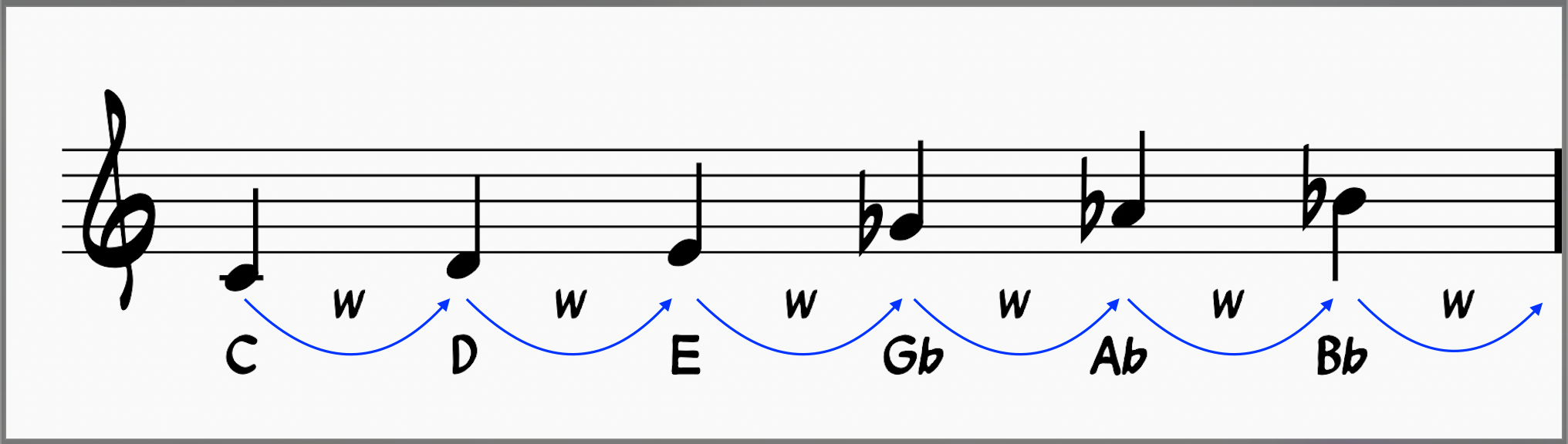
- C-D-E-Gb-Ab-Bb-C
We know that there are twelve notes within an octave:
- C-Db-D-Eb-E-F-Gb-G-Ab-A-Bb-B-C
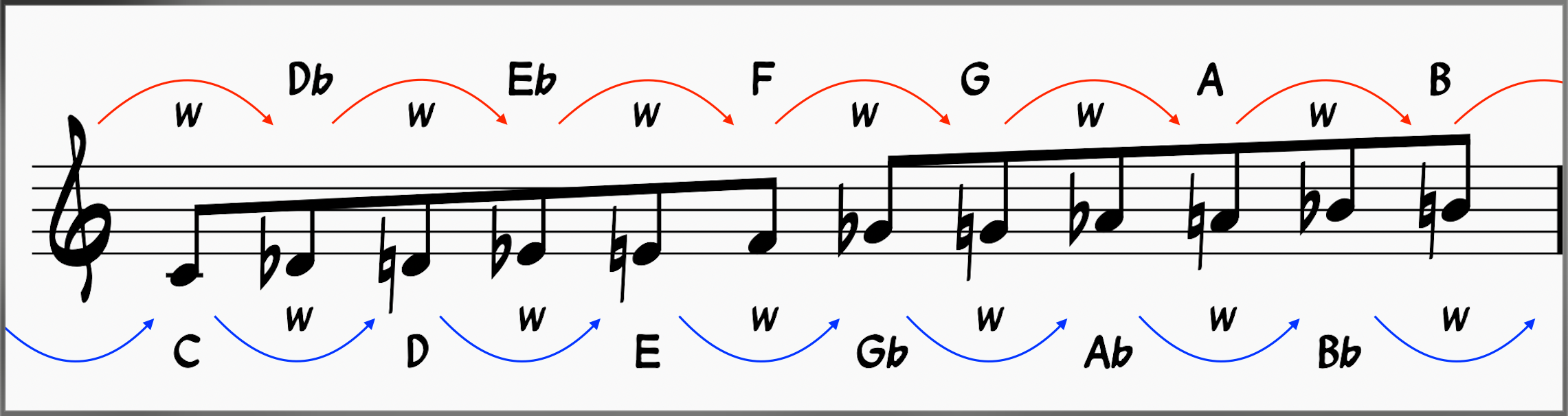
Notice how I’ve bolded the C whole tone scale above. If you take the unbolded notes, you are left with the other whole tone scale.
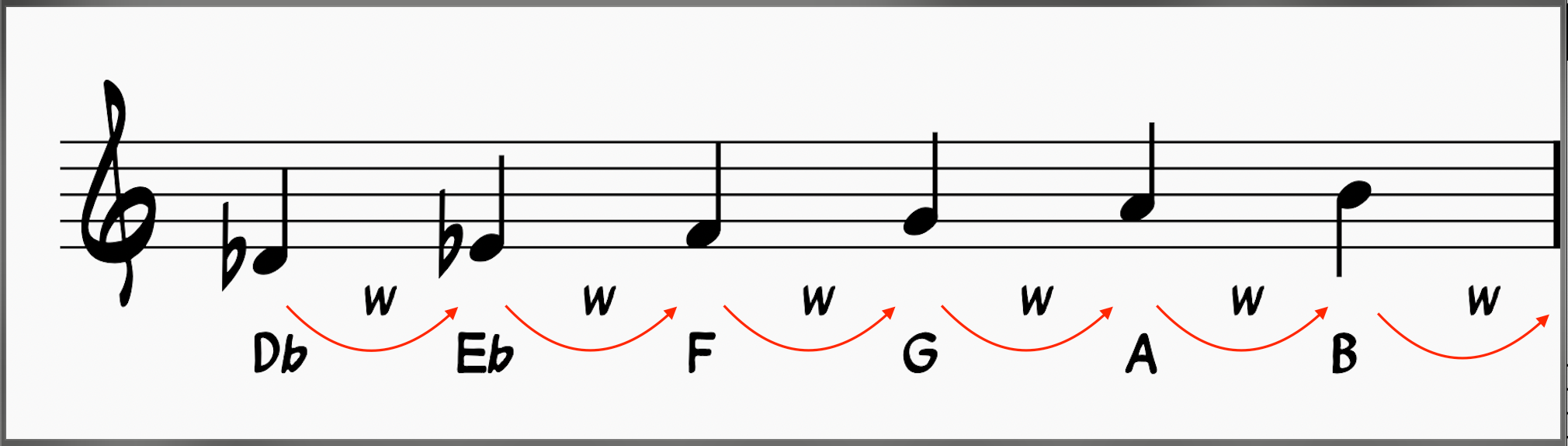
- Db-Eb-F-G-A-B-Db
Let’s look at the chromatic scale and isolate both whole tones scales. The Db whole tone scale is spelled out above, and the C whole tone scale is spelled out below. Here are the two scales:
The Whole Tone Scale and Augmented Triads
Whole tone harmony is represented by augmented triads. Augmented triads are three-note chords of stacked major thirds. A C augmented triad would be spelled C, E, and G#.
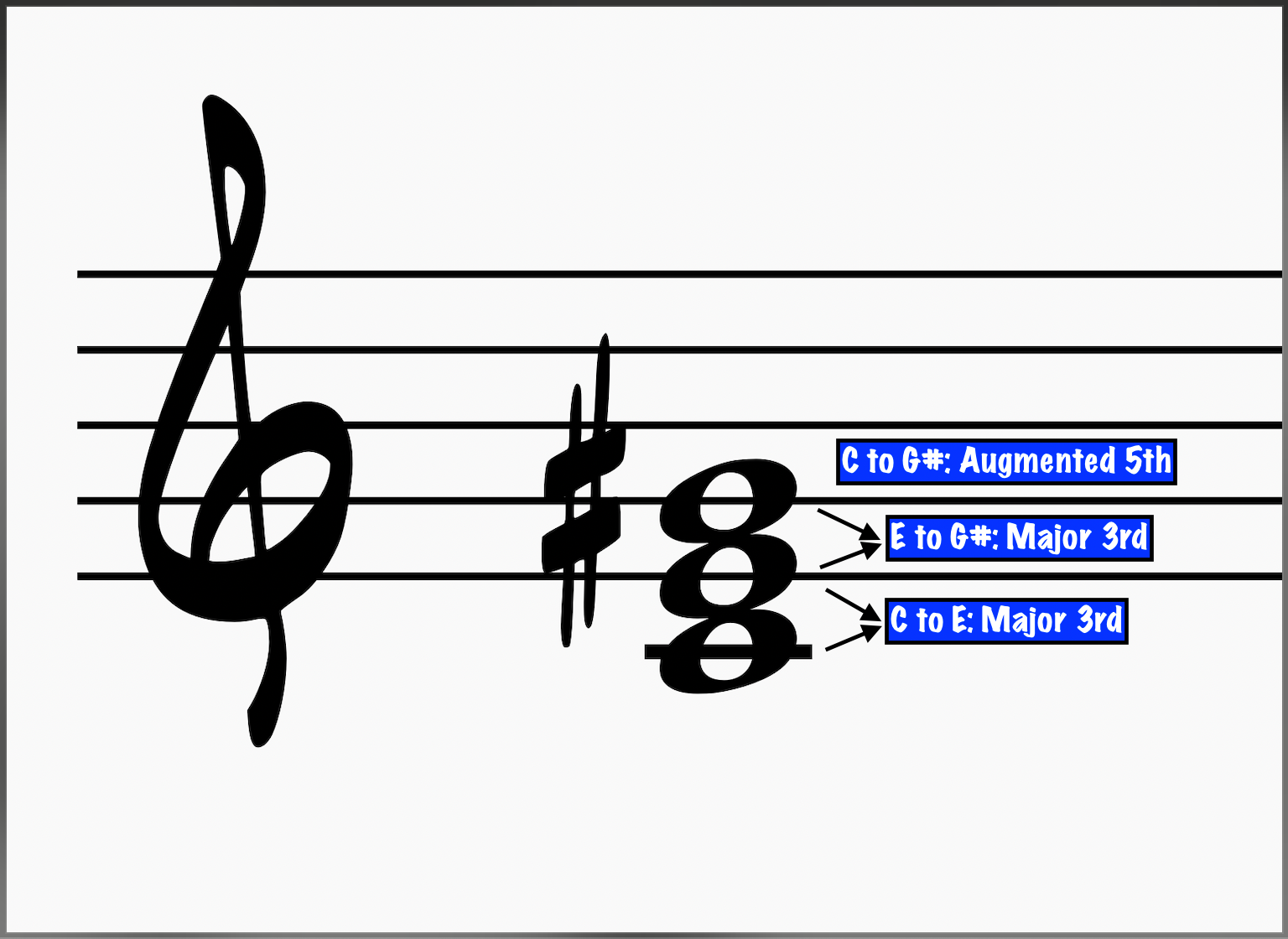
- Augmented 5th: G#
- Major 3rd: E
- Root: C
Let’s harmonize a C whole-tone scale to analyze the chords within it (hint: they will all be augmented triads). We’ll harmonize a whole tone scale starting on C by stacking a major third and an augmented fifth onto each note in the scale.
The original scale is shown in red, the stacked major thirds are shown in blue, and the augmented fifths are shown in green. Each color reveals a different whole tone scale (or the same whole tone scale, just starting on different notes).
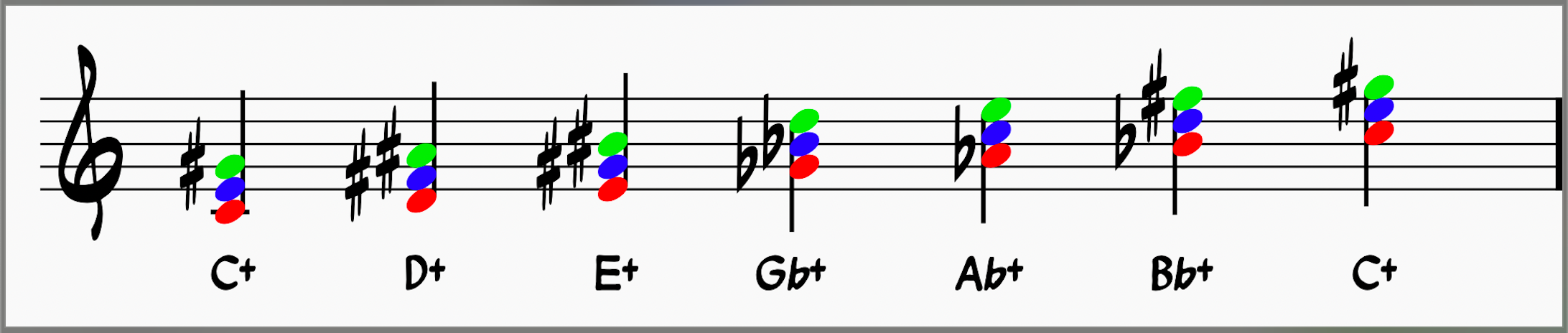
- Red: Whole tone scale from C
- Blue: Whole tone scale from E
- Green: Whole tone
Another way to break down the whole tone scale is to visualize it as being made of two augmented chords. Check out these two augmented triads below and how they contain all the notes of one whole tone scale.
Put another way, the whole tone scale is made of two augmented triads a whole step apart:
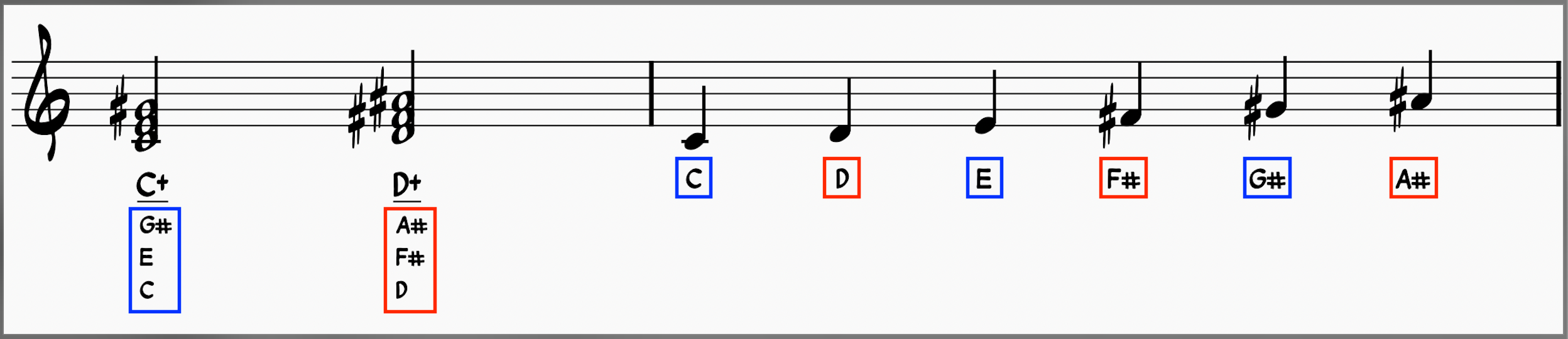
All the other chords from a harmonized whole tone scale can be seen as augmented triads or inversions of these original two augmented triads. E augmented is the same as a first inversion C augmented triad.
- E+: E-G#-B#(C)
- C+: C-E-G#
Check out this article for more on augmented triads.
The Whole Tone Scale and Dominant Seventh Chords
Seventh chords are chords made of four notes. You have a root note, some kind of third (major or minor), some sort of fifth (diminished, perfect, or augmented), and some kind of 7th (either a minor seventh or a major seventh). Below is a C major seventh chord:
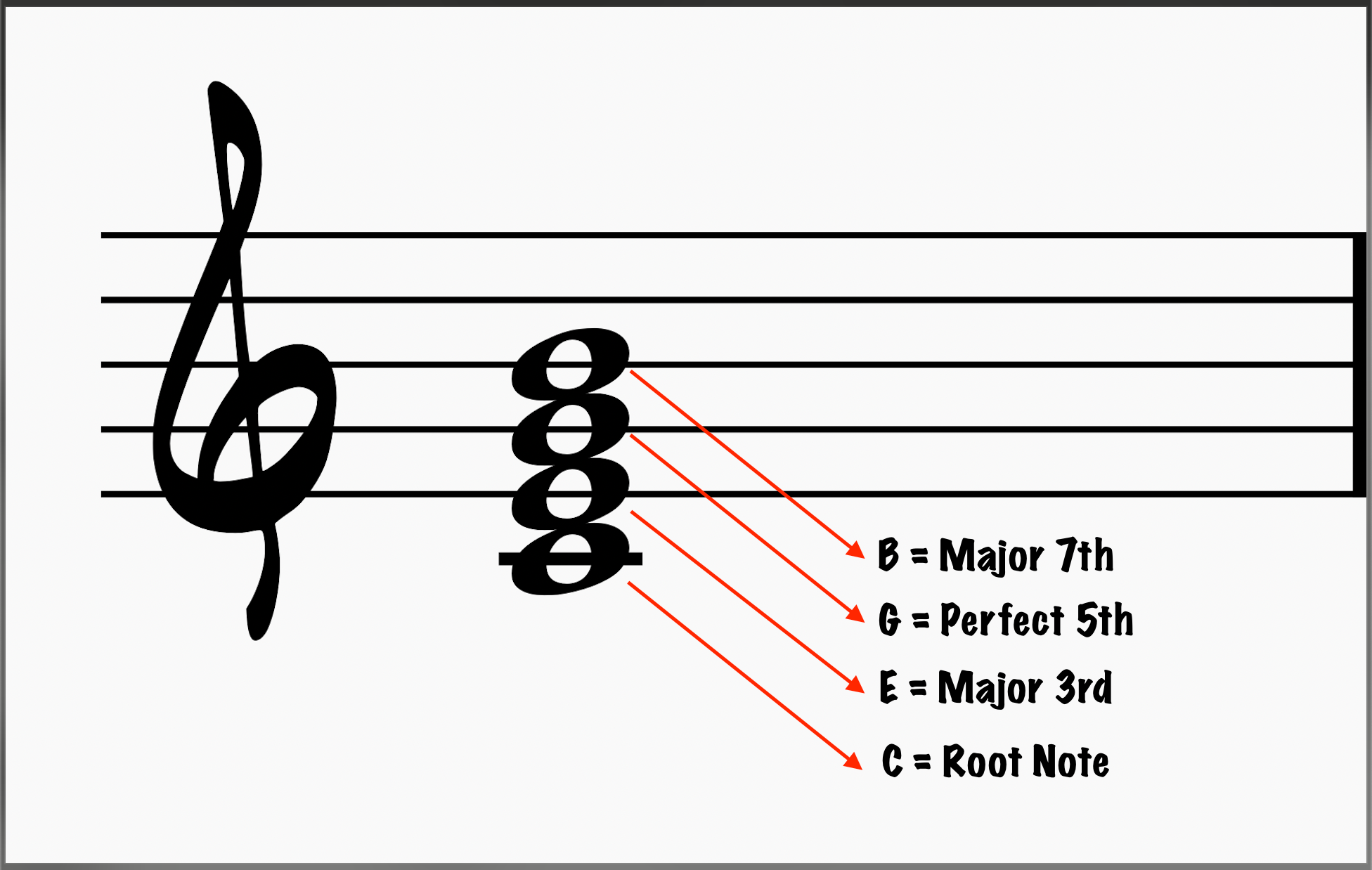
When you analyze each note in a whole tone scale starting on C, you have all the notes of a C9#11/#5 dominant chord, or a C9b5/b13 dominant chord. The dominant #5/b13 and #11/b5 sounds occur often in jazz music and other examples of Western art music.
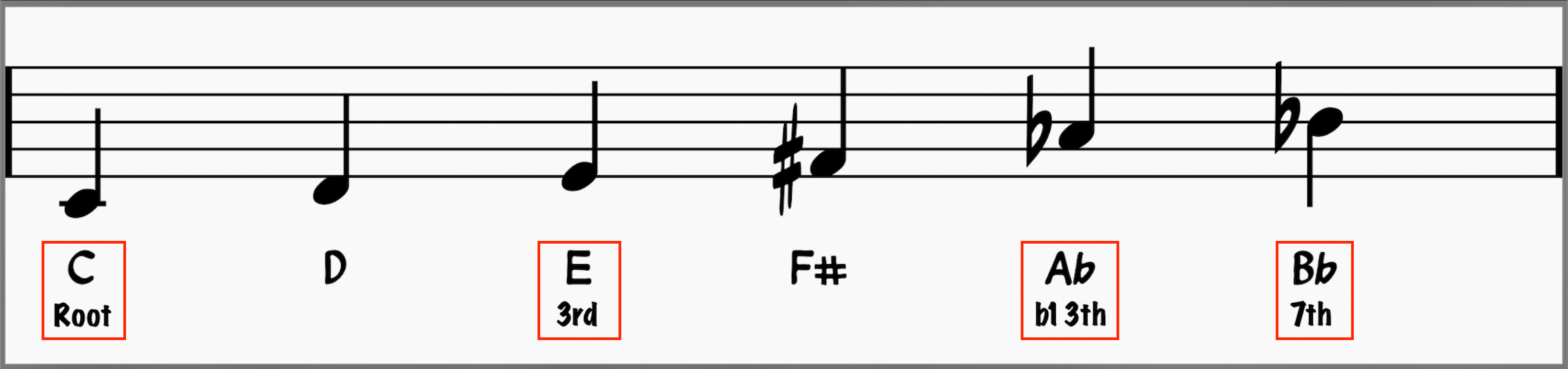
Understanding how to build dominant seventh chords with the notes from the whole tone scale will help you utilize these sounds in your jazz solos. Below, you’ll see all the notes of a C whole tone scale and which chord tones they represent in a dominant chord.
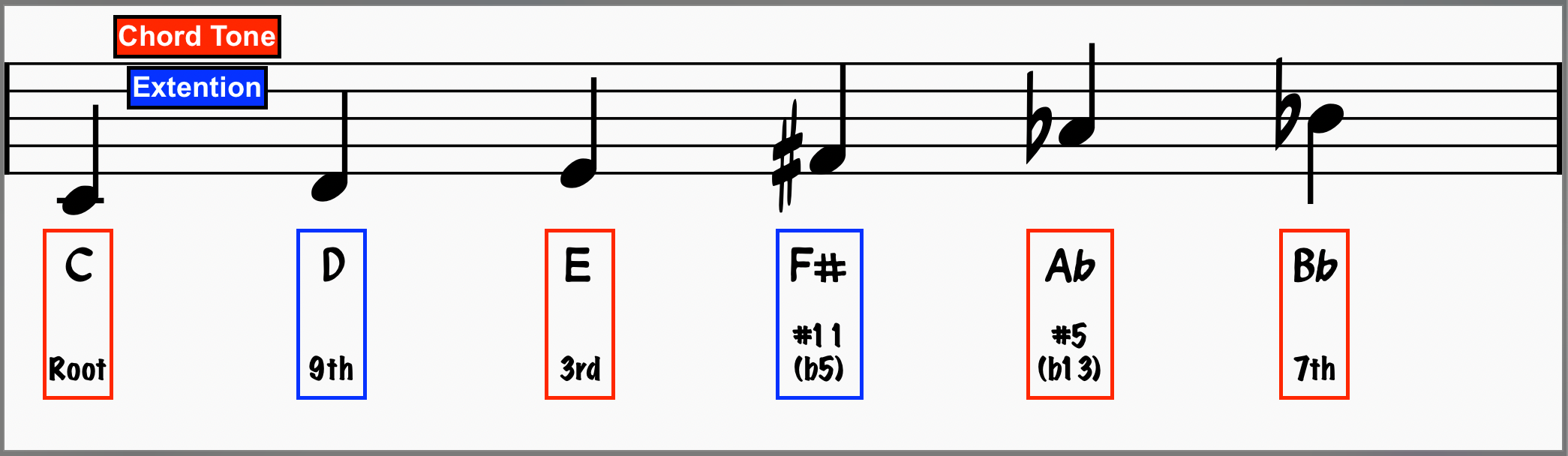
- 7th: Bb
- #5/b13: G# (Ab)
- #11/b5: F# (Gb)
- 3rd: E
- 9th: D
- Root: C
A C9#5 chord implies that the 5th scale degree is augmented. This is technically different than a C9b13 chord where the natural 5th is present, and the 6th scale degree is a minor 6th away from the root. The difference is subtle, but it’s important to make the distinction for improvisational accuracy.
Building a C9#5 Chord:
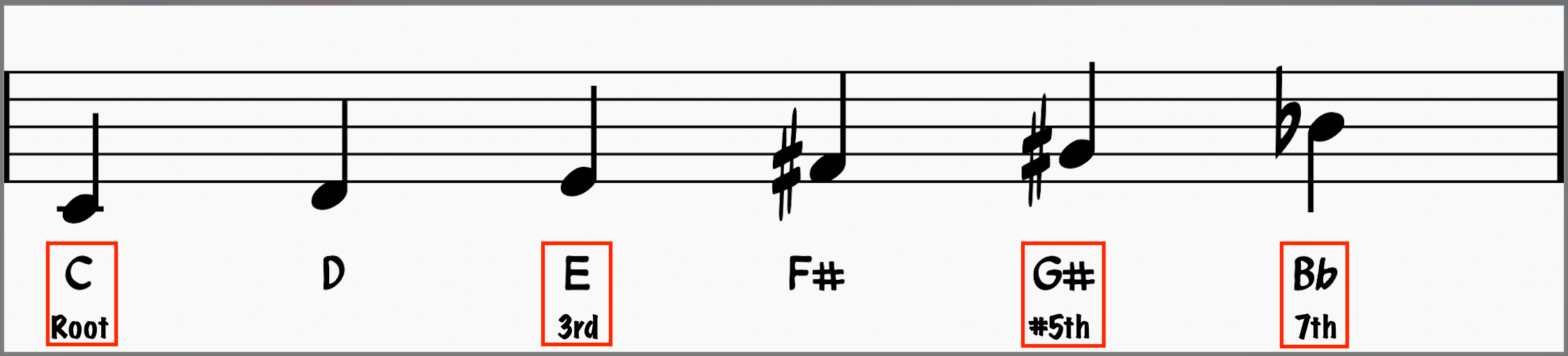
- 7th: Bb
- #5: G#
- 3rd: E
- Rt: C
Building a C9b13 chord:
Chord Extensions Found in the Whole Tone Scale
There are two chord extensions found in the whole tone scale.
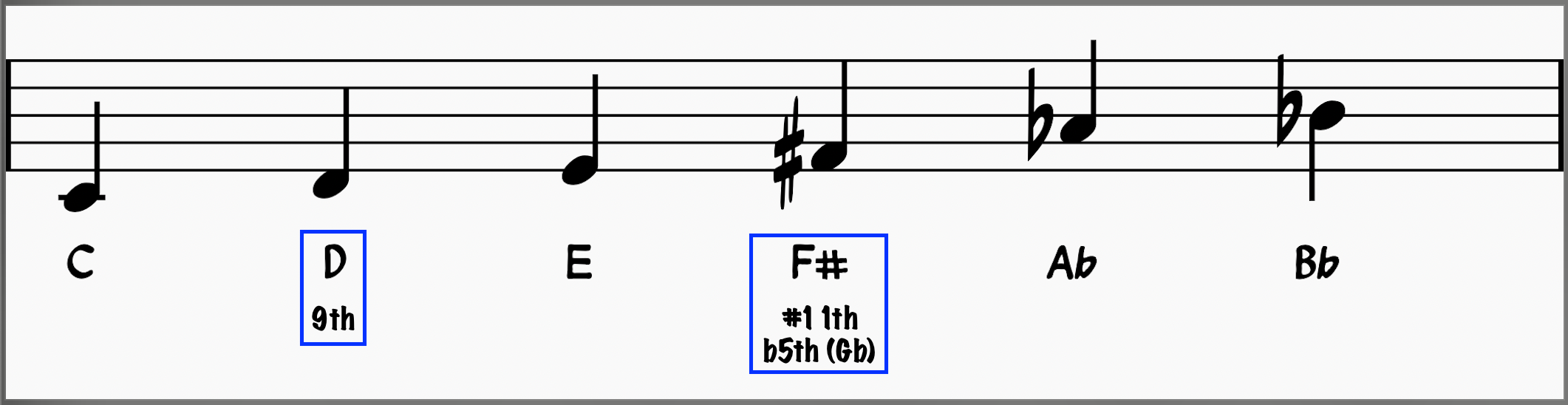
- #11/b5
- 9th
Check out this article for more on chord extensions and alterations.
Because of the translational symmetry discussed earlier, this scale will work for the same seventh chord quality built from each scale degree of the whole tone scale. This exact whole tone scale also works over:
- D9#11/#5 and D9b5/b13
- E9#11/#5 and E9b5/b13
- F#9#11/#5 and F#9b5/b13
- Ab9#11/#5 and Ab9b5/b13
- Bb9#11/#5 and Bb9b5/b13
The Whole Tone Scale on Guitar and Piano
Let’s get practical! In this section, we’ll learn the whole tone scale on guitar and piano.
The Whole Tone Scale on Guitar
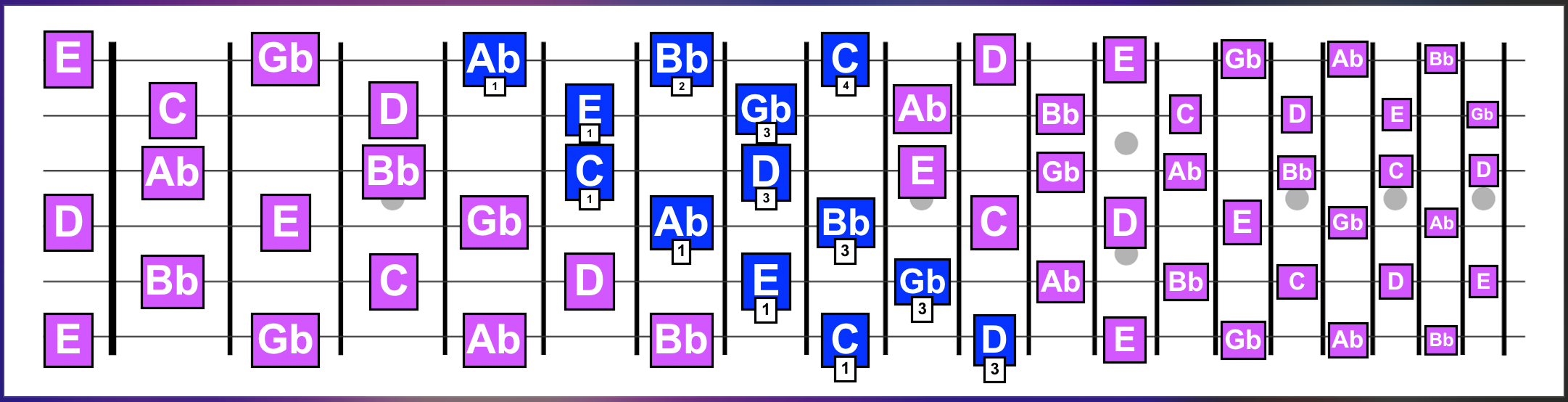
The whole tone scale makes a unique pattern on the guitar fretboard. When you map out whole steps on the guitar, you get this checkerboard pattern:
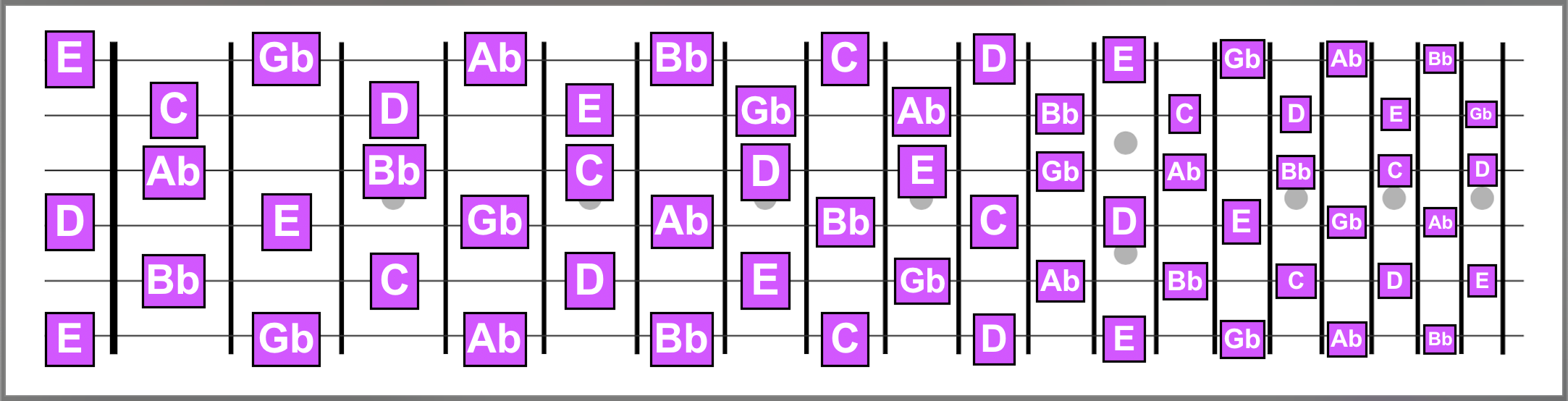
Notice how the pattern changes between the G and B strings. The pattern looks different because the interval between the G and B strings is a major third and not a perfect fourth like with the other strings.
Here are two ways to play the whole tone scale on the guitar. Both are similar because—let’s face it—we’re only dealing with whole steps. The notable difference is at the beginning of each fingering.
C Whole Tone Scale Guitar Fingering 1
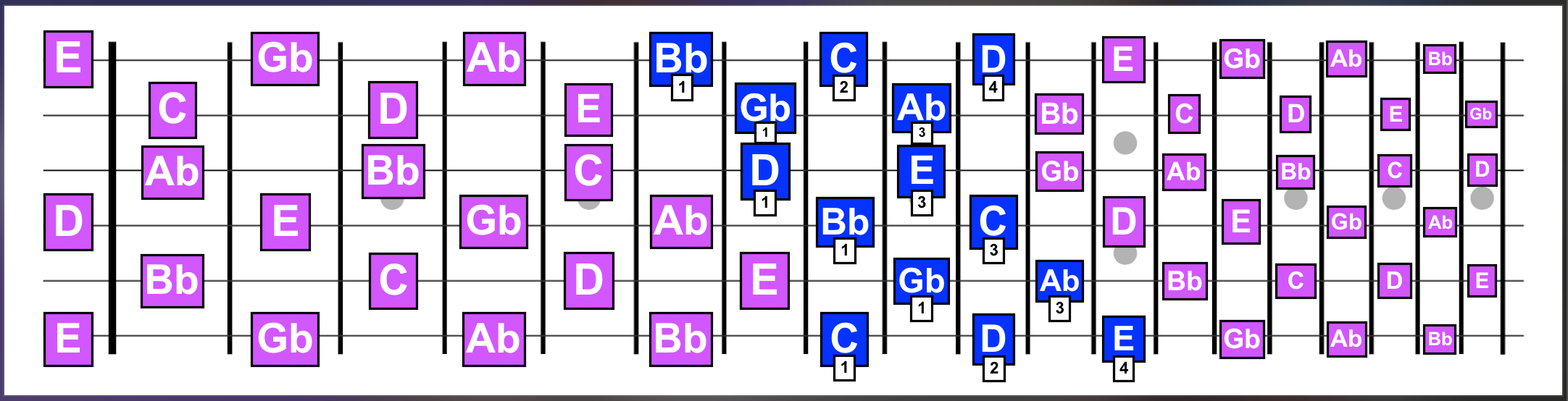
C Whole Tone Scale Guitar Fingering 2
The Whole Tone Scale on Piano
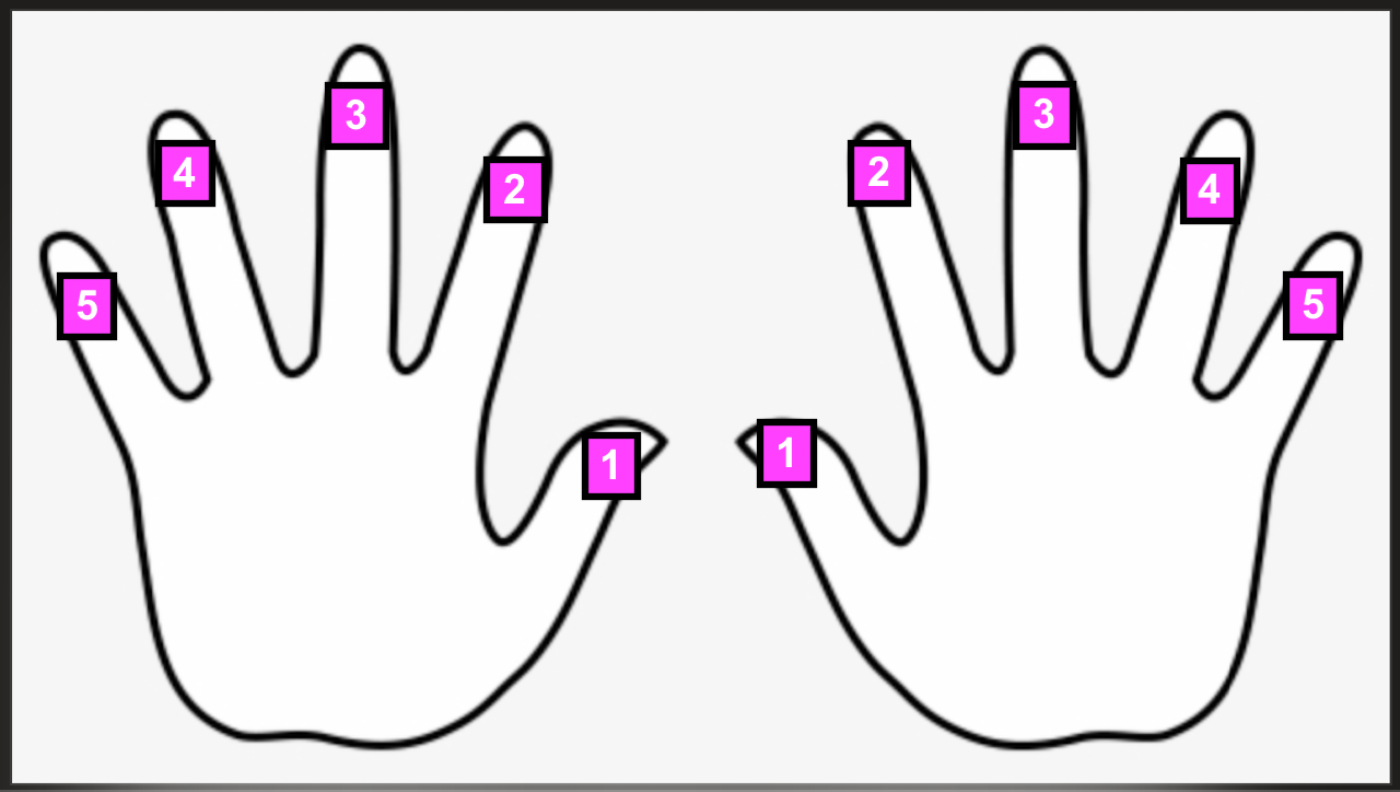
Let’s learn the whole tone scale on piano! Use this fingering chart to help you learn which fingers are which.
Here is the C whole tone scale on piano:
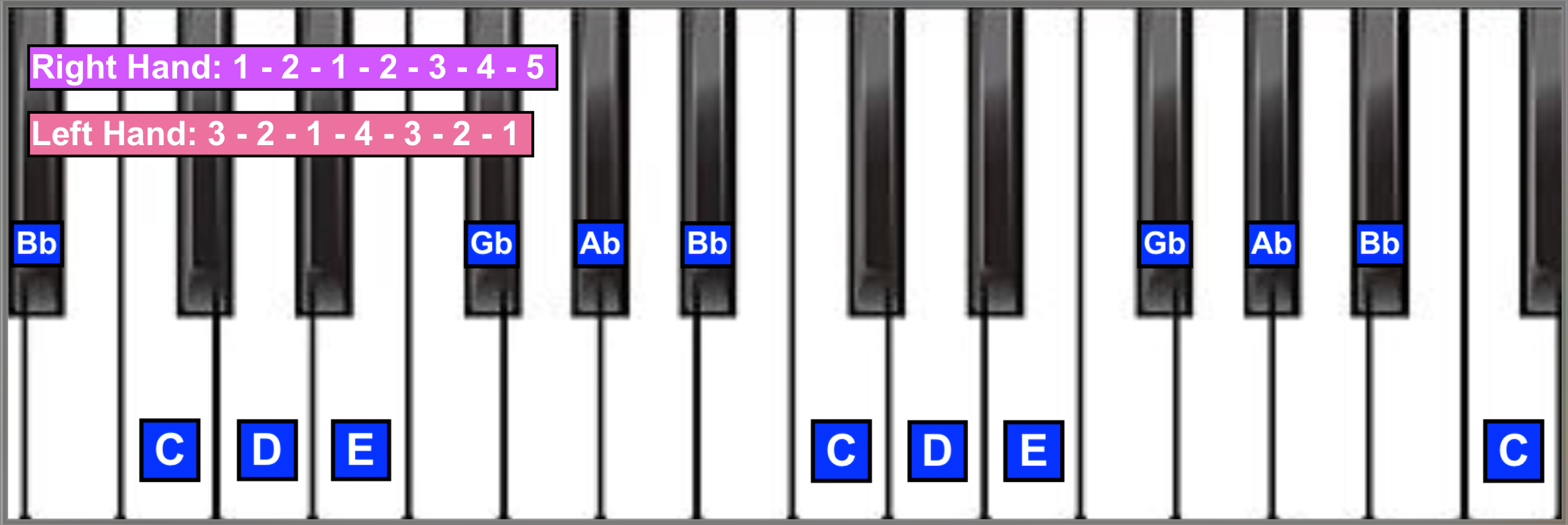
Right Hand:
- 1-2-1-2-3-4-5
Left Hand:
- 3-2-1-4-3-2-1
For more on piano scales, check out this article on major and minor scales on piano with fingerings.
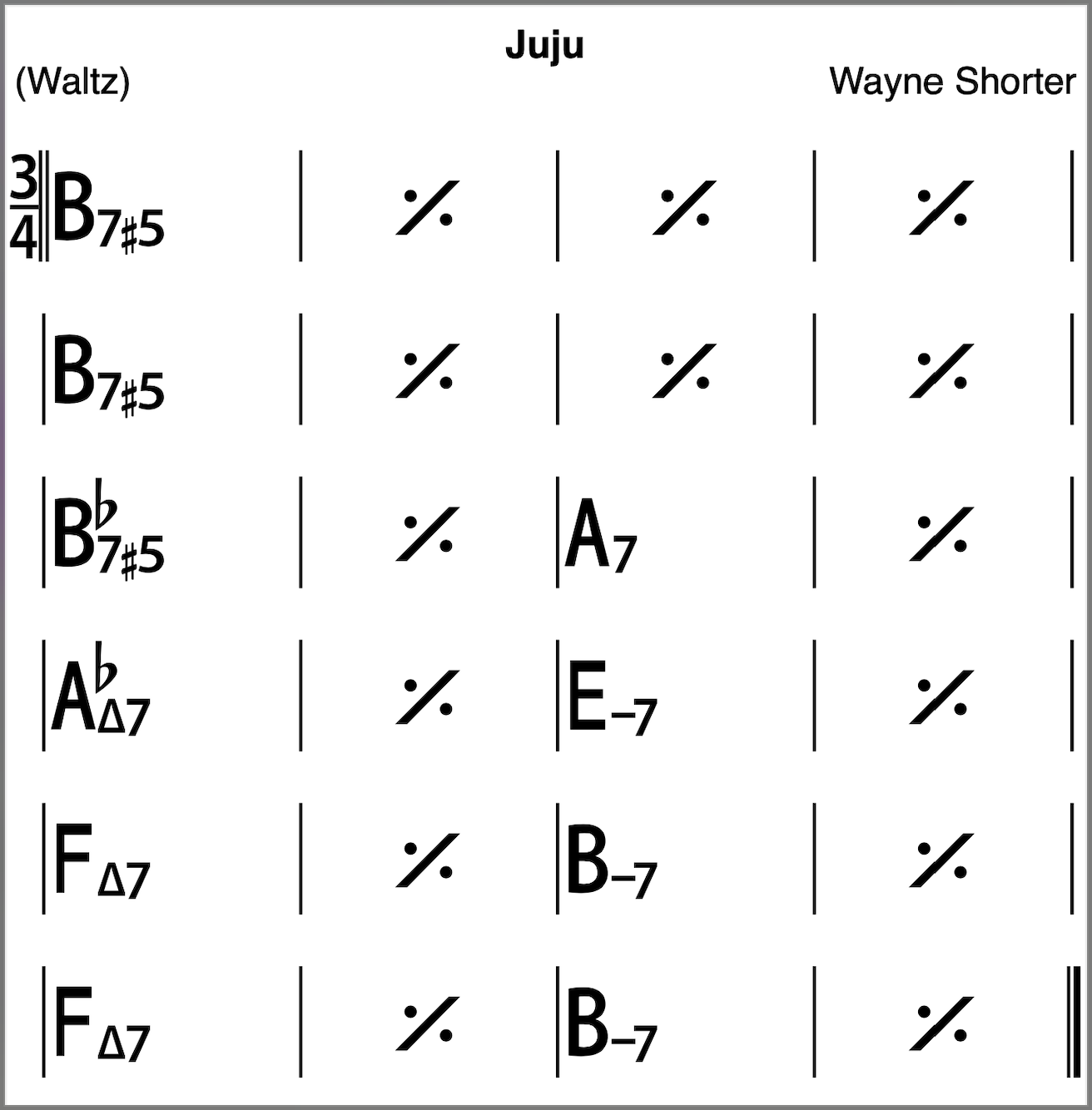
The Wayne Shorter Song “Juju” and Whole Tone Harmony
There are many great examples of whole tone harmony in songs across all genres. From Stevie Wonder’s “You Are The Sunshine of My Life” to compositions of great classical Russian composers like Mikhail Glinka, the whole tone scale’s unique qualities make it a popular choice.
Stevie Wonder and Mikhail Glinka are great, but the example I want to explore is Wayne Shorter’s composition “Juju.” It’s the title track of Wayne Shorter’s 1965 album Juju. Nearly the entire first half of the tune is played over a B7#5 chord, and the melody is constructed from the whole tone scale.
It’s a clear example of whole tone harmony in action and provides insight on how improvisers might approach playing in this pitch environment for an extended period.
Using The Whole Tone Sound In Your Jazz Solos
Let’s use this scale in a real playing example. Here are two common chord progressions in jazz:
- ii-V-I-IV
- ii-V-I
Over the dominant chords, we’ll play ideas that utilize the whole tone scale.
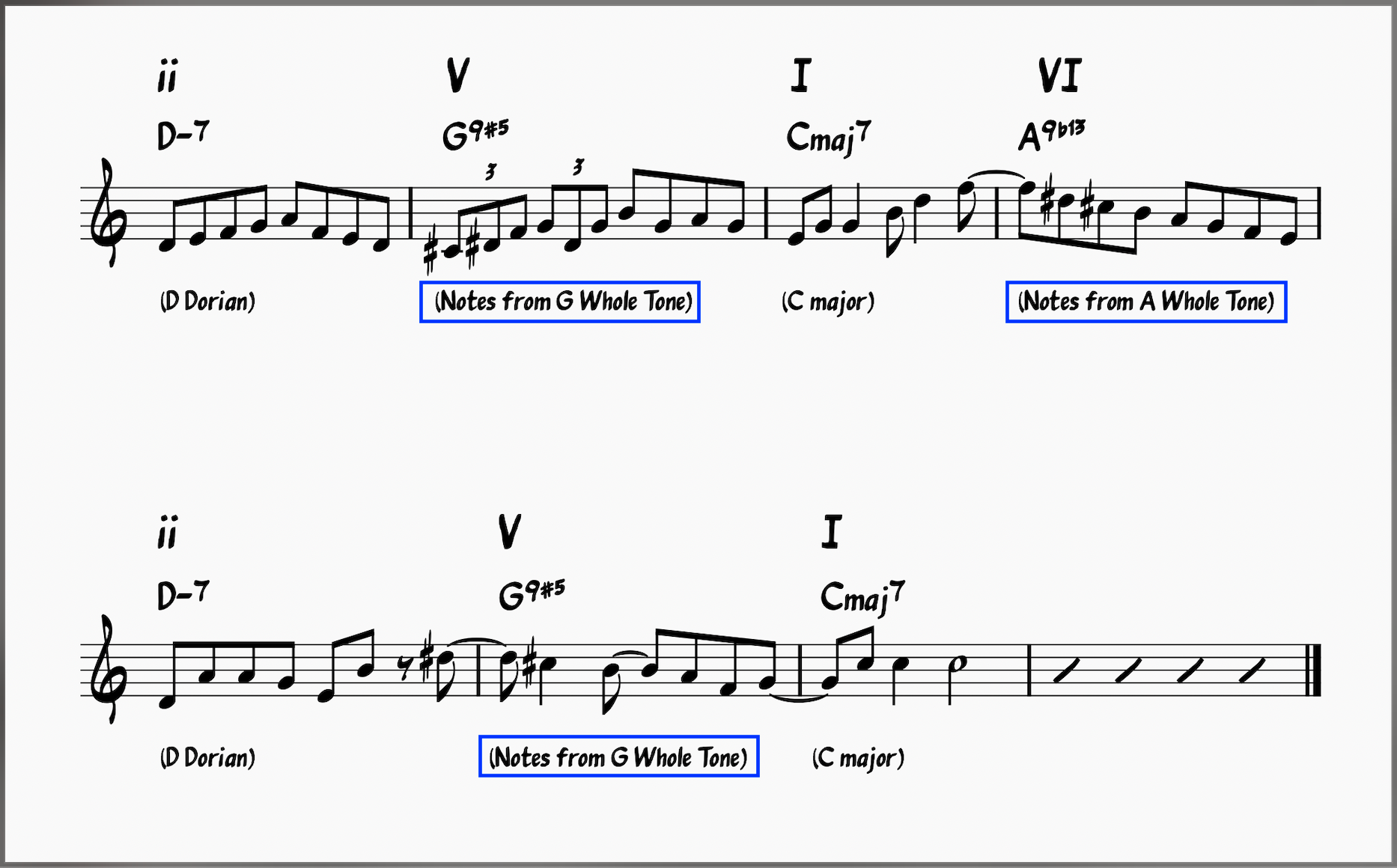
Over the G9#5 and A9b13 chords, we are actually using the same whole tone scale because these scales have translational symmetry. The G whole tone scale is the same as the A whole tone scale, which is the same as the B whole tone scale, and so on.
Check out this article for more information on jazz scales you can use to spice up your improv.
Want to Master Other Jazz Scales Like The Whole Tone Scale? Join The Learn Jazz Standards Inner Circle.
Want to become the best jazz player you can be but don’t know how you can get there? Check out the Learn Jazz Standards Inner Circle and take your playing to the next level in 30 days or less.