
Comping in jazz is an essential skill for every musician—whether you play guitar, piano, drums, or even a wind instrument (yes, wind players can comp too!). Jazz Comping is just as much an art form as soloing over changes, and any instrument can take on a supportive role to elevate the rest of the band.
In this article, we’ll cover everything you need to know to become a strong, supportive jazz musician on the bandstand. You’ll learn:
- What comping is
- Why comping is important
- Core comping philosophies and patterns
- Rhythmic factors, jazz styles, and important grooves
- Harmonic factors, chord voicings, and advanced comping concepts to consider
- Common comping mistakes to avoid
By the end, you’ll not only understand why comping is an art form, but you’ll also have concrete strategies for developing your own unique comping style.
If you’re serious about leveling up your comping chops, the Learn Jazz Standards Inner Circle will help you break through plateaus and make real progress. Our step-by-step resources and community will have you jazz comping with confidence in 30 days or less.
Table of Contents
What Is Comping in Jazz?
You might think comping is simply playing the chords over a jazz standard. While that’s true in the most basic sense, comping can—and should—be much more than that.
Comping—jazz shorthand for “accompanying”—is one of the most essential skills in jazz. It plays a vital role in shaping the feel and flow of a performance. Serious comping requires you to draw on multiple musicianship skills at a high level and apply your music theory knowledge in real time.
Good jazz comping demands:
- A strong and well-trained musical ear
- The ability to sense what the music needs in the moment
- A knack for supporting and enhancing the creativity of other musicians
- A solid command of jazz rhythm and time feel
- Thorough knowledge of chords, voicings, inversions, and substitutions
- Understanding of chord extensions and alterations
- The ability to improvise (yes—comping is improvisational!)
That last point might surprise you. You may think only soloists improvise, but creating a supportive, interactive backdrop that lifts the soloist is still a form of improvisation.
You can simply play the chords. Or you can comp like a pro.
Instruments That Comp (It’s More Than You Think)
Comping is most often associated with rhythm section players and chordal accompaniment. In jazz, that typically means a chordal instrument (piano, guitar, vibes), a bass player, and a drummer. But instrumentation isn’t always standard—and when it changes, so do the comping responsibilities.
Sometimes non-traditional comping instruments step in to fill the gaps, or familiar instruments adapt to cover missing roles. The constant? Serving the music with whatever tools you have. You don’t need drums to swing. You don’t need a guitar or piano to imply harmony.
You don’t even need a backing band to carry an entire performance—if you know how to comp effectively.
Let’s look at a few non-standard situations.
Chordless Jazz Ensembles
Many classic groups thrived without a chordal instrument. Sonny Rollins famously recorded A Night at the Village Vanguard (1958) with only bass and drums—no piano or guitar:
Gerry Mulligan’s chordless quartet—featuring Chet Baker (trumpet), Carson Smith (bass), and Chico Hamilton (drums)—relied on horn players to help comp alongside the bass and drums:
Drumless Jazz Ensembles
Without drums, other players must take on more responsibility for the groove and time. Guitarist Jim Hall was a master at this, whether with the Jimmy Giuffre 3 (Hall on guitar, Ralph Pena on bass, Jim Giuffre on woodwinds) or in duo settings with Bill Evans, Ron Carter, or Bob Brookmeyer.
Listen to the Jimmy Giuffre 3:
Solo Performances (Comping for Yourself)
Sometimes you have to comp for yourself—common for chordal instrumentalists in solo gigs. I often take solo guitar jobs where I carry both melody and harmony simultaneously. Pianists and vibraphonists do the same.
Listen to Keith Jarrett’s entirely improvised solo concert:
What Have We Learned So Far?
Comping means accompanying—serving the soloist and the music in the moment. While it’s traditionally the rhythm section’s job, “rhythm section” is a flexible concept.
The best compers listen, adapt, and step into whatever role the music calls for—whether that’s in a standard quartet, a chordless group, a drumless setting, or completely on your own.
See how it’s so much more than simply “playing the changes?”
Basic Comping Competencies: Rhythm and Harmony
Now that we’ve established what comping is and why it’s an essential skill all jazz musicians should practice, let’s talk about two crucial components of comping competency: rhythm and harmony.
You need to have a solid grasp on jazz rhythmic language and jazz harmonic language to navigate the changes of a tune and create a supportive sonic environment for your fellow musicians.
Rhythm and Comping Skills
Let’s talk about rhythm first.
Rhythm, groove, and time-feel are perhaps the most important aspects of jazz musicianship, so it makes sense to start here. As Louis Armstrong sang, “It don’t mean a thing if it ain’t got that swing,” and this is absolutely true.
All the harmonic and theoretical knowledge in the world won’t help you play something that actually feels good. You might hit all the right notes, but without a strong sense of swing and time-feel, your comping will sound stiff and robotic.
Just as importantly, without a deep familiarity with the rhythmic environments common in jazz, you won’t know how to support your bandmates if they call a tune with a feel you haven’t mastered.
That’s why we’ll begin by exploring several of the most common jazz rhythmic feels—ones you need to practice, study, and internalize if you want a complete picture of jazz’s rhythmic language.
The Charleston Rhythm and Reverse Charleston
The Charleston rhythm is one of the earliest syncopated jazz rhythms, originating in the 1920s dance craze. In 4/4, it accents beat 1 and the “and” of beat 2, creating a long–short feel that’s instantly recognizable.
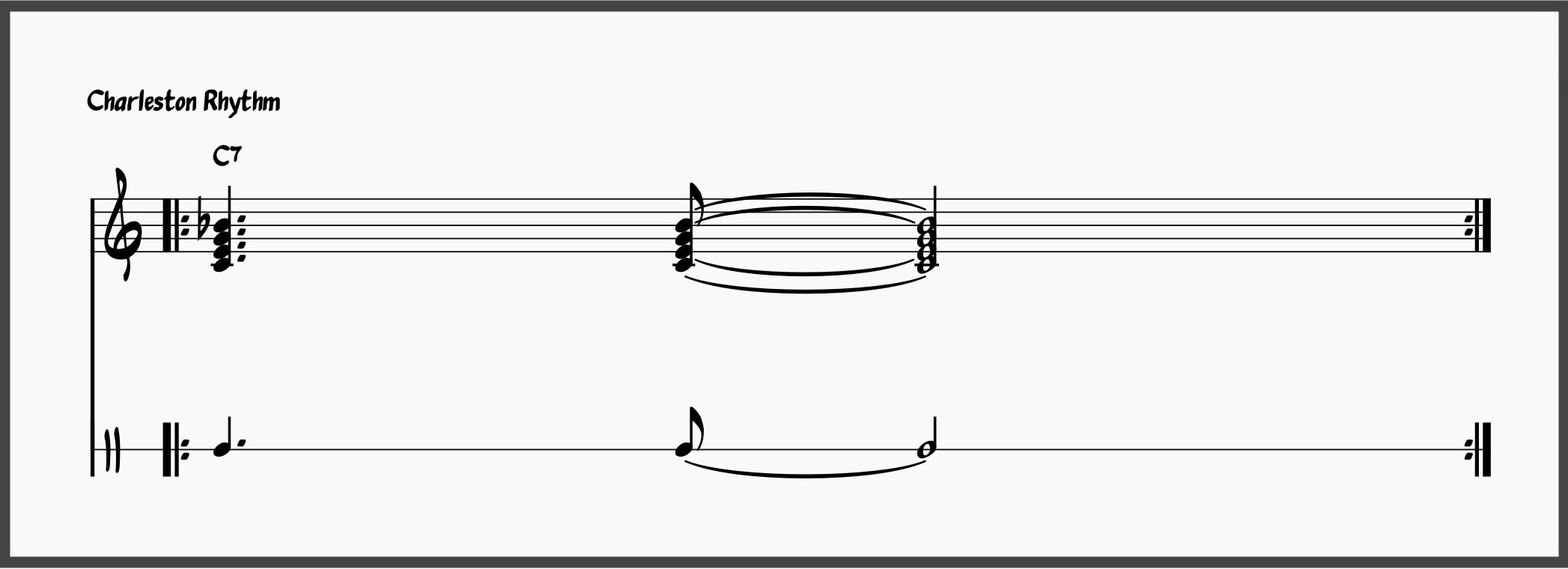
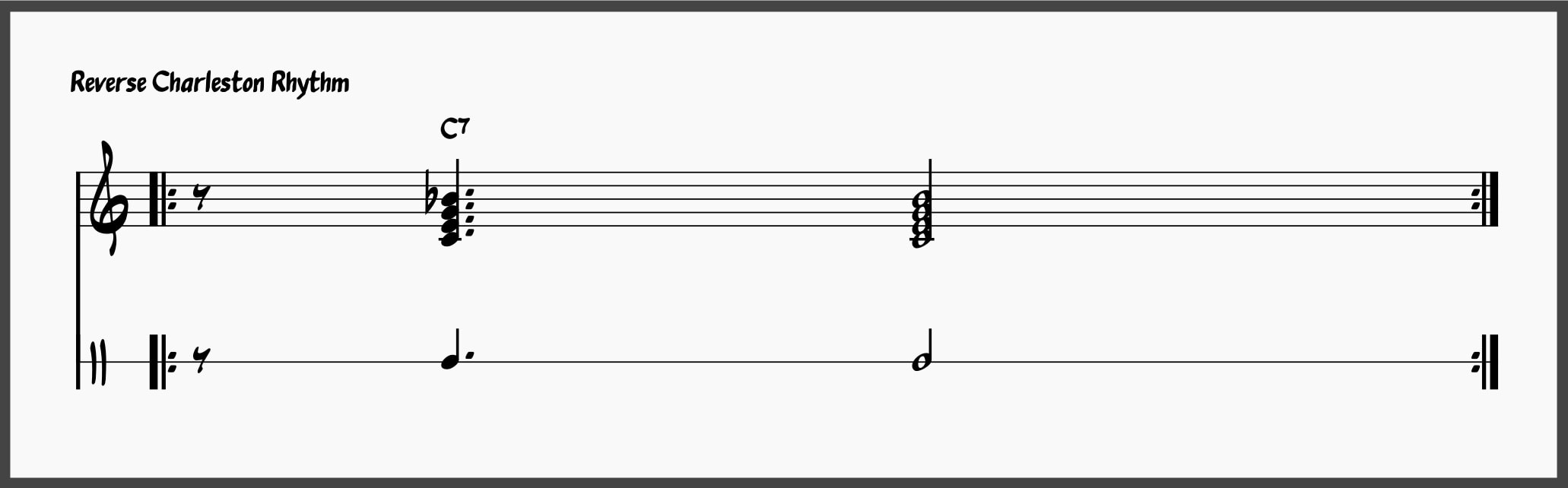
The reverse Charleston flips this pattern, accenting the “and” of beat 1 and beat 3. Both variations are staples in early jazz comping, stride piano, and New Orleans–style swing, and they still show up in modern comping patterns.
Swing 2-Feel and Swing 4-Feel
With a swing 2-feel, the bassist plays primarily on beats 1 and 3, often with a half-note walking pattern, while the drummer keeps a swinging ride cymbal pattern. This feel creates an open, airy texture—common in ballads, early swing, and the first chorus or two of a medium-tempo standard before moving into a walking 4-feel.
You can hear the bass player playing a 2-feel in the classic Louis Armstrong rendition of “It Don’t Mean a Thing If It Ain’t Got That Swing.” The 2-feel is more noticeable when the bass player breaks out of it around one minute into the recording.
Here you can see the bass in the left hand change from a 2-feel to a 4-feel in the 5th bar, while the right hand comping patterns also change feels.
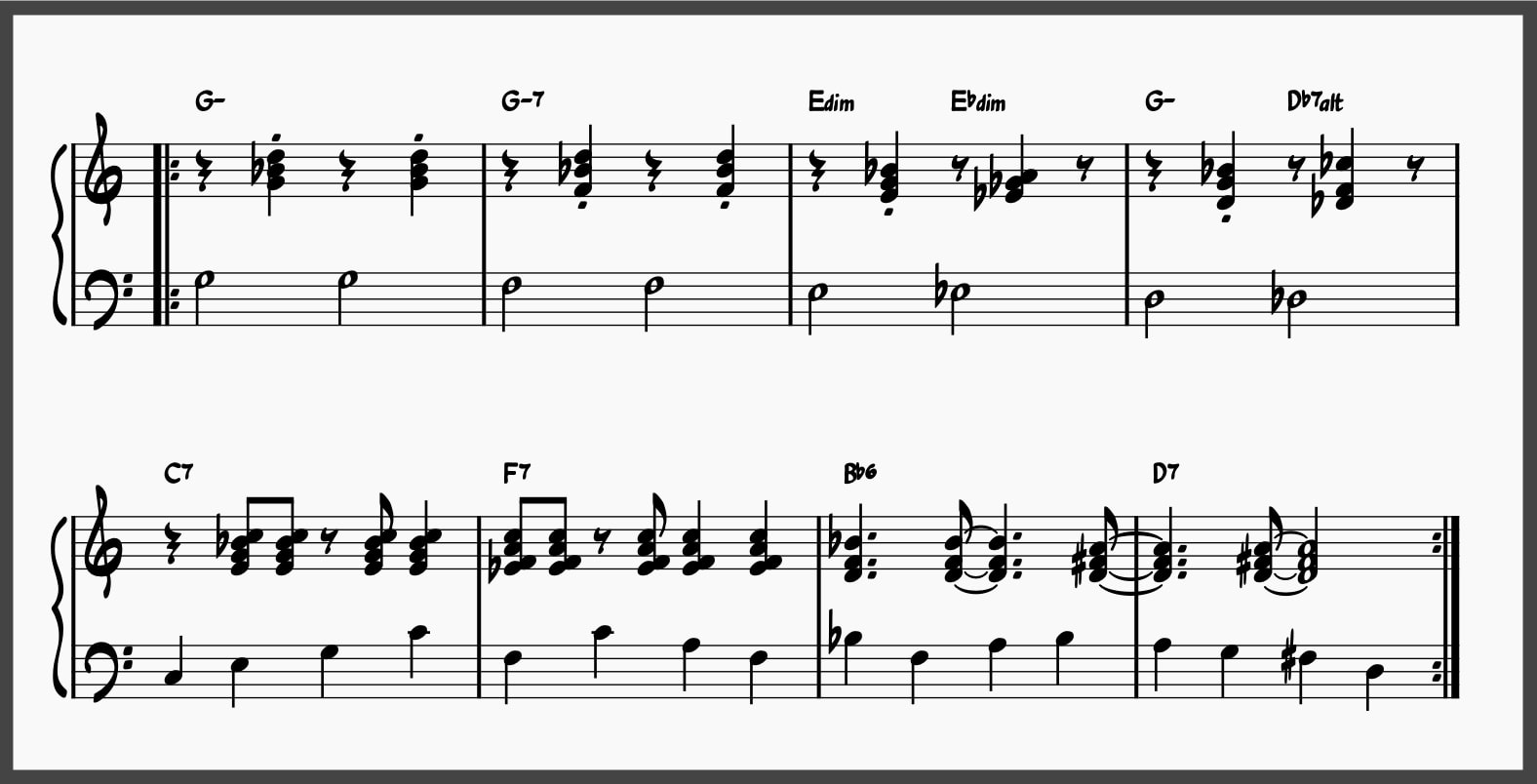
You’ll also hear the Charleston rhythm in the drums!
The classic Miles Davis recording of “If I Were a Bell” is an excellent example of the band playing in a 2-feel during the head and breaking into a 4-feel during the solo section.
The swing 4-feel you hear is the standard walking bass feel in jazz, with the bassist playing quarter notes on all four beats of the measure. Drums keep time on the ride cymbal with a swing pattern, and comping instruments punctuate with syncopated chords.
Anticipations Are The Secret To Swing Groove
Listen to the pianist Red Garland mostly comping chords on the upbeats in “If I Were A Bell.” The use of anticipation and syncopation is very common in straight-ahead jazz chord comping, and this is a great example.
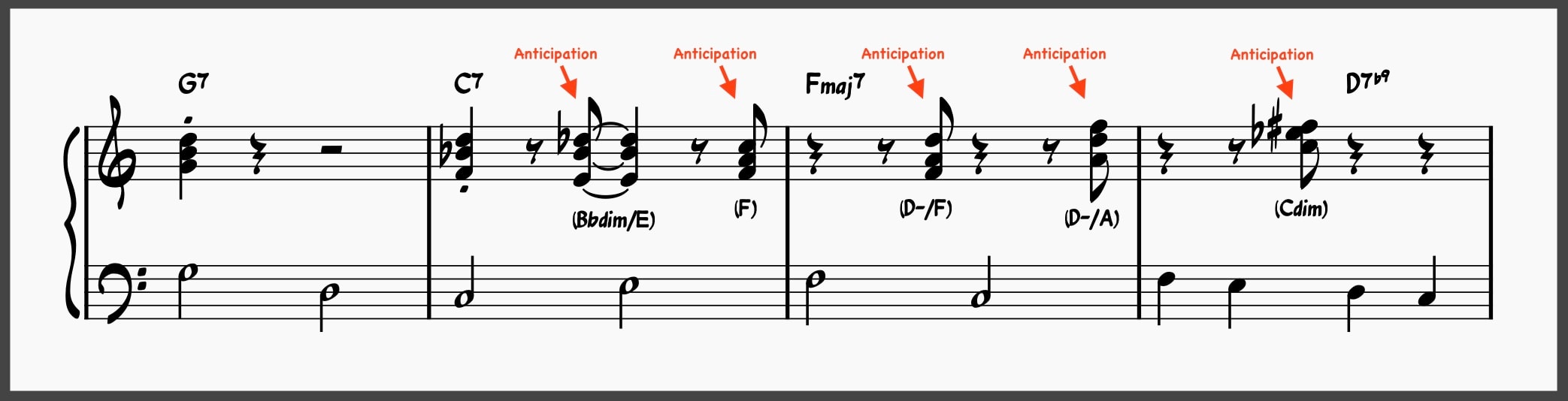
Notice how Red Garland places the chords right behind the downbeats over the C7 and Fmaj7 sections.
Up-Tempo Swing
At fast tempos, the comping dynamic has to change. The rhythm section often thins out to avoid overwhelming the music—bass lines become more economical, drummers use a lighter ride cymbal touch, and comping instruments play longer duration chords.
Check out this recording of “Cherokee” from Clifford Brown and Max Roach’s Study in Brown.
- Listen to the head of the tune and listen to the rapid 4-feel of the bass.
- Listen to how the drums set up the swing feel.
- Notice how the pianist frequently plays block chords that span whole notes or a full four beats.
The fast tempo reduces the need for ornamentation and complexity, and instead calls for a simple approach.
Jazz Waltz
A jazz waltz is in 3/4 time, with a flowing triplet-based swing feel. The bass often outlines all three beats, and the ride cymbal may accent beat 1 while keeping a triplet subdivision.
Bill Evans’ Someday My Prince Will Come is a classic example of the jazz waltz feel.
During the head in, the bass is walking in quarter notes, the drums are accenting beat two, and Bill Evans plays staccato chords outlining the harmony.
Shuffle Rhythm
A shuffle is a swung 4/4 groove that emphasizes a triplet subdivision—beats are divided into three, with notes played on the first and third triplet. The result is a heavy, rolling swing groove used heavily in blues, Kansas City swing, and soul jazz.
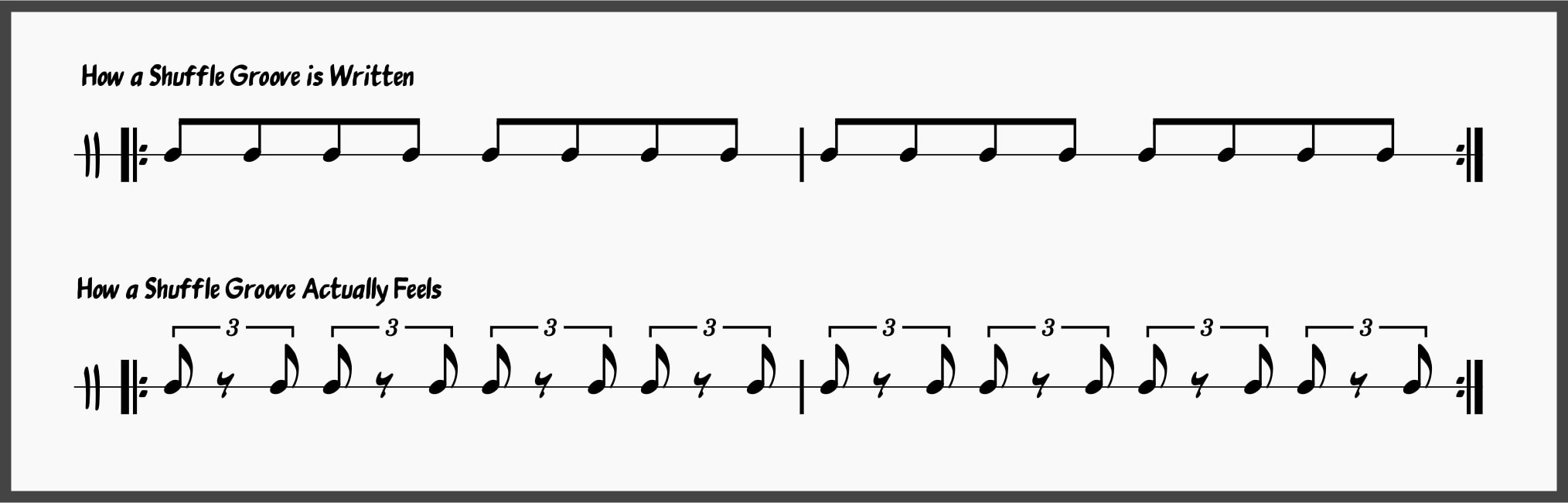
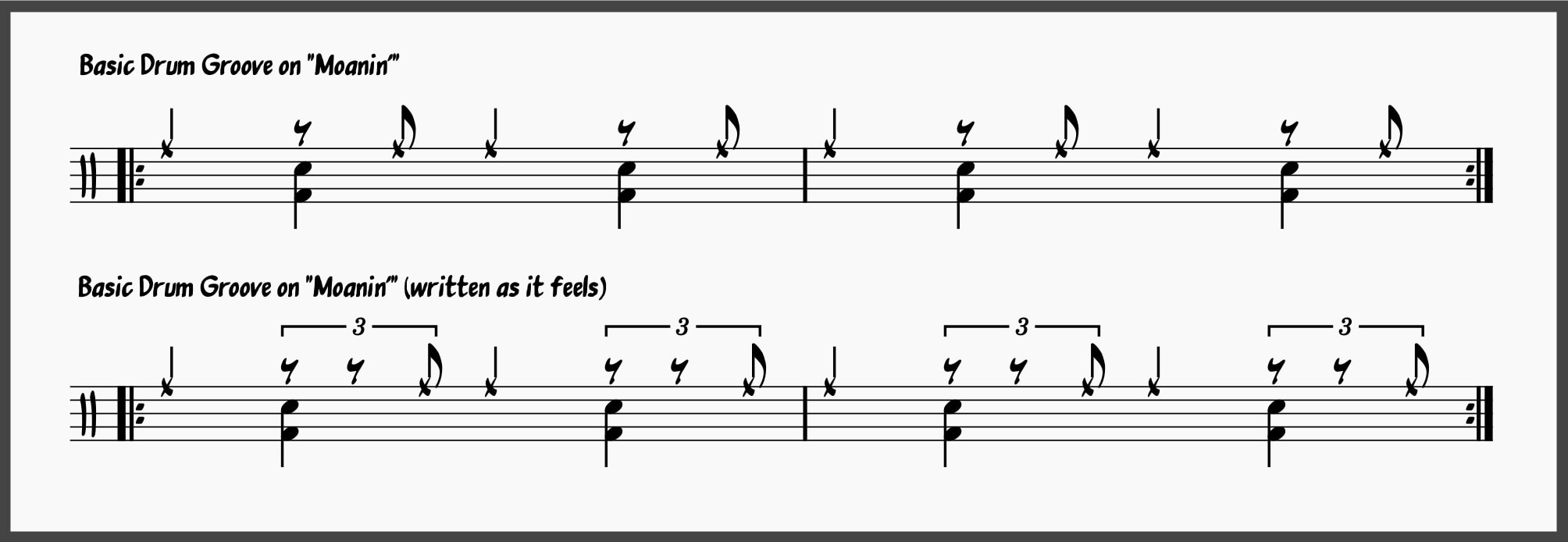
Though you’d write a shuffle groove in 8th notes, it would feel more like 8th note triplets with notes played on the first and third note in each triplet. The Art Blakey and the Jazz Messengers tune “Moanin'” is an excellent example of a classic jazz shuffle feel.
Art Blakey sets up a hard swinging shuffle groove that feels much more like accented triplets than 8th notes. Also, notice the heavy snare and kick hits on beats 2 and 4. Recognize elements of the Charleston rhythm in this groove?
Latin Feels (Clave and Bossa Nova)
Many jazz tunes borrow Latin feels from Afro-Cuban and Brazilian traditions.
Clave-Based Feels
Clave-based feels underpin Afro-Cuban jazz, with interlocking rhythmic patterns in the percussion, bass tumbao lines, and syncopated comping figures. Clave means “key” and can refer to wooden percussion instruments or the actual rhythm played on them.
The clave rhythm helps demarcate the passage of time in Afro-Cuban music. In this sense, it is analogous to a measure. However, it also has rhythmic properties. One side of the clave rhythm is even, and the other is odd—three beats versus two or vice versa.

Above, we have a 3:2 son clave. Here, the group of three comes first and is followed by the group of two. However, you can start with two and end with three, also.
There are two flavors of clave: son clave and rumba clave.
The difference between son and rumba clave is in the placement of the last beat on the three-side of the clave. Notice the subtle difference:
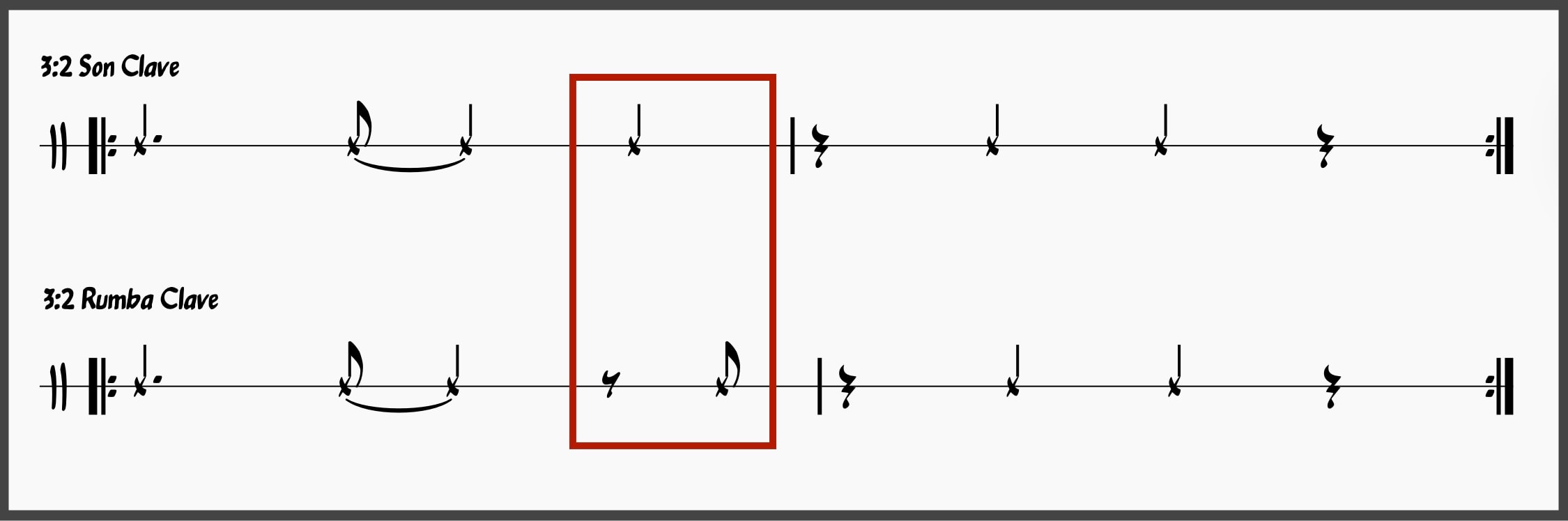
With a rumba clave, the last of the beats on the three-side is offset by one 8th note.
Check out this article to learn more about the clave rhythm.
Bossa Nova Groove
Bossa nova, from Brazil, uses an even 8th-note feel with a syncopated guitar or piano pattern against a steady 2-feel bass line. Though there are elements of Afro-Cuban clave in Bossa Nova music, it is less strict with its forms.
Some musicians say Bossa Nova has “Bossa clave” or “Brazilian clave.”
A typical Bossa Nova groove features straight 8ths, a bass playing in a two feel (so on 1 and 3), and syncopated, “clave-adjacent” rhythms like the ones pictured below.
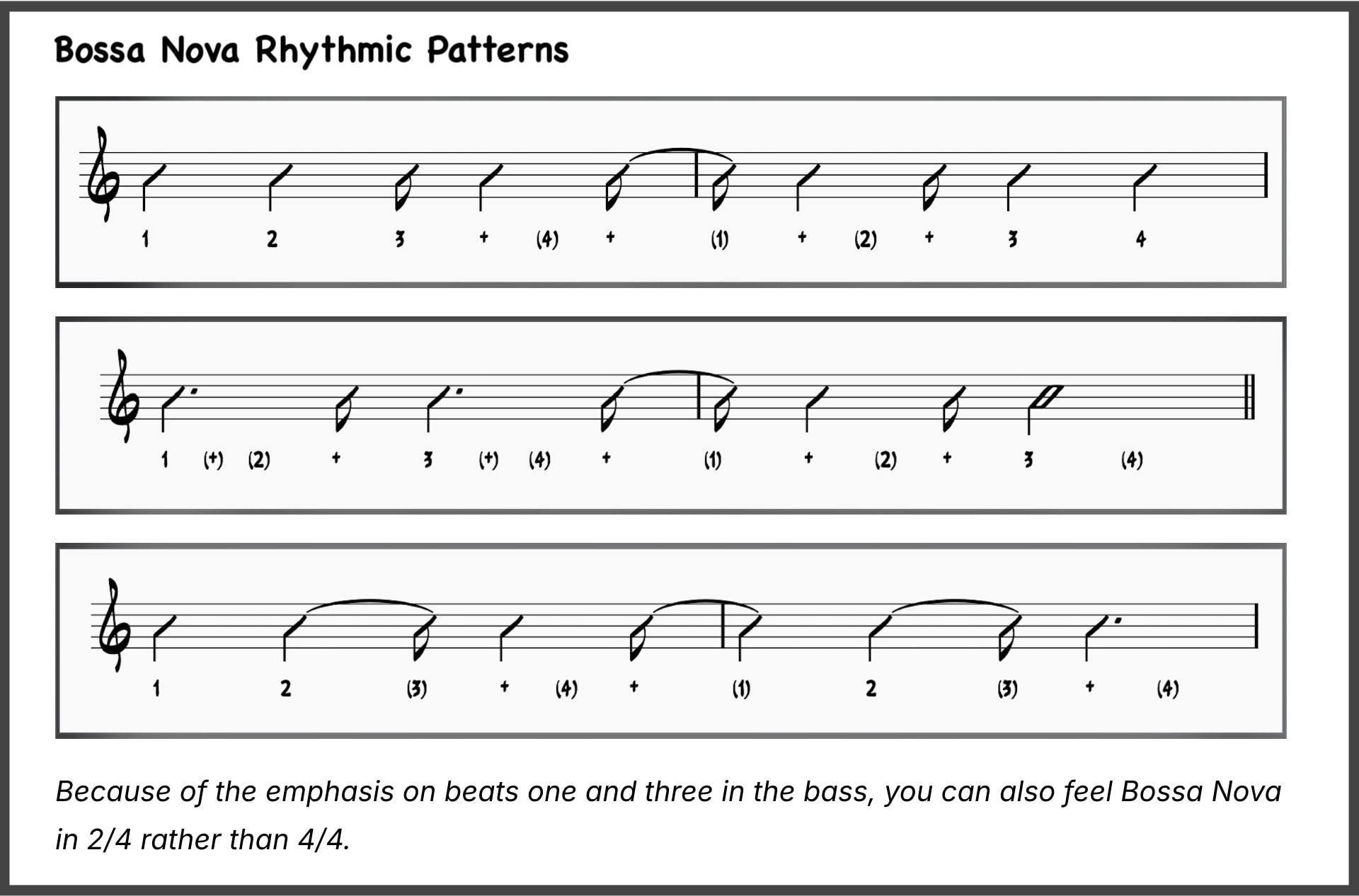
The classic Antônio Carlos Jobim tune “Só Danço Samba” is a perfect example of the bossa nova groove. Check out this version from Getz/Gilberto (1964).
Check out this article for more on Bossa Nova.
Second Line or New Orleans Groove
Second line refers to the syncopated parade rhythms of New Orleans brass bands, rooted in African, Caribbean, and marching band traditions. It has a loose, loping feel with accents that often anticipate or delay the beat.
The second line feel or “New Orleans groove” feels like a shuffle with accented hits. Let’s check out a common second line feel rhythm.
Here is an example of a second line feel as played in the Meters tune “Hey Pocky Way.” Though the Meters weren’t a jazz group per se, they are heavily rooted in the New Orleans tradition. Therefore, their groove on this tune perfectly represents the second line feel. Listen to “Hey Pockey Way” here:

This groove is one-half of the son clave rhythm. It’s the 3 in a 3:2 son clave. Clave is a Latin feel with African roots, but New Orleans was a melting pot of musical cultures, so it makes sense that we’d see aspects of clave here.
Check out the son clave groove and note the orange box outlining the three-side of the clave. This is called the tresillo, or triplet.

12/8 Feel (Not Afro-Cuban 12/8)
The 12/8 feel is a triplet-based groove with four beats per measure, each subdivided into three pulses. It’s common in gospel-influenced jazz, slow blues, and ballads, providing a smooth, rolling momentum that sits somewhere between a shuffle and a swing ballad.
This is different than tunes explicitly written in a 12/8 time signature. Many Afro-Cuban songs naturally fit into a 12/8 grid, but many slow jazz ballads and blues tunes develop a triplet feel over the quarter note, so while a tune might be in 4/4, it feels like there are 12 8th notes as if it were in 12/8.

The Oscar Peterson rendition of “Things Ain’t What They Used to Be” is a great example of a slow blues with a 12/8 feel. Each quarter note can easily be divided into triplets instead of 8th notes. Take a listen:
Jazz Straight 8ths
In a straight 8ths feel, the eighth notes are played evenly rather than swung. This feel is common in modal jazz, contemporary ECM-style tunes, fusion, and bossa novas. While the subdivision is even, jazz straight 8ths are still phrased with subtle accents and dynamics.
A great example of a tune with straight 8ths is Roy Hargrove’s Strasbourg / St. Denis:
Odd Meter
Odd meters are time signatures other than the standard 3/4 or 4/4—such as 5/4, 7/4, or 9/8. In jazz, odd meters often flow naturally by grouping beats into smaller patterns (e.g., 3+2 in 5/4) and can swing, be straight, or incorporate mixed subdivisions. Odd meter is common in modern jazz compositions, fusion, and world-influenced jazz.
Let’s explore 5/4 meter for our example.
5/4 Meter
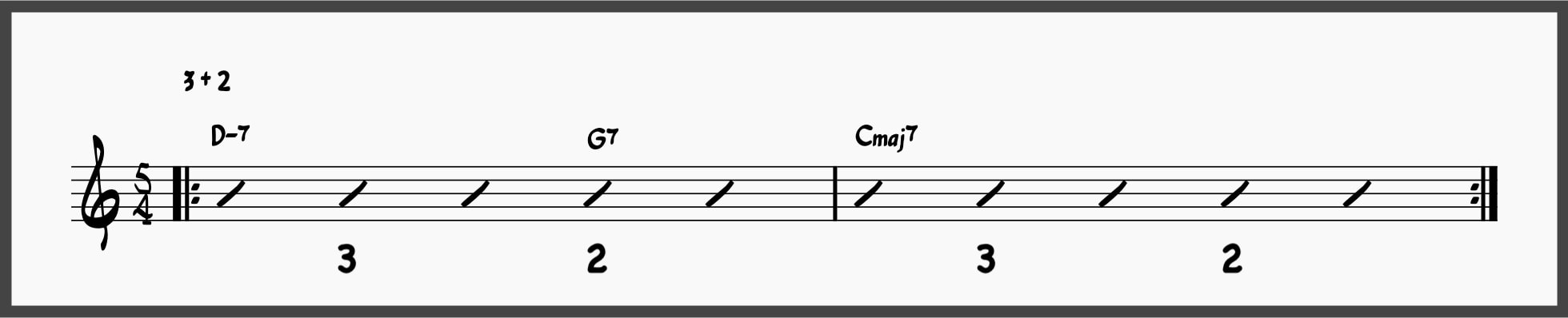
A measure of 5/4 is usually divided into a group of three and a group of two. The order of groupings doesn’t matter and can even be mixed across measures.
Here is an example of 5/4 meter with a 3+2 grouping.
Here is an example of 5/4 meter with a 2+3 grouping.

Here is an example of 5/4 meter with mixed groupings.
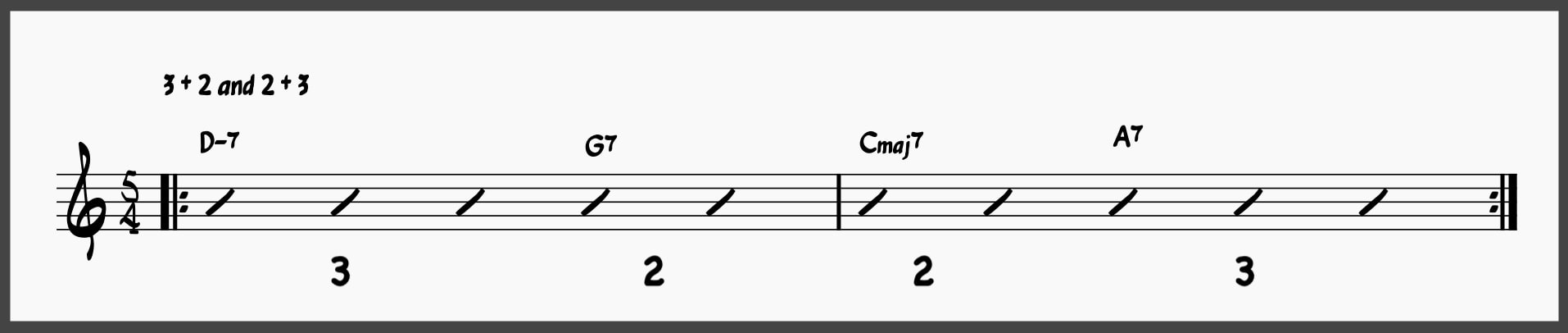
The most iconic example of 5/4 meter in jazz is the tune “Take 5,” by Paul Desmond, which appeared on Dave Brubeck’s famous album Time Out. The song features a consistent (3 + 2) grouping within each measure.
Funk / Jazz-Funk Groove
The funk groove in jazz uses a straight 16th-note subdivision with strong backbeat accents and syncopated bass lines. Comping is often rhythmically tight and riff-based, locking in with the drummer’s snare and hi-hat patterns. Common in fusion, soul jazz, and groove-oriented modern jazz.
A great example of a jazz-funk groove is Pee Wee Ellis’ “The Chicken.” In Jaco Pastorius’ version, you even get a gospel intro with a 12/8 gospel groove.
Harmony and Comping Over Chord Changes
Now that we’ve taken a thorough tour of jazz’s various rhythms and grooves, we’re ready to explore the harmonic elements of comping! We’re going to assume you have a basic understanding of jazz harmony.
However, if you need a review, check out these articles on:
The Importance of Inversions, Diatonic Substitutions, and Chord Voicings
What would you do if you were reading a chart and you saw this?

If you were to interpret this literally, you’d be stuck on the same root position voicing and playing that chord on every downbeat. Barring very specific stylistic circumstances (i.e., Freddie Green’s guitar comping style), this would be a very boring and uninspired way to comp over a C7 chord.
However, if you took advantage of various chord voicings, inversions, and chord substitutions, you could take this static C7 chord and play a very engaging, dynamic, and supportive chordal accompaniment.
We’re going to take these four static bars of C7 and turn them into a dynamic comping etude that incorporates jazz rhythms and advanced harmonic techniques! By the end of our exploration, these four bars will sound like pro jazz comping!
Chord Inversions
Chord inversions cycle through the order of stacked notes in a chord. By utilizing chord inversions in your comping, you can add movement and direction to your playing even when the harmony is static.
Let’s explore an example.
A C7 chord has four notes: C, E, G, and Bb.
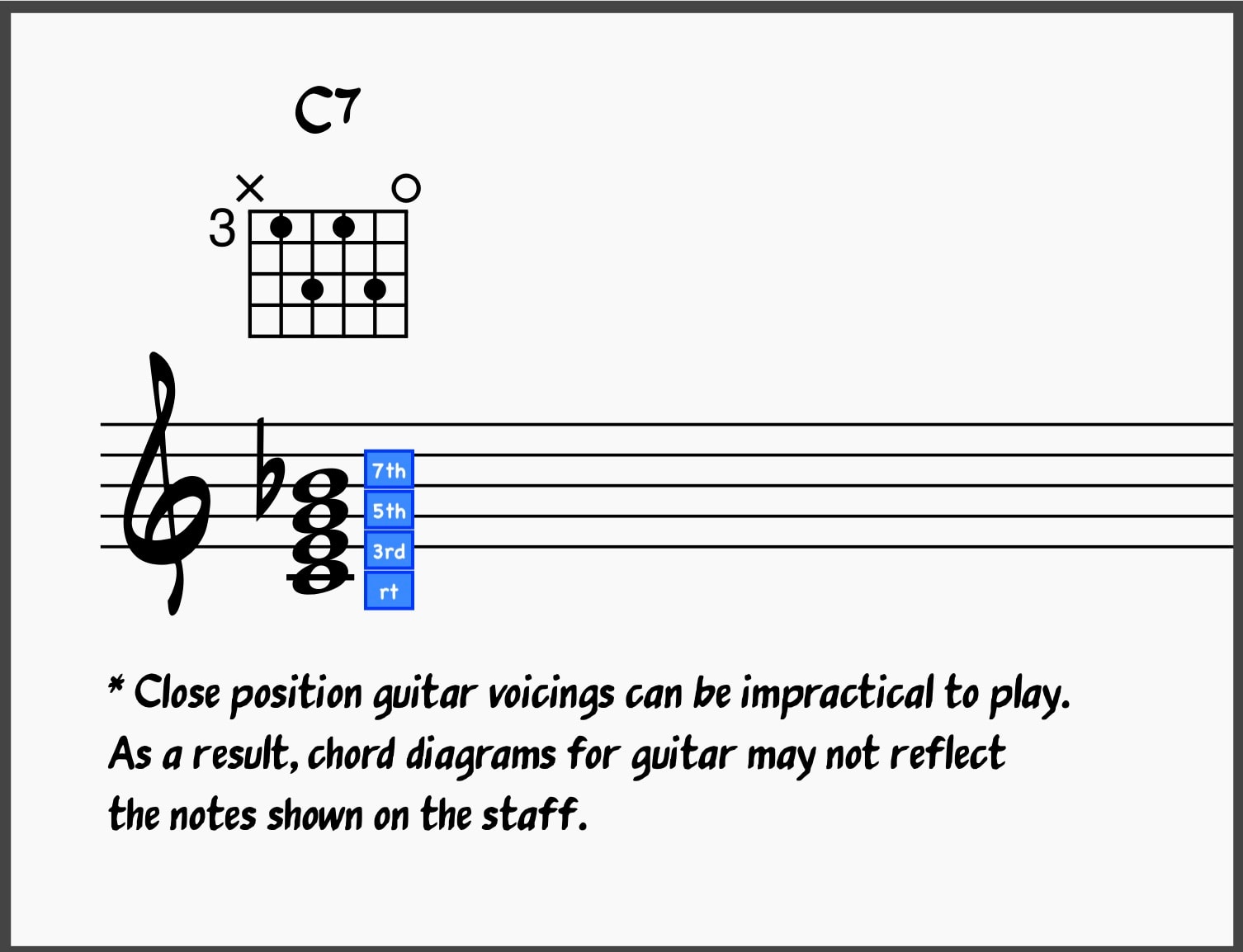
A C7 chord structured this way is in close root position. Close position means the maximum range of notes in the chord doesn’t exceed an octave. Root position means that the lowest note of the chord is the root of the chord.
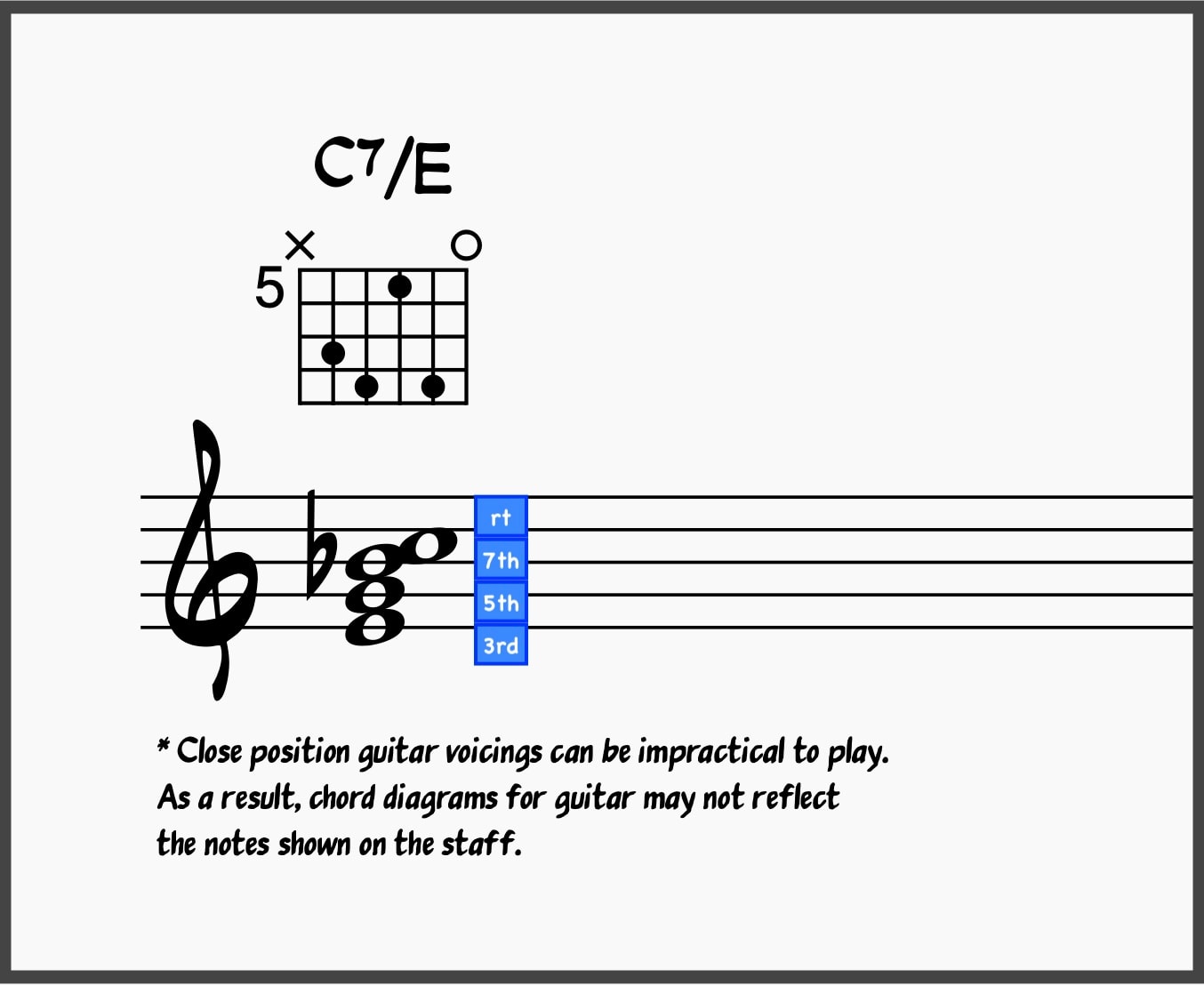
To create a first inversion C7 chord, let’s take the root note and make it the top note of our C7 chord. This creates a C7/E chord because E is now the lowest note.
To create a 2nd inversion C7 chord, move the bottom note (E) up to the top of the voicing. This leaves the 5th of the chord, or G, on the bottom.
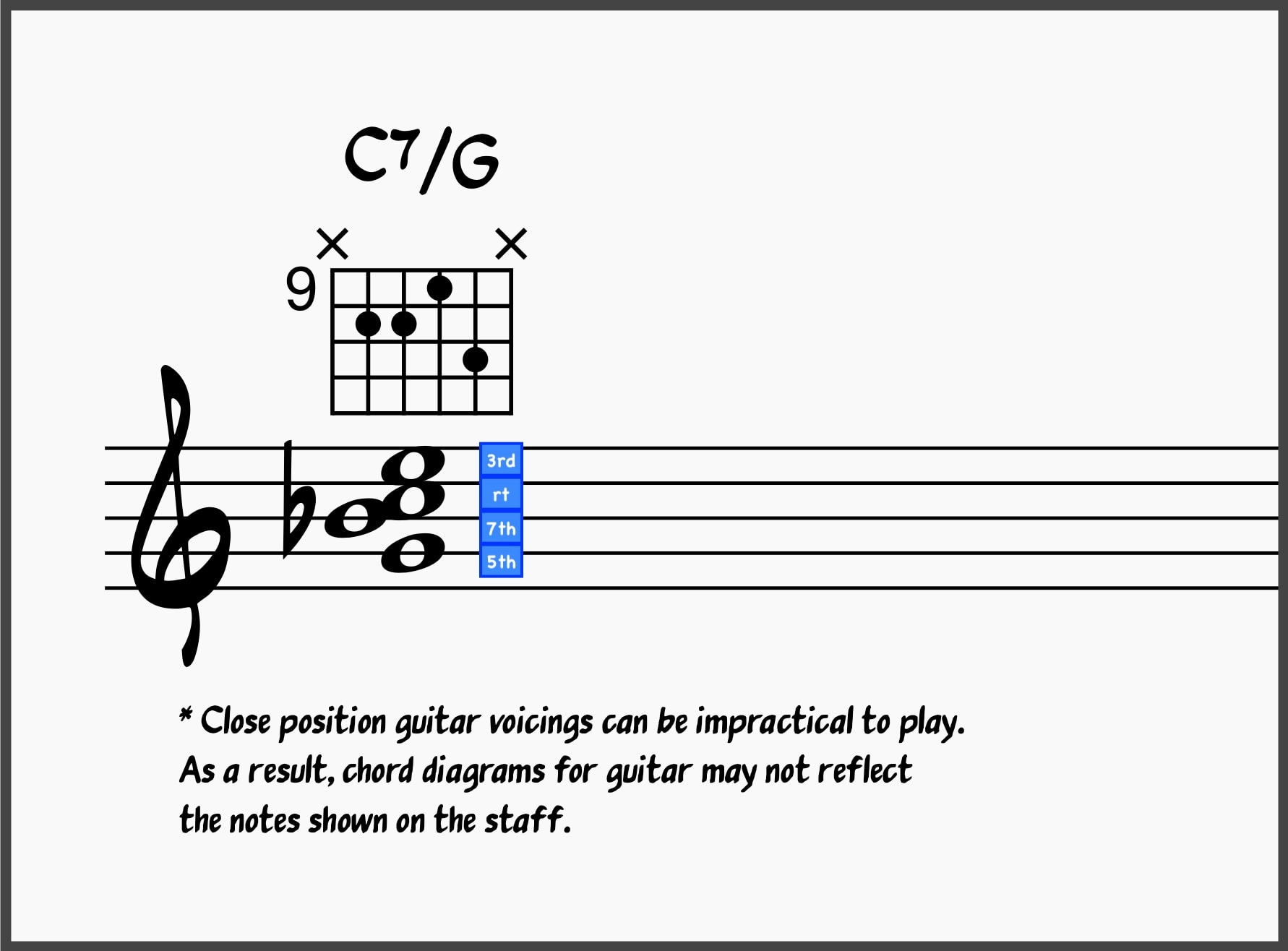
To create a 3rd inversion close C7 chord, we need to move the bottom note (G) to the top of the chord voicing. This leaves Bb at the bottom of the chord.
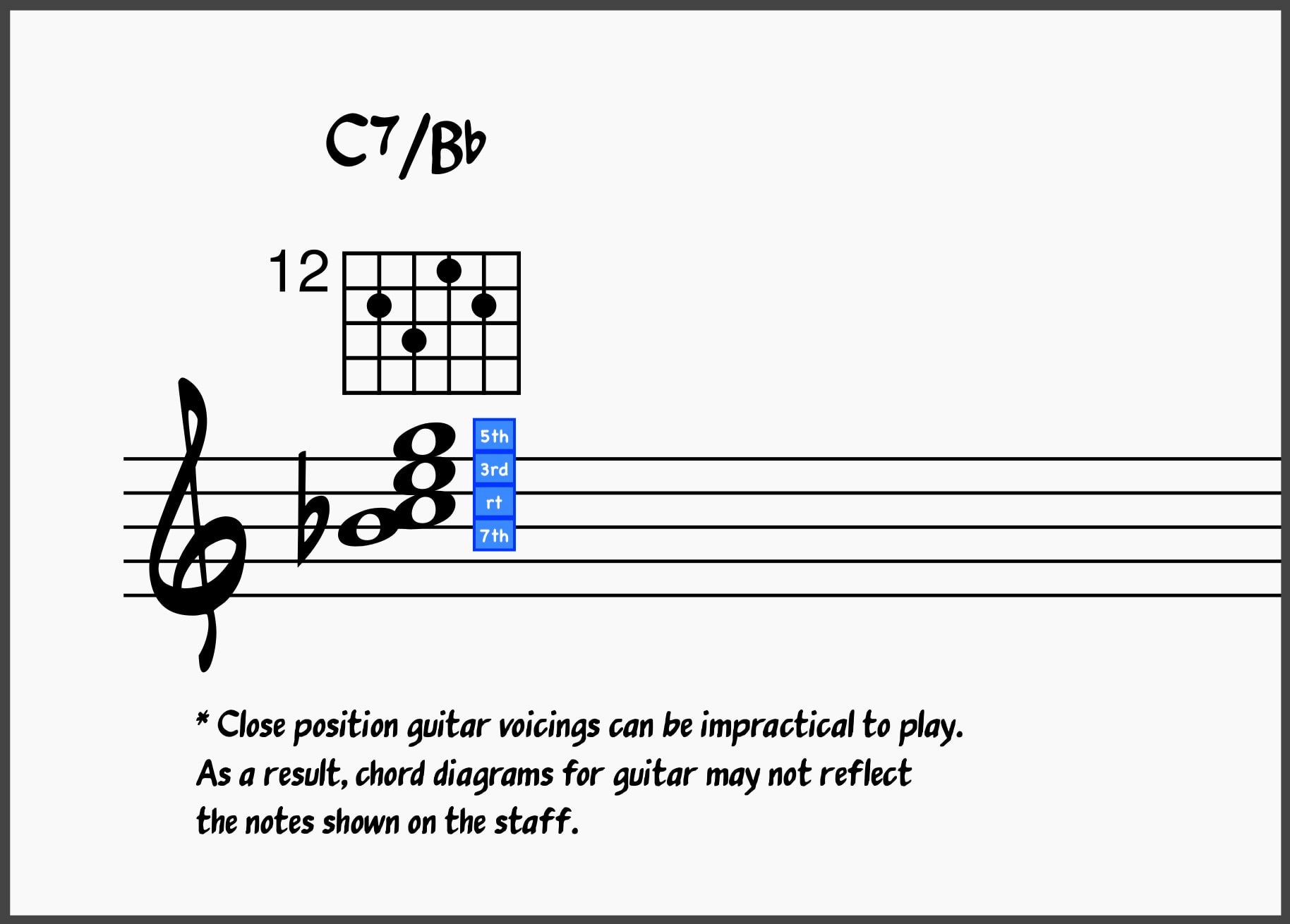
By learning chord inversions, we have four different ways we can play a C7 chord. We can ascend, descend, or jump through these inversions to create movement and direction when comping. Let’s apply these inversions to the static bar of C7 from above to demonstrate.
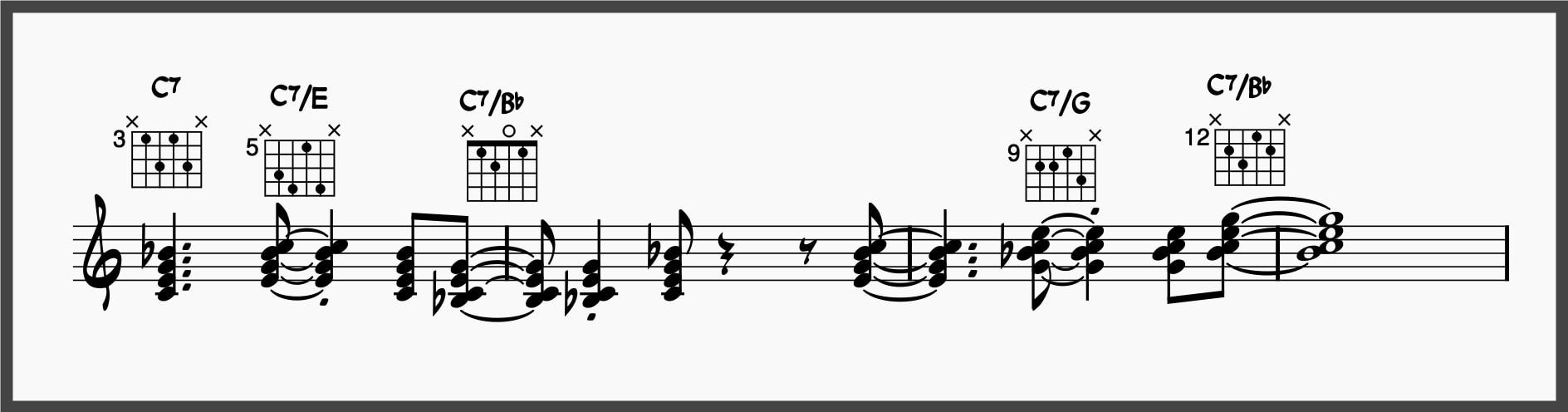
By using different inversions of the C7 chord, we’ve found a dynamic and engaging way to comp over a static C7 harmonic environment. We’ve added movement and melody to our comping using simple chord inversions.
When coupled with some common rhythms found in jazz, we have a solid comping etude that you can take through all twelve keys on your instrument!
Diatonic Substitutions
Another vital skill you need to develop to comp competently as a jazz musician is commanding diatonic substitutions to enrich the textures further and expand your harmonic reach when playing comping patterns.
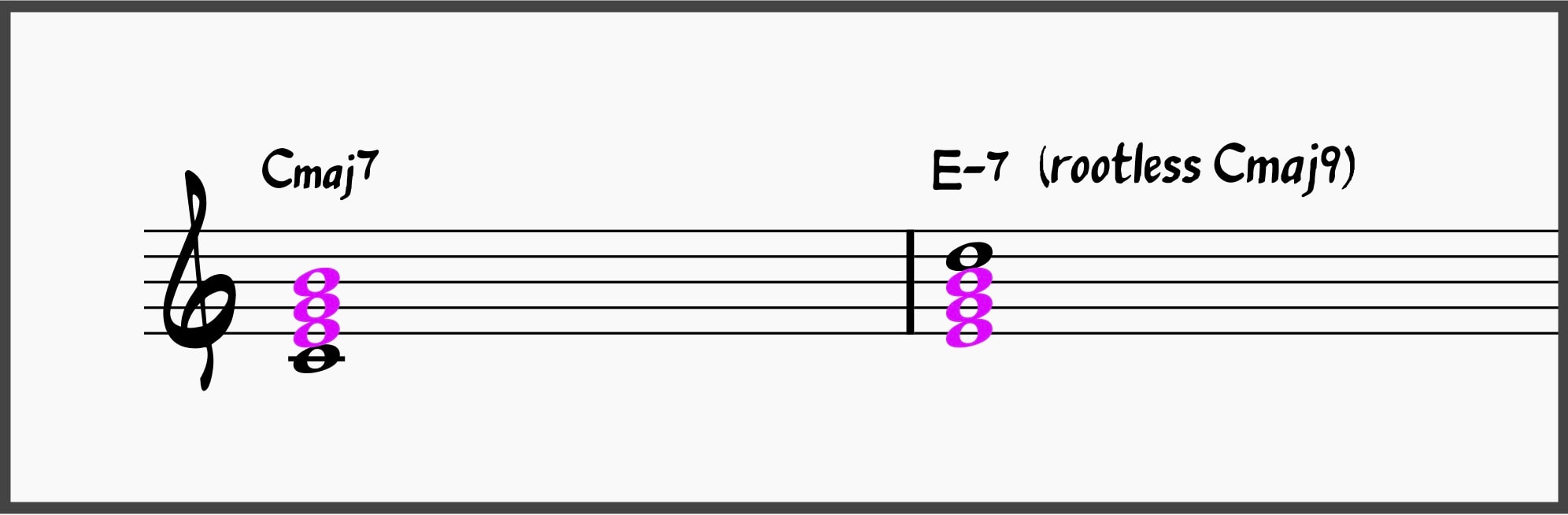
Diatonic chord substitutions are a type of chord substitution that replaces one diatonic chord with another that shares many of the same notes. In the key of C, a Cmaj7 chord is spelled C, E, G, and B. However, you don’t need to play these notes exactly to imply the tonic chord.
Instead, you could replace it with an E-7 or the iii chord. E-7 is spelled E, G, B, and D. E-7 is an extension of a Cmaj7 chord because it shifts up one set of thirds. Here is a way to visualize Cmaj7:
- C-D-E-F-G-A-B-C-D-E-F-G-A-B-C-D-E-F-G-A-B-C
Now let’s shift over a set of thirds and visualize an E-7:
- C-D-E-F-G-A-B-C-D-E-F-G-A-B-C-D-E-F-G-A-B-C
We lose the C and add a D, but the 3rd, 5th, and 7th of the Cmaj7 chord are still intact within the E-7. If you are playing with a bass player, the root will be covered anyway. Also, playing an E-7 hits the 9th chord extension. Therefore, this E-7 can be a rootless Cmaj9 voicing.
Let’s go back to our C7 example and incorporate diatonic substitution into our chord etude. C7 implies the V chord in the key of F major. The third of our C7 chord is E, and if we stick to the key signature of F major, we end up with an E-7b5 chord, or the viiø chord in F.
C7:
- F-G-A-Bb-C-D-E-F-G-A-Bb-C-D-E-F-G-A-Bb-C-D-E-F
E-7b5:
- F-G-A-Bb-C-D-E-F-G-A-Bb-C-D-E-F-G-A-Bb-C-D-E-F
The E-7b5 is a rootless C9 chord because it shares the E, G, and B while adding the natural 9th (D).
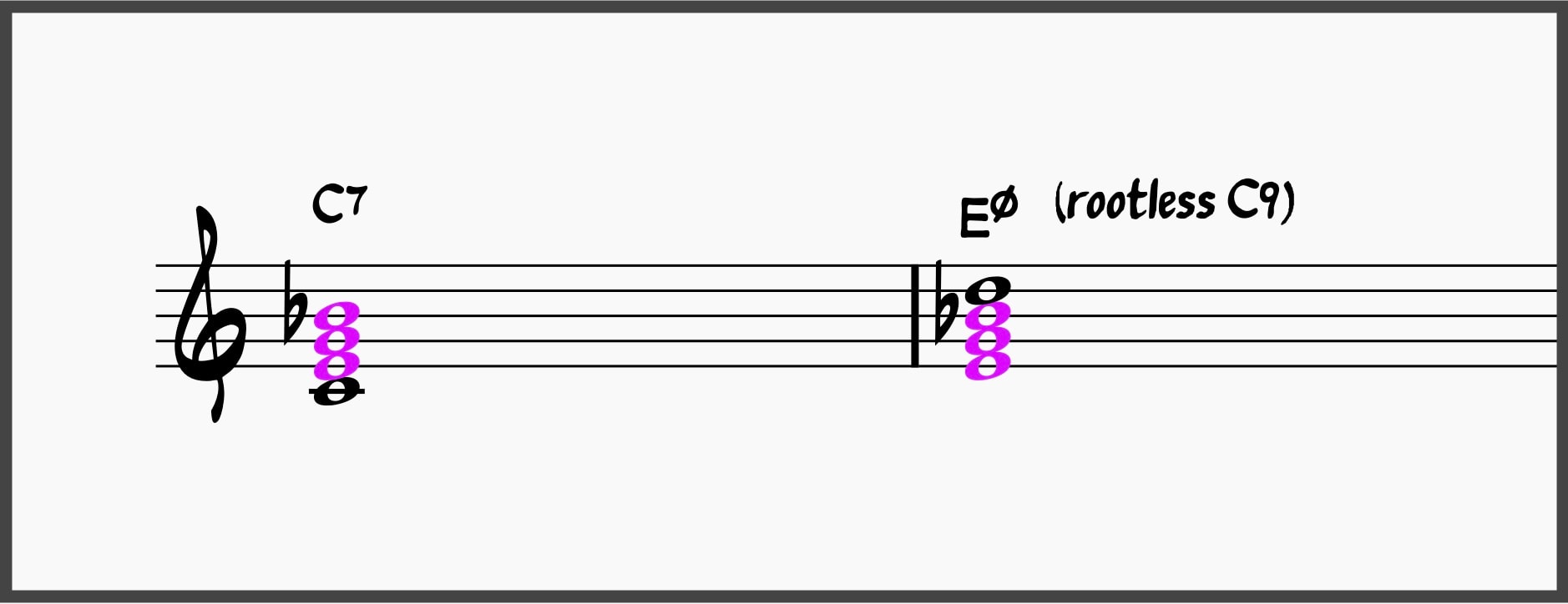
Let’s replace instances of C7/E with our rootless C9 voicing to add some harmonic interest to our chord etude. Having the natural 9th present in the progression adds more harmonic interest than sticking with the same four notes from our C7.
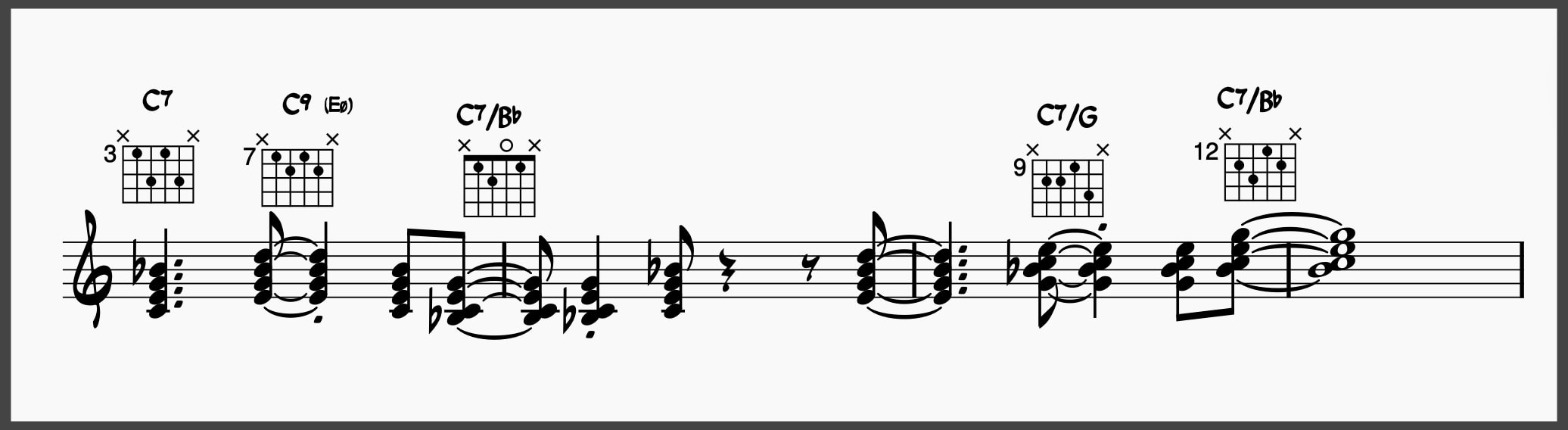
Chord Voicings
Listening back to our chord etude, you might feel like the chords sound too cluttered and dense. This is because the chords are in close position (the span of all notes in a chord doesn’t exceed an octave). To remedy this, you might experiment with different chord voicings.
One solution would be to open these chords up by changing them to an open position chord voicings. The notes in open position chords span more than one octave. Using drop two and drop three voicings can help us open up the chords in our etude, making it sound less cluttered and dense.
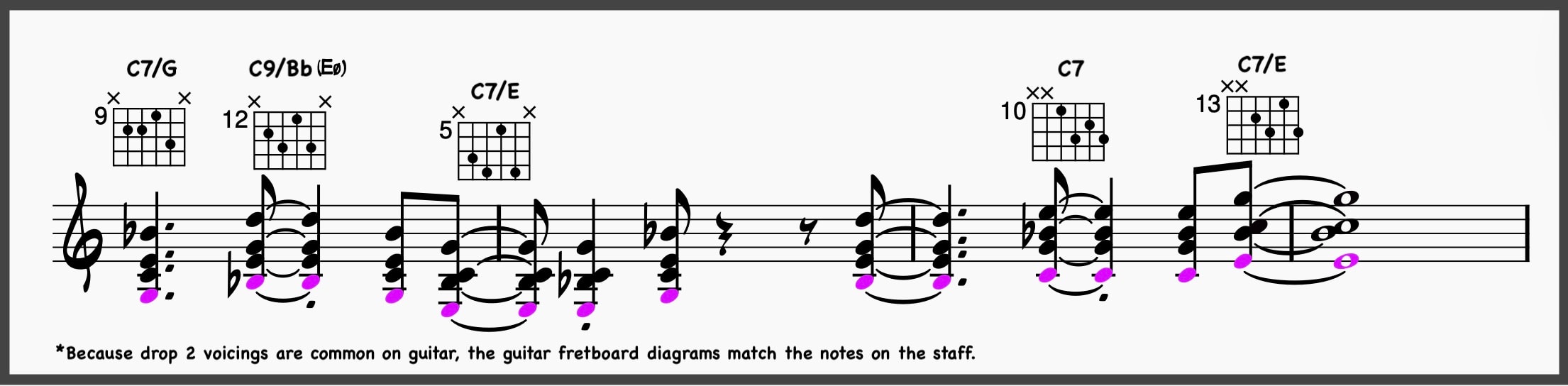
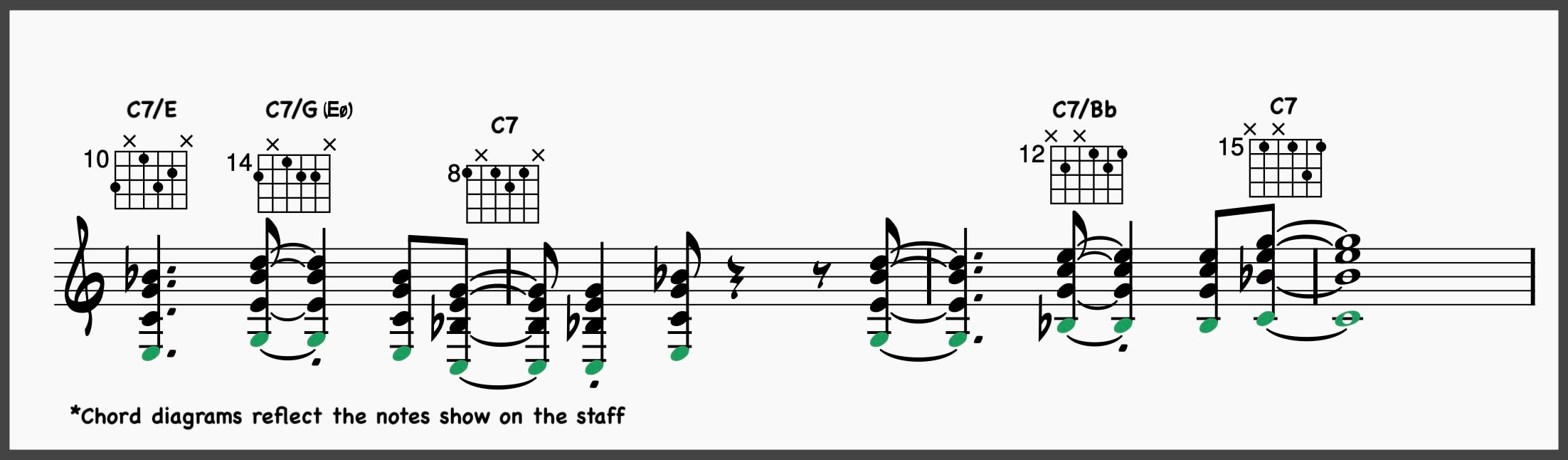
It’s difficult and impractical for a guitarist to play closed position chords all the time. However, drop two and drop three voicings work naturally over the fretboard. When looking at the drop two and drop three examples below, the guitar chord diagrams will match the notes on the staff!
Drop Two Voicings
To turn a close position chord into a drop two voicing, take the second voice from the top and drop it down an octave. This will open up your chords and make them sound less cluttered and dense.
Here is our chord etude with the second voice from the top highlighted in purple:
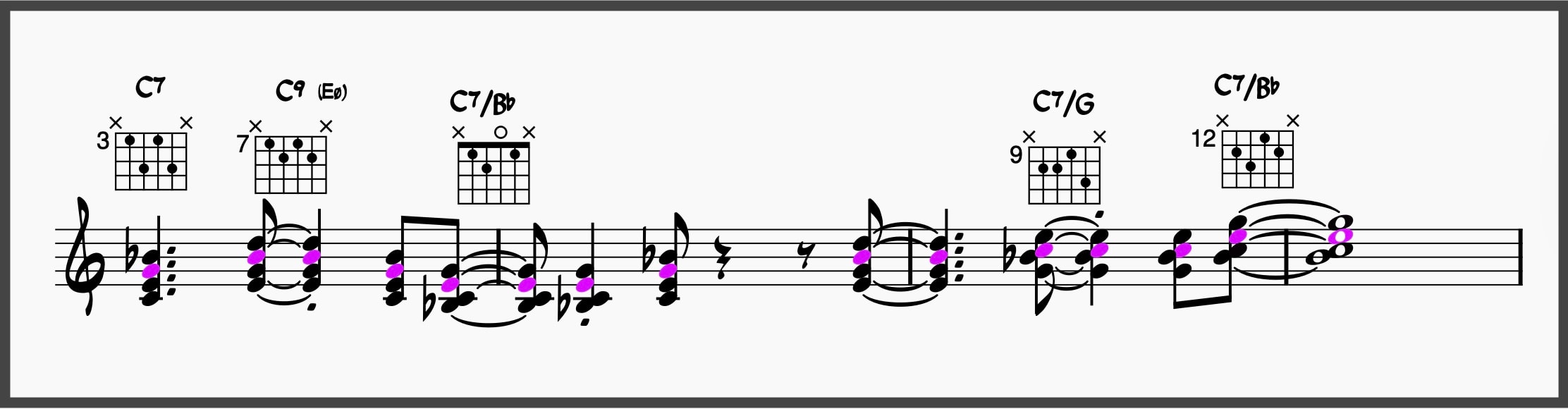
All we have to do is move the purple notes down an octave, and we will have successfully transformed this close position chord etude into one using drop two voicings.
Drop Three Voicings
Drop three voicings take the third note from the top down an octave. This creates a wider spread than drop two voices. Here is the original progression with the third note from the top highlighted in green.
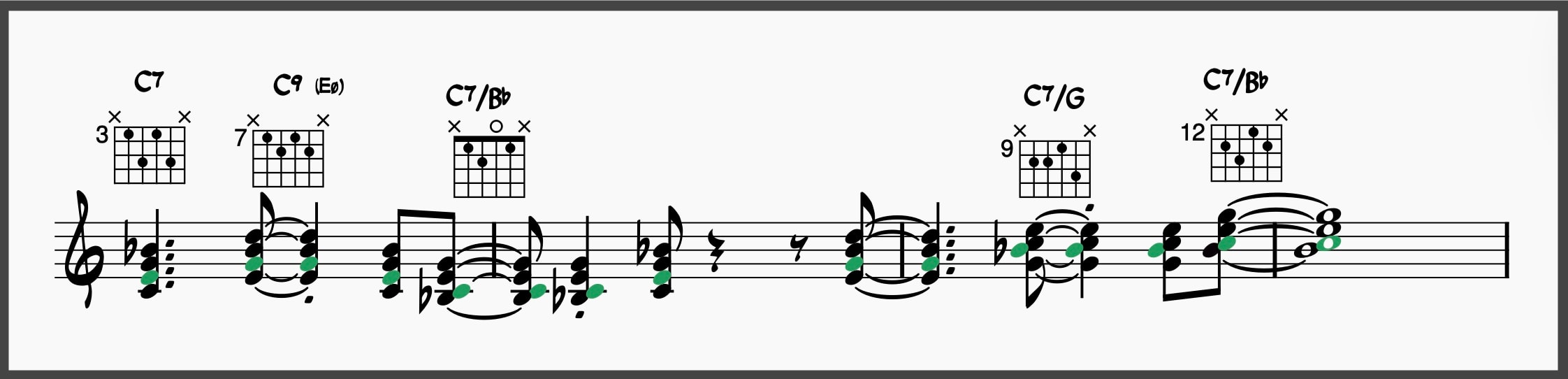
Here’s what we get when we drop that third voice from the top down one octave.
Shell Voicings (Roots, 3rds, and 7ths)
Instead of taking notes and moving them around to create new voicings, you could alternatively choose to take notes away to make the progression sound less cluttered. Shell voicings are a great way to strip down your chords to the bare essentials.
Shell voicings consist of a root, a third, and a seventh. These notes give you everything you need to convey chord function without needing to include the fifth, which is often a perfect fifth and not necessary for hearing what’s happening in a chord progression.
Let’s go through our original progression and highlight the fifth of each chord voicing in orange.
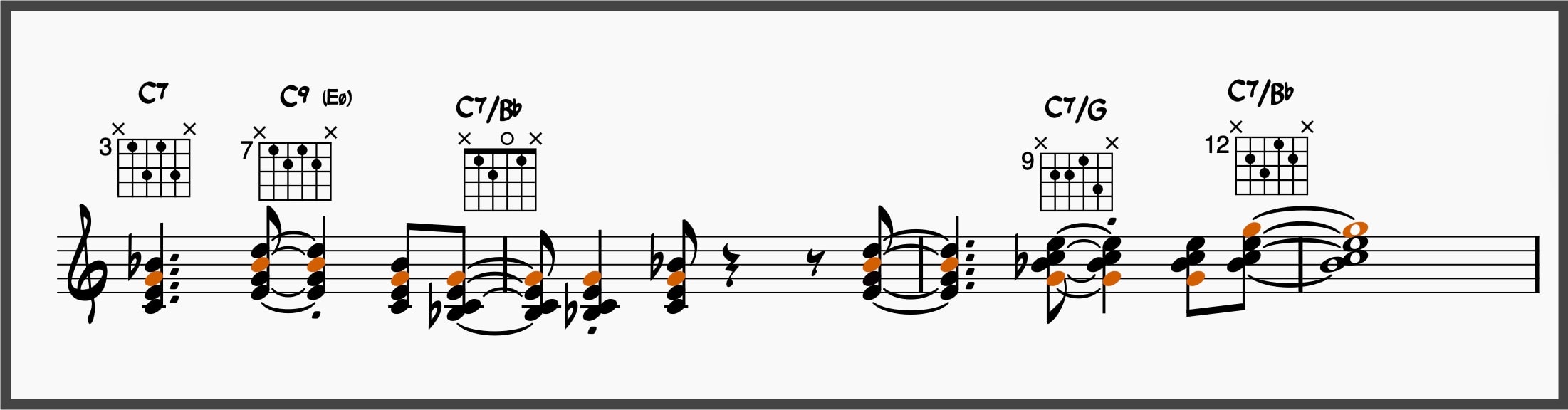
When we remove the 5ths, this is what we are left with.
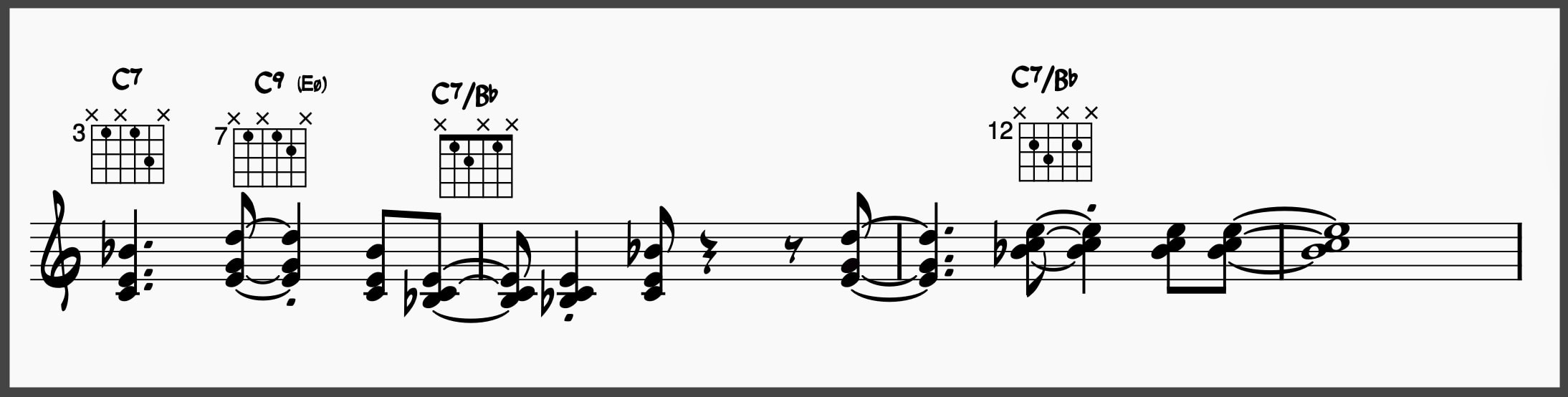
Check out this article to learn more about chord voicings.
Using a combination of inversions, chord voicings, and jazz rhythms, our comping over a static C7 chord has gotten way more interesting! However, there is more we can do to further jazzify this etude.
Advanced Comping Concepts: Chromatic Approach Chords, Tritone Substitutions, and Passing Chords
Let’s explore some advanced jazz comping concepts that can take your jazz comping even further!
Chromatic Approach Chords
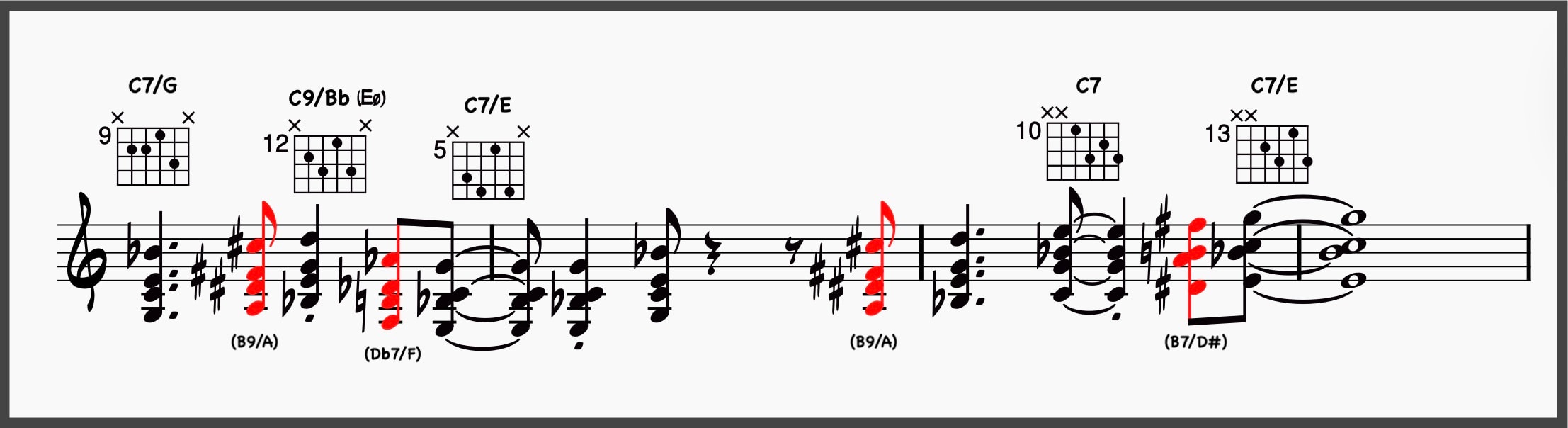
Chromatic approach chords are chords that lead into a target chord by moving from a half step above or below. The “approach” chord has the same quality as the target chord (major, minor, dominant, etc.), just shifted up or down by a half step.
Chromatic approach chords work best when placed on upbeats that resolve to the target chord on the following downbeat. I’ve taken the drop two voicing version of our C7 chord etude and strategically placed chromatic approach chords on downbeats to create tension or on upbeats to aid in resolving to the target chord.
The chromatic approach chords are highlighted in red:
Tritone Substitution
Let’s develop our etude by incorporating tritone substitutions. Tritone substitutions replace a dominant chord with another dominant chord whose root is a tritone (three whole steps) away from the original root.
Because the two chords share the same guide tones (3rd and 7th), the substitution still carries the harmonic function of the original chord while adding some color and dissonance.
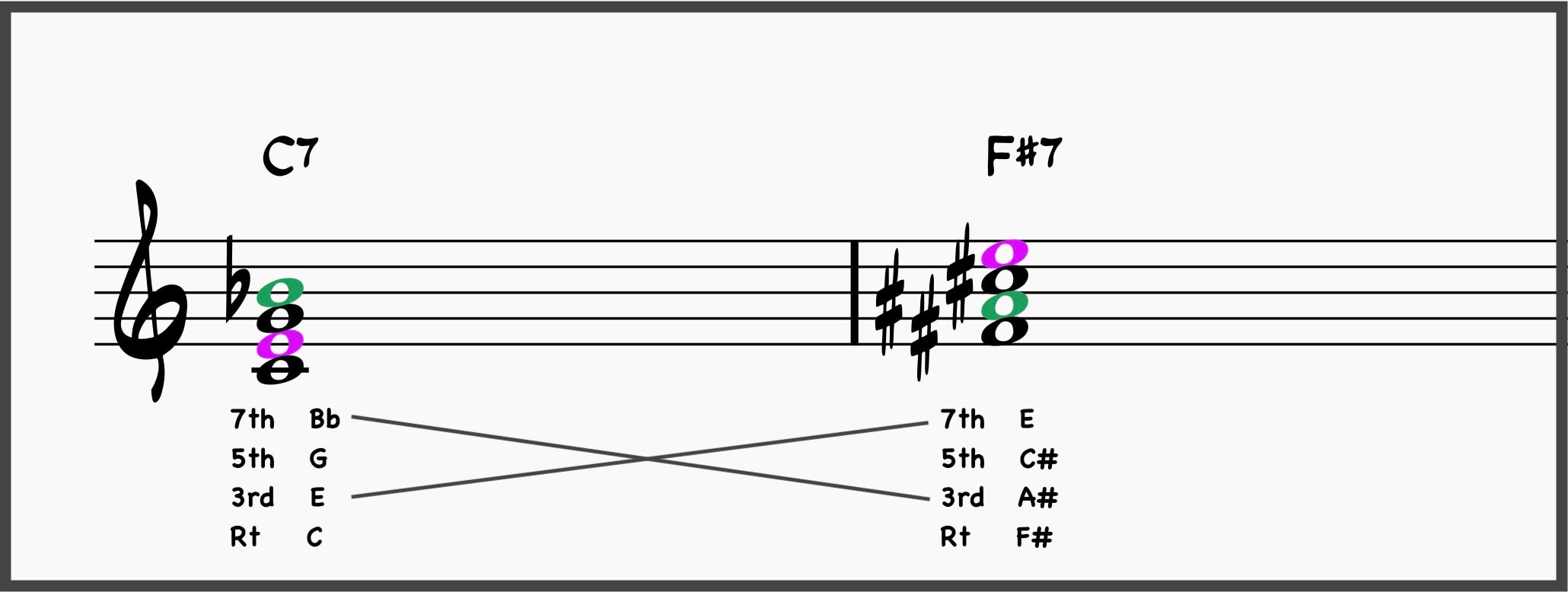
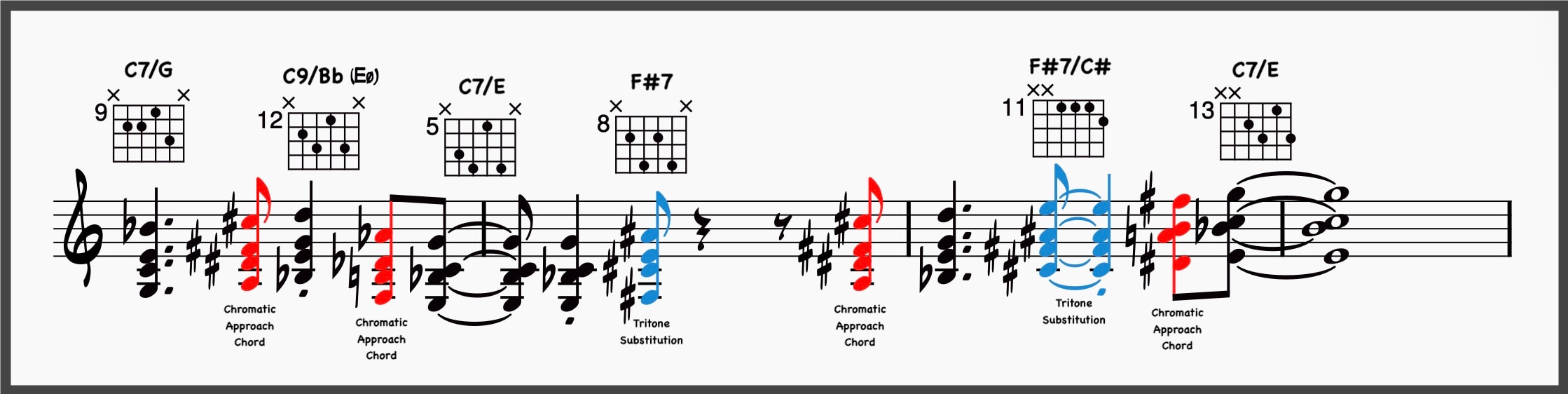
Let’s infuse our etude with tritone substitutions for C7. Spot the two F#7 chords below in blue and listen to how they introduce some dissonance and tension into the progression.
Passing Chords
Passing chords are chords inserted between two main chords in a progression to create smoother voice-leading and forward motion. They typically last for a beat or less and “pass through” harmonically, connecting one chord to the next with stepwise or chromatic movement.
You can connect diatonic chords in this way or cycle back between your main chord and an adjacent chord to create the impression of movement over a static chord.
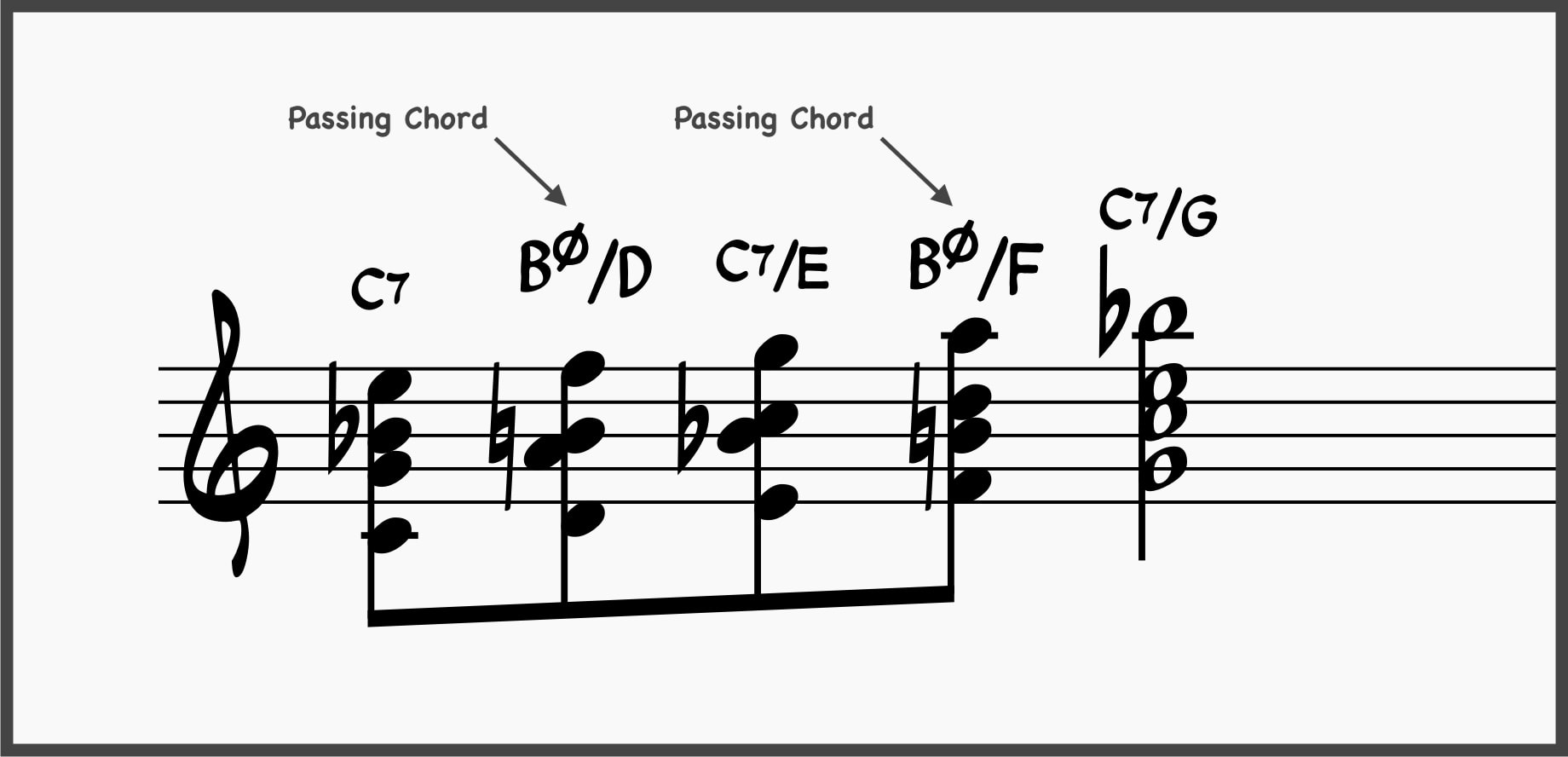
To demonstrate, let’s pair our C7 with an adjacent chord. I’ll chord a chord whose root is a half step below C, so we always have that half step pull back to C. I am choosing a non-diatonic chord (B isn’t in the key of F), but you can also cycle between diatonic chords depending on your preference.
Because this is over a dominant chord, non-diatonic tones are encouraged!
Here is an example of cycling between C7 and B-7b5. The step-wise movement between the notes of C7 and B-7b5 creates brief tension on the upbeats, which resolves on the downbeats.
Let’s use a different chord quality to see how that changes the sound of our passing chord phrase. In the following example, I use a B-7 instead of a B-7b5. This change incorporates the F# or tritone of C.
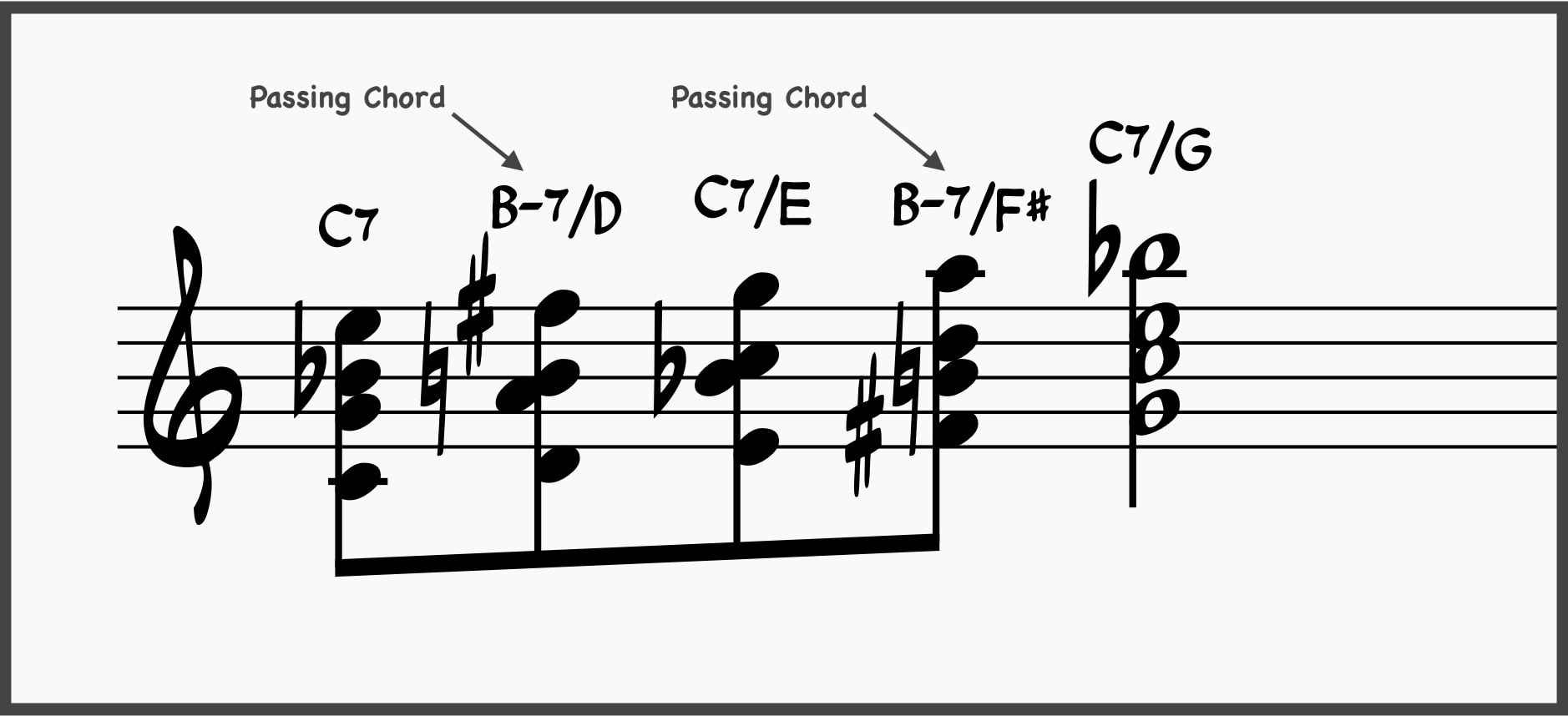
I prefer the version with the F# because we already have tritone subs in our chord etude, which implies a C7#11 sound. Let’s incorporate passing chord phrases into our chord etude. Passing chords are shown below in orange.
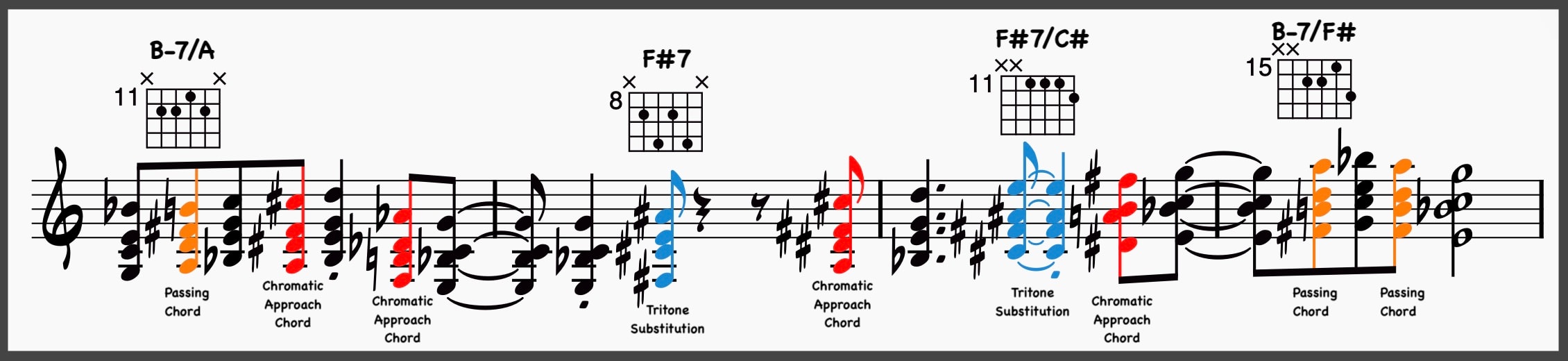
Compare our “jazzified” chord etude to the basic version, which uses only C7 chord inversions and drops two voicings.
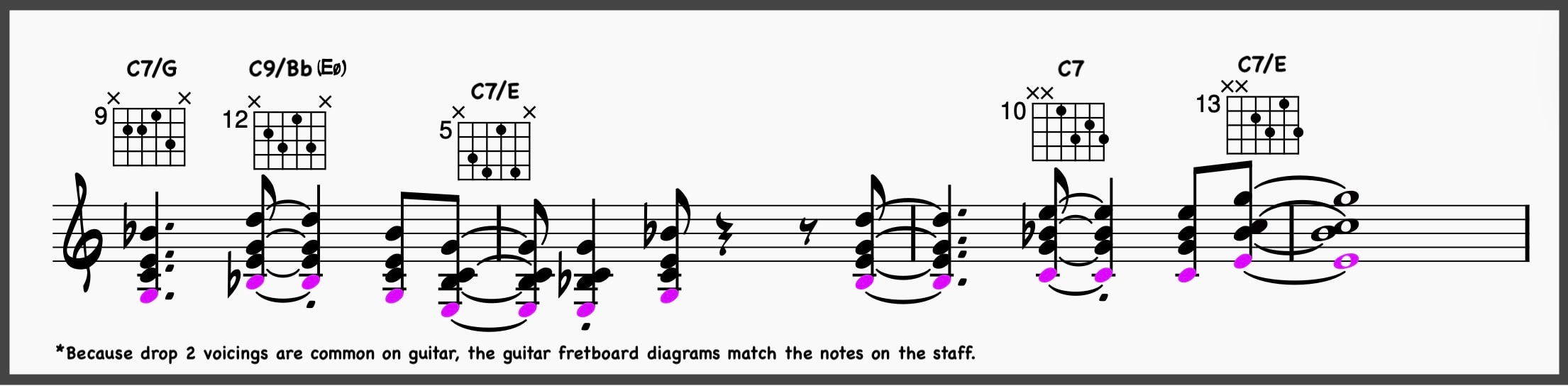
One isn’t better than the other—both comping options are good choices depending on the circumstances. However, one features advanced comping concepts like chromatic approach chords, tritone subs, and passing chords, while the latter relies on simple chord inversions.
Common Comping Mistakes to Avoid
image source: Wikimedia Commons
If you’re serious about improving your comping, it’s just as important to learn what not to do as it is to study the right concepts. Many beginners (and even experienced players!) fall into the same traps that make their comping sound stiff, distracting, or unsupportive.
Here are some of the most common comping mistakes to avoid, along with tips for how to comp in jazz more effectively.
Overplaying (Too Busy, Too Loud)
One of the biggest comping mistakes is overplaying—filling every space with chords, playing too loud, or stepping on the soloist’s ideas. Remember that comping isn’t about showing off your harmonic vocabulary; it’s about serving the needs of the music.
Ignoring the Soloist
When the soloist takes their solo, your job is to support their solo first. If you aren’t listening to their solo, you can’t possibly support it! Actively listen to the soloist when comping and prioritize what the music needs in the moment. For example, are they soloing in a higher range? Comp in a lower range.
Playing Complex Chords and Harmonic Concepts Before Mastering the Basics
It’s tempting to reach for flashy voicings with lots of extensions and alterations when comping rhythms. But if your time feel and chord vocabulary aren’t solid, your playing will stick out like a sore thumb.
Clashing With The Other Rhythm Section Members
This is an important one! One of my pet peeves is when a guitarist plays with another chord instrument like piano or vibes, and fails to work with them when both are comping. The piano and guitar are capable of producing a lot of clashing notes and rhythms when “just having at it.”
Chord players must take great care when sharing comping duties with another chord player. There is so much that can go wrong!
Join The Learn Jazz Standards Inner Circle To Supercharge Your Comping Skills
Want to become the best jazz player you can be and comp like the pros? Check out the Learn Jazz Standards Inner Circle. The Inner Circle has everything you need to take your jazz chops to the next level.
Improve in 30 Days or Less. Join the Inner Circle.