2 Jazz Improv Concepts and an Etude Over “Solar”

GOOD FOR

Learn Jazz Standards Instuments
Should I Learn a Second Instrument? (Pros and Cons)

“Solar” is a jazz standard written by one of the most famous jazz musicians of all time, trumpeter Miles Davis. The best-known Miles recording of “Solar” is probably from his iconic 1957 Prestige album Walkin’.

Miles typically receives compositional credit for this song even though there is an ongoing debate over the true authorship of “Solar.” Some musicians and scholars have argued that Davis’s “Solar” is essentially a copy of an earlier tune called “Sonny,” which was written by guitarist Chuck Wayne.

Indeed, Miles is no stranger to authorship controversies. There are some well-known disputes over the origin of other famous jazz songs as well.

For example, Miles claimed he wrote the bebop standard “Donna Lee” (many credit Charlie Parker as the true composer). Similarly, both Davis and jazz pianist Bill Evans have been credited as the sole composers of “Blue in Green” from the best-selling jazz record of all time, Miles’s 1959 album Kind of Blue.

Regardless of the true provenance of “Solar,” this tune has certainly been made popular by Miles Davis, and it is a “must-know” tune because it is frequently called on gigs and at jam sessions.

“Solar” is most commonly played in the key of C minor, but be aware that the tune goes through four tonal centers: C minor, F major, Eb major, and Db major.

This lesson on “Solar” is going to tackle two different concepts simultaneously:

  1. First, we’re going to look at the melodic minor scale and a few of its modes and use them to generate melodic ideas.
  2. Secondly, we’re going to work on the eighth-note and quarter-note triplet subdivisions to help us spice up our solos with some nice rhythmic variety.

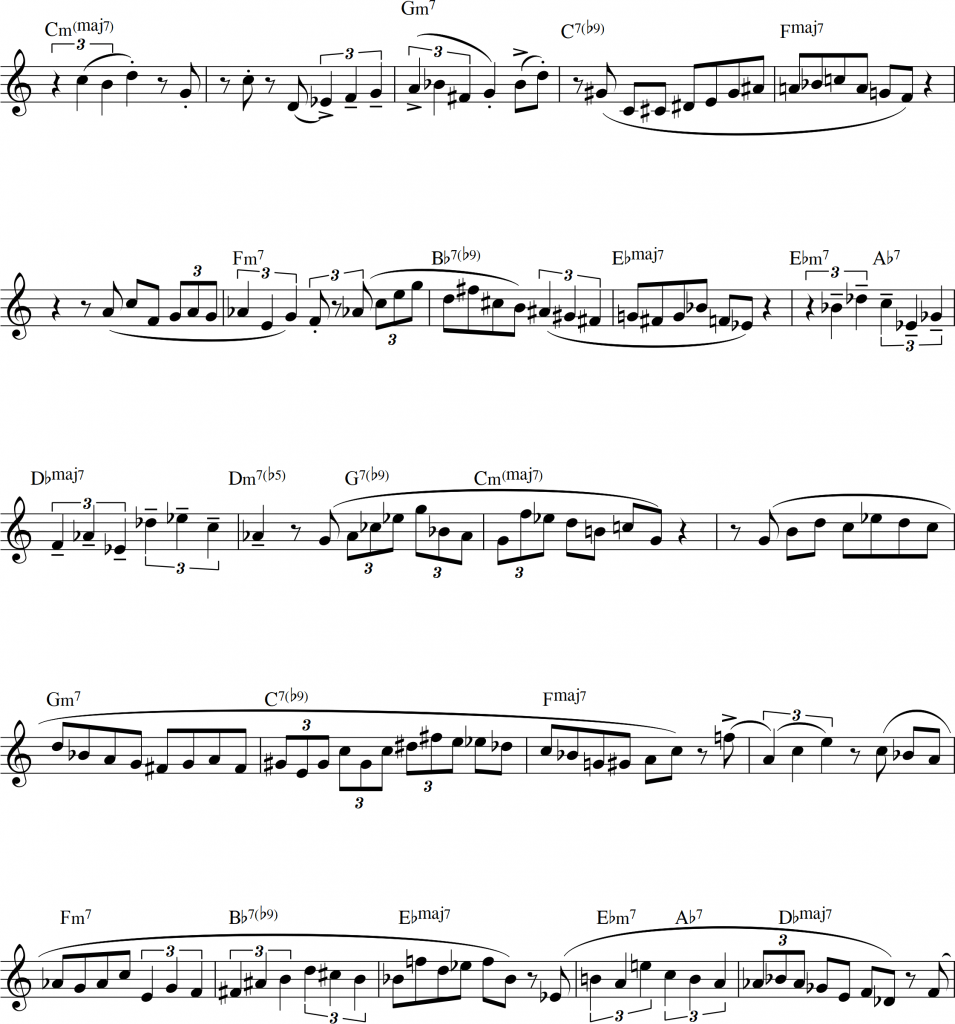
At the end of this post, I have an etude over Solar that uses these concepts.

Part 1: The Melodic Minor Scale

In addition to learning the major scale in all 12 keys and the 7 diatonic or “church” modes derived from the major scale, the melodic minor scale is one of the most important and useful scales for jazz improvisers to master.

To review, in the jazz context, a melodic minor scale is just the ascending version of the “classical” melodic minor scale. Basically, a melodic minor scale is identical to a major scale except the third scale degree is lowered one half-step.

Here’s the C melodic minor scale:

C mel minor
C D Eb F G A B C

You can create modes based on this scale by playing the same melodic minor scale but starting on a different scale degree, just like you can with the major scale.

There is a lot of confusion over what to call the various modes derived from melodic minor, so I’ll give you multiple names for each scale.

It’s important to know all the different “aliases” or nicknames that are used to refer to the same scale so that you’ll know which scales other jazz musicians are talking about.

For this lesson, we’ll focus on the melodic minor scale played from the tonic, from the 6th, and from the 7th.

From the tonic = melodic minor.

The “modal” nickname for the melodic minor scale is “Dorian natural 7,” because the melodic minor scale is just like a Dorian minor scale except with a natural (or major) seventh instead of a flatted seventh (when compared with a parallel major scale starting on the same root).

The melodic minor scale played from the root is simple to use, you can use it over any tonic minor-major-seventh chords, and you can also use it on II minor chords. So, for example, the C melodic minor scale works perfectly over a C-(maj.7) chord.

The melodic minor sound is so strong that it often works over a II-7 chord despite the fact that the seventh of the melodic minor scale might clash with the flatted seventh of a II-7 chord.

Additionally, sensitive pianists and guitarists will quickly hear it if you play a strong melodic minor sounding idea over a II-7 chord, and they will likely change their voicing to accommodate your melodic choice (they can do so by switching to a minor-major-seventh chord voicing or by avoiding playing the seventh in their voicing altogether).

From the 6th = Locrian natural 2.

One of the other very common modes of the melodic minor scale is the 6th mode. This mode works great over half-diminished 7th chords (also called minor-seven-flat-five chords) when you want a natural 2 in your scale (which corresponds to a natural 9 in a piano or guitar voicing).

This is particularly useful over half-diminished chords that are part of minor 2-5-1’s that resolve to a major I chord because the natural 2 of the II-7(b5) is the same note as the natural/major third of the tonic major scale.

Because of mode mixture, in jazz, it’s common for tunes to have major 2-5’s that resolve to a minor I chord and vice versa. Even if you do play a minor 2-5-1 that does, in fact, resolve to a minor tonic chord, however, you can still play Locrian natural 2 over the II-7(b5) chord.

So in the key of C minor, the II-7(b5) chord is D-7(b5), and the melodic minor scale that works over this (the “parent scale”) is F melodic minor. So F melodic minor played from D works well over D-7(b5) chords.

From the 7th = the altered scale.

Yet another commonly used mode of the melodic minor scale is the 7th mode. This scale is used frequently in mainstream jazz melodic vocabulary, and it is known by at least four different names.

Perhaps the most common name is the “altered scale” or the “altered dominant scale,” but this scale is also sometimes called “the diminished whole tone scale” (because the first half of the scale is like a diminished scale with the half-step first and the second half of the scale is like a whole-tone scale).

Ionian #1” (because it’s just like a major or Ionian scale except with a root/tonic that’s been raised a half step), and “the super Locrian scale” (because it’s like Locrian but with a lowered 4th, which makes it “super” dark sounding to some people’s ears).

Because there are so many different names for the same scale, people also sometimes just refer to it as “the seventh mode of melodic minor.”

Using C melodic minor as a parent scale to generate modes, the seventh mode gives you the B altered scale. It is C melodic minor played from B, and it looks like this:

B Altered Scale:

B altered scaleB C D Eb F G A B

The altered scale is a type of dominant scale, and it is used of dominant 7th chords that have been altered. You can use it over a dominant 7 (b9) chord, for example.

The full list of altered notes contained in the altered scale (also called “upper structure tensions” or just “tensions” by some) are the following: b9, #9, #11, b13.

Since this scale has a b13, it doesn’t work as well over dominant 13 (b9) chords because they have a natural 13 which clashes with the b13. However, many jazz standards notate altered dominant chords as a generic “7(b9)” chords without a 13th specified.

In such cases, the altered scale generally works well as a viable scale choice option for generating improvised melodies.

Further, anytime a chord progression features a dominant 7th chord that features a root movement that resolves up a perfect 4th or down a perfect 5th, the chord progression is moving in a V7-I type of pattern, and you can almost always turn the dominant 7th chord into a 7(b9) chord in such scenarios.

So for example, if you have a chord progression such as G7 to C (major, dominant, or minor), you can turn the G7 into a G7(b9) and play the G altered scale (Ab melodic minor, played from G).

This holds true regardless of whether the C is actually the tonic chord of the song – it doesn’t matter, because no matter what key the song is in, C is being temporarily tonicized.

So for this etude on “Solar,” we’re going to maximize our use of the melodic minor scale.

We’ll use the melodic minor sound to create melodies every time we have a minor chord, and we’ll use the 7th mode of melodic minor (the altered scale) every time there is a dominant chord that is resolving V7-I.

Part 2: Adding triplets

As an added layer of musical challenge, we’ll also practice spicing up our melodic improvisations by alternating between using 8th note vs. triplet rhythms as we create our melodies.

Triplets are important to practice because the 8th-note triplet is the primary subdivision in jazz. Jazz vocabulary is rich with triplet-based rhythms, and you can really create a wonderful sense of rhythmic interest and variety by introducing more triplets into your playing.

It’s true that the rhythmic feel we call “swing” certainly is elusive and hard to define and conceptualize. But subdividing in 8th note triplets gets you close to a good model for a solid 8th-note swing feel. In other words, jazz is all about the 8th-note triplet.

If you want to approach a more “authentic” swing feeling in your jazz playing, you need to address the triplet feel that gives swing its characteristic “bounce,” and you need to become aware of and internalize, visualize, and exploit jazz’s polyrhythmic elements.

In recent decades, a consensus has emerged among many scholars, musicians, and jazz aficionados that many rhythmic characteristics of jazz, including swing, are the result of the influence of West African music on jazz.

Jazz is inherently polyrhythmic, and the cultural preference for polyrhythms can be traced back to African practices that both influenced jazz directly and informed the musical precursors to jazz.

The polyrhythms that are common in jazz involve the mixing of duple and triple rhythmic feels. Swing feel arises at least in part from tapping into the triplet or 12/8 feel and exploiting all of the polyrhythms, rhythmic tensions, and variety of ways of breaking up the beat that is possible when a triple-meter subdivision is superimposed on a duple-meter foundation.

This is not to detract from or deny the fact that everyone will place their swing 8th notes in a slightly different place – perhaps somewhere between a triplet-swing and -straight-8th feel. This is a good thing!

Part of what makes swing special is that, though it is almost always understood to arise from polyrhythmic use of a triplet time feel inside a duple meter, everyone has their own slightly different rhythmic “voice” – their own approach to swing.

By tapping into the triplet subdivision and becoming aware of the inherent polyrhythmic aspects of jazz, you will automatically increase your rhythmic prowess and improve your time-feel when playing swing 8th notes.

On a final note, it is also important to note here that certainly, the 8th note feel of jazz lines tends to straighten out as tempos increase, which is natural since it allows the music flow better. So don’t be afraid to let go of the triplets a bit as tempos increase.

Solar Etude:
LJS Jazz Etude Solar 0001

TAKE YOUR JAZZ PLAYING TO THE NEXT LEVEL.

We help musicians of all instruments start improvising confidently over jazz standards in just 30 days without mind-numbing hours of practice or the overwhelm.

TAKE YOUR JAZZ PLAYING TO THE NEXT LEVEL.

We help musicians of all instruments start improvising confidently over jazz standards in as little as 30 days without mind-numbing hours of practice or the overwhelm.

“Jazz music is the power of now. There is no script. It’s conversation. The emotion is given to you by musicians as they make split-second decisions to fulfill what they feel the moment requires.”
WYNTON MARSALIS

YOU MAY ALSO BE INTERESTED IN

Learn Jazz Standards The Smart Way Ebook Cover

OUR PROVEN PROCESS FOR LEARNING JAZZ STANDARDS LIKE A PRO

A step-by-step guide for how to effectively learn jazz standards so you’ll feel confident playing them, and won’t forget them.

TERMS AND CONDITIONS

Welcome to LearnJazzStandards.com! We’ve created this page so that you (and any visitor to LearnJazzStandards.com) will understand the terms and conditions that govern your use of this website. If you continue to browse and use this website you are agreeing to comply with and be bound by the following terms and conditions, which together with our privacy policy comprise our (LearnJazzStandards.com’s) entire relationship with you.

Exclusion of Liability

The content found on any page of this website is for your general information and use only, and it is subject to change without notice. Neither we nor any third parties provide any warranty or guarantee as to the accuracy, timeliness, performance, completeness or suitability of the information and materials found or offered on this website for any particular purpose. You acknowledge that such information and materials may contain inaccuracies or errors and we expressly exclude liability for any such inaccuracies or errors to the fullest extent permitted by law. Your use of any information or materials on this website is entirely at your own risk, for which we shall not be liable. It shall be your own responsibility to ensure that any products, services or information available through this website meet your specific requirements.

Indemnity

By accessing our website, you agree to indemnify and hold us harmless from all claims, actions, damages, costs and expenses including legal fees arising from or in connection with your use of our website.

Copyright Laws & Intellectual Property

This website contains some material which is owned by or licensed to us. This material includes, but is not limited to, the design, layout, look, appearance and graphics. Reproduction is prohibited other than in accordance with the copyright notice, which forms part of these terms and conditions. All logos, trademarks, and other intellectual property found on LearnJazzStandards.com are the property of their respective owners. They do not indicate ownership, affiliation, sponsorship, or any other relationship with LearnJazzStandards.com. In addition, this website may also include links to other websites. These links are provided for your convenience to provide further information. They do not signify that we endorse those websites, and we have no responsibility for the content of those linked websites.

Unauthorized Use

Your use of this website and any dispute arising out of such use of the website is subject to the laws of the United States of America. Any unauthorized use of this website may give rise to a claim for damages and/or be a criminal offense. Thanks, and enjoy LearnJazzStandards.com!

Return Policy for Products

Refund Policy

For play-alongs and eBooks:

Because these are digital downloads, and not returnable, we have a strict no refund policy. All purchases are final and cannot be reversed. Please be sure that you fully understand the product you are purchasing and what is and what is not included. Of course, if you ever have any questions about a product feel free to contact us or visit our FAQ page.

For 30 Days to Better Jazz Playing eCourse

Please make sure you completely understand the product you are buying before purchasing. 14 Day 100% Money Back Guarantee
  • This guarantee lasts 14 days, which completely covers almost half of the course, enough for you to observe its’ effectiveness.
  • We can’t guarantee you will be Miles Davis, Charlie Parker, or John Coltrane in 2 weeks. We’d be suspicious of anyone who could promise that. Becoming a better jazz musician is a process and it requires work.
  • If you’re not happy with the quality of this program…send us an email and showing you did the work. We’ll refund 100% of your money (We’ll even eat the credit-card processing fees) and we’ll part as friends. We believe in the power of this course and so we’ll take responsibility for it.

For Inner Circle Membership

Please make sure you completely understand the product you are buying before purchasing. 30 Day 100% Money Back Guarantee
  • This guarantee lasts 30 days, which is enough for you to observe the membership’s effectiveness.
  • We can’t guarantee you will be Miles Davis, Charlie Parker, or John Coltrane in 30 days. We’d be suspicious of anyone who could promise that. Becoming a better jazz musician is a process and it requires work.
  • If you’re not happy with the quality of this program…send us an email and showing you did the work. We’ll refund 100% of your money (We’ll even eat the credit-card processing fees) and we’ll part as friends. We believe in the power of this course and so we’ll take responsibility for it.

Rights of use

All digital products are for the use of the individual customer only. Redistribution or reselling of our digital products is strictly prohibited and a violation of United States and New York State law.

PRIVACY POLICY

At Learn Jazz Standards LLC, we recognize that privacy of your personal information is important.

Here are the types of personal information we may collect when you use and visit LearnJazzStandards.com, and how we safeguard your information. We never sell your personal information to third parties.

Log Files

As with most other websites, we collect and use the data contained in log files. The information in the log files include your IP (internet protocol) address, your ISP (internet service provider, such as AOL or Shaw Cable), the browser you used to visit our site (such as Internet Explorer or Firefox), the time you visited our site and which pages you visited throughout our site.

Cookies and Web Beacons

We may use cookies to store information, such as your personal preferences when you visit our site. This could include only showing you a popup once in your visit, or the ability to log in to some of our features, such as forums. We collect this information to help send you only pertinent content that we believe you are interested in and will benefit from.

We also use third party advertisements on LearnJazzStandards.com to support our site. Some of these advertisers may use technology such as cookies and web beacons when they advertise on our site, which will also send these advertisers (such as Google through the Google AdSense program) information including your IP address, your ISP, the browser you used to visit our site, and in some cases, whether you have Flash installed.

This is generally used for geotargeting purposes (showing New York real estate ads to someone in New York, for example) or showing certain ads based on specific sites visited (such as showing cooking ads to someone who frequents cooking sites).

DoubleClick DART cookies

We also may use DART cookies for ad serving through Google’s DoubleClick service, which places a cookie on your computer when you are browsing the web and visit a site using DoubleClick advertising (including some Google AdSense advertisements).

This cookie is used to serve ads specific to you and your interests (“interest based targeting”). The ads served will be targeted based on your previous browsing history (For example, if you have been viewing sites about visiting Las Vegas, you may see Las Vegas hotel advertisements when viewing a non-related site, such as on a site about hockey).

DART uses “non personally identifiable information.” It does NOT track personal information about you, such as your name, email address, physical address, telephone number, social security numbers, bank account numbers or credit card numbers. You can opt-out of this ad serving on all sites using this advertising by visiting http://www.doubleclick.com/privacy/dart_adserving.aspx

You can chose to disable or selectively turn off our cookies or third-party cookies in your browser settings, or by managing preferences in programs such as Norton Internet Security. However, this can affect how you are able to interact with our site as well as other websites. This could include the inability to login to services or programs, such as logging into forums or accounts.

Deleting cookies does not mean you are permanently opted out of any advertising program. Unless you have settings that disallow cookies, the next time you visit a site running the advertisements, a new cookie will be added.

Email Addresses

If you share your email address with LearnJazzStandards.com via the contact page, we will only use it to contact you, and will NOT add you to any lists or newsletters without your consent.

In addition, if you sign up for the free newsletter, your email address will only be used to send special offers and updates from LearnJazzStandards.com. Addresses are recorded and kept secure through MailChimp, which we use to distribute information to our subscribers. Neither MailChimp nor LearnJazzStandards.com will give or sell your address to any third party, nor will you be added to any additional lists.

Right to Be Forgotten

If at any point you wish to be completely deleted from our databases, whether it be as a newsletter subscriber or an account holder on learnjazzstandards.com, you have the complete right to do so.

Contact us, and we will ensure your data is cleared from our system.

Data Control Contact

If you ever wish to reach out to us regarding the use of your data, we are reachable at [email protected]. Additionally, you can use our contact page, to reach out any time.

In short, your information is safe with us, and we greatly value your trust.

Thanks for using Learn Jazz Standards!

Terms of Use

Welcome to LearnJazzStandards.com!

We’ve created this page so that you (and any visitor to LearnJazzStandards.com) will understand the terms and conditions that govern your use of this website.

If you continue to browse and use this website you are agreeing to comply with and be bound by the following terms and conditions, which together with our privacy policy comprise our (LearnJazzStandards.com’s) entire relationship with you.

Exclusion of Liability

The content found on any page of this website is for your general information and use only, and it is subject to change without notice.

Neither we nor any third parties provide any warranty or guarantee as to the accuracy, timeliness, performance, completeness or suitability of the information and materials found or offered on this website for any particular purpose.

You acknowledge that such information and materials may contain inaccuracies or errors and we expressly exclude liability for any such inaccuracies or errors to the fullest extent permitted by law.

Your use of any information or materials on this website is entirely at your own risk, for which we shall not be liable. It shall be your own responsibility to ensure that any products, services or information available through this website meet your specific requirements.

Indemnity

By accessing our website, you agree to indemnify and hold us harmless from all claims, actions, damages, costs and expenses including legal fees arising from or in connection with your use of our website.

Copyright Laws & Intellectual Property

This website contains some material which is owned by or licensed to us. This material includes, but is not limited to, the design, layout, look, appearance and graphics. Reproduction is prohibited other than in accordance with the copyright notice, which forms part of these terms and conditions.

All logos, trademarks, and other intellectual property found on LearnJazzStandards.com are the property of their respective owners. They do not indicate ownership, affiliation, sponsorship, or any other relationship with LearnJazzStandards.com.

In addition, this website may also include links to other websites. These links are provided for your convenience to provide further information. They do not signify that we endorse those websites, and we have no responsibility for the content of those linked websites.

Unauthorized Use

Your use of this website and any dispute arising out of such use of the website is subject to the laws of the United States of America. Any unauthorized use of this website may give rise to a claim for damages and/or be a criminal offense.

Thanks, and enjoy LearnJazzStandards.com!

Return Policy for Products

Refund Policy

For play-alongs and eBooks:

Because these are digital downloads, and not returnable, we have a strict no refund policy. All purchases are final and cannot be reversed. Please be sure that you fully understand the product you are purchasing and what is and what is not included. Of course, if you ever have any questions about a product feel free to contact usor visit our FAQ page.

For 30 Days to Better Jazz Playing eCourse

Please make sure you completely understand the product you are buying before purchasing.

14 Day 100% Money Back Guarantee

  • This guarantee lasts 14 days, which completely covers almost half of the course, enough for you to observe its’ effectiveness.
  • We can’t guarantee you will be Miles Davis, Charlie Parker, or John Coltrane in 2 weeks. We’d be suspicious of anyone who could promise that. Becoming a better jazz musician is a process and it requires work.
  • If you’re not happy with the quality of this program…send us an email and showing you did the work. We’ll refund 100% of your money (We’ll even eat the credit-card processing fees) and we’ll part as friends. We believe in the power of this course and so we’ll take responsibility for it.

Rights of use

All digital products are for the use of the individual customer only. Redistribution or reselling of our digital products is strictly prohibited and a violation of United States and New York State law.

Learn Jazz Standards Messaging Terms & Conditions

Effective Date:

This SMS message program is a service of Learn Jazz Standards. By providing your cell phone number, you agree to receive recurring automated promotional and personalized marketing text messages (e.g., SMS/MMS cart reminders, sale notices, etc) from Learn Jazz Standards. These messages include text messages that may be sent using an automatic telephone dialing system, to the mobile telephone number you provided when signing up or any other number that you designate. You give Learn Jazz Standards permission to send text messages to the enrolled cell phone number through your wireless phone carrier, unless and until you end permission per these Terms & Conditions. Consent to receive automated marketing text messages is not a condition of any purchase. Message & data rates may apply.

Message frequency may vary. Learn Jazz Standards reserves the right to alter the frequency of messages sent at any time, so as to increase or decrease the total number of sent messages. Learn Jazz Standards also reserves the right to change the short code or phone number from which messages are sent and we will notify you if we do so.

Not all mobile devices or handsets may be supported and our messages may not be deliverable in all areas. Learn Jazz Standards, its service providers and the mobile carriers supported by the program are not liable for delayed or undelivered messages.

By enrolling in the Learn Jazz Standards messaging program, you also agree to these messaging terms & conditions (“Messaging Terms”), our Learn Jazz Standards Terms of Use and Learn Jazz Standards Privacy Policy.

Cancellation

Text the keyword STOP, STOPALL, END, CANCEL, UNSUBSCRIBE or QUIT to the telephone number, long code, or short code that sends you our initial confirmation message to cancel. After texting STOP, STOPALL, END, CANCEL, UNSUBSCRIBE or QUIT to the telephone number, long code, or short code that sends you our initial confirmation message you will receive one additional message confirming that your request has been processed. If you change your preferences, it may take up to 48 hours for it to take effect. You acknowledge that our text message platform may not recognize and respond to unsubscribe requests that do not include the STOP, STOPALL, END, CANCEL, UNSUBSCRIBE or QUIT keyword commands and agree that Learn Jazz Standards and its service providers will have no liability for failing to honor such requests. If you unsubscribe from one of our text message programs, you may continue to receive text messages from Learn Jazz Standards through any other programs you have joined until you separately unsubscribe from those programs.

Help or Support

Text the keyword HELP to the telephone number, long code, or short code that sends you our initial confirmation message to receive a text with information on how to unsubscribe.

No Warranty

TO THE MAXIMUM EXTENT ALLOWED BY APPLICABLE LAW, YOU ACKNOWLEDGE AND AGREE THAT THE MESSAGING PROGRAM IS PROVIDED ON AN “AS IS” AND “AS AVAILABLE” BASIS WITHOUT WARRANTIES OF ANY KIND, WHETHER EXPRESS OR IMPLIED.

Limitation of Liability

TO THE MAXIMUM EXTENT ALLOWED BY APPLICABLE LAW, YOU AGREE THAT IN NO EVENT SHALL EITHER OF Learn Jazz Standards OR ANY PARTY ACTING ON BEHALF OF Learn Jazz Standards BE LIABLE FOR: (A) ANY CLAIMS, PROCEEDINGS, LIABILITIES, OBLIGATIONS, DAMAGES, LOSSES OR COSTS IN AN AGGREGATE AMOUNT EXCEEDING THE GREATER OF THE AMOUNT YOU PAID TO Learn Jazz Standards HEREUNDER OR $100.00; OR (B) ANY DIRECT, INDIRECT, CONSEQUENTIAL, SPECIAL, INCIDENTAL, PUNITIVE OR ANY OTHER DAMAGES. YOU AGREE EVEN IF Learn Jazz Standards HAS BEEN TOLD OF POSSIBLE DAMAGE OR LOSS ARISING OR RESULTING FROM OR IN ANY WAY RELATING TO YOUR USE OF THE Learn Jazz Standards MESSAGING PROGRAM. Learn Jazz Standards AND ITS REPRESENTATIVES ARE NOT LIABLE FOR THE ACTS OR OMISSIONS OF THIRD PARTIES, INCLUDING BUT NOT LIMITED TO DELAYS OR NON-DELIVERY IN THE TRANSMISSION OF MESSAGES.

Indemnity

To the maximum extent allowed by applicable law, you agree to indemnify, defend and hold harmless Learn Jazz Standards, its directors, officers, employees, servants, agents, representatives, independent contractors and affiliates from and against any and all claims, damages, liabilities, actions, causes of action, costs, expenses, including reasonable attorneys’ fees, judgments or penalties of any kind or nature arising from or in relation to the these Messaging Terms or your receipt of text messages from Learn Jazz Standards or its service providers.

Dispute Resolution

  1. General. Any dispute or claim arising out of or in any way related to these Messaging Terms or your receipt of text messages from Learn Jazz Standards or its service providers whether based in contract, tort, statute, fraud, misrepresentation, or any other legal theory, and regardless of when a dispute or claim arises will be resolved by binding arbitration. YOU UNDERSTAND AND AGREE THAT, BY AGREEING TO THESE MESSAGING TERMS, YOU AND Learn Jazz Standards ARE EACH WAIVING THE RIGHT TO A TRIAL BY JURY OR TO PARTICIPATE IN A CLASS ACTION AND THAT THESE MESSAGING TERMS SHALL BE SUBJECT TO AND GOVERNED BY ARBITRATION.
  2. Exceptions. Notwithstanding subsection (a) above, nothing in these Messaging Terms will be deemed to waive, preclude, or otherwise limit the right of you or Learn Jazz Standards to: (i) bring an individual action in small claims court; (ii) pursue an enforcement action through the applicable federal, state, or local agency if that action is available; (iii) seek injunctive relief in aid of arbitration from a court of competent jurisdiction; or (iv) file suit in a court of law to address an intellectual property infringement claim.
  3. Arbitrator. Any arbitration between you and Learn Jazz Standards will be governed by the JAMS, under the Optional Expedited Arbitration Procedures then in effect for JAMS, except as provided herein. JAMS may be contacted at www.jamsadr.com. The arbitrator has exclusive authority to resolve any dispute relating to the interpretation, applicability, or enforceability of this binding arbitration agreement.
  4. No Class Actions. YOU AND Learn Jazz Standards AGREE THAT EACH MAY BRING CLAIMS AGAINST THE OTHER ONLY IN AN INDIVIDUAL CAPACITY AND NOT AS A PLAINTIFF OR CLASS MEMBER IN ANY PURPORTED CLASS OR REPRESENTATIVE PROCEEDING. Further, unless both you and Learn Jazz Standards agree otherwise in a signed writing, the arbitrator may not consolidate more than one person’s claims, and may not otherwise preside over any form of a representative or class proceeding. You agree that, by agreeing to these Messaging Terms, you and Learn Jazz Standards are each waiving the right to a trial by jury or to participate in a class action, collective action, private attorney general action, or other representative proceeding of any kind.
  5. No Class Actions. YOU AND Learn Jazz Standards AGREE THAT EACH MAY BRING CLAIMS AGAINST THE OTHER ONLY IN AN INDIVIDUAL CAPACITY AND NOT AS A PLAINTIFF OR CLASS MEMBER IN ANY PURPORTED CLASS OR REPRESENTATIVE PROCEEDING. Further, unless both you and Learn Jazz Standards agree otherwise in a signed writing, the arbitrator may not consolidate more than one person’s claims, and may not otherwise preside over any form of a representative or class proceeding.
  6. Modifications to this Arbitration Provision. Notwithstanding anything to the contrary in these Messaging Terms, if Learn Jazz Standards makes any future change to this arbitration provision, you may reject the change by sending us written notice within 30 days of the change to Learn Jazz Standards’s contact information provided in the “Contact Us” section below, in which case this arbitration provision, as in effect immediately prior to the changes you rejected, will continue to govern any disputes between you and Learn Jazz Standards.
  7. Enforceability. If any provision of these Messaging Terms is found to be unenforceable, the applicable provision shall be deemed stricken and the remainder of these Messaging Terms shall remain in full force and effect.

Changes to the Messaging Terms

We reserve the right to change these Messaging Terms or cancel the messaging program at any time. By using and accepting messages from Learn Jazz Standards after we make changes to the Messaging Terms, you are accepting the Messaging Terms with those changes. Please check these Messaging Terms regularly.

Entire Agreement/Severability

These Messaging Terms, together with any amendments and any additional agreements you may enter into with us in connection herewith, will constitute the entire agreement between you and Learn Jazz Standards concerning the Messaging Program.

Contact

Please contact us with any inquiries or concerns at [email protected]

OUR PROVEN PROCESS FOR LEARNING JAZZ STANDARDS LIKE A PRO

Get our FREE eGuide “Learn Jazz Standards the Smart Way” and follow the 5 simple steps for crushing it with jazz standards.

Learn Jazz Standards The Smart Way Cover

OUR PROVEN PROCESS FOR LEARNING JAZZ THEORY LIKE A PRO

Get our FREE “Jazz Theory Made Easy Fast Track Guide” and follow the 4 simple steps that make learning jazz theory easy.

Jazz Theory Made Easy Fast Track Guide Ebook Cover

OUR PROVEN PROCESS FOR IMPROVISING JAZZ SOLOS LIKE A PRO

Get our FREE “Jazz Improv Made Easy Fast Track Guide” and follow the 3 simple steps for improvising amazing jazz solos.

Jazz Improv Made Easy Fast Track Guide Ebook Cover

DOWNLOAD THIS CHORD CHART

Get our FREE "2 Jazz Improv Concepts and an Etude Over “Solar”" chord chart and our entire library of 200+ jazz standards!

Chord Chart

DOWNLOAD THIS CHORD CHART

Get our FREE "2 Jazz Improv Concepts and an Etude Over “Solar”" chord chart and our entire library of 200+ jazz standards!

Chord Chart

DOWNLOAD THIS CHORD CHART

Get our FREE "2 Jazz Improv Concepts and an Etude Over “Solar”" chord chart and our entire library of 200+ jazz standards!

Chord Chart