Is Transcribing Jazz Effective for Everyone?

GOOD FOR

Learn Jazz Standards Instuments
Should I Play Other Styles of Music? (Non-Jazz)
Transcribing (learning licks and solos by ear) has become such an accepted sacred cow of the jazz education world that few bother to question its effectiveness.  But is it really an effective practice tool for everyone?

In a word, no.

Before you gasp at my sacrilege, hear me out:  I’m not anti-transcribing.  First of all, I have done quite a bit of transcribing over the years.  I did my first few transcriptions in high school. The first solo I transcribed was an Ellis Marsalis piano solo.  I also remember doing a Carl Fontana trombone solo, and a Bill Evans solo piano arrangement of All the Things You Are.  Solo piano is NOT easy to transcribe, and it’s generally much more difficult than transcribing a horn solo.  I didn’t do a ton of transcribing in high school, but I remember doing at least those three solos.  I later did quite a bit more transcribing in my twenties.

In my mid-to-late twenties, I did a fair amount of transcribing, including the two big band transcriptions that were performed by groups at the Great Basin jazz camp.  Those big band transcriptions took about 40 hours apiece.  The 2nd big band transcription was easier than the first because I had already done it once before.  Here’s another example of a Miles Davis solo I’ve transcribed.  Horn solos are super fast for me to transcribe now, after doing a couple big band charts.  Not that I have a lot of time for transcribing now…
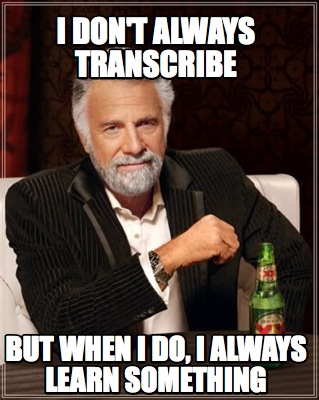
I Don't Always Transcribe

For the Bill Evans solo piano transcription, I remember putting in about 12 hours of work into that solo, learning around 2.5 minutes of the solo piano piece.   My mom, a classical piano teacher, stepped into our piano studio and posed the question as to whether transcribing that solo by ear was the best use of my time, given all the school work I had, not to mention the classical piano festival coming up…

Unfortunately, I didn’t transcribe much for the next 7 years or so.  I say unfortunately because I do think transcribing is good for me.  It is a very good thing for some people.  But not for everyone.

Transcribing takes a lot of time.  In my mom’s mind, the time spent transcribing those laborious bars of music wasn’t worth the small increments of progress.  Was she right?  Or was it an effective use of time for me?  It’s generally not wise to say your mother is wrong… so I’ll sidestep it and just say that transcribing those early solos probably helped set a foundation for me to train my ear…but so did all the other things I was practicing and listening to.  The transcribing helped my ear, but so did the Suzuki violin lessons I took in 3rd grade.  So did writing out 4-part German chorale harmonies by ear on college music theory tests, not to mention just playing a lot of jazz. People say I have a good ear now, but it’s hard to say that’s just the result of transcribing jazz.  Although, I did notice that my ear was actually noticeably stronger after the two big band transcriptions I did in my late 20’s.

With all these transcriptions under my belt, you wouldn’t think that I would question the effectiveness of transcribing.  I do.  

 Understand that my perspective is of a jazz musician and music educator in the trenches.  My job is to make kids fall in love with the music and to succeed at their own levels of talent and commitment.

 I perform regularly, but my day job is teaching jazz to junior high, high school, and college kids.  They have a great time, but most of the kids don’t want to be professional musicians, and that’s ok!  From my perspective, there are seven problems with transcribing:

1) Transcribing is extremely time-consuming.

Transcribing is a slow process, particularly in the early stages.  Even if you are good at it, it’s a slow process.  I remember seeing a Jaleel Shaw clinic almost ten years ago in which he demonstrated the process of transcribing. He didn’t write the solo down (the “scribe” part of “transcribe”), but he learned to play a significant chunk of a Miles Davis solo in front of an audience, phrase by phrase.  Jaleel has a fantastic ear and was lightning fast, with a great memory, but it was still a slow process just because transcribing itself is, by nature, slow, when compared with reading music.  And if you haven’t developed a great ear yet, then transcribing is REALLY, painstakingly slow.

2) Transcribing isn’t fun for some people.

Listening to jazz is fun.  Playing jazz is fun.  Transcribing isn’t fun for some people.  It’s hard work!  It pays off for many people, but it isn’t the only way to learn jazz language.

3) Transcribing is very hard for some people.

I don’t believe transcribing it is an effective use of time for some people.  If someone doesn’t have a good ear and tries transcribing for a long time without producing any noticeable results in their playing, then they may want to try to try other ways to learn jazz language.  Either that, or transcribe easier solos!

4) There are other important things to learn.

This is a important concept.  I live in the real world with real limitations, teaching jazz to normal public school kids.  In addition to my gig as a public school music teacher, getting to teach some jazz in addition to everything else, I also teach jazz as a part-time adjunct professor.  I also have a few college music majors as private jazz students, but I have just as many college students who simply like jazz but are majoring in something else.  My job is to help all of these people learn jazz and enjoy playing it within the time constraints of their lives.  My job is to help students regardless of their background.  

My problem with teaching transcribing is this:  it doesn’t work so well unless a student is willing to put in a TON of time.  

If a student has a very limited amount of time, then I don’t think it’s the most helpful way to spend their time unless they are already fairly advanced.  

Alas, jazz isn’t the top priority for everyone.  If you’ve got a 9th grade kid who has committed 30 minutes a day to practicing music, then transcribing may not be the best way to spend their time. 

When given the choice between helping my beginning jazz piano and guitar students learn to voice chords and comp vs. transcribing single note lines, I’ll prioritize voicings/comping until they are up and running.  It’s more foundational to playing with other people, and we have performances to prepare for.  If they had four hours a day to devote to jazz, then it would be a different story.

When given the choice between helping a student learn to read music vs. transcribing a solo, I will prioritize reading music (yes, even when my students are guitar players) because reading music is a more foundational skill. When given the choice between helping a horn player transcribe vs. learning to play in tune, I’ll have them learn to play in tune first.

It is fairly difficult to transcribe a jazz solo.  I view transcribing as a great thing for a talented student with a good ear and a lot of time to practice.  Transcribing can help many people, but I think there is a time and a place for transcribing.  I don’t think it’s for everyone.  A certain degree of proficiency with an instrument is a prerequisite. And I don’t think it’s wise to only focus on transcribing while neglecting other skills.

Transcribing takes a lot of time, and so transcribing solos only begins to show it’s benefits to students who are willing to put in a LOT of time.  That brings us to our next point:

5) Transcribing doesn’t help with every goal.

Whether or not someone should spend a lot of time transcribing should depend on their musical goals and their level of dedication.  People have lives outside of jazz, and that’s very ok.  Not everyone has the goal of playing at the Village Vanguard, but jazz is still a great hobby for them.

I have seen young musicians transcribe so much that they never really learned to read music.  This is a problem.  Reading music is important.  Even if some musicians don’t read music on every gig, the time will come where a jazz musician who doesn’t read music will wish they did.  They will inevitably feel their limitations because some gig will require it, like the “jazz lore” story in which Vic Juris had to turn down a Michael Brecker gig because he couldn’t (yet) read music.  Vic then made reading music a priority and learned to do it well!  Ideally you can read music well AND have also spent countless hours transcribing.

If a person’s goal is to become a professional jazz musician with a serious command of the language of other jazz musicians, then transcribing is a great path to that goal.   Transcribing is also NOT the only path to success as a jazz musician.  Oscar Peterson, Fred Hersch, Mulgrew Miller, and Ambrose Akinmusire are notable examples of famous jazz musicians who reportedly didn’t spend much time transcribing, if any.
Advanced high school and college players can benefit a lot from transcribing to help them understand jazz language as played by other musicians. Younger players can benefit also from transcribing.  I’ve had students as young as sixth grade transcribe solos in their private lessons, but they already had a few years of playing classical music under their belt first.

My guess is that most professional jazz musicians have spent at least some time transcribing, but not all.  But becoming a professional jazz musician isn’t the goal of every musician.

Let’s be real here.  Many people who play jazz are hobbyists with families, day jobs, mortgages, and countless adult responsibilities.  Transcribing is very low on their priority list.  They just want to play music and enjoy it.  Many people just want music to be a fun hobby, and if transcribing is a part of that, then great!  If not…

6) Transcribing can, in some cases, kill a passion for the music.

This is by far the biggest problem I have with transcribing, and the jazz religion it has become.  There is a large sub-culture in jazz that seems to believe that transcribing is the only way you can learn the music, which just isn’t true.  I’ve seen serious jazz students who transcribe a lot get frustrated and want to quit.  Was there a correlation between transcribing and wanting to quit?  Perhaps in some cases.
Transcribing can have a detrimental psychological effect in some cases when people spend so much time comparing their own inabilities to the abilities of the Greats.  Who compares favorably with John Coltrane?  Very few people…

I’ve seen musicians become very discouraged through the transcribing process.  If transcribing kills your love of the music, don’t do it!  There are other ways to improve.  I happen to believe that playing your instrument should be fun.  There are other ways to improve your ability to improvise, and there are alternative ways to improve your ear.

I am not against transcribing.  The way I see it, as someone who has done quite a bit of transcribing, there are three main benefits to transcribing:

  1. Transcribing helps expand your vocabulary of musical ideas and helps you understand what others have done before you.  
  2. Transcribing helps to improve your ear.  
  3. Transcribing helps to improve your technique.  

The thing is, each of these goals of transcribing can be accomplished in various other ways that don’t involve transcribing.  Learning jazz etudes, written transcriptions, learning bebop tunes, practicing licks, and just listening to music can all help with learning jazz vocabulary, which is one of the primary objectives of transcribing.  There are multiple paths to learning the jazz language.  Transcribing is a good path, but not the only one.   The other two main objectives of transcribing-training your ear and improving technique-can also be accomplished in many other ways.

Many musicians benefit from transcribing, but for some people it can be a very frustrating experience.  I’d much rather have my students listen more and transcribe less if transcribing is going to kill their passion for the music.

7)  The Bigger Issue is Listening.

I can tell you from my experience in the trenches teaching jazz to junior high, high school, and college kids, is that getting kids to be excited about the music and listening to jazz at all is a more important battle in the full scheme of things.  While some students are interested enough to put in the time to transcribe, a bigger concern for many jazz educators who aren’t at magnet schools or music conservatories is just getting kids excited and listening to jazz at all.

I’m not anti-transcribing.  I’m anti-drudgery.  I’m anti-things that make people hate music.  Practicing music should be fun, at least the majority of the time.  If transcribing is a joy to you, then get after it!

If transcribing is effective for you, then great!  Learn all you can from it.  Transcribing requires a great deal of practice time to pull it off, in most cases.  If you are able to “swing” it, then go make Count Basie proud!

But if you know deep down that transcribing isn’t your thing, I encourage you to develop other practice techniques that will help you keep your love of the music alive.  Give yourself permission to give it up if it just isn’t working for you.  Transcribing isn’t the only way to get better at jazz.  A good healthy dose of listening to jazz and just playing a lot can be a great alternative.

Music should be fun.  Always enjoy the journey!
TAKE YOUR JAZZ PLAYING TO THE NEXT LEVEL.

We help musicians of all instruments start improvising confidently over jazz standards in just 30 days without mind-numbing hours of practice or the overwhelm.

TAKE YOUR JAZZ PLAYING TO THE NEXT LEVEL.

We help musicians of all instruments start improvising confidently over jazz standards in as little as 30 days without mind-numbing hours of practice or the overwhelm.

“Jazz music is the power of now. There is no script. It’s conversation. The emotion is given to you by musicians as they make split-second decisions to fulfill what they feel the moment requires.”
WYNTON MARSALIS

YOU MAY ALSO BE INTERESTED IN

Learn Jazz Standards The Smart Way Ebook Cover

OUR PROVEN PROCESS FOR LEARNING JAZZ STANDARDS LIKE A PRO

A step-by-step guide for how to effectively learn jazz standards so you’ll feel confident playing them, and won’t forget them.

TERMS AND CONDITIONS

Welcome to LearnJazzStandards.com! We’ve created this page so that you (and any visitor to LearnJazzStandards.com) will understand the terms and conditions that govern your use of this website. If you continue to browse and use this website you are agreeing to comply with and be bound by the following terms and conditions, which together with our privacy policy comprise our (LearnJazzStandards.com’s) entire relationship with you.

Exclusion of Liability

The content found on any page of this website is for your general information and use only, and it is subject to change without notice. Neither we nor any third parties provide any warranty or guarantee as to the accuracy, timeliness, performance, completeness or suitability of the information and materials found or offered on this website for any particular purpose. You acknowledge that such information and materials may contain inaccuracies or errors and we expressly exclude liability for any such inaccuracies or errors to the fullest extent permitted by law. Your use of any information or materials on this website is entirely at your own risk, for which we shall not be liable. It shall be your own responsibility to ensure that any products, services or information available through this website meet your specific requirements.

Indemnity

By accessing our website, you agree to indemnify and hold us harmless from all claims, actions, damages, costs and expenses including legal fees arising from or in connection with your use of our website.

Copyright Laws & Intellectual Property

This website contains some material which is owned by or licensed to us. This material includes, but is not limited to, the design, layout, look, appearance and graphics. Reproduction is prohibited other than in accordance with the copyright notice, which forms part of these terms and conditions. All logos, trademarks, and other intellectual property found on LearnJazzStandards.com are the property of their respective owners. They do not indicate ownership, affiliation, sponsorship, or any other relationship with LearnJazzStandards.com. In addition, this website may also include links to other websites. These links are provided for your convenience to provide further information. They do not signify that we endorse those websites, and we have no responsibility for the content of those linked websites.

Unauthorized Use

Your use of this website and any dispute arising out of such use of the website is subject to the laws of the United States of America. Any unauthorized use of this website may give rise to a claim for damages and/or be a criminal offense. Thanks, and enjoy LearnJazzStandards.com!

Return Policy for Products

Refund Policy

For play-alongs and eBooks:

Because these are digital downloads, and not returnable, we have a strict no refund policy. All purchases are final and cannot be reversed. Please be sure that you fully understand the product you are purchasing and what is and what is not included. Of course, if you ever have any questions about a product feel free to contact us or visit our FAQ page.

For 30 Days to Better Jazz Playing eCourse

Please make sure you completely understand the product you are buying before purchasing. 14 Day 100% Money Back Guarantee
  • This guarantee lasts 14 days, which completely covers almost half of the course, enough for you to observe its’ effectiveness.
  • We can’t guarantee you will be Miles Davis, Charlie Parker, or John Coltrane in 2 weeks. We’d be suspicious of anyone who could promise that. Becoming a better jazz musician is a process and it requires work.
  • If you’re not happy with the quality of this program…send us an email and showing you did the work. We’ll refund 100% of your money (We’ll even eat the credit-card processing fees) and we’ll part as friends. We believe in the power of this course and so we’ll take responsibility for it.

For Inner Circle Membership

Please make sure you completely understand the product you are buying before purchasing. 30 Day 100% Money Back Guarantee
  • This guarantee lasts 30 days, which is enough for you to observe the membership’s effectiveness.
  • We can’t guarantee you will be Miles Davis, Charlie Parker, or John Coltrane in 30 days. We’d be suspicious of anyone who could promise that. Becoming a better jazz musician is a process and it requires work.
  • If you’re not happy with the quality of this program…send us an email and showing you did the work. We’ll refund 100% of your money (We’ll even eat the credit-card processing fees) and we’ll part as friends. We believe in the power of this course and so we’ll take responsibility for it.

Rights of use

All digital products are for the use of the individual customer only. Redistribution or reselling of our digital products is strictly prohibited and a violation of United States and New York State law.

PRIVACY POLICY

At Learn Jazz Standards LLC, we recognize that privacy of your personal information is important.

Here are the types of personal information we may collect when you use and visit LearnJazzStandards.com, and how we safeguard your information. We never sell your personal information to third parties.

Log Files

As with most other websites, we collect and use the data contained in log files. The information in the log files include your IP (internet protocol) address, your ISP (internet service provider, such as AOL or Shaw Cable), the browser you used to visit our site (such as Internet Explorer or Firefox), the time you visited our site and which pages you visited throughout our site.

Cookies and Web Beacons

We may use cookies to store information, such as your personal preferences when you visit our site. This could include only showing you a popup once in your visit, or the ability to log in to some of our features, such as forums. We collect this information to help send you only pertinent content that we believe you are interested in and will benefit from.

We also use third party advertisements on LearnJazzStandards.com to support our site. Some of these advertisers may use technology such as cookies and web beacons when they advertise on our site, which will also send these advertisers (such as Google through the Google AdSense program) information including your IP address, your ISP, the browser you used to visit our site, and in some cases, whether you have Flash installed.

This is generally used for geotargeting purposes (showing New York real estate ads to someone in New York, for example) or showing certain ads based on specific sites visited (such as showing cooking ads to someone who frequents cooking sites).

DoubleClick DART cookies

We also may use DART cookies for ad serving through Google’s DoubleClick service, which places a cookie on your computer when you are browsing the web and visit a site using DoubleClick advertising (including some Google AdSense advertisements).

This cookie is used to serve ads specific to you and your interests (“interest based targeting”). The ads served will be targeted based on your previous browsing history (For example, if you have been viewing sites about visiting Las Vegas, you may see Las Vegas hotel advertisements when viewing a non-related site, such as on a site about hockey).

DART uses “non personally identifiable information.” It does NOT track personal information about you, such as your name, email address, physical address, telephone number, social security numbers, bank account numbers or credit card numbers. You can opt-out of this ad serving on all sites using this advertising by visiting http://www.doubleclick.com/privacy/dart_adserving.aspx

You can chose to disable or selectively turn off our cookies or third-party cookies in your browser settings, or by managing preferences in programs such as Norton Internet Security. However, this can affect how you are able to interact with our site as well as other websites. This could include the inability to login to services or programs, such as logging into forums or accounts.

Deleting cookies does not mean you are permanently opted out of any advertising program. Unless you have settings that disallow cookies, the next time you visit a site running the advertisements, a new cookie will be added.

Email Addresses

If you share your email address with LearnJazzStandards.com via the contact page, we will only use it to contact you, and will NOT add you to any lists or newsletters without your consent.

In addition, if you sign up for the free newsletter, your email address will only be used to send special offers and updates from LearnJazzStandards.com. Addresses are recorded and kept secure through MailChimp, which we use to distribute information to our subscribers. Neither MailChimp nor LearnJazzStandards.com will give or sell your address to any third party, nor will you be added to any additional lists.

Right to Be Forgotten

If at any point you wish to be completely deleted from our databases, whether it be as a newsletter subscriber or an account holder on learnjazzstandards.com, you have the complete right to do so.

Contact us, and we will ensure your data is cleared from our system.

Data Control Contact

If you ever wish to reach out to us regarding the use of your data, we are reachable at [email protected]. Additionally, you can use our contact page, to reach out any time.

In short, your information is safe with us, and we greatly value your trust.

Thanks for using Learn Jazz Standards!

Terms of Use

Welcome to LearnJazzStandards.com!

We’ve created this page so that you (and any visitor to LearnJazzStandards.com) will understand the terms and conditions that govern your use of this website.

If you continue to browse and use this website you are agreeing to comply with and be bound by the following terms and conditions, which together with our privacy policy comprise our (LearnJazzStandards.com’s) entire relationship with you.

Exclusion of Liability

The content found on any page of this website is for your general information and use only, and it is subject to change without notice.

Neither we nor any third parties provide any warranty or guarantee as to the accuracy, timeliness, performance, completeness or suitability of the information and materials found or offered on this website for any particular purpose.

You acknowledge that such information and materials may contain inaccuracies or errors and we expressly exclude liability for any such inaccuracies or errors to the fullest extent permitted by law.

Your use of any information or materials on this website is entirely at your own risk, for which we shall not be liable. It shall be your own responsibility to ensure that any products, services or information available through this website meet your specific requirements.

Indemnity

By accessing our website, you agree to indemnify and hold us harmless from all claims, actions, damages, costs and expenses including legal fees arising from or in connection with your use of our website.

Copyright Laws & Intellectual Property

This website contains some material which is owned by or licensed to us. This material includes, but is not limited to, the design, layout, look, appearance and graphics. Reproduction is prohibited other than in accordance with the copyright notice, which forms part of these terms and conditions.

All logos, trademarks, and other intellectual property found on LearnJazzStandards.com are the property of their respective owners. They do not indicate ownership, affiliation, sponsorship, or any other relationship with LearnJazzStandards.com.

In addition, this website may also include links to other websites. These links are provided for your convenience to provide further information. They do not signify that we endorse those websites, and we have no responsibility for the content of those linked websites.

Unauthorized Use

Your use of this website and any dispute arising out of such use of the website is subject to the laws of the United States of America. Any unauthorized use of this website may give rise to a claim for damages and/or be a criminal offense.

Thanks, and enjoy LearnJazzStandards.com!

Return Policy for Products

Refund Policy

For play-alongs and eBooks:

Because these are digital downloads, and not returnable, we have a strict no refund policy. All purchases are final and cannot be reversed. Please be sure that you fully understand the product you are purchasing and what is and what is not included. Of course, if you ever have any questions about a product feel free to contact usor visit our FAQ page.

For 30 Days to Better Jazz Playing eCourse

Please make sure you completely understand the product you are buying before purchasing.

14 Day 100% Money Back Guarantee

  • This guarantee lasts 14 days, which completely covers almost half of the course, enough for you to observe its’ effectiveness.
  • We can’t guarantee you will be Miles Davis, Charlie Parker, or John Coltrane in 2 weeks. We’d be suspicious of anyone who could promise that. Becoming a better jazz musician is a process and it requires work.
  • If you’re not happy with the quality of this program…send us an email and showing you did the work. We’ll refund 100% of your money (We’ll even eat the credit-card processing fees) and we’ll part as friends. We believe in the power of this course and so we’ll take responsibility for it.

Rights of use

All digital products are for the use of the individual customer only. Redistribution or reselling of our digital products is strictly prohibited and a violation of United States and New York State law.

Learn Jazz Standards Messaging Terms & Conditions

Effective Date:

This SMS message program is a service of Learn Jazz Standards. By providing your cell phone number, you agree to receive recurring automated promotional and personalized marketing text messages (e.g., SMS/MMS cart reminders, sale notices, etc) from Learn Jazz Standards. These messages include text messages that may be sent using an automatic telephone dialing system, to the mobile telephone number you provided when signing up or any other number that you designate. You give Learn Jazz Standards permission to send text messages to the enrolled cell phone number through your wireless phone carrier, unless and until you end permission per these Terms & Conditions. Consent to receive automated marketing text messages is not a condition of any purchase. Message & data rates may apply.

Message frequency may vary. Learn Jazz Standards reserves the right to alter the frequency of messages sent at any time, so as to increase or decrease the total number of sent messages. Learn Jazz Standards also reserves the right to change the short code or phone number from which messages are sent and we will notify you if we do so.

Not all mobile devices or handsets may be supported and our messages may not be deliverable in all areas. Learn Jazz Standards, its service providers and the mobile carriers supported by the program are not liable for delayed or undelivered messages.

By enrolling in the Learn Jazz Standards messaging program, you also agree to these messaging terms & conditions (“Messaging Terms”), our Learn Jazz Standards Terms of Use and Learn Jazz Standards Privacy Policy.

Cancellation

Text the keyword STOP, STOPALL, END, CANCEL, UNSUBSCRIBE or QUIT to the telephone number, long code, or short code that sends you our initial confirmation message to cancel. After texting STOP, STOPALL, END, CANCEL, UNSUBSCRIBE or QUIT to the telephone number, long code, or short code that sends you our initial confirmation message you will receive one additional message confirming that your request has been processed. If you change your preferences, it may take up to 48 hours for it to take effect. You acknowledge that our text message platform may not recognize and respond to unsubscribe requests that do not include the STOP, STOPALL, END, CANCEL, UNSUBSCRIBE or QUIT keyword commands and agree that Learn Jazz Standards and its service providers will have no liability for failing to honor such requests. If you unsubscribe from one of our text message programs, you may continue to receive text messages from Learn Jazz Standards through any other programs you have joined until you separately unsubscribe from those programs.

Help or Support

Text the keyword HELP to the telephone number, long code, or short code that sends you our initial confirmation message to receive a text with information on how to unsubscribe.

No Warranty

TO THE MAXIMUM EXTENT ALLOWED BY APPLICABLE LAW, YOU ACKNOWLEDGE AND AGREE THAT THE MESSAGING PROGRAM IS PROVIDED ON AN “AS IS” AND “AS AVAILABLE” BASIS WITHOUT WARRANTIES OF ANY KIND, WHETHER EXPRESS OR IMPLIED.

Limitation of Liability

TO THE MAXIMUM EXTENT ALLOWED BY APPLICABLE LAW, YOU AGREE THAT IN NO EVENT SHALL EITHER OF Learn Jazz Standards OR ANY PARTY ACTING ON BEHALF OF Learn Jazz Standards BE LIABLE FOR: (A) ANY CLAIMS, PROCEEDINGS, LIABILITIES, OBLIGATIONS, DAMAGES, LOSSES OR COSTS IN AN AGGREGATE AMOUNT EXCEEDING THE GREATER OF THE AMOUNT YOU PAID TO Learn Jazz Standards HEREUNDER OR $100.00; OR (B) ANY DIRECT, INDIRECT, CONSEQUENTIAL, SPECIAL, INCIDENTAL, PUNITIVE OR ANY OTHER DAMAGES. YOU AGREE EVEN IF Learn Jazz Standards HAS BEEN TOLD OF POSSIBLE DAMAGE OR LOSS ARISING OR RESULTING FROM OR IN ANY WAY RELATING TO YOUR USE OF THE Learn Jazz Standards MESSAGING PROGRAM. Learn Jazz Standards AND ITS REPRESENTATIVES ARE NOT LIABLE FOR THE ACTS OR OMISSIONS OF THIRD PARTIES, INCLUDING BUT NOT LIMITED TO DELAYS OR NON-DELIVERY IN THE TRANSMISSION OF MESSAGES.

Indemnity

To the maximum extent allowed by applicable law, you agree to indemnify, defend and hold harmless Learn Jazz Standards, its directors, officers, employees, servants, agents, representatives, independent contractors and affiliates from and against any and all claims, damages, liabilities, actions, causes of action, costs, expenses, including reasonable attorneys’ fees, judgments or penalties of any kind or nature arising from or in relation to the these Messaging Terms or your receipt of text messages from Learn Jazz Standards or its service providers.

Dispute Resolution

  1. General. Any dispute or claim arising out of or in any way related to these Messaging Terms or your receipt of text messages from Learn Jazz Standards or its service providers whether based in contract, tort, statute, fraud, misrepresentation, or any other legal theory, and regardless of when a dispute or claim arises will be resolved by binding arbitration. YOU UNDERSTAND AND AGREE THAT, BY AGREEING TO THESE MESSAGING TERMS, YOU AND Learn Jazz Standards ARE EACH WAIVING THE RIGHT TO A TRIAL BY JURY OR TO PARTICIPATE IN A CLASS ACTION AND THAT THESE MESSAGING TERMS SHALL BE SUBJECT TO AND GOVERNED BY ARBITRATION.
  2. Exceptions. Notwithstanding subsection (a) above, nothing in these Messaging Terms will be deemed to waive, preclude, or otherwise limit the right of you or Learn Jazz Standards to: (i) bring an individual action in small claims court; (ii) pursue an enforcement action through the applicable federal, state, or local agency if that action is available; (iii) seek injunctive relief in aid of arbitration from a court of competent jurisdiction; or (iv) file suit in a court of law to address an intellectual property infringement claim.
  3. Arbitrator. Any arbitration between you and Learn Jazz Standards will be governed by the JAMS, under the Optional Expedited Arbitration Procedures then in effect for JAMS, except as provided herein. JAMS may be contacted at www.jamsadr.com. The arbitrator has exclusive authority to resolve any dispute relating to the interpretation, applicability, or enforceability of this binding arbitration agreement.
  4. No Class Actions. YOU AND Learn Jazz Standards AGREE THAT EACH MAY BRING CLAIMS AGAINST THE OTHER ONLY IN AN INDIVIDUAL CAPACITY AND NOT AS A PLAINTIFF OR CLASS MEMBER IN ANY PURPORTED CLASS OR REPRESENTATIVE PROCEEDING. Further, unless both you and Learn Jazz Standards agree otherwise in a signed writing, the arbitrator may not consolidate more than one person’s claims, and may not otherwise preside over any form of a representative or class proceeding. You agree that, by agreeing to these Messaging Terms, you and Learn Jazz Standards are each waiving the right to a trial by jury or to participate in a class action, collective action, private attorney general action, or other representative proceeding of any kind.
  5. No Class Actions. YOU AND Learn Jazz Standards AGREE THAT EACH MAY BRING CLAIMS AGAINST THE OTHER ONLY IN AN INDIVIDUAL CAPACITY AND NOT AS A PLAINTIFF OR CLASS MEMBER IN ANY PURPORTED CLASS OR REPRESENTATIVE PROCEEDING. Further, unless both you and Learn Jazz Standards agree otherwise in a signed writing, the arbitrator may not consolidate more than one person’s claims, and may not otherwise preside over any form of a representative or class proceeding.
  6. Modifications to this Arbitration Provision. Notwithstanding anything to the contrary in these Messaging Terms, if Learn Jazz Standards makes any future change to this arbitration provision, you may reject the change by sending us written notice within 30 days of the change to Learn Jazz Standards’s contact information provided in the “Contact Us” section below, in which case this arbitration provision, as in effect immediately prior to the changes you rejected, will continue to govern any disputes between you and Learn Jazz Standards.
  7. Enforceability. If any provision of these Messaging Terms is found to be unenforceable, the applicable provision shall be deemed stricken and the remainder of these Messaging Terms shall remain in full force and effect.

Changes to the Messaging Terms

We reserve the right to change these Messaging Terms or cancel the messaging program at any time. By using and accepting messages from Learn Jazz Standards after we make changes to the Messaging Terms, you are accepting the Messaging Terms with those changes. Please check these Messaging Terms regularly.

Entire Agreement/Severability

These Messaging Terms, together with any amendments and any additional agreements you may enter into with us in connection herewith, will constitute the entire agreement between you and Learn Jazz Standards concerning the Messaging Program.

Contact

Please contact us with any inquiries or concerns at [email protected]

OUR PROVEN PROCESS FOR LEARNING JAZZ STANDARDS LIKE A PRO

Get our FREE eGuide “Learn Jazz Standards the Smart Way” and follow the 5 simple steps for crushing it with jazz standards.

Learn Jazz Standards The Smart Way Cover

OUR PROVEN PROCESS FOR LEARNING JAZZ THEORY LIKE A PRO

Get our FREE “Jazz Theory Made Easy Fast Track Guide” and follow the 4 simple steps that make learning jazz theory easy.

Jazz Theory Made Easy Fast Track Guide Ebook Cover

OUR PROVEN PROCESS FOR IMPROVISING JAZZ SOLOS LIKE A PRO

Get our FREE “Jazz Improv Made Easy Fast Track Guide” and follow the 3 simple steps for improvising amazing jazz solos.

Jazz Improv Made Easy Fast Track Guide Ebook Cover

DOWNLOAD THIS CHORD CHART

Get our FREE "Is Transcribing Jazz Effective for Everyone?" chord chart and our entire library of 200+ jazz standards!

Chord Chart

DOWNLOAD THIS CHORD CHART

Get our FREE "Is Transcribing Jazz Effective for Everyone?" chord chart and our entire library of 200+ jazz standards!

Chord Chart

DOWNLOAD THIS CHORD CHART

Get our FREE "Is Transcribing Jazz Effective for Everyone?" chord chart and our entire library of 200+ jazz standards!

Chord Chart