
Almost all Western music, jazz included, is built on the diatonic scale! But, despite being so ubiquitous in music, many musicians don’t actually know what “diatonic” means.
We’re going to remedy that in this article!
Diatonic scales are the backbone of Western music theory and the foundation for most of the harmony you’ll encounter in jazz. We’re going to give you a useful definition for diatonic scales and help you understand why these scales are so important for jazz musicians to master!
Finally, we’ll go over essential practice tips and cover some common misconceptions surrounding the diatonic scale that often confuse and stump musicians.
If you want to become the best jazz musician you can be, check out the Learn Jazz Standards Inner Circle. The Inner Circle helps musicians like you take your jazz playing to the next level.
Improve in 30 Days or Less. Join the Inner Circle.
Table of Contents
What Is the Diatonic Scale?
The diatonic scale is one of the most important building blocks of Western music. At its core, it’s a seven-note scale made up of five whole steps and two half steps. The sequence of half steps and whole steps is spaced in just the right way to give us the tonal system we’ve been using for centuries.
Speaking of the centuries…
A Brief History of the Diatonic Scale
Before we get too ahead of ourselves, let’s first explore the historical context of scales and systems of organized pitches.
The roots of the diatonic scale trace back to Ancient Greece, where theorists organized tetrachords—four-note groups spanning a perfect fourth—as the building blocks of melodic systems. Greek theory named these frameworks tonoi and harmoniai.
Though it’s certainly an oversimplification, tonoi are comparable to the modern concept of tonal centers or keys, and harmoniai are similar to the contemporary idea of scales and modes.
The Medieval Foundation of Our Modern Modes
Fast forward to the Middle Ages, where the Catholic church repurposed and refined the theories developed by the Ancient Greeks into the modal system that shapes our Western music today. The medieval church modes are the direct ancestors of our modern diatonic modes.
Many of our modern modes share the same names with their Ancient counterparts.
When jazz musicians talk about diatonic modal improvisation or chord-scale relationships, they’re still drawing from this lineage. Recognizing that these modes were formalized over a millennium ago adds historical depth to why they function the way they do—and why they remain so powerful today.
Ok! We now know what the diatonic scale is and where it comes from. Let’s explore the different forms the diatonic scale can take in Western music.
The Types of Diatonic Scales
When we talk about types of diatonic scales, we’re usually referring to two forms:
- The major scale
- The natural minor scale
The Major Scale
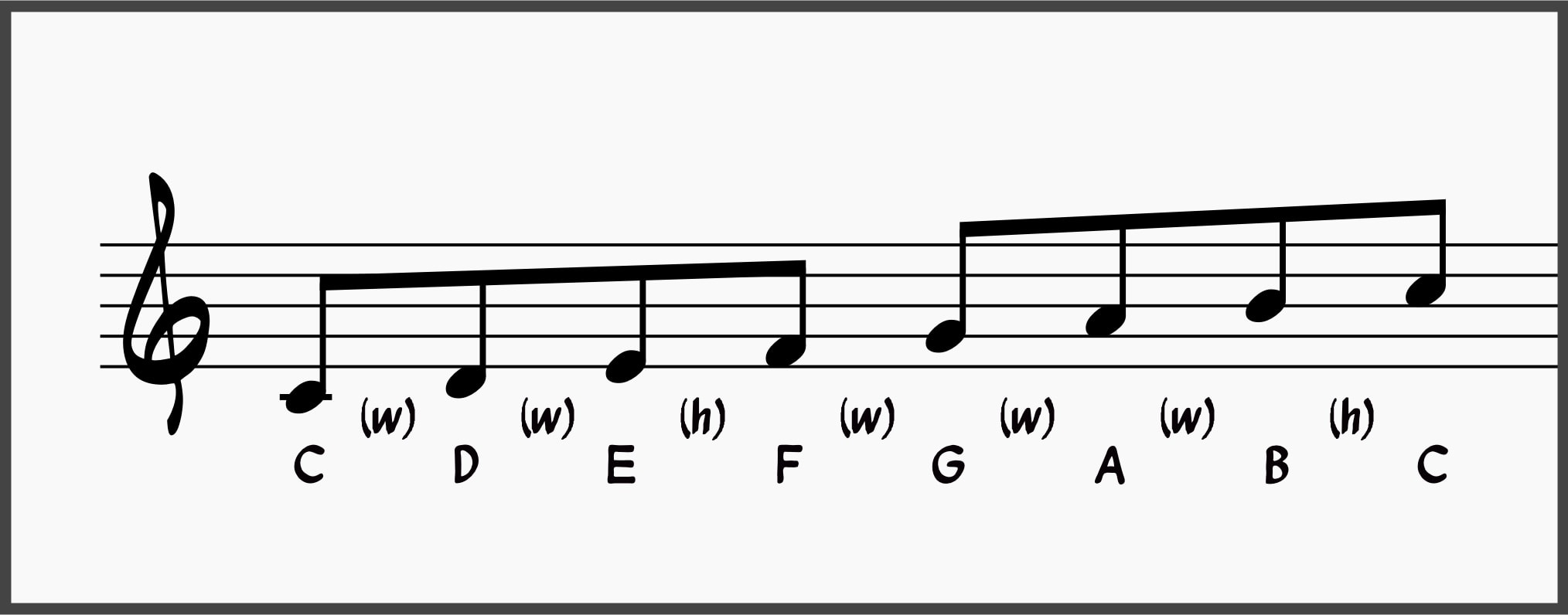
The major scale formula looks like this:
W – W – H – W – W – W – H
(W = whole step, H = half step)
If you start on C and follow that formula, you get the C major scale:
C – D – E – F – G – A – B – C
This is why you’ll often hear musicians use “major scale” and “diatonic scale” interchangeably—but in reality, diatonic is the broader category, and the major scale is just one type of diatonic scale. The other is the natural minor scale.
Natural Minor Scale
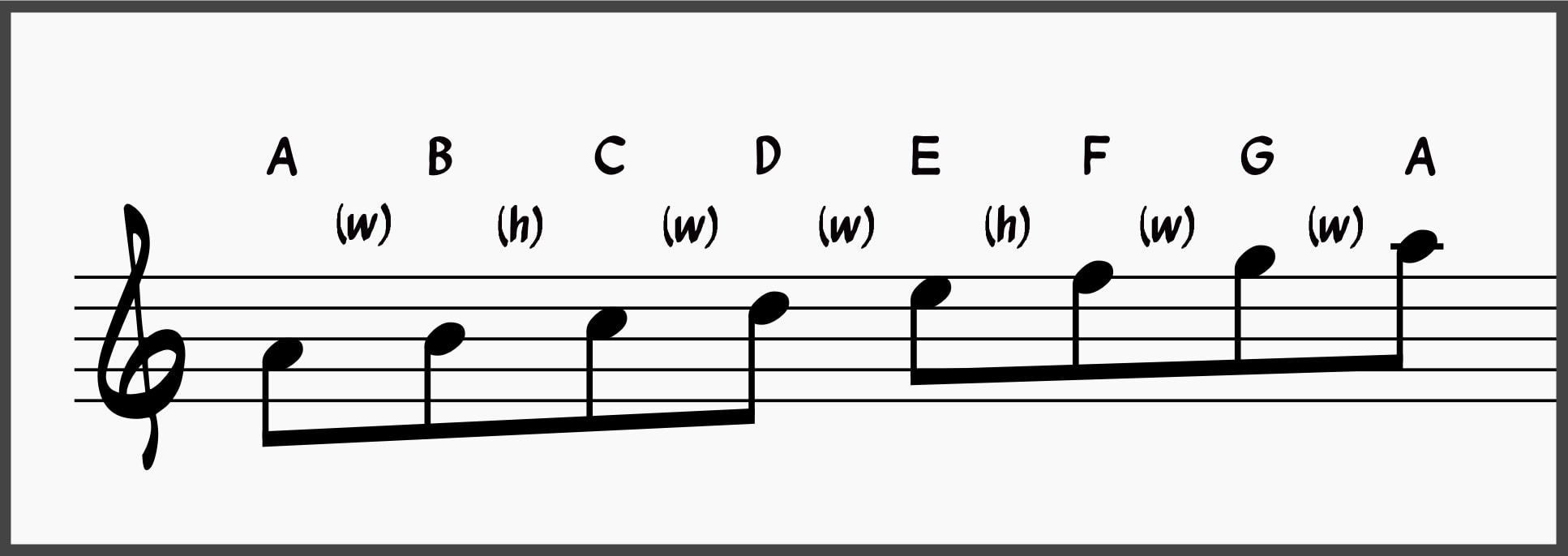
The natural minor scale formula looks like this:
W – H – W – W – H – W – W
(W = whole step, H = half step)
If you start on A and follow that formula, you get the A natural minor scale:
A – B – C – D – E – F – G – A
Relative Major and Minor
The C major scale and A minor scale share the same sequence of notes. That is because they are actually the same scale! It’s just that C is the starting note in C major and A is the starting note in A minor.
We call the relationship between C major and A minor relative because they are related to one another in that way. Diatonic harmony is either major or minor—that’s why we have major keys and minor keys.
Major and minor keys that share the same sequence of notes are called relative major and minor keys.
Check out this article for more on relative major and minor keys.
Diatonic Modes
However, the diatonic scale contains more scales than just the major scale and the natural minor scale. We still have to talk about all the modes!
Every note in the major scale can be the starting point in its very own scale. If there are seven tones total, that means there are seven scales contained within that one sequence of whole and half steps.
We’ve already covered two of them:
- Major Scale (Also called the Ionian mode when in minor keys)
- Natural Minor Scale (Also called the Aeolian mode when in major keys)
Let’s look at all seven scales in the context of the C major scale.
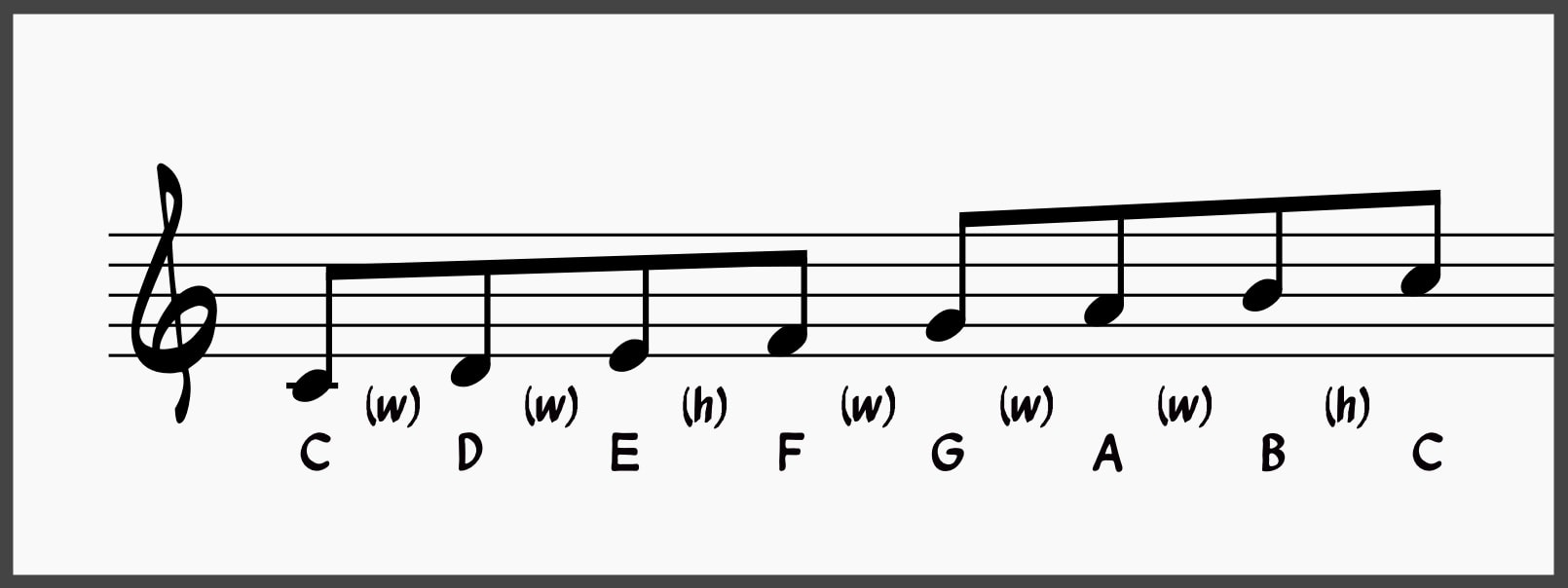
C Ionian Mode (C-D-E-F-G-A-B-C)
Check out this article to learn more about the major scale.
D Dorian Mode (D–E–F–G–A–B–C–D)
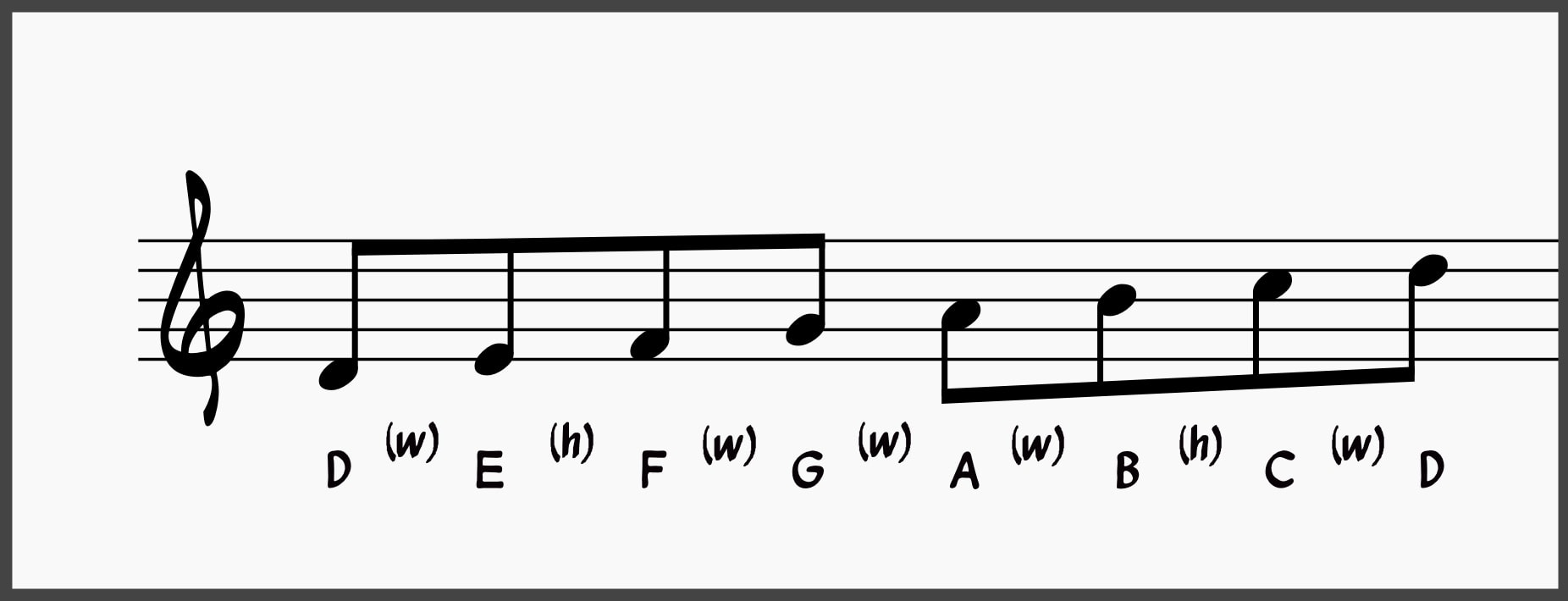
Check out this article to learn more about the Dorian minor scale.
E Phrygian Mode (E–F–G–A–B–C–D–E)
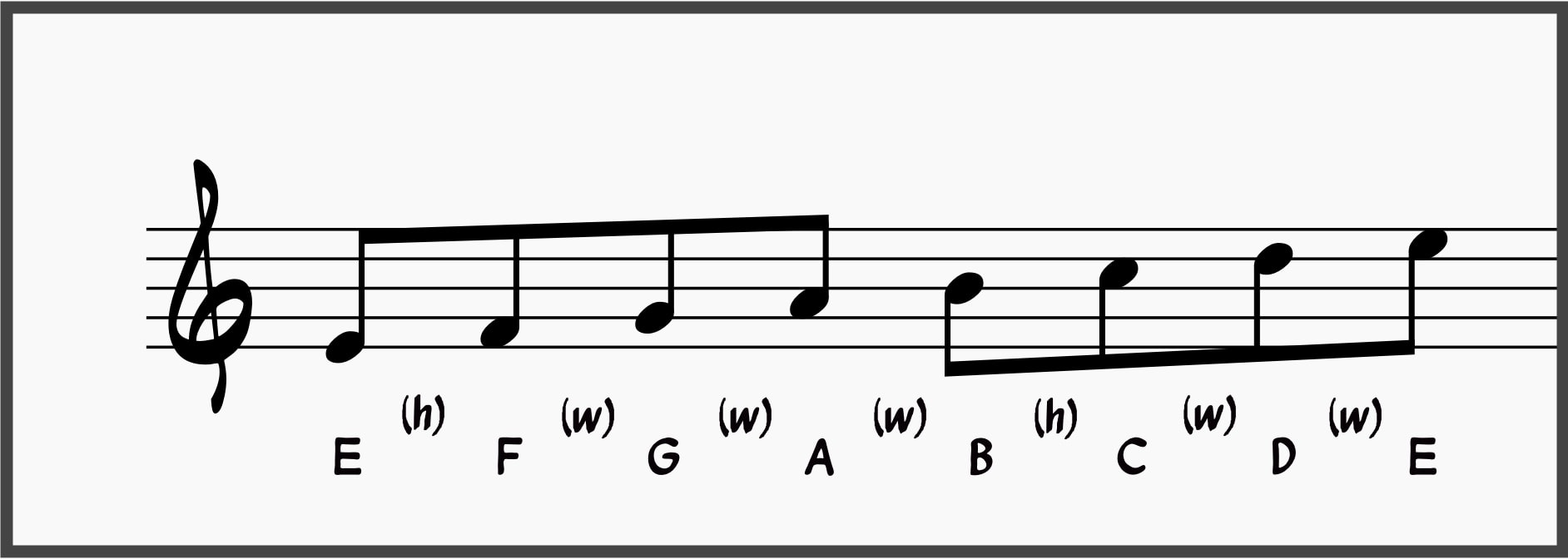
Check out this article to learn more about the Phrygian minor scale.
F Lydian Mode (F-G-A-B-C-D-E-F)
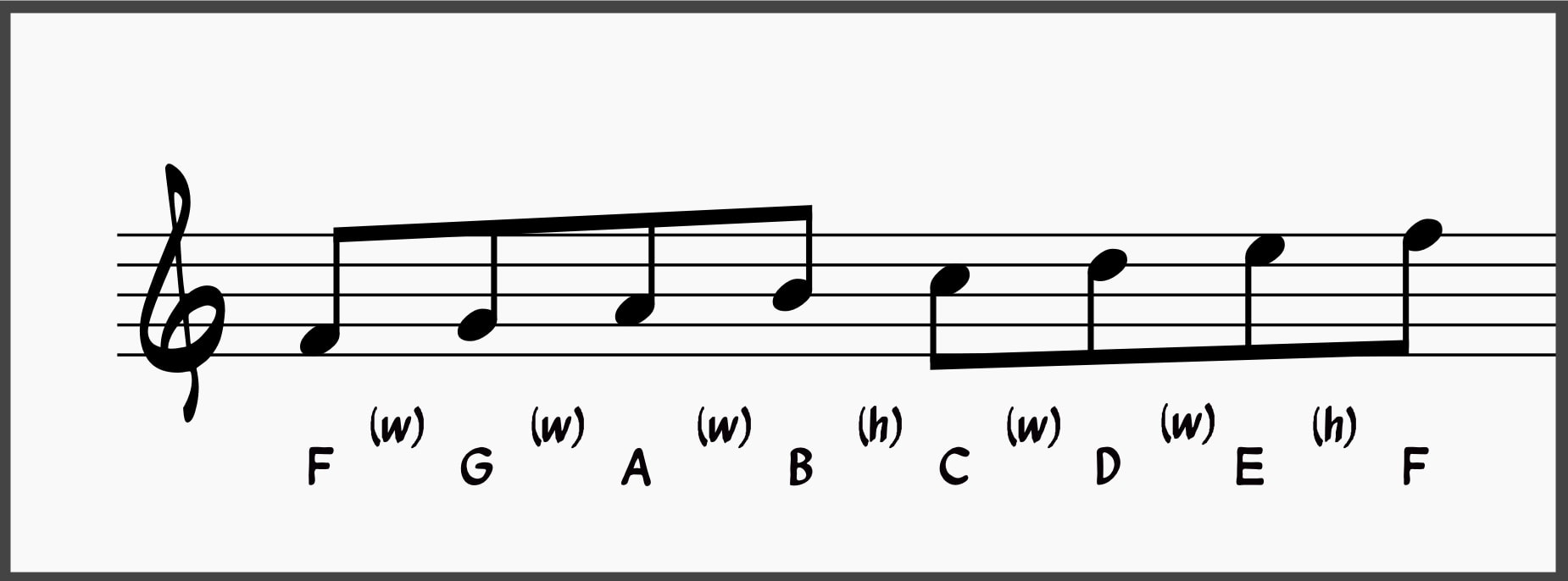
Check out this article to learn more about the Lydian scale.
G Mixolydian Mode (G–A–B–C–D–E–F–G)
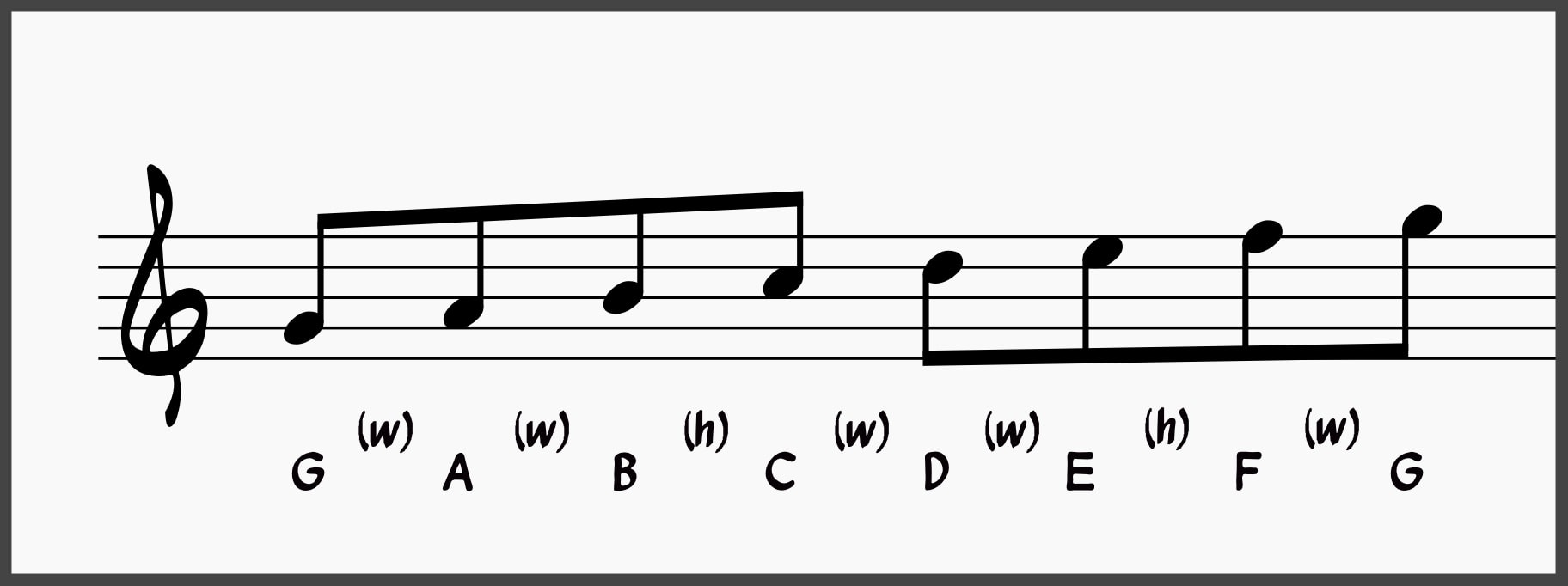
Check out this article to learn more about the Mixolydian scale.
A Aeolian Mode (A-B-C-D-E-F-G-A)
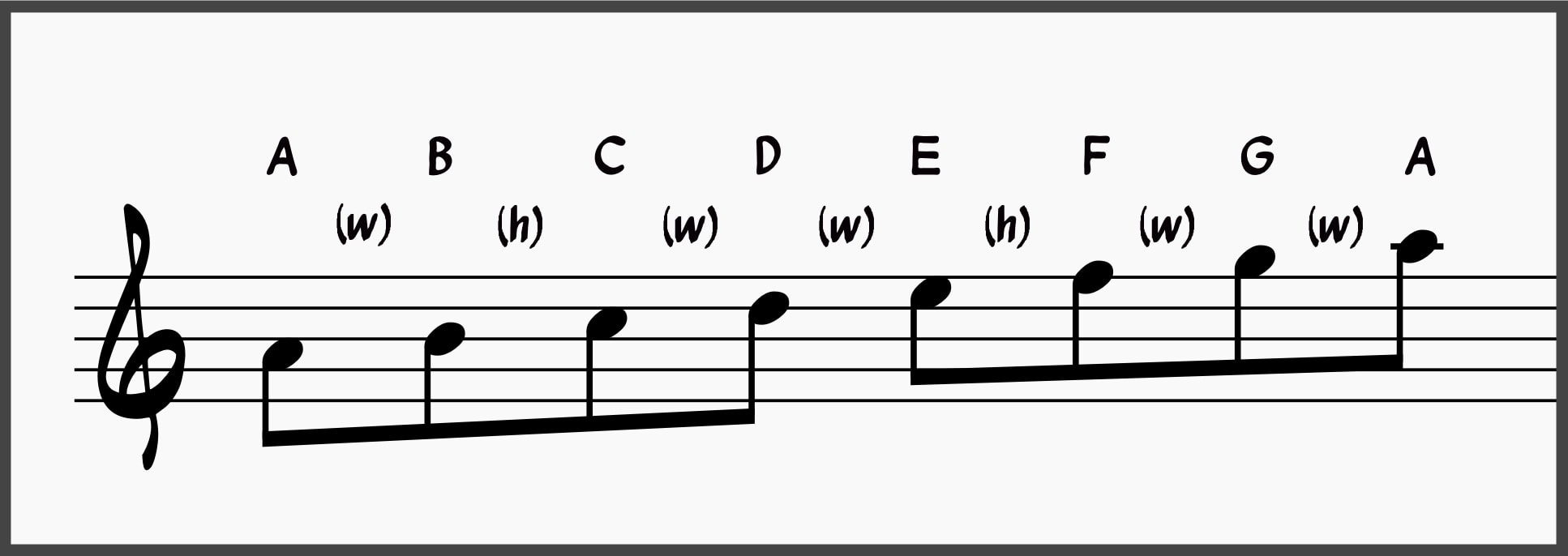
Check out this article to learn more about the natural minor scale.
B Locrian Mode (B-C-D-E-F-G-A-B)
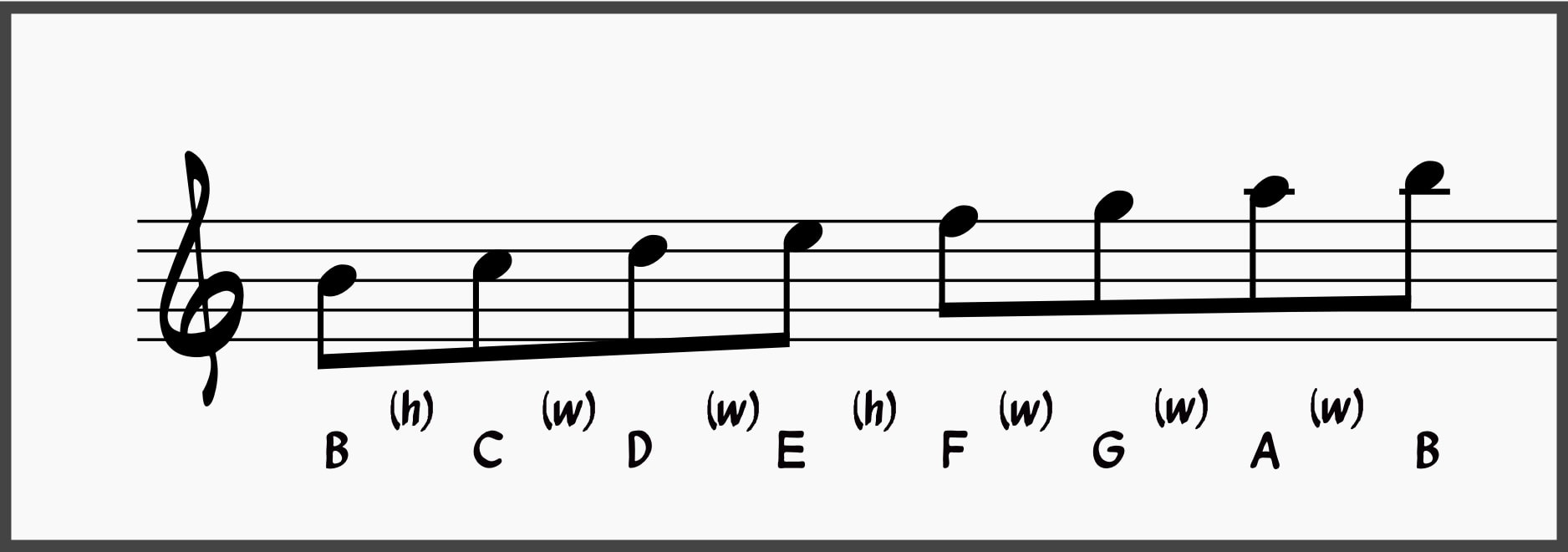
Check out this article to learn more about the Locrian minor scale.
All of these are diatonic scales too, because they use the same seven notes of the parent major scale, just starting from a different scale degree.
How the Diatonic Scale Works in Harmony
Not only can you use the diatonic scale to create major and minor scales, but you can also use it to generate chords. Many jazz standards are written using the logic and chords of the diatonic scale.
Diatonic Triads
Let’s use the major scale to build out all the chords in the key of C major. If you take the first note of the major scale and stack every other note on top of it, you’ll get a triad:
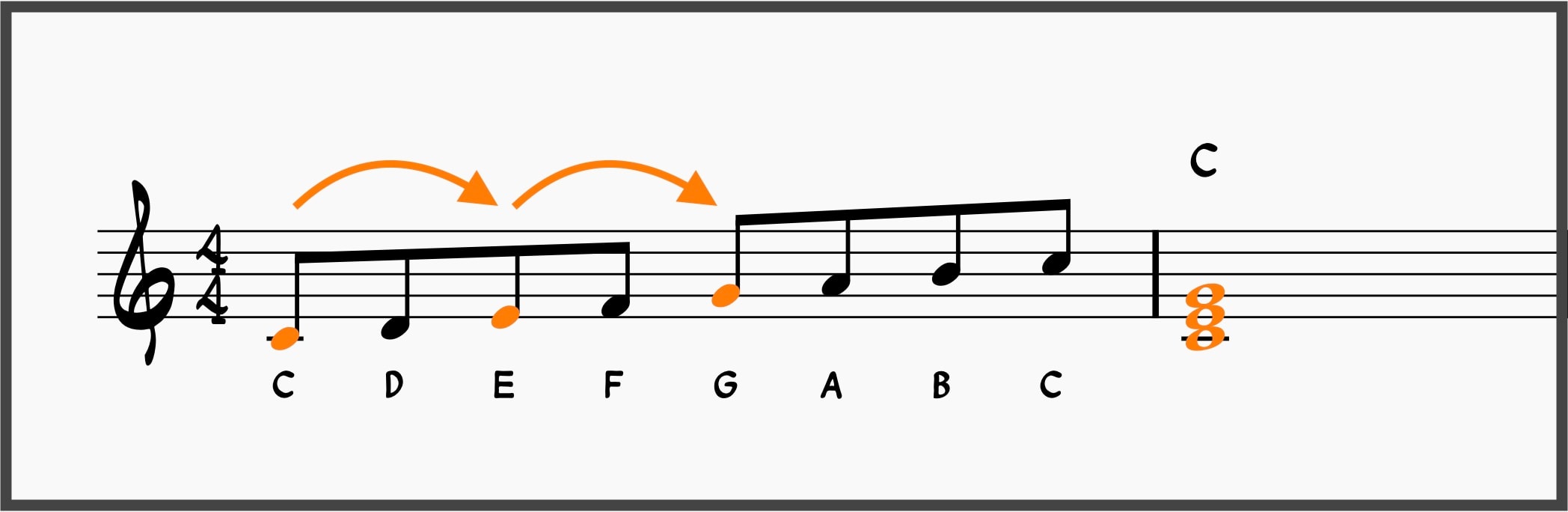
- C (C-D–E–F-G) → C major
Let’s repeat that process with the other notes in the major scale:
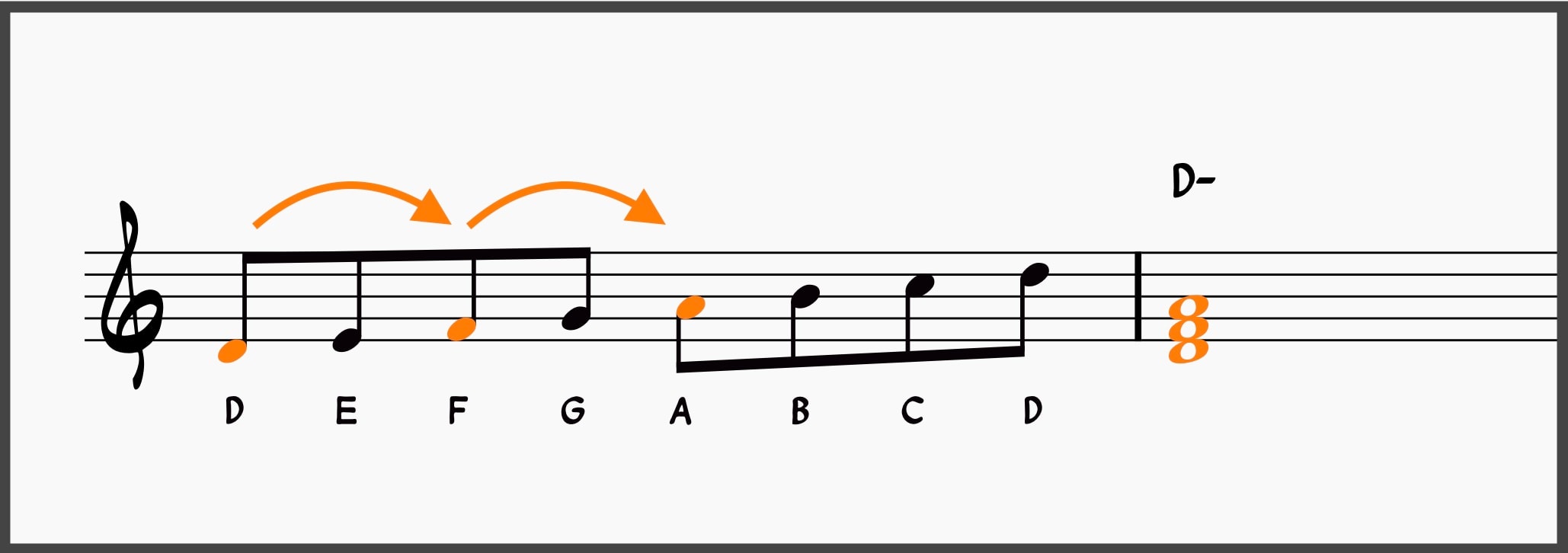
- D (D-E–F-G–A) → D minor
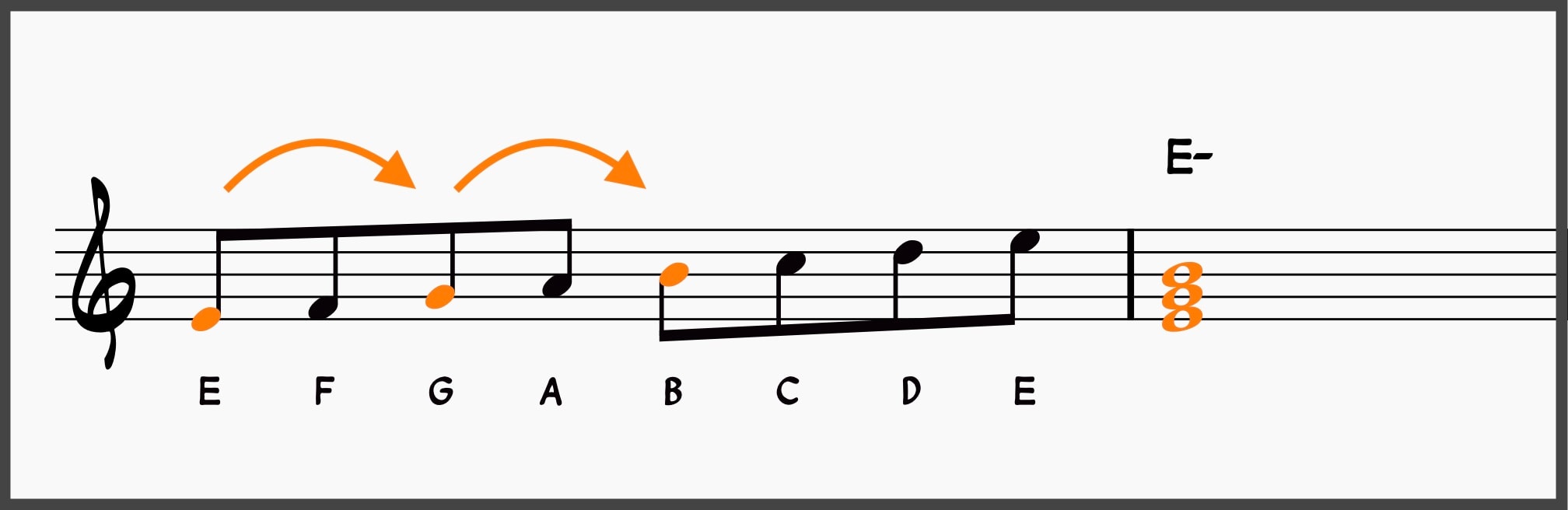
- E (E-F–G–A-B) → E minor
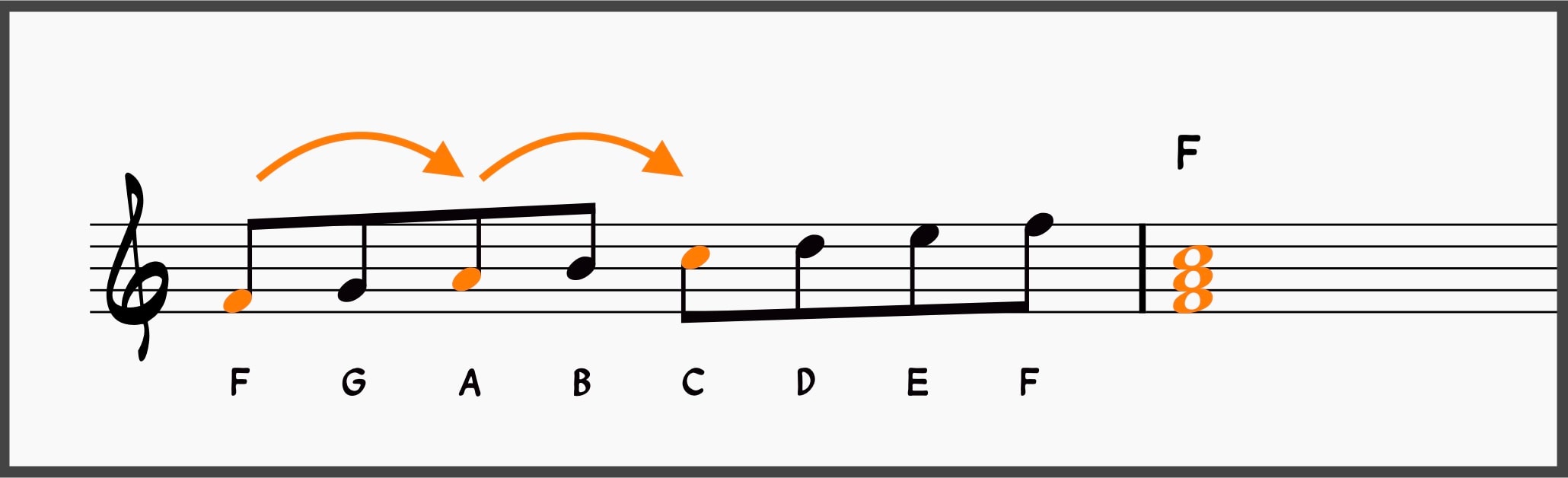
- F (F-G–A-B–C) → F major
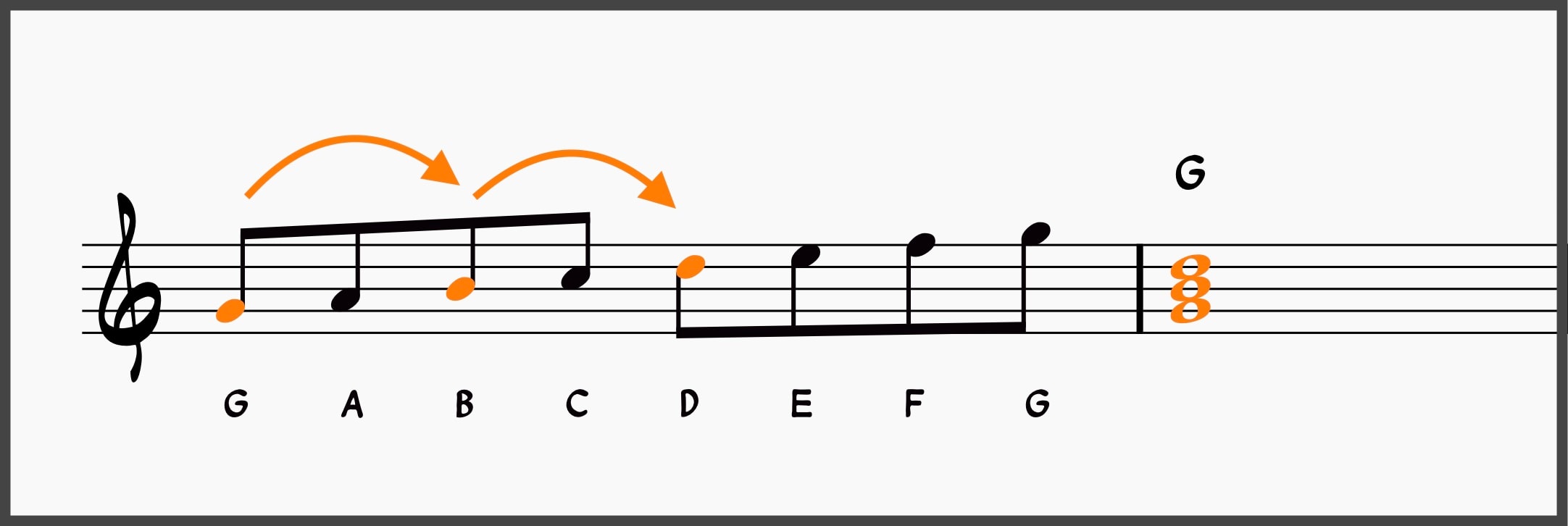
- G (G-A–B-C–D) → G major
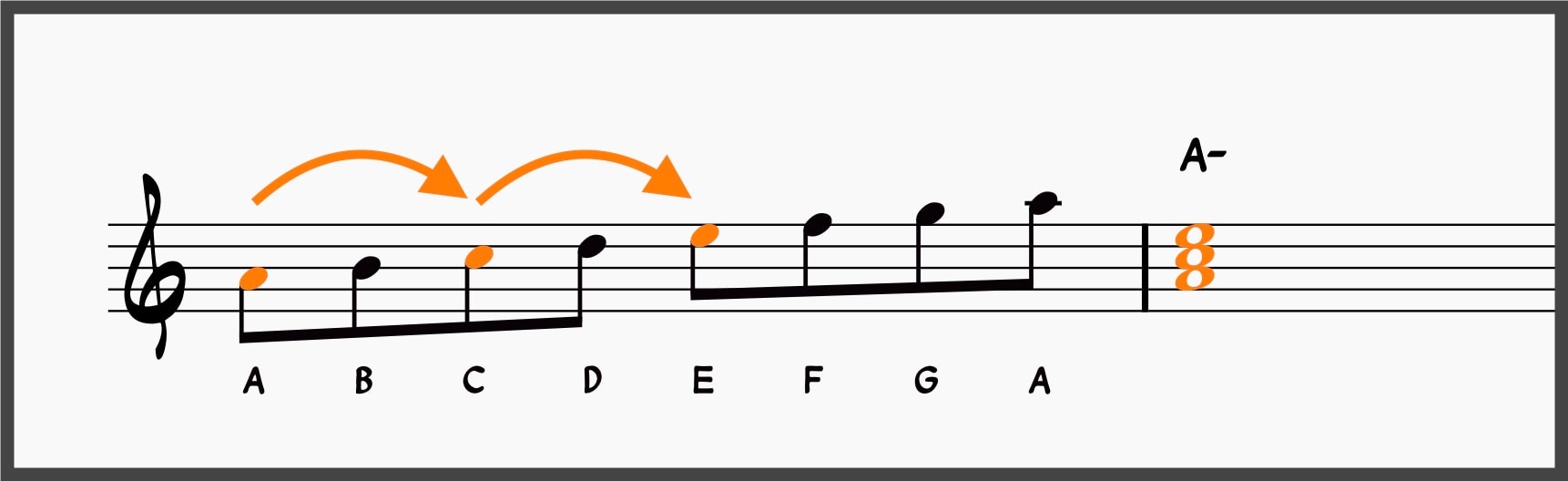
- A (A-B–C-D–E) → A minor
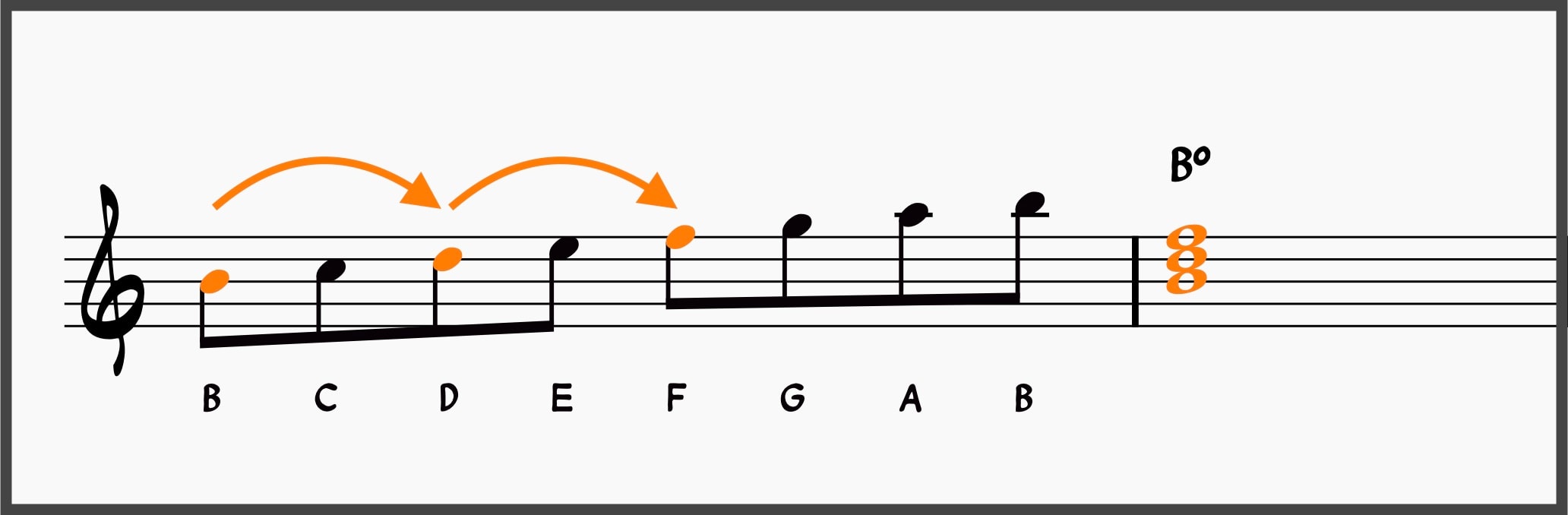
- B (B-C–D-C–F) → B diminished
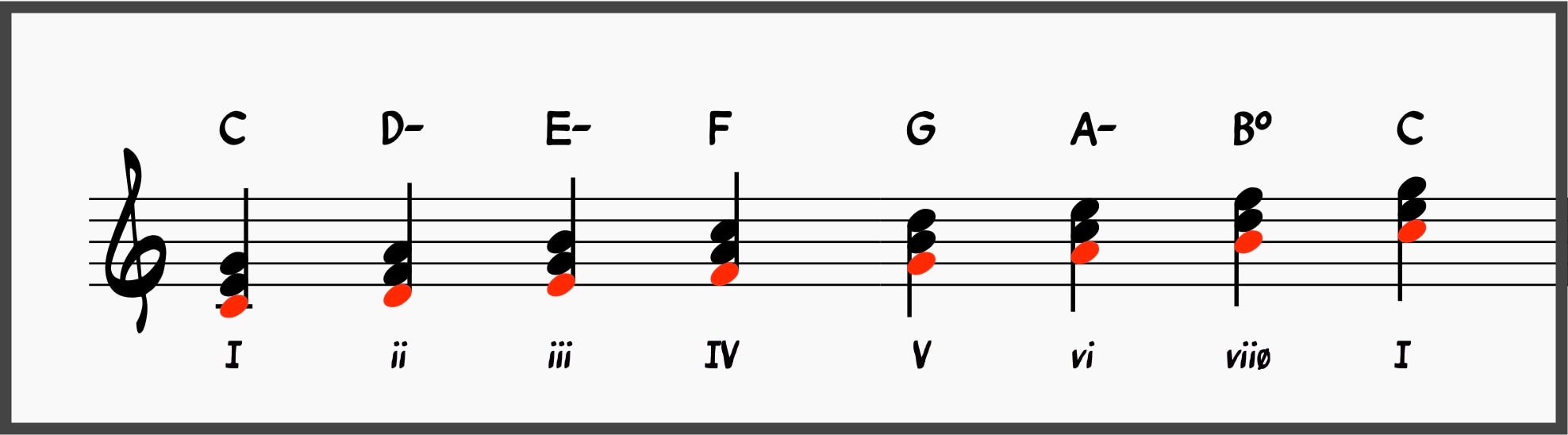
Here are all the diatonic chords in the key of C major. Note the original C major scale shown in red.
Diatonic Seventh Chords
From diatonic triads, we can build diatonic seventh chords, which are the fundamental building blocks of jazz harmony.
Seventh chords add a fourth note (a minor or major seventh interval) to the top of the triad.
- 7th
- 5th
- 3rd
- Root
Here is the C major scale harmonized in 7th chords. Notice that the seventh of each chord is highlighted in green.
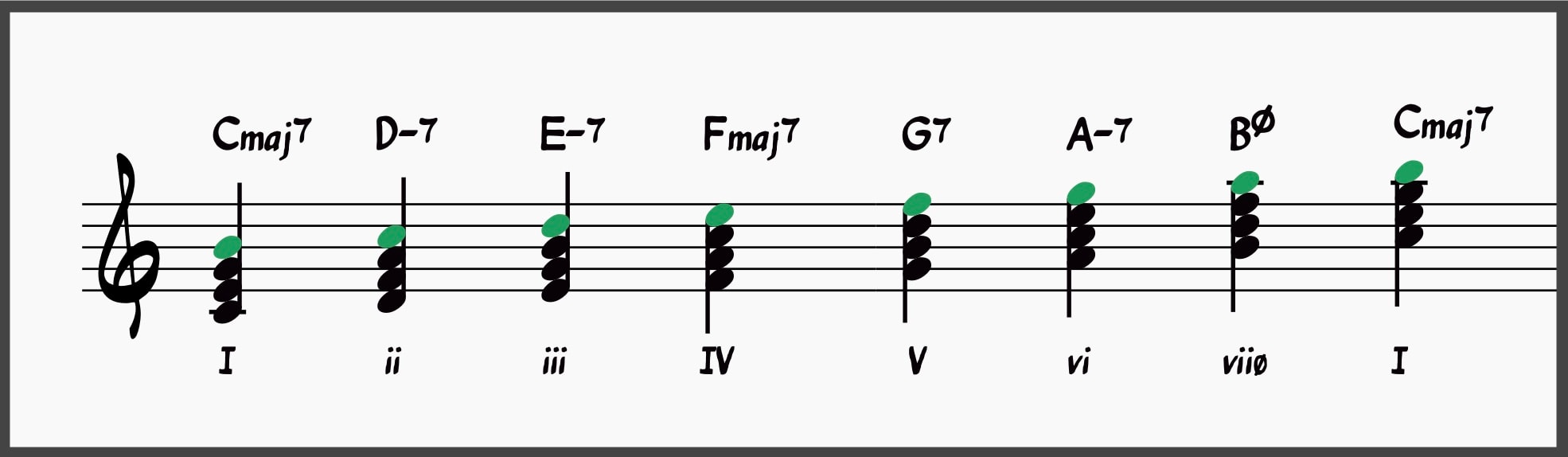
We use Roman numerals to label the relationship of diatonic chords to their tonic chord (the tonal center chord).
In the key of C major, we’d have:
- viiø Chord (Bø)
- vi Chord (A-7)
- V Chord (G7)
- IV Chord (Fmaj7)
- iii Chord (E-7)
- ii Chord (D-7)
- I Chord (Cmaj7)
This diatonic series of 7th chords is the backbone of functional harmony in jazz.
Check out this article for more on the diatonic series of chords.
Jazz standards are filled with diatonic progressions like the ii–V–I (Dm7–G7–Cmaj7). Understanding the diatonic system means you’re no longer guessing which chords “fit”—you can see exactly how they all originate from scales.
Check out this article to learn more about jazz chord progressions like the ii-V-I.
Diatonic Scale vs. Non-Diatonic Scales
It’s easy to get confused with terminology, so let’s clear it up. Here are three non-diatonic scales that don’t fit into the diatonic system.
Chromatic Scales
The chromatic scale consists entirely of half steps and contains all twelve notes within an octave.
- C-C#-D-D#-E-F-F#-G-G#-A-A#-B-C
Whole Tone Scales
The whole tone scale is built entirely from whole steps and consists of six notes within an octave.
- C-D-E-F#-G#-A#-C
Check out this article to learn more about the whole tone scale.
Diminished Scales
Diminished scales consist of an alternating series of half steps and whole steps. There are eight notes in one octave of the diminished scale.
Diminished scales have two forms: one that starts with a half step (called half-whole diminished), and another that begins with a whole step (called the whole-half diminished).
Half-Whole Diminished
- C-Db-Eb-E-F#-G-A-Bb-C
Whole-Half Diminished
- C-D-Eb-F-Gb-Ab-A-B-C
Check out this article to learn more about diminished scales.
Are the Harmonic Minor and Melodic Minor Scales Considered Diatonic?
Harmonic minor and melodic minor are common variations on the natural minor scale. The scale sequence differs from the traditional step sequence that makes up diatonic major and minor scales. So, are these variations considered diatonic?
Yes—but with some nuance.
What “Diatonic” Means
In the strictest, historical sense, “diatonic” refers to scales built out of seven notes spanning an octave, organized by whole steps (W) and half steps (H) in such a way that each letter name is used once.
The prototype is the major scale (W–W–H–W–W–W–H). The harmonic minor scale and melodic minor scale don’t technically fit the step sequence of W-W-H-W-W-W-H, unlike the natural minor scale and all the modes.
In the most strict sense, these scales aren’t diatonic. However, chords and modes from these alternate minor scales are used all the time within compositions based on the diatonic system. They also contain seven notes and feature no repeated notes.
It’s okay to classify these scales as diatonic, provided you understand the context and that their step sequence differs from that of the major scale, natural minor scale, and other modes derived from them.
Check out these articles to learn more about the harmonic minor and melodic minor scales.
Let’s Review!
There are two main forms of the diatonic scale:
The Major Diatonic Scale
- Formula: W – W – H – W – W – W – H
- Example: C major (C–D–E–F–G–A–B–C)
- This is the “default” diatonic scale and the foundation for most Western harmony.
The Natural Minor Diatonic Scale
- Formula: W – H – W – W – H – W – W
- Example: A natural minor (A–B–C–D–E–F–G–A)
- Natural minor is also diatonic because it follows the same “seven-note system” of whole and half steps.
There are also diatonic modes you need to know, too!
Diatonic Harmony
When you harmonize diatonic scales, you get diatonic chords. Diatonic chords are the backbone or the harmonic foundation on which Western music is composed.
Practical Applications for Jazz Musicians
So why does this matter for you as a jazz player? Because most of the harmony in jazz standards is diatonic—at least as a starting point.
- Improvisation: The diatonic scale gives you “home base” notes that will always fit over the chords. For example, C major scale tones all fit cleanly over a Cmaj7 chord.
- Progressions: Diatonic progressions like ii–V–I or I–vi–ii–V are everywhere. Being able to instantly recognize and map them comes straight from knowing your diatonic scales.
- Ear Training: When you can hear diatonic movement, you’ll start recognizing standards faster—like how “Autumn Leaves” moves around the diatonic circle of fifths.
How to Practice the Diatonic Scale
Knowing the definition is one thing—owning it on your instrument is another. Here are some effective ways to practice:
- Play in All 12 Keys
Don’t just stick to C major. Cycle through all the keys so your ear and fingers adapt. - Map Out Chords
Build diatonic triads and seventh chords directly from the scale. This strengthens your harmony knowledge. - Use Patterns and Intervals
Practice scales in 3rds, 4ths, and arpeggios. Example in C major. - Guide Tone Exercises
Focus on 3rds and 7ths of diatonic chords to train your voice-leading. - Improvise Diatonic Lines
Create simple motifs using only scale tones over diatonic progressions. Record yourself and listen back.
Common Misconceptions About the Diatonic Scale
Let’s clear up a few diatonic scale myths:
- “Diatonic means major only.” → Not true. Natural minor and all the modes are diatonic too.
- “The diatonic scale is too basic for jazz.” → Wrong again. Diatonicism is the foundation. Even advanced reharmonizations usually start from a diatonic base.
- “You don’t need to practice diatonic scales if you’re advanced.” → Every pro constantly reinforces their command of the fundamentals—it’s the language everything else is built on.
Level Up Your Jazz Chops—Join the Learn Jazz Standards Inner Circle
Want to become the best jazz player you can be, but not sure where to start? Check out the Learn Jazz Standards Inner Circle. The Inner Circle has everything you need to blast through practice plateaus and become a better musician.
Improve in 30 Days or Less. Join the Inner Circle.