
Perhaps the most important concept you’ll encounter when studying jazz is chord quality. Chord qualities tell musicians everything they need to know about chord progressions and how to improvise over them.
Being able to identify chord qualities by ear is an essential skill you must develop if you want to be the best jazz musician you can be. Understanding chord qualities gives you the blueprint for how harmony works, how to comp effectively, and how to improvise lines that sound intentional rather than random.
In this guide, we’ll go over all the most common types of chord qualities you need to know. You’ll learn about:
- The four triad chord qualities every musician must know
- The four foundational seventh chord qualities used in jazz
- Less common seventh chord qualities that add color, tension, and that jazzy, contemplative sound to chord changes
By the end, you’ll have a roadmap for hearing, recognizing, and using your knowledge of chord qualities to solo like a jazz pro!
If you want to take your jazz playing to the next level, check out the Learn Jazz Standards Inner Circle. The Inner Circle has everything you need to take your jazz playing to the next level!
Improve in 30 days or less. Join the Inner Circle.
Table of Contents
What Is a Chord Quality?
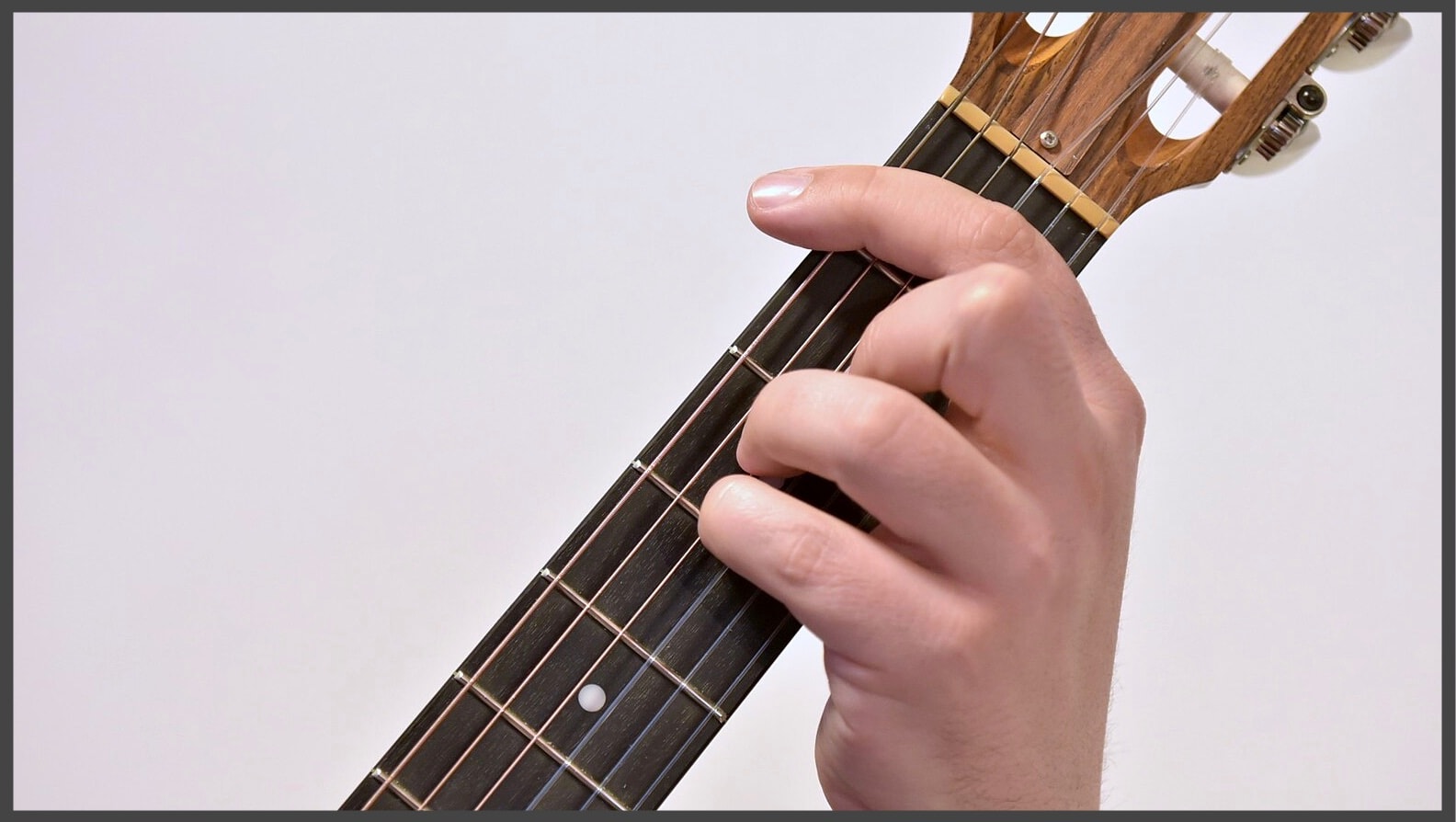
image source: Wikimedia Commons
First things first! Let’s define chord quality.
A chord quality describes the specific type of chord you’re dealing with, determined by the intervals between its notes. Western harmony predominantly uses tertian harmony or chords based on stacked thirds.
At its core, every chord needs three notes:
- root note
- third
- fifth
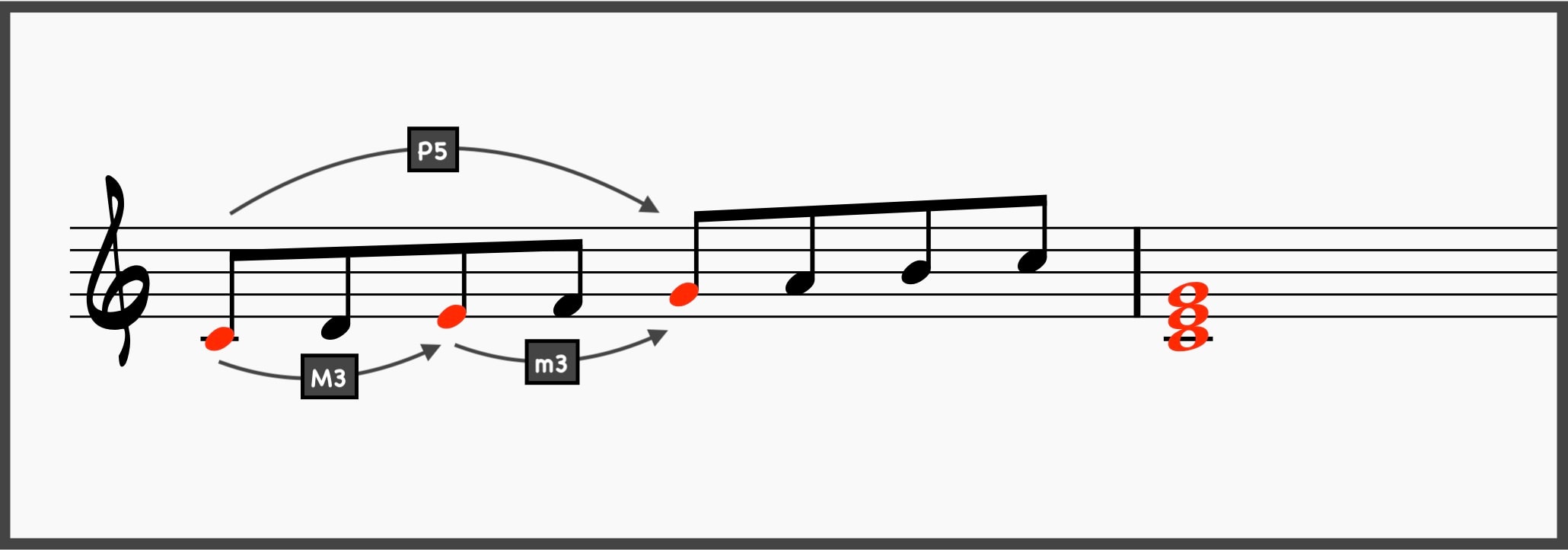
Here, we’ve taken the C major scale and highlighted C, E, and G. These notes are each a third apart. C to E is a major third, and E to G is a minor third. The major and minor refer to the size of the intervals. In music theory, music intervals describe the distance between two notes.
We can also describe this distance in the number of half steps. A minor third is three half steps, and a major third is four half steps. The distance from C to E is four half steps, and the distance from E to G is three half steps.
Check out this article for more on musical intervals.
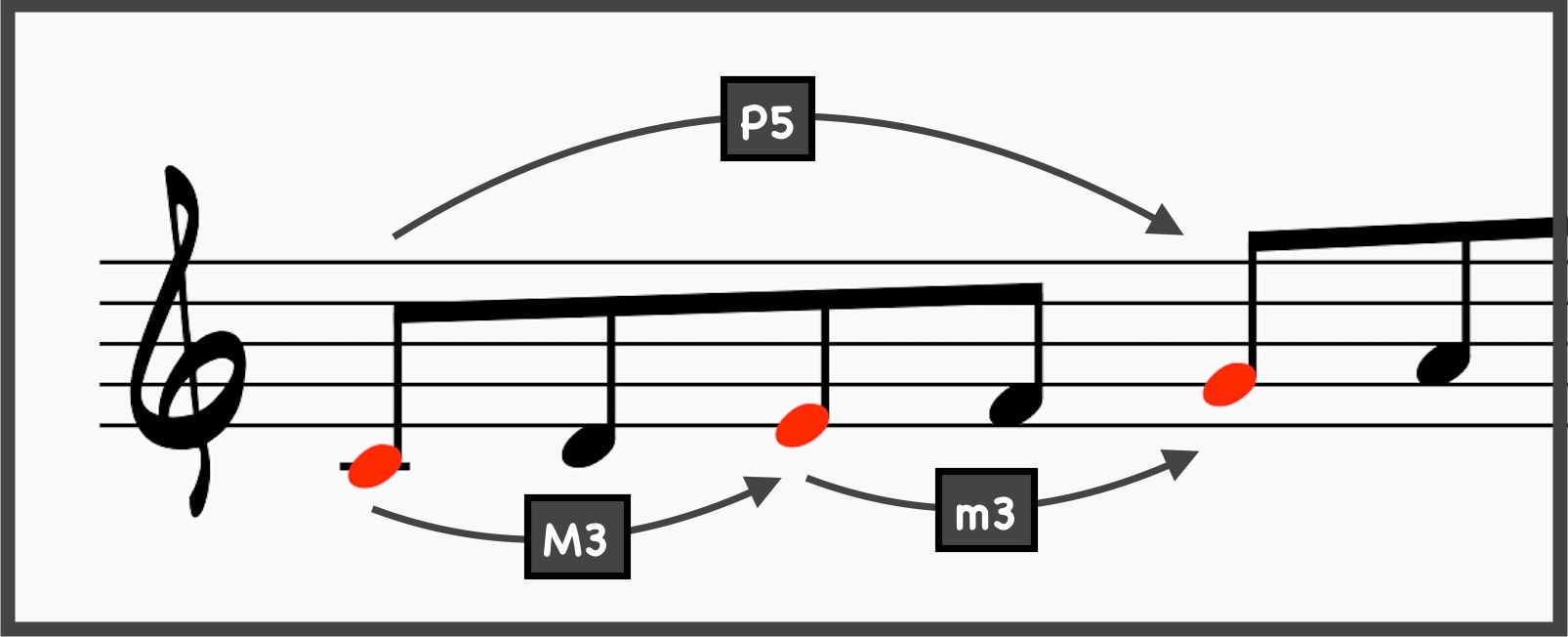
This particular triad is a major chord, but there are other triad chord qualities you need to be aware of, too! Let’s learn about the four triad chord qualities.
The Four Triad Chord Qualities
As we’ve discussed, triads are chords built from three notes stacked in thirds. There are four triad qualities you need to know, and they all derive from the possible combinations of two intervals—major and minor thirds.
1. Major Triad (1 – 3 – 5)

We’ve already examined a major triad quality in the section above, but here it is again for thoroughness! Here are the important interval relationships that determine if a chord is of major quality.
- We need a major third interval between the root note and the 3rd (C to E is a major third)
- We need a minor third interval between the 3rd and the 5th (E to G is a minor third)
- The combination of those intervals (M3 + m3) adds up to a perfect 5th between the root and the fifth (C to G).
Diatonic Chords: When harmonizing diatonic scales (major scale, natural minor scale, and associated modes), major triads make up a significant number of the chords you encounter.
Check out this article for more on the diatonic scale and this one for diatonic chords.
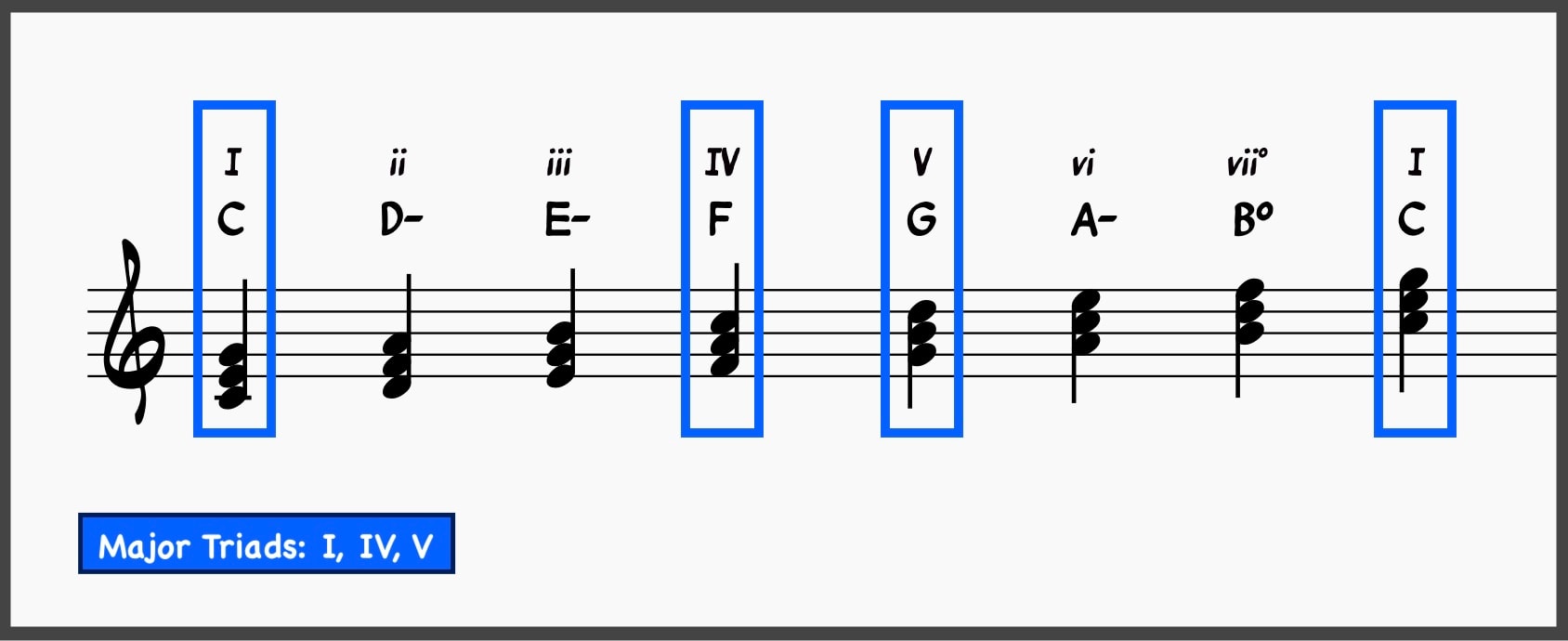
The I chord, IV chord, and V chord are major triads in major keys.
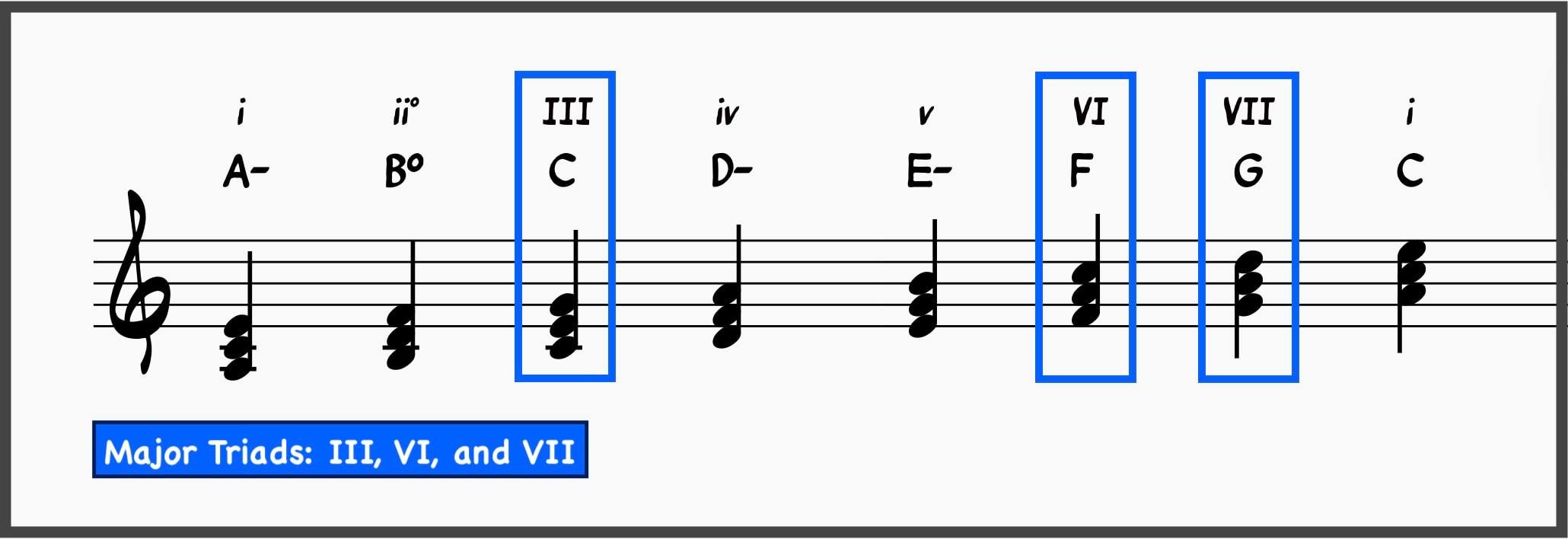
The III chord, VI chord, and VII chord are major triads in minor keys.
Check out this article for more on major triads on guitar.
2. Minor Triad (1 – b3 – 5)
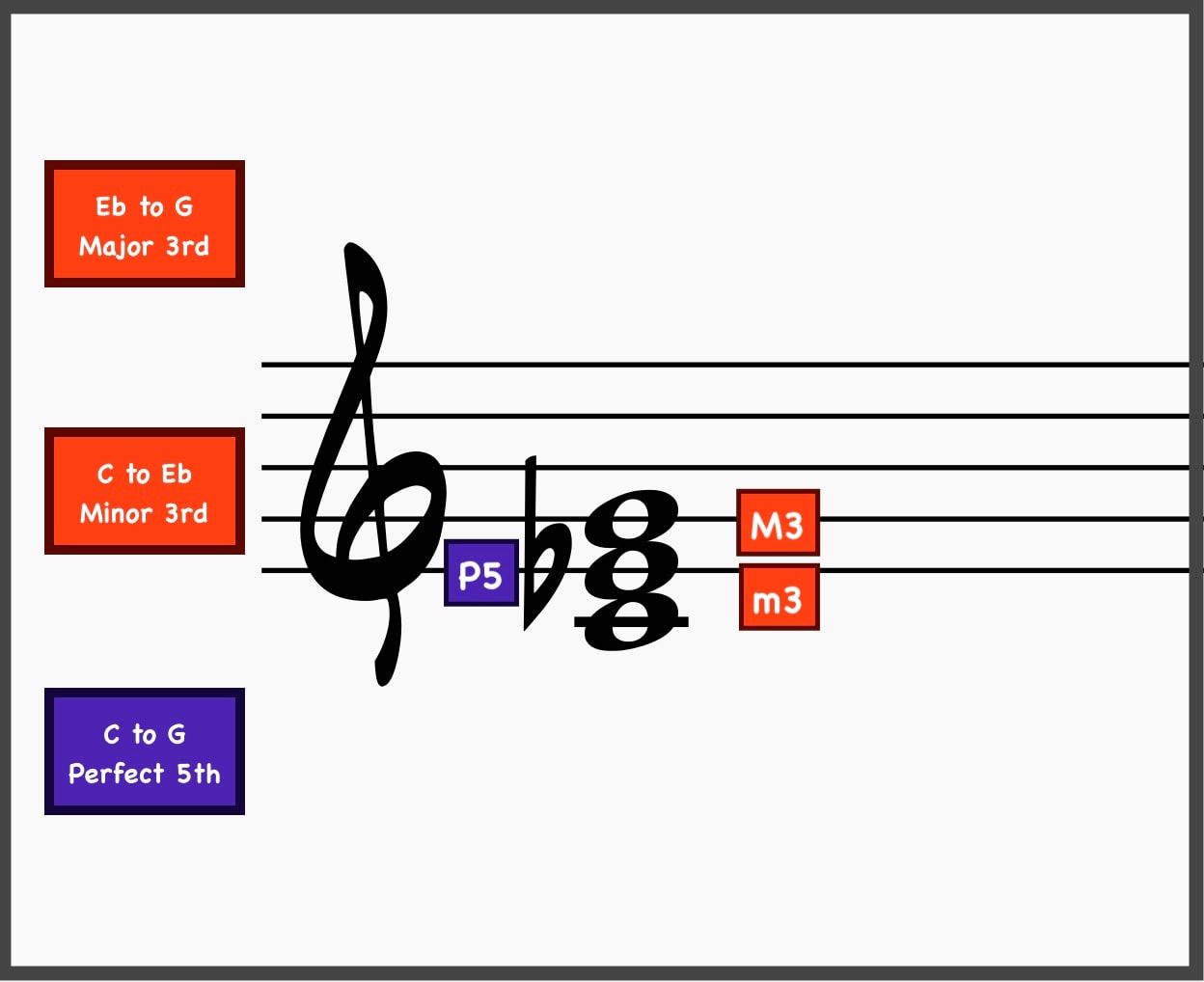
Minor triads still span the total interval distance of a perfect fifth (C to G), but the internal intervals are flipped. Instead of a major third on the bottom and a minor third on top (major triad), you get the opposite—a minor third on the bottom (C to Eb) and a major third on top (Eb to G).
- We need a minor third interval between the root note and the 3rd (C to Eb is a minor third)
- We need a major third interval between the 3rd and the 5th (Eb to G is a major third)
- The combination of those intervals (m3 + M3) adds up to a perfect 5th between the root and the fifth (C to G).
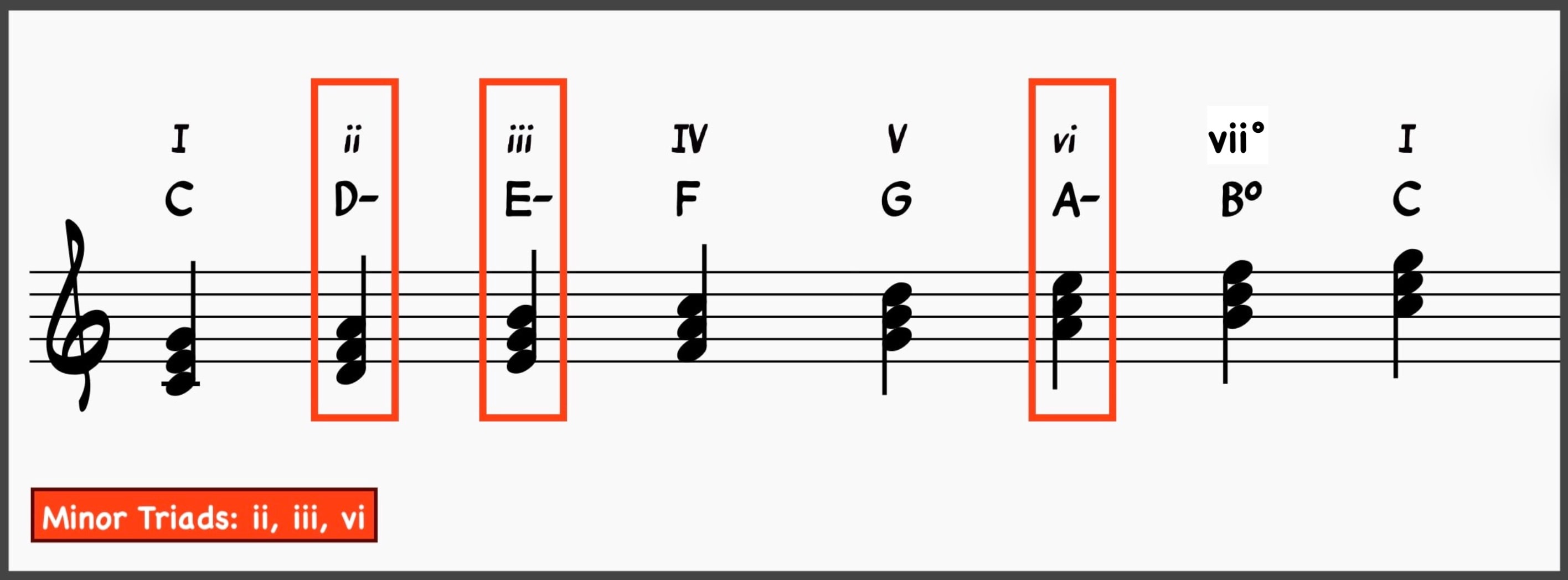
Diatonic Chords: You can also find minor triads in harmonized diatonic scales. Here are all the minor triads in the major scale.
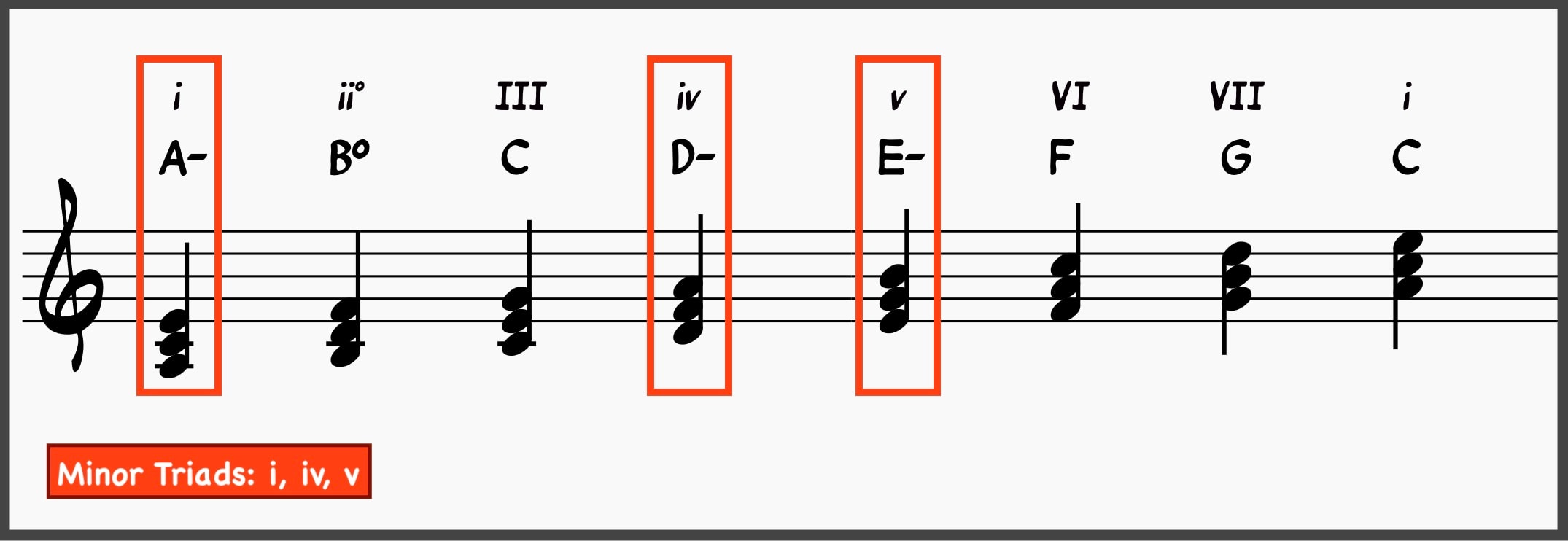
And here are all the minor triads in the natural minor scale.
Check out this article to learn more about minor triads on the guitar.
3. Diminished Triad (1 – b3 – b5)
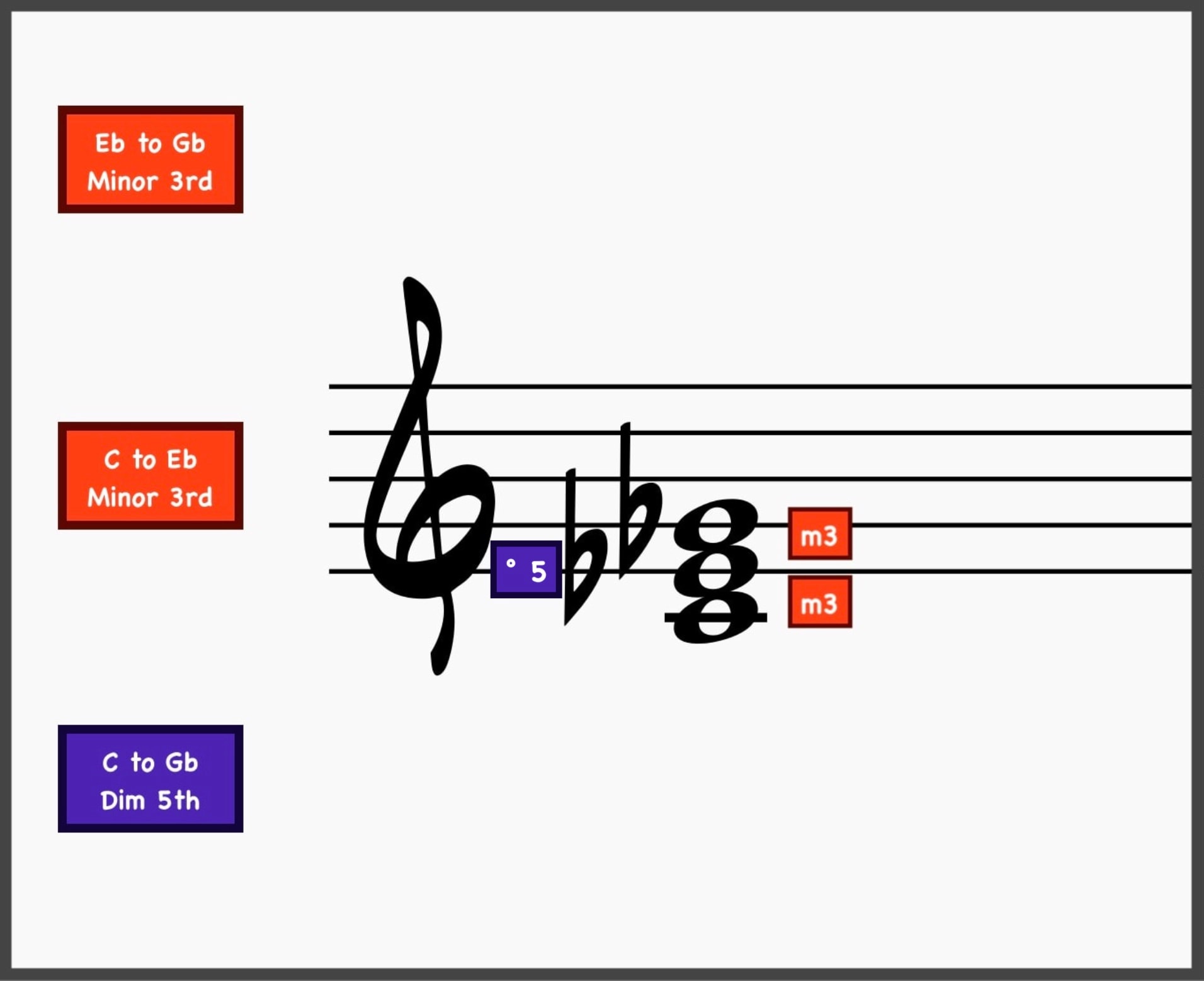
Diminished triads span the total distance of a diminished fifth and are built from two minor thirds. The total distance from the root note to the fifth of the chord is a half step lower than with major or minor triads.
- We need a minor third interval between the root note and the 3rd (C to Eb is a minor third)
- We need another minor third interval between the 3rd and the 5th (Eb to Gb is a major third)
- The combination of those intervals (m3 + M3) adds up to a perfect 5th between the root and the fifth (C to G).
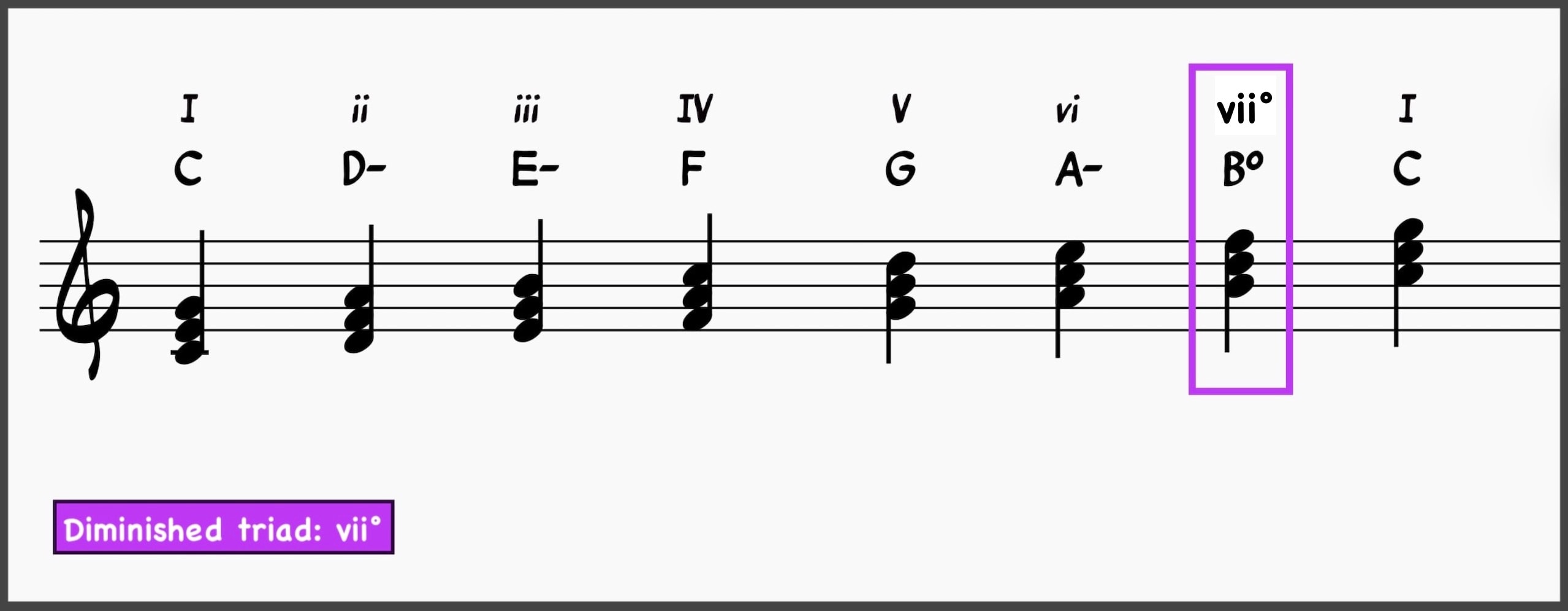
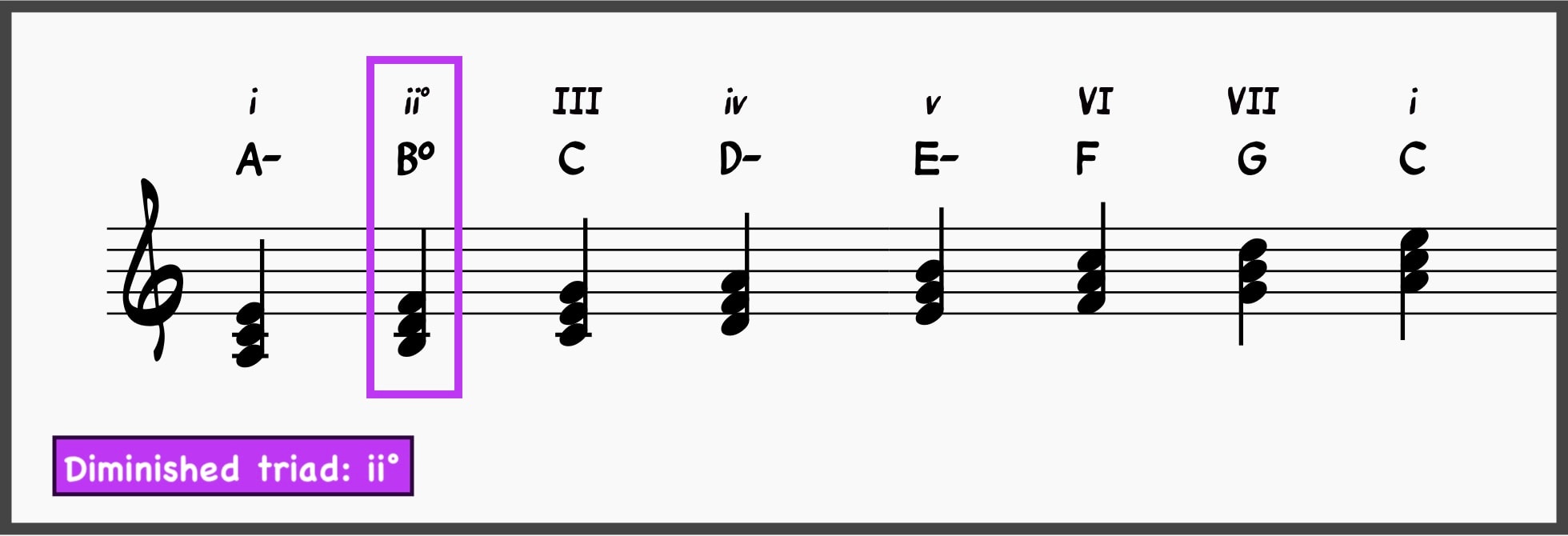
Diatonic Chords: One diminished triad appears in diatonic major and minor scales. In major keys, it is the vii° chord, and in minor keys, it is the ii° chord.
Here is the diminished triad in the natural minor scale.
Check out this article on diminished triads on guitar for more information.
4. Augmented Triad (1 – 3 – #5)
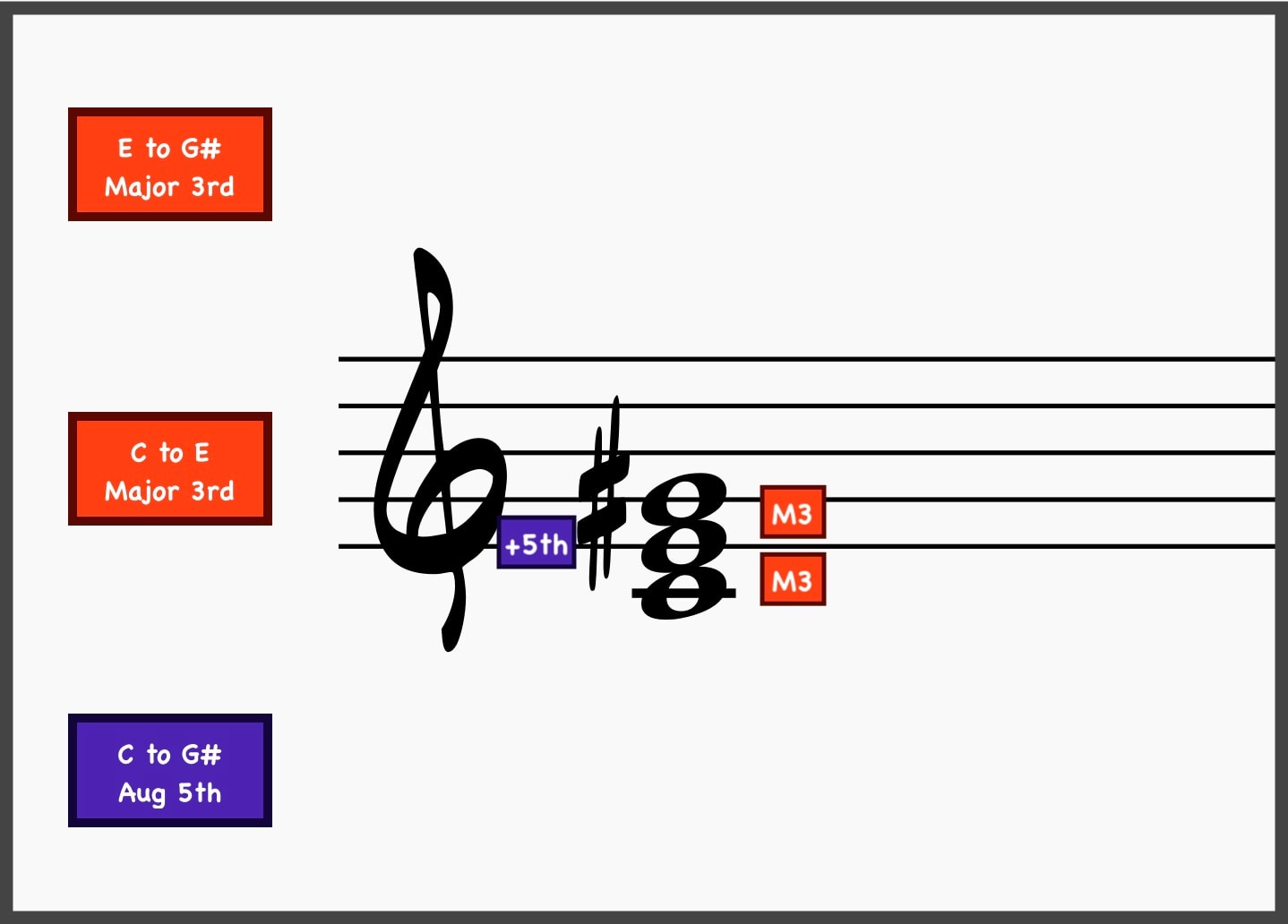
Diminished triads span the total distance of an augmented fifth (or minor sixth interval) and are built from two major thirds stacked on top of one another. The total distance from the root note to the augmented fifth of the augmented triad is one half step larger than major or minor chords.
- We need a major third interval between the root note and the 3rd (C to E is a major third)
- We need another major third interval between the 3rd and the 5th (E to G# is a major third)
- The combination of those intervals (M3 + M3) adds up to an augmented 5th (minor 6th) between the root and the fifth (C to G#).
Diatonic Chords? Augmented triads don’t appear in the major or natural minor scales; however, they do occur in the melodic and harmonic minor scales.
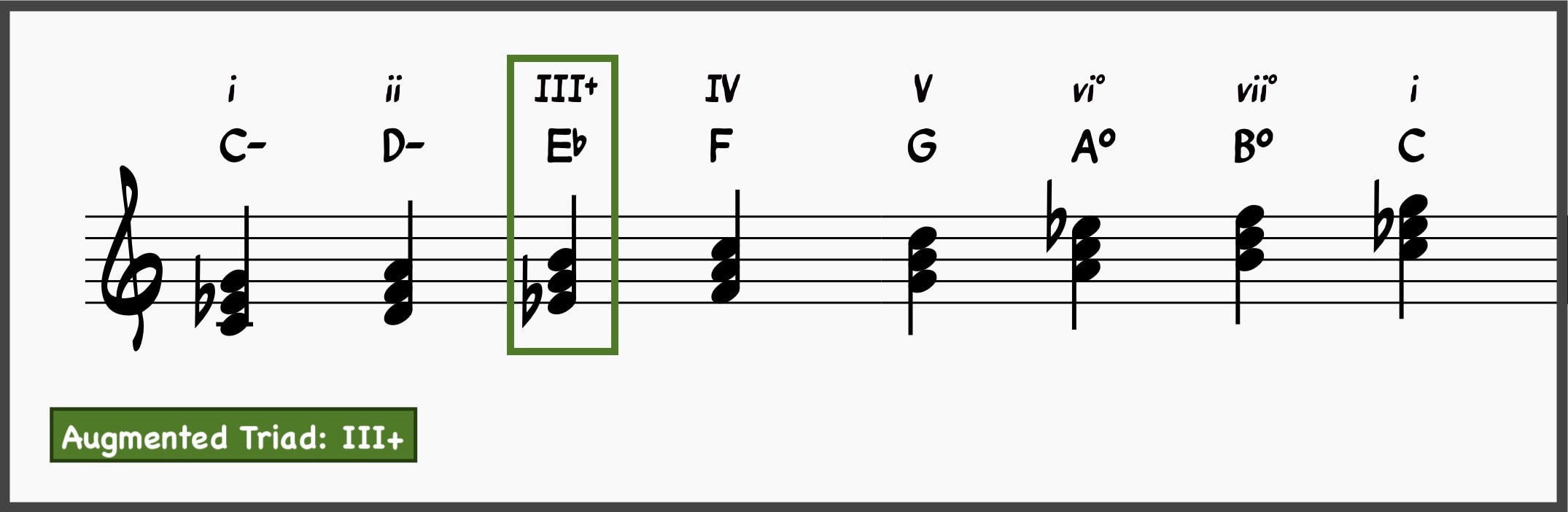
There is an augmented triad on the third scale degree of the melodic minor scale.

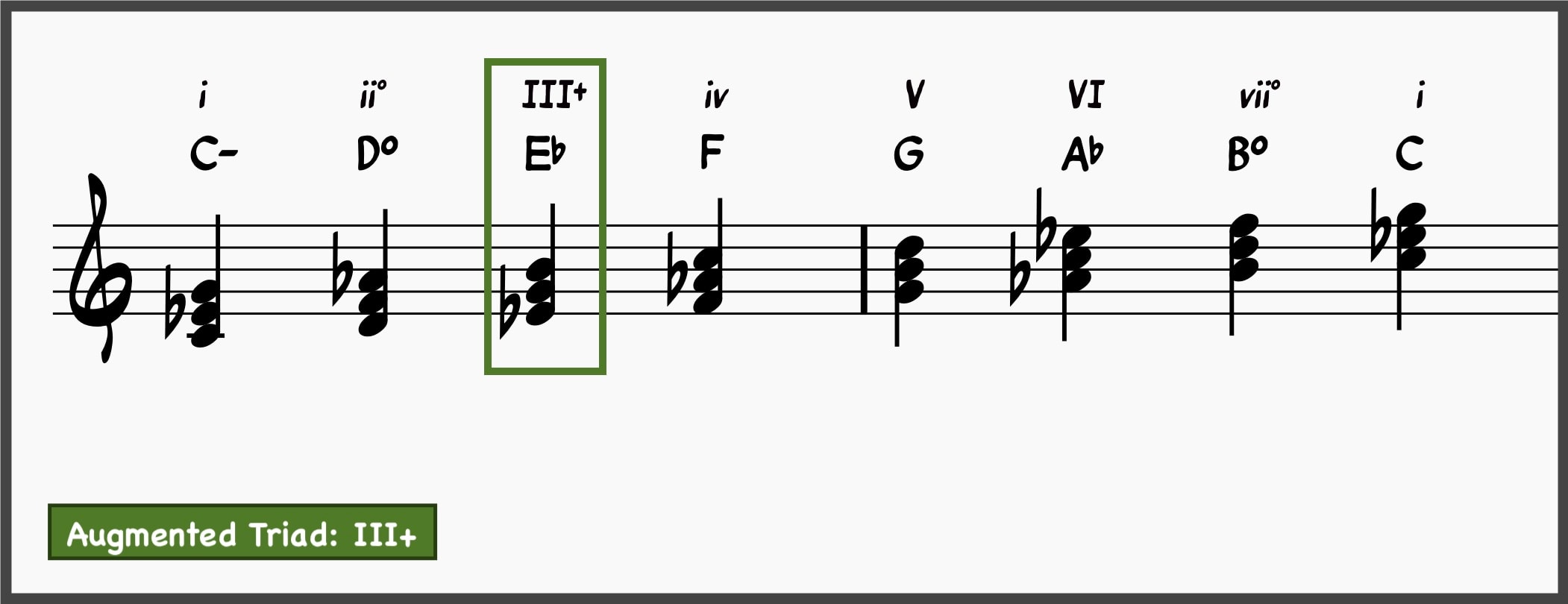
And there is an augmented chord on the third scale degree of the harmonic minor scale.
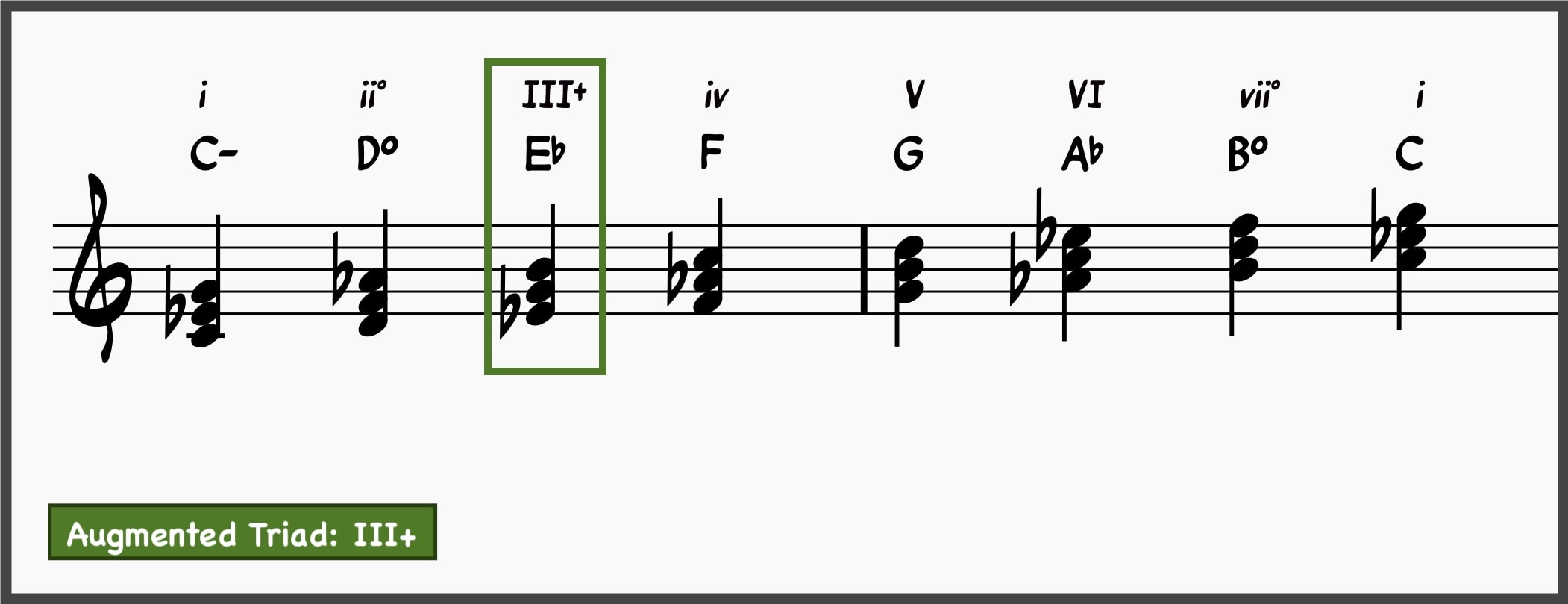
Diatonic and Non-Diatonic Triads
We’ve talked about four triad qualities: major, minor, diminished, and augmented chords. Three out of our four triad chord qualities appear in the major and natural minor scales.
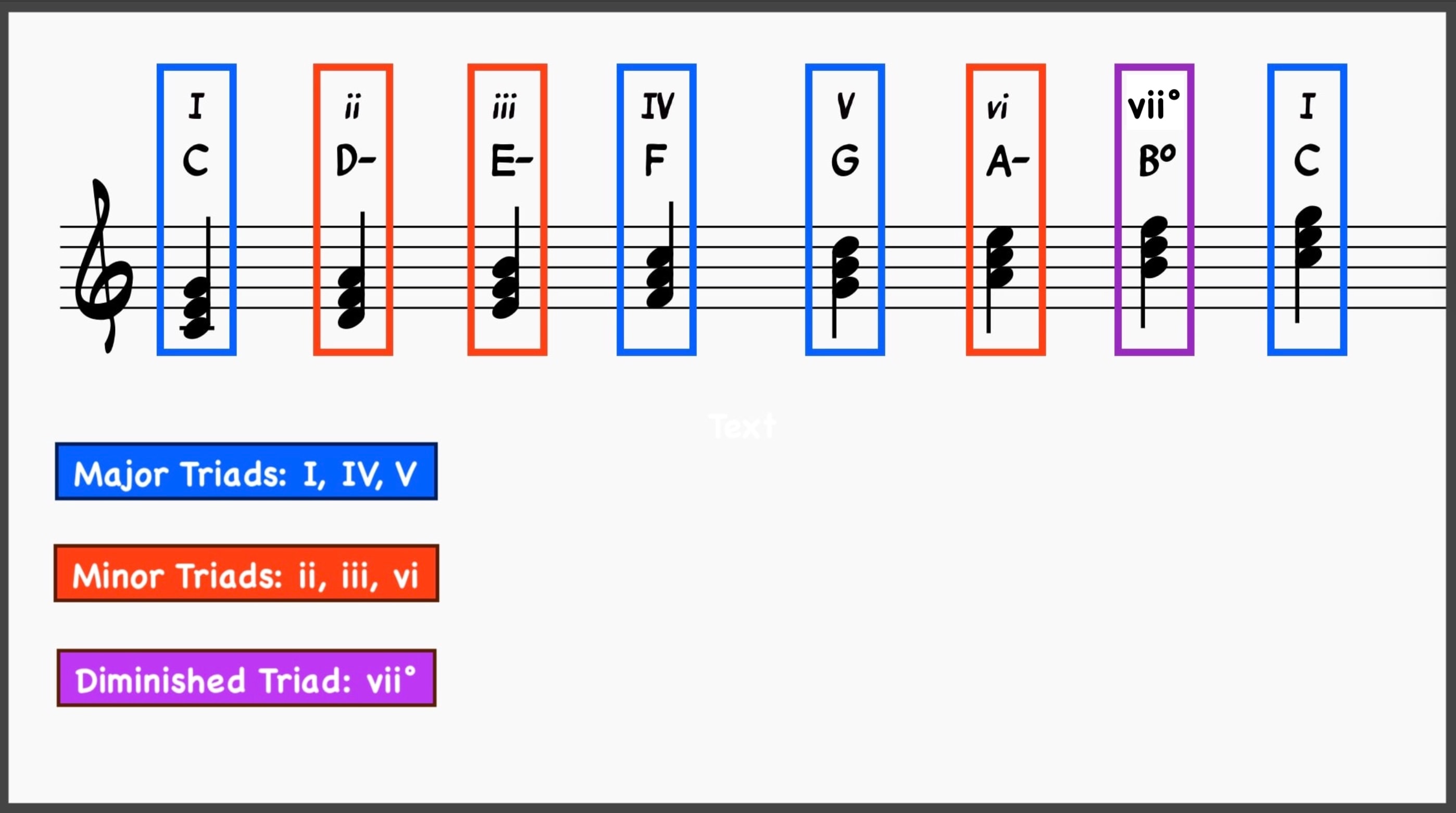
Augmented triads do not appear in these diatonic scales, but do appear in the harmonic minor and melodic minor scales. Here is an augmented triad highlighted in the melodic minor scale.
And here it is in the harmonic minor scale.
Check out this article for more on harmonic minor and this one for more on melodic minor.
The Four Basic Seventh Chord Qualities
Jazz players need to know their triads, but seventh chords are more important when it comes to jazz chord progressions. Seventh chords expand triads by adding another third on top of the 5th.
This extra note introduces a new variable into the mix, creating richer and denser chord qualities than your typical triad. There are four main types of seventh chord qualities you need to memorize:
- Major Seventh Chord
- Dominant Seventh Chord
- Minor Seventh Chord
- Half-Diminished Chord
Let’s start with the major seventh chord.
1. Major Seventh Chord (maj7)

A major seventh chord consists of a major triad and has a major seventh interval from the root as the top note. In the key of C, a major 7th chord is spelled:
- 7th: B
- 5th: G
- 3rd: E
- Root: C
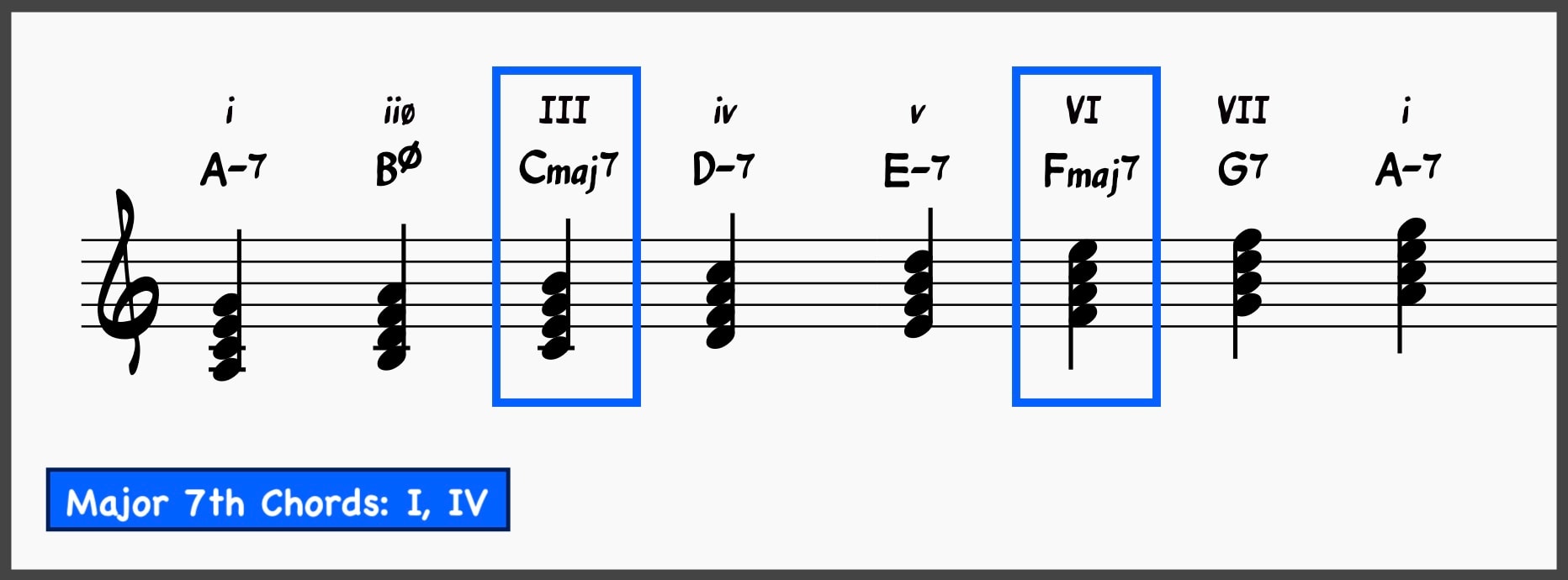
Diatonic Chords: Major seventh chords appear in major and minor keys. In major keys, the I chord and the IV chord are major seventh chords. In minor keys, the III chord and the VI chord are major seventh chords.
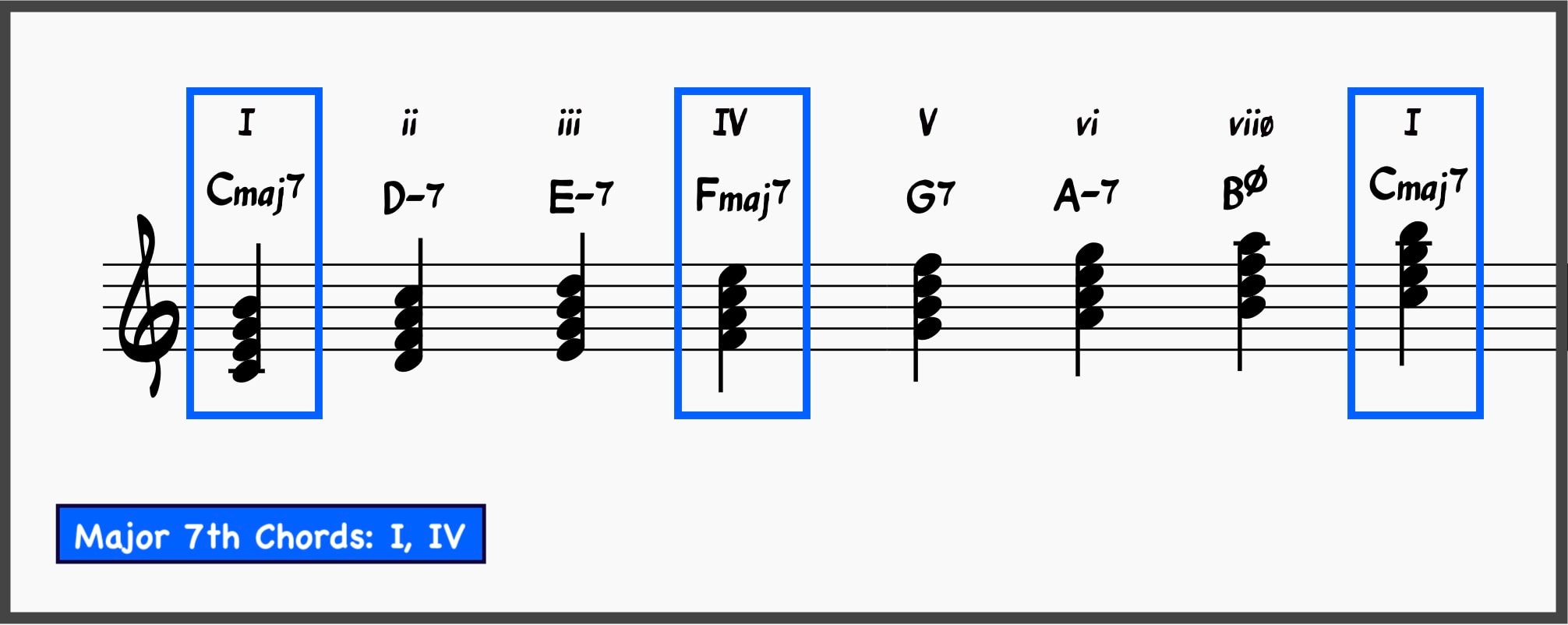
When we were dealing with triads, the I and IV chords were grouped with the V chord, but when we add the seventh, we end up with two categories: major seventh chords and dominant seventh chords.
Here are major seventh chords as they appear in the minor diatonic series.
Check out this article to learn more about major seventh chords.
2. Dominant Seventh Chord (7)
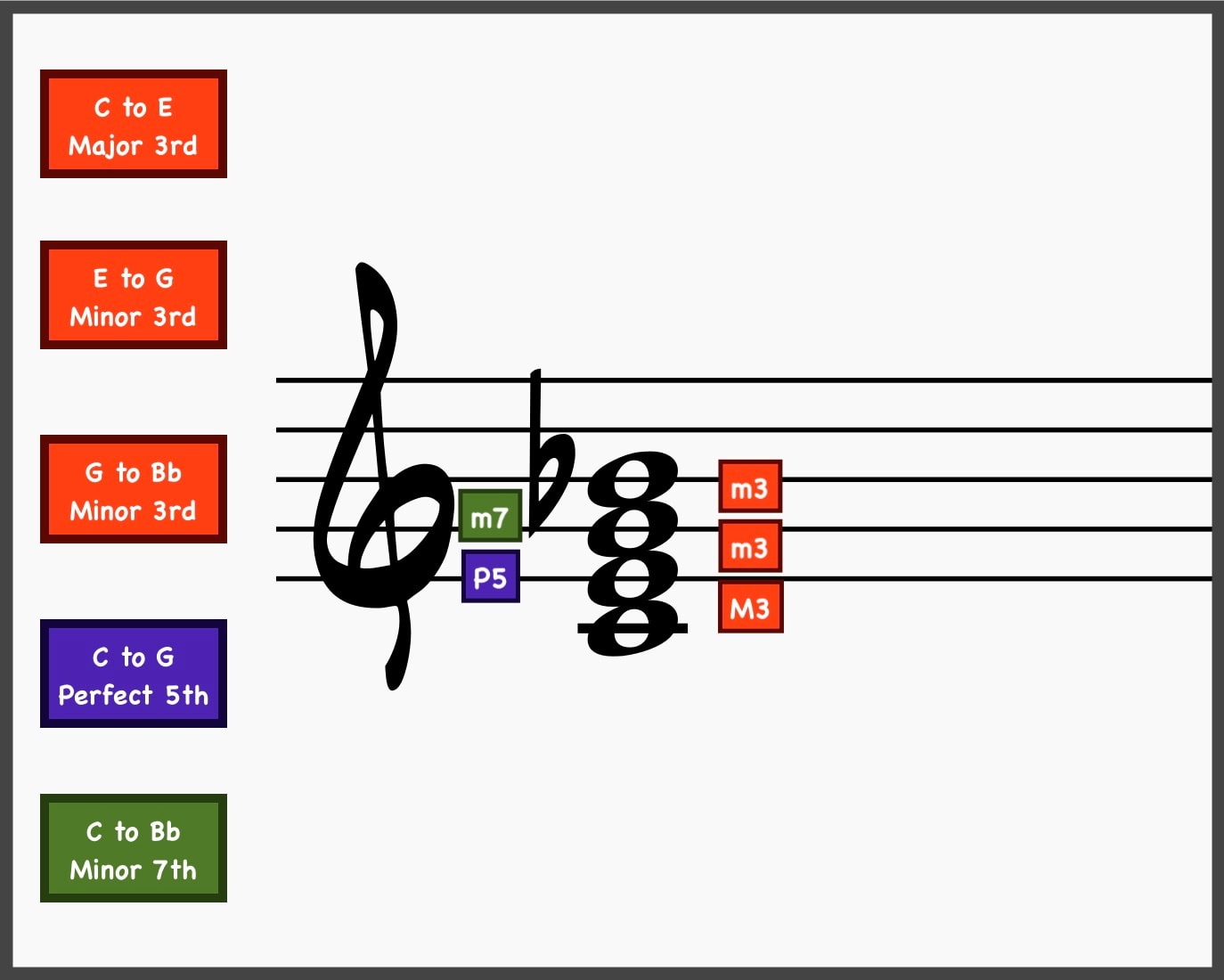
A dominant seventh chord consists of a major triad with a minor seventh interval from the root added to the top. A C7 chord is spelled:
- 7th: Bb
- 5th: G
- 3rd: E
- Root note: C
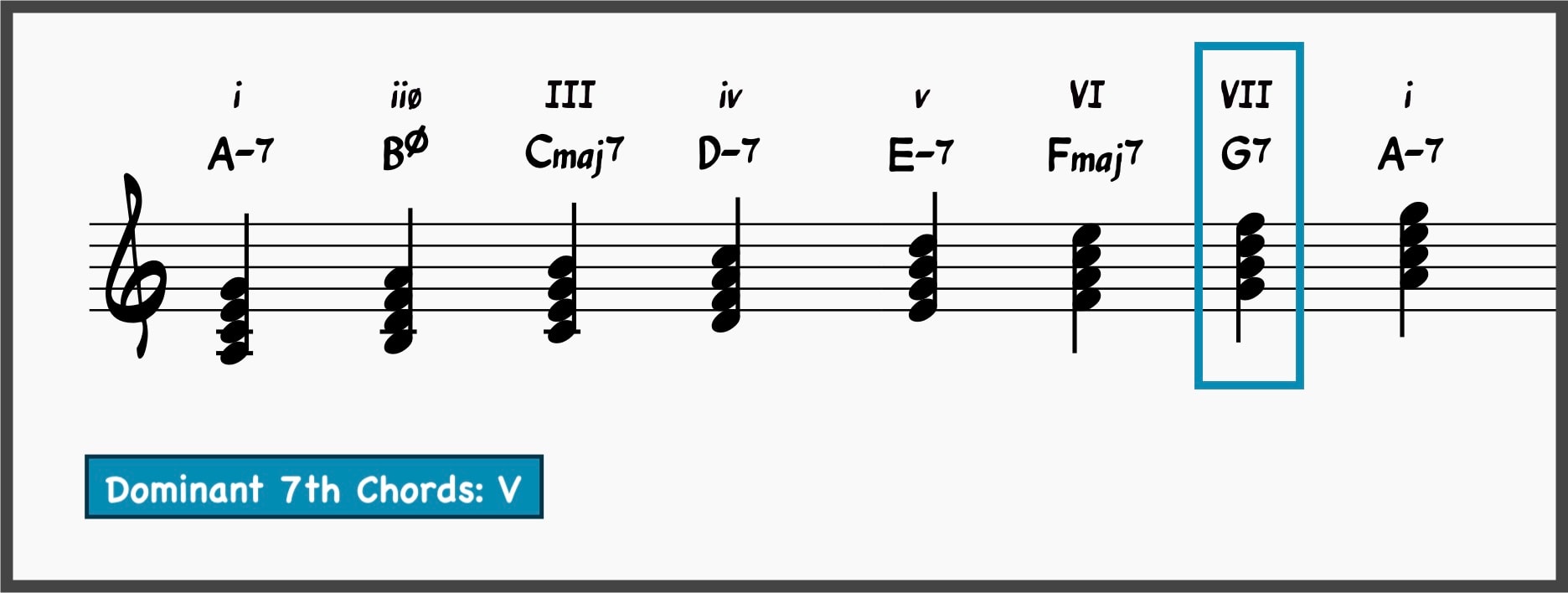
Diatonic Chords: Dominant chords appear once in major and minor keys. In major keys, the dominant chord is built from the fifth scale degree.
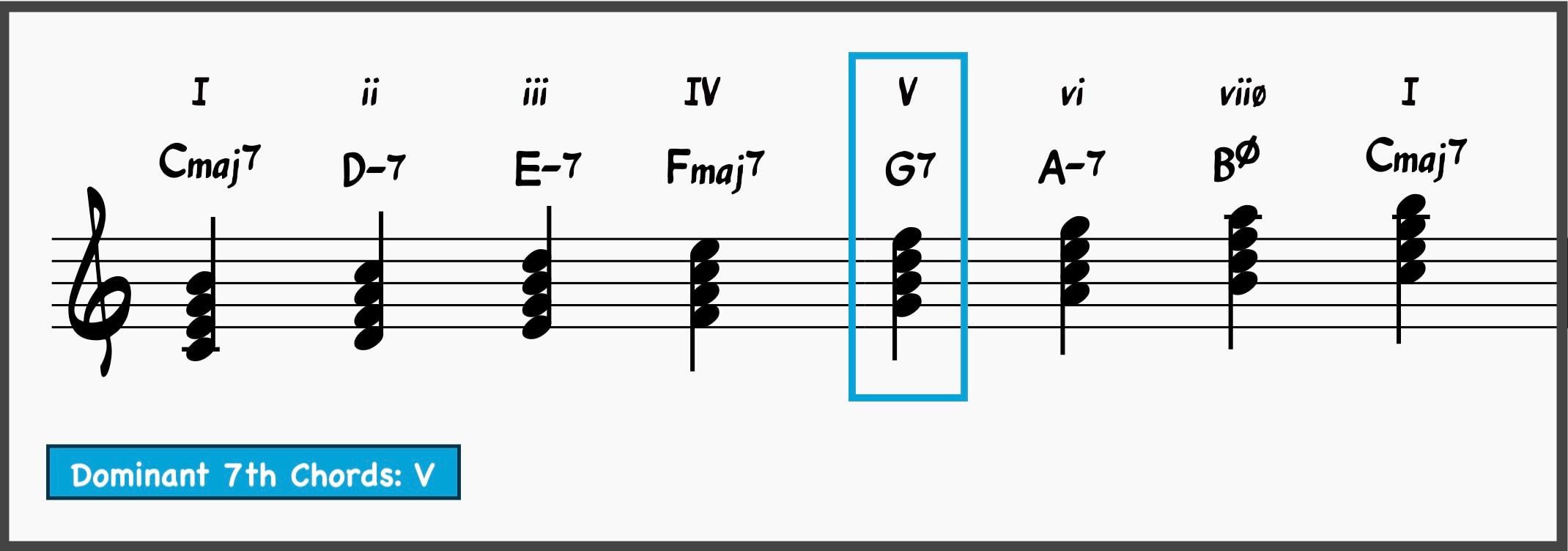
In minor keys, you’ll find the dominant seventh on the seventh scale degree.
Check out this article to learn more about dominant seventh chords.
3. Minor Seventh Chord (m7)

We’ve added to a major triad and built a major seventh chord and a dominant seventh chord, but what about minor triads? When you add a minor seventh interval from the root of a minor triad, you get a minor seventh chord! A C-7 chord is spelled:
- 7th: Bb
- 5th: G
- 3rd: Eb
- root: C
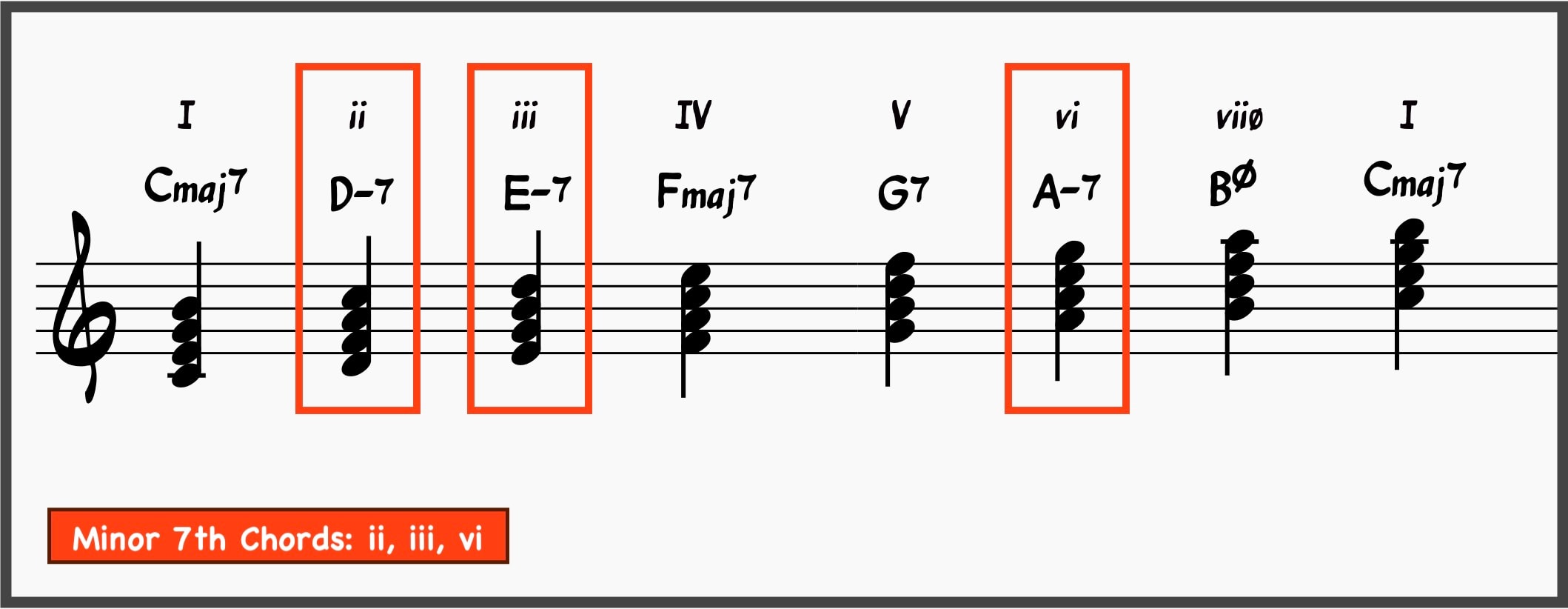
Diatonic Chords: Minor seventh chords occur in major and minor keys. In major keys, the ii, iii, and vi chords are minor seventh chords.
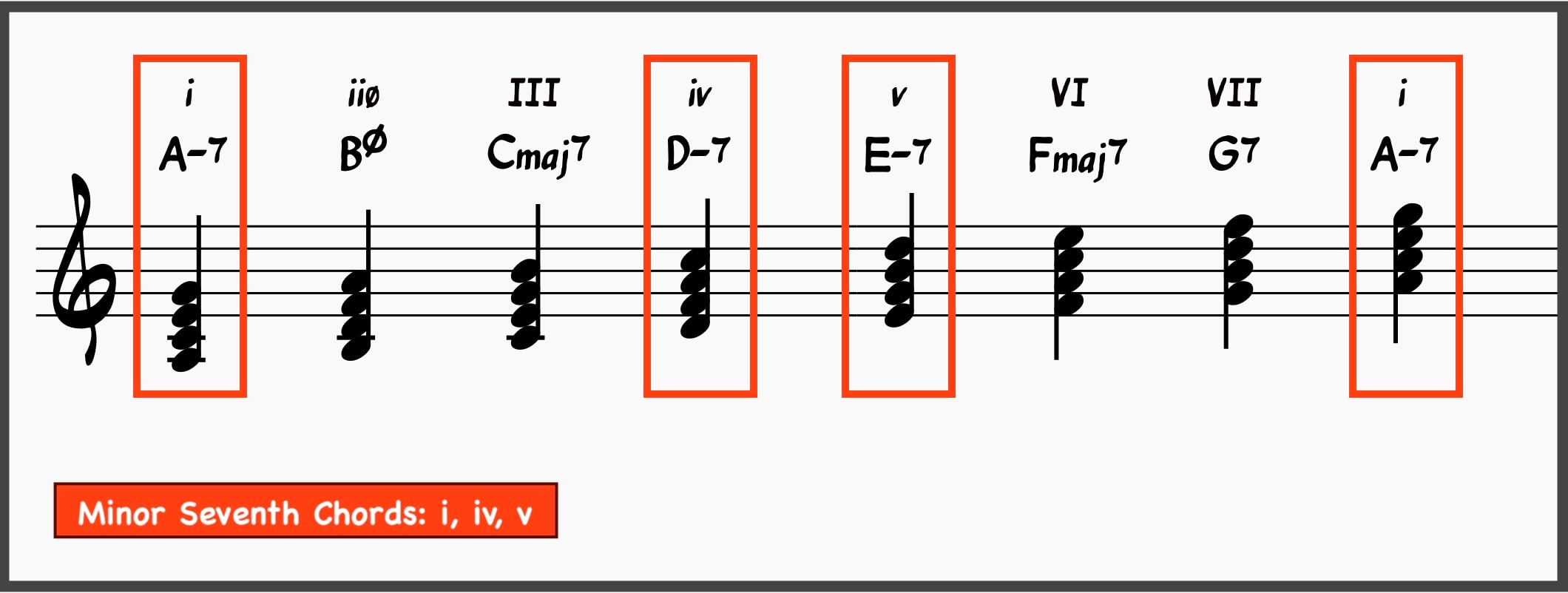
In minor keys, the i, iv, and v chords are minor seventh chords.
Check out this article to learn more about minor seventh chords.
4. Half-Diminished Seventh Chord (m7♭5)
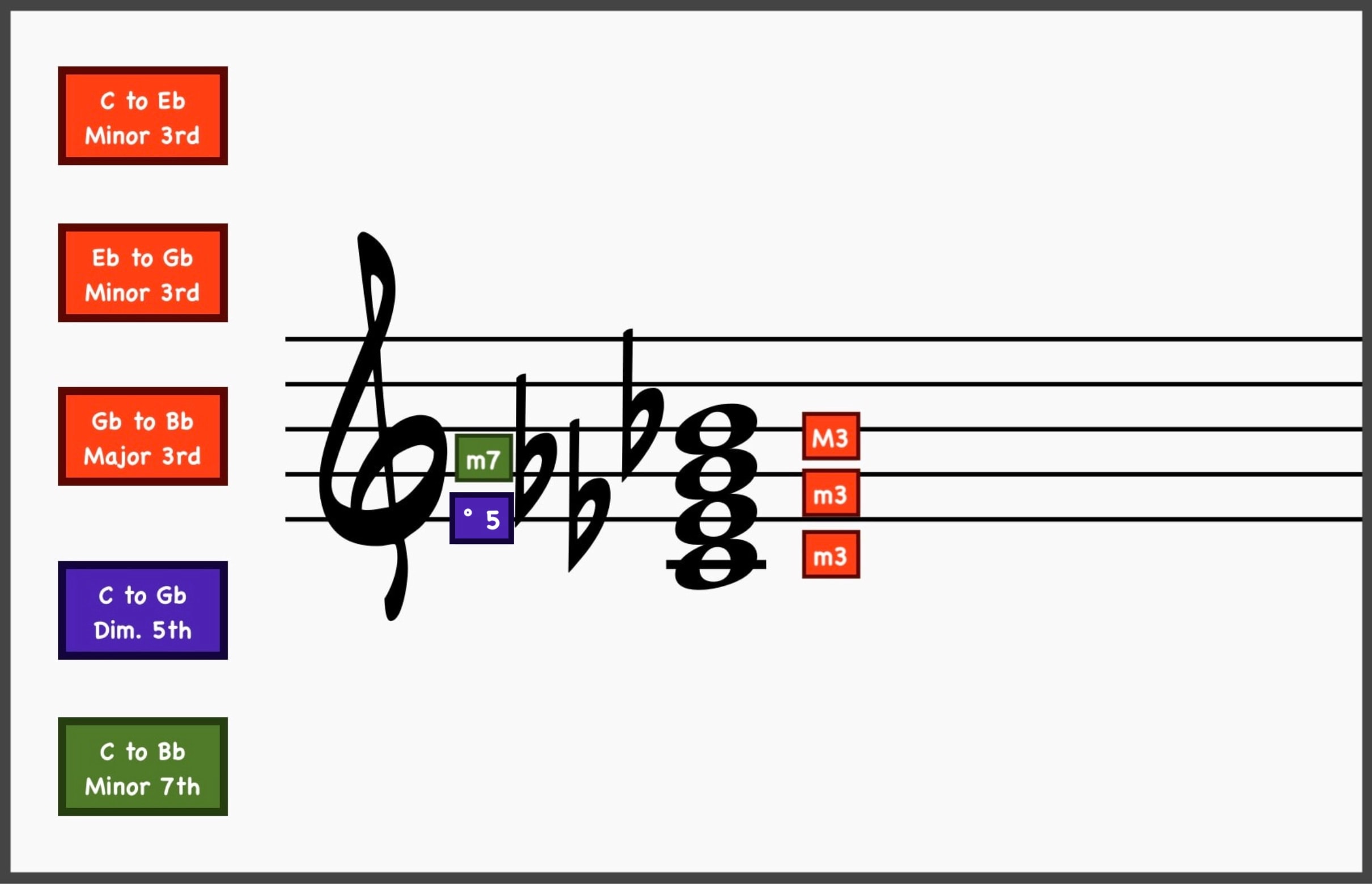
When you add a minor seventh interval over a diminished triad, you get a half-diminished chord or -7b5 chord. A C-7b5 chord is spelled:
- 7th: Bb
- 5th: Gb
- 3rd: Eb
- root: C
Diatonic Chords: Like dominant chords, half-diminished chords appear once in major and minor keys. In major keys, the viiø chord is half-diminished.
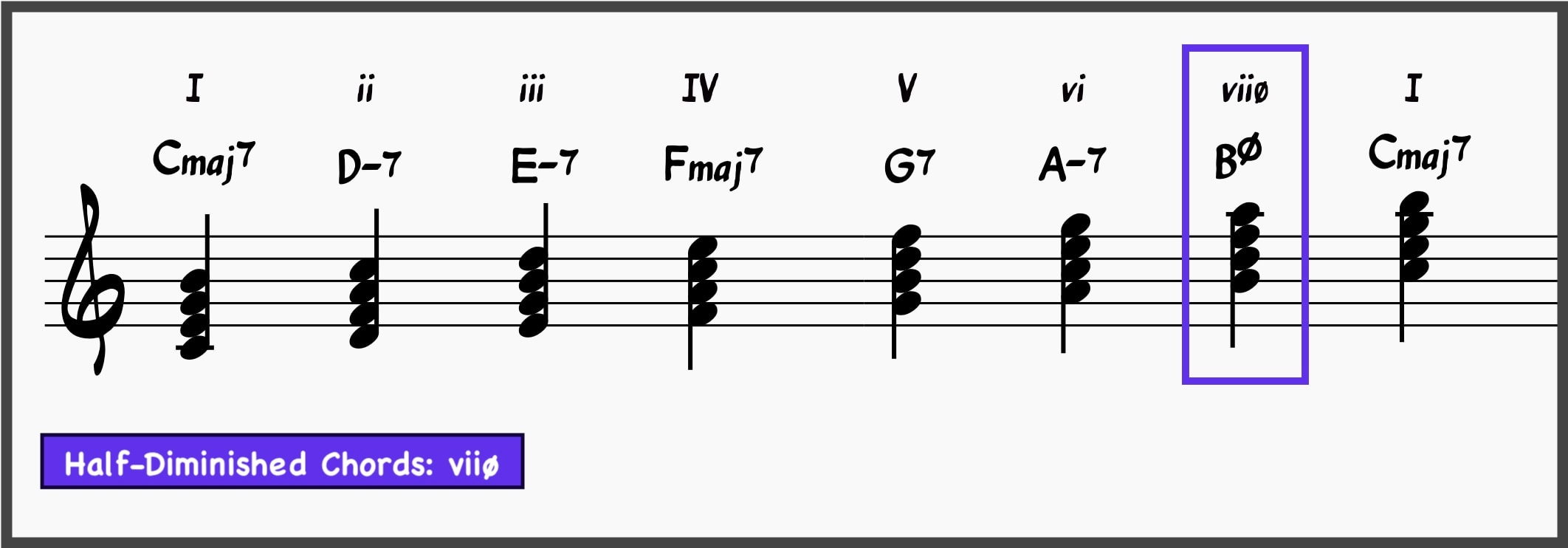
In minor keys, the iiø chord is half diminished.
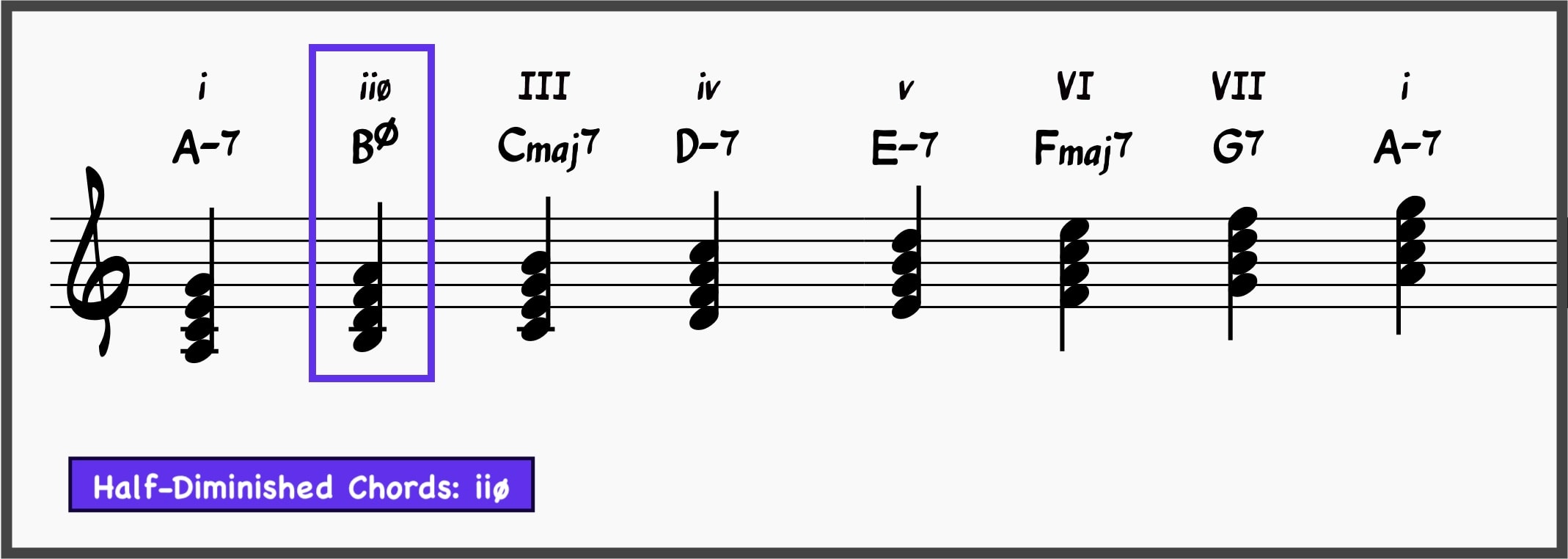
Check out this article to learn more about half-diminished chords.
Diatonic Seventh Chords
All four of these chord qualities appear in diatonic chord progressions.
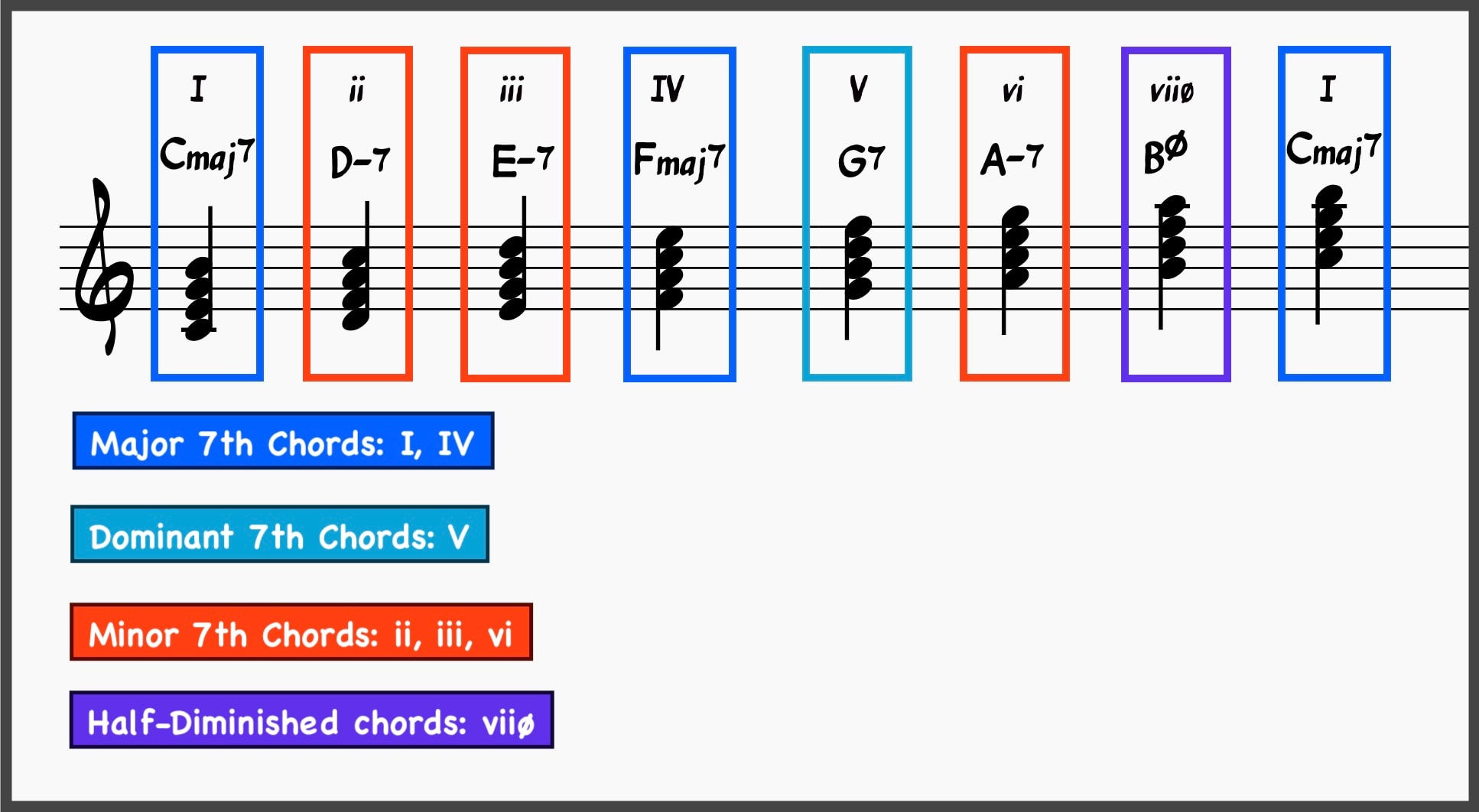
Our diatonic seventh chords are:
- Maj7 Chord
- 7 Chord
- -7 Chord
- -7b5 Chord
But what about seventh chord qualities that aren’t derived from the major or natural minor scale? There are other chords we still need to explore!
Less Common Seventh Chord Qualities
Most chords you’ll encounter in jazz will be the varieties we’ve already talked about. However, there are occasions where you’ll encounter these less common seventh chords.
- Minor-Major Seventh Chords
- Major Seventh #5 Chords
- Fully Diminished Seventh Chords
Minor-Major 7 (-Maj7)
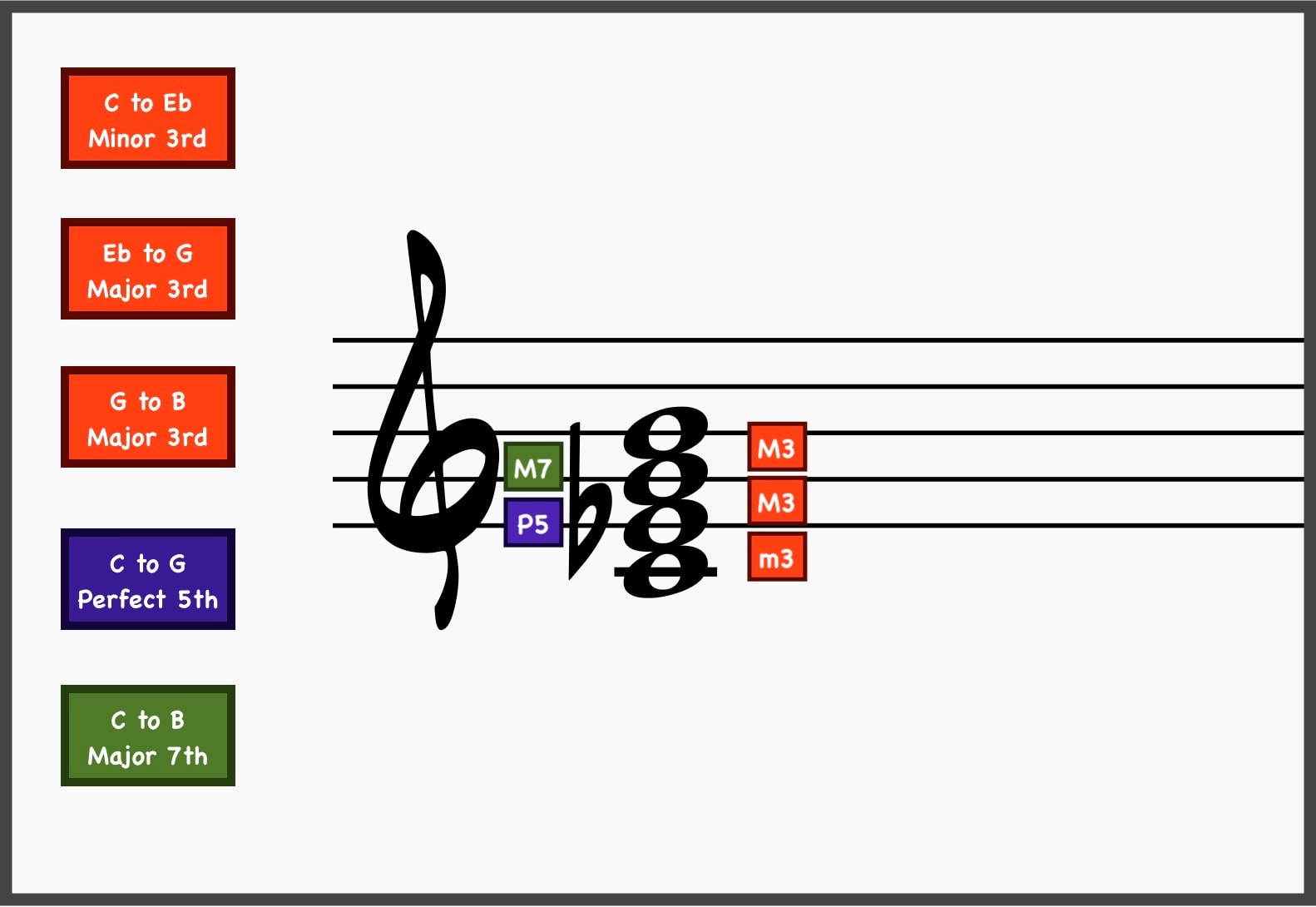
Minor major seventh chords or -(maj7) chords add a major seventh interval to a minor triad. This chord type isn’t found in the major scale, but can be found in the melodic minor and harmonic minor scales. Often, these chords are used as the i chord in minor ii-V-i chord progressions.
Check out this article to learn more about the minor ii-V-i chord progression.
A C-(maj7) chord is spelled:
- 7th: B
- 5th: G
- 3rd: Eb
- Root Note: C
Major 7#5 (augMaj7)
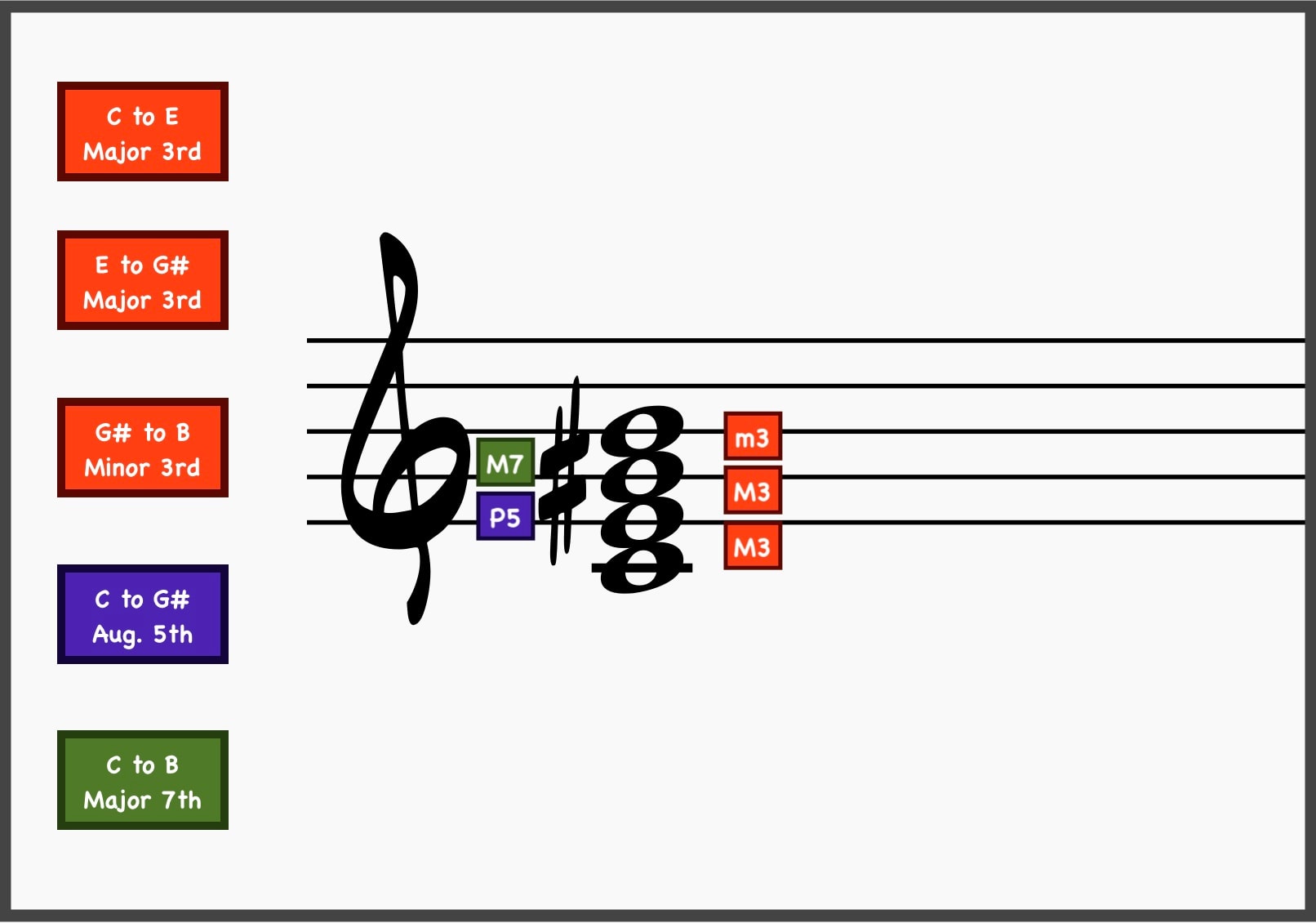
When you place a major seventh interval above the root of an augmented triad, you get a major seventh #5 chord (also known as an augmented major seventh).
This chord doesn’t come from the diatonic major or natural minor scale. Instead, it is built from the 3rd scale degree of the harmonic and melodic minor scales. A Cmaj7#5 is spelled:
- 7th: B
- 5th: G#
- 3rd: E
- Root: C
Fully Diminished 7 (°7)
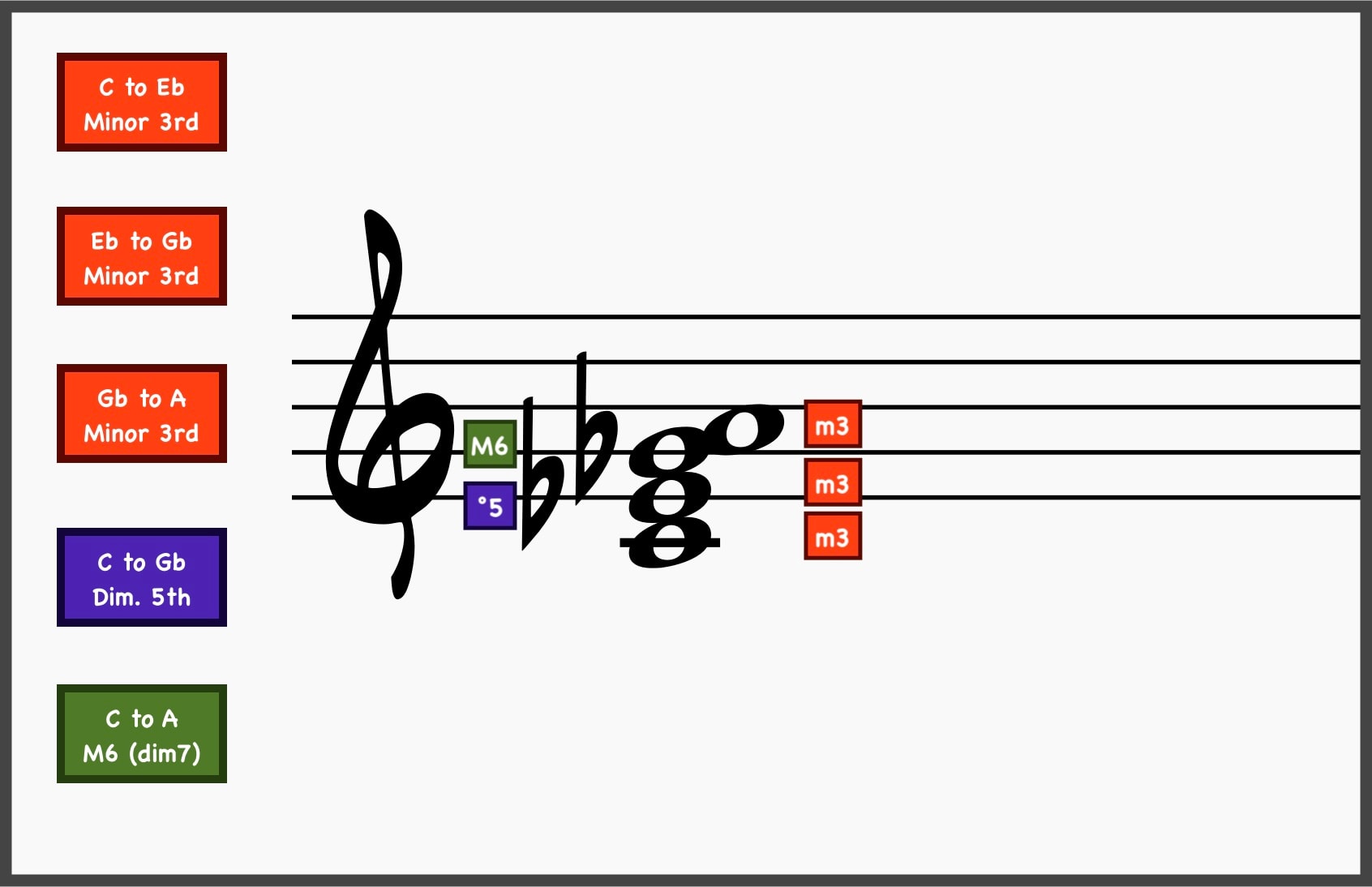
Fully diminished chords feature a diminished triad with a diminished seventh (or major sixth) interval added into the mix. This chord quality doesn’t occur in the diatonic major and minor scales, but does occur on the seventh scale degree of the harmonic minor scale.
A C fully diminished seventh chord is spelled:
- dim7th: Bbb (A)
- 5th: Gb
- 3rd: Eb
- Root note: C
Altered Dominants and Extended Chords
We didn’t even cover all the crazy-sounding altered dominant chord varieties that exist. There are crazy suspended chords and wild extended chords that add an extra layer to the chord qualities we’ve discussed so far.
Check out this article for more on these extended and altered chords.
Take Your Jazz Playing and Music Theory Chops to the Next Level—Join the Learn Jazz Standards Inner Circle
Chord qualities are the DNA of jazz harmony! Once you develop chord identification skills, you’ll have the tools to unlock thousands of standards, comp confidently behind soloists, and improvise with clarity.
And if you want a guided path to mastering chord qualities, progressions, and improvisation, the Learn Jazz Standards Inner Circle gives you the structured practice materials, backing tracks, and community you need to level up your playing.
Improve in 30 days or less. Join the Inner Circle.