Welcome to this “All of Me” Jazz Workshop! We will review everything you need to know to master this iconic jazz standard. By the end of this article, you’ll be ready to improvise over and perform “All of Me,” whether at home or your local jam session!
Here are some of the essentials we’ll cover:
- The History of “All of Me”
- Why This Tune is a Must-Know For Jazz Musicians
- “All of Me Jazz” Chord Changes and Harmonic Analysis
- “All of Me” Jazz Improvisation Tips (No Matter What Instrument You Play)
- Incredible Recordings of “All of Me” You Need to Check Out
If you are serious about learning to play jazz, check out the Learn Jazz Standards Inner Circle. The Inner Circle has everything you need to seriously overhaul your jazz playing and music theory chops.
Improve in 30 Days or Less. Join The Inner Circle.
Table of Contents
All Of Me Jazz Standard History
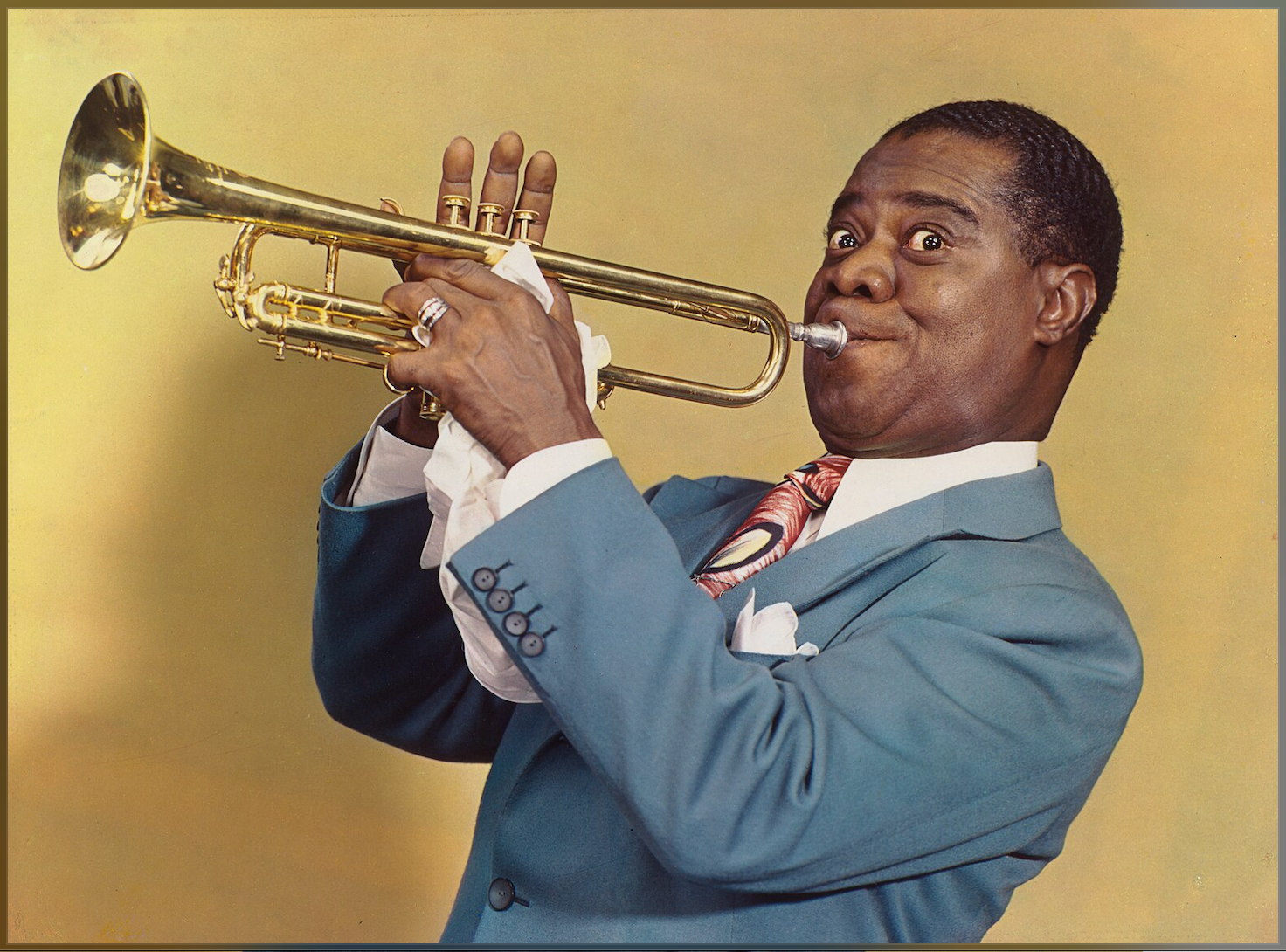
image source: Wikimedia Commons
“All of Me” has dominated jazz and pop charts at various points throughout its many years. Co-written by Gerald Marks and Seymour Simons, All of Me was a classic American song way back when it debuted in 1931!
With its beautiful melody and melodramatic lyrics, this jazz standard is part of many jazz singer’s repertoire. Vocalists and instrumentalists have recorded it many times over the years. Read to the end of this article to see our recommended versions!
All Of Me Jazz Lyrics
All of me
Why not take all of me?
Can’t you see
I’m no good without you?
Take my lips
I want to lose them
Take my arms
I’ll never use them
Your goodbye left me with eyes that cry
How can I go on dear without you?
You took the part that once was my heart
So why not take all of me?
All of me
Why not take all of me?
Can’t you see
I’m no good without you?
Take my lips
I want to lose them
Take my arms
I’ll never use them
Your goodbye left me with eyes that cry
How can I go on dear without you?
You took the best
So why not take the rest?
Baby, take all of me
Why Learn All Of Me? Jazz Musicians Must Know This Jazz Standard
“All of Me” is a classic jazz standard for a reason! It contains many common chord progressions and harmonic devices found in many other jazz standards. It is comprised of chord progressions that serve as essential examples of jazz harmonic language.
Also, despite being in the key of C major, the progression utilizes many non-diatonic chords that are commonplace in jazz harmony. Though initially written and first recorded in the key of Bb, most jazz musicians will play it in the key of C.
This tune is way more than simple background music, as non-jazz folk may believe. We know better!
Non-Diatonic Chords Are Common In Jazz Tunes
Roughly half of the chords in this tune can be built from the C major scale, but the other half are non-diatonic, which means they utilize notes outside of the key signature.
Here are the diatonic chords in the key of C major:
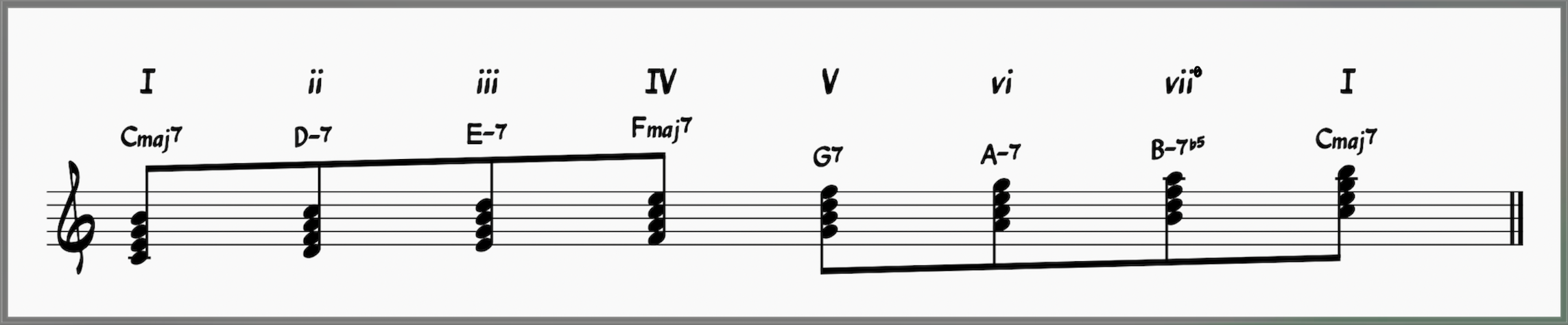
- viiø – B-7b5
- vi – A-7
- V – G7
- IV – Fmaj7
- iii – E-7
- ii – D-7
- I – Cmaj7
However, “All of Me” contains dominant IIs, III, and VIs, which all break the key signature. There is also the infamous minor iv chord in the second half, which is borrowed from the parallel minor key.
These two devices—secondary dominants and borrowed chords—are essential chord substitutions that every jazz musician needs to be familiar with.
Secondary Dominants
Secondary dominants briefly tonicize a chord directly after it by becoming a dominant chord. The target chord must be a perfect fourth above or a perfect fifth below the secondary dominant to get a natural V-I cadence.
Here is a VI-II-V-I chord progression where the first two chords are secondary dominants. Notice how I’ve also labeled them the “V of” the target chord. This helps identify secondary dominants and describes their function as a temporary cadence to a non-tonic chord.
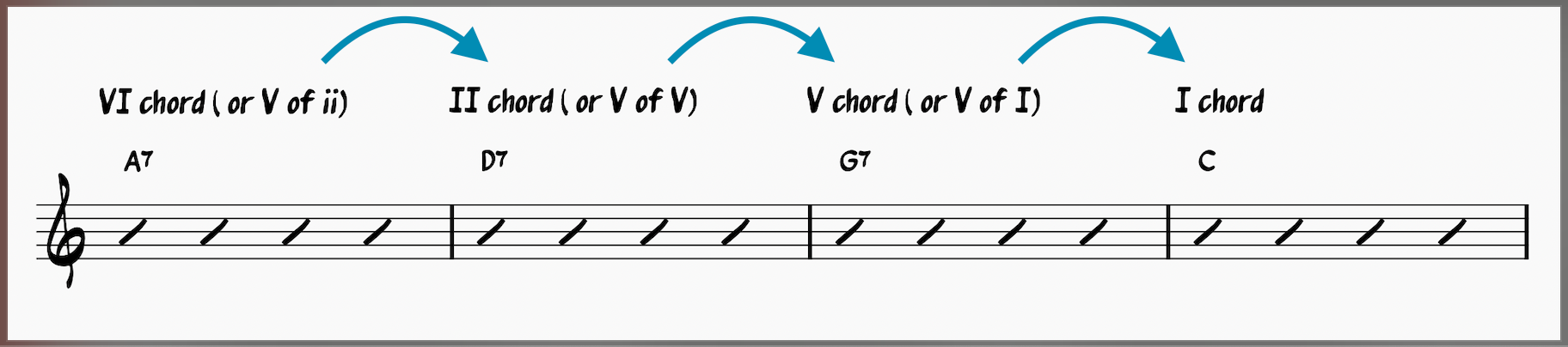
In our harmonic analysis, I’ll label when a chord functions as a secondary dominant.
Check out this article for more on secondary dominants and this one for more on musical cadences.
Borrowed Chords (Modal Interchange)
Additionally, this tune uses modal interchange, which borrows chords from a different scale or key. Iconically, the Fmaj7 in the C section turns into an F-6, non-diatonic chord. However, this isn’t a key change because the tonal center hasn’t moved anywhere.
It’s still C, only the chord doesn’t come from C major. Instead, it is borrowed from C-, the parallel minor key.
Check out this article for more on parallel minor keys.
All Of Me Jazz Standard Harmonic Analysis
Now, we are ready to dig into the chord progression itself! This tune has an ABAC structure that stays in the key of C despite the heavy use of secondary dominants.
First A Section
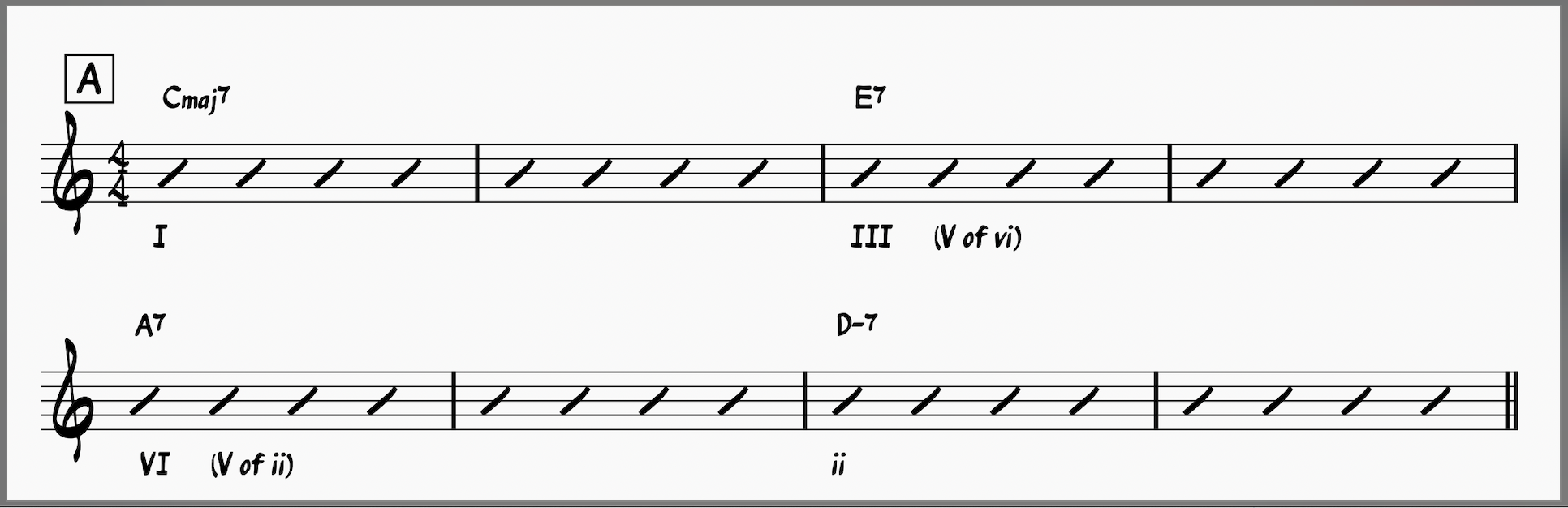
The chord progression for the first A section is a I-III-VI-ii chord progression. There are two secondary dominants here—the E7, the V of vi, and the A7, the V of ii.
B Section
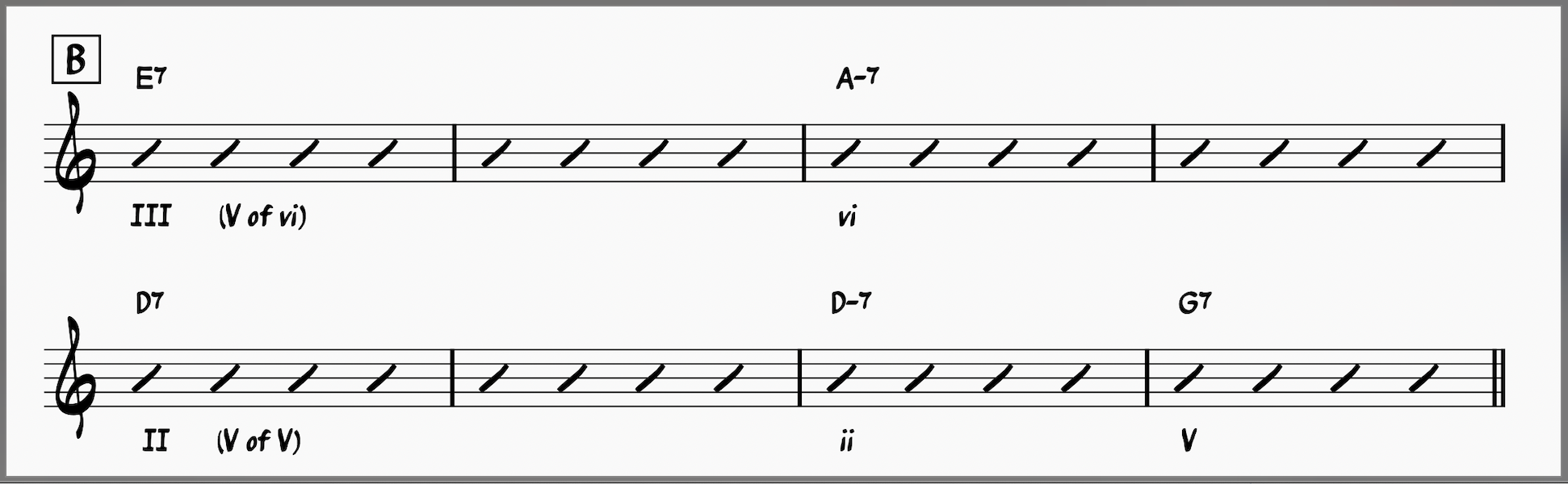
The B section also uses two secondary dominants, which occur differently than the first. This section has a III-vi-II-ii-V chord progression. The first measure has an E7, or V of vi chord, and the fifth and sixth measures have a D7 or dominant II chord, which becomes minor for our ii-V back to C major.
Check out this article for more on the ii-V-I progression.
Second A Section
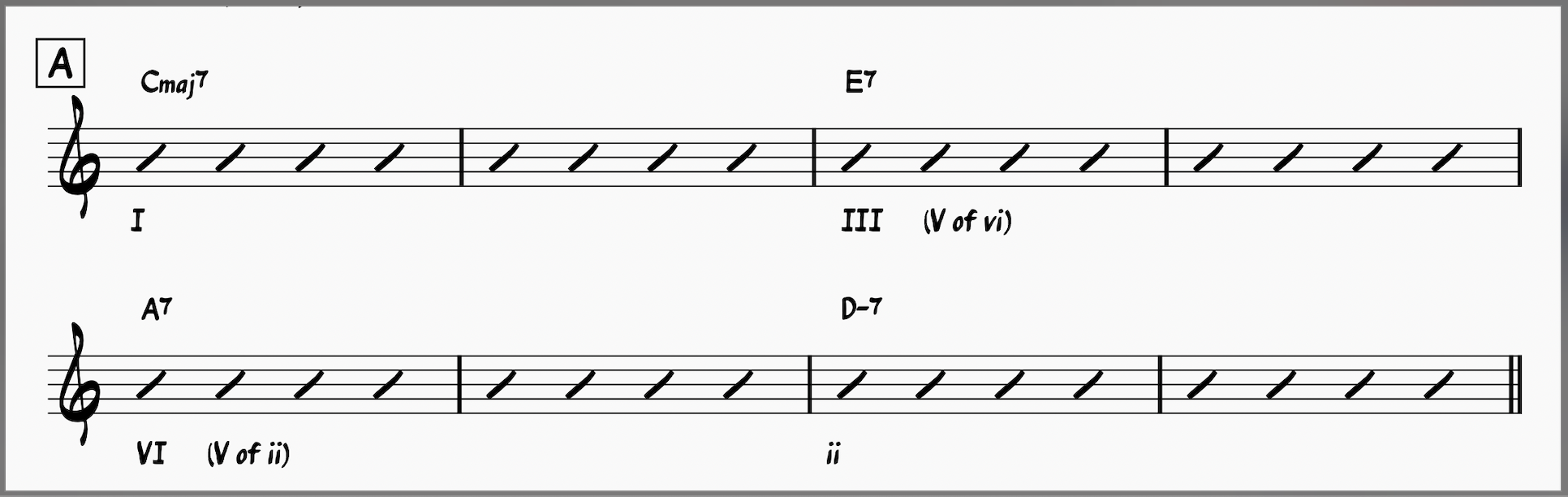
The second A section is identical to the first!
C Section
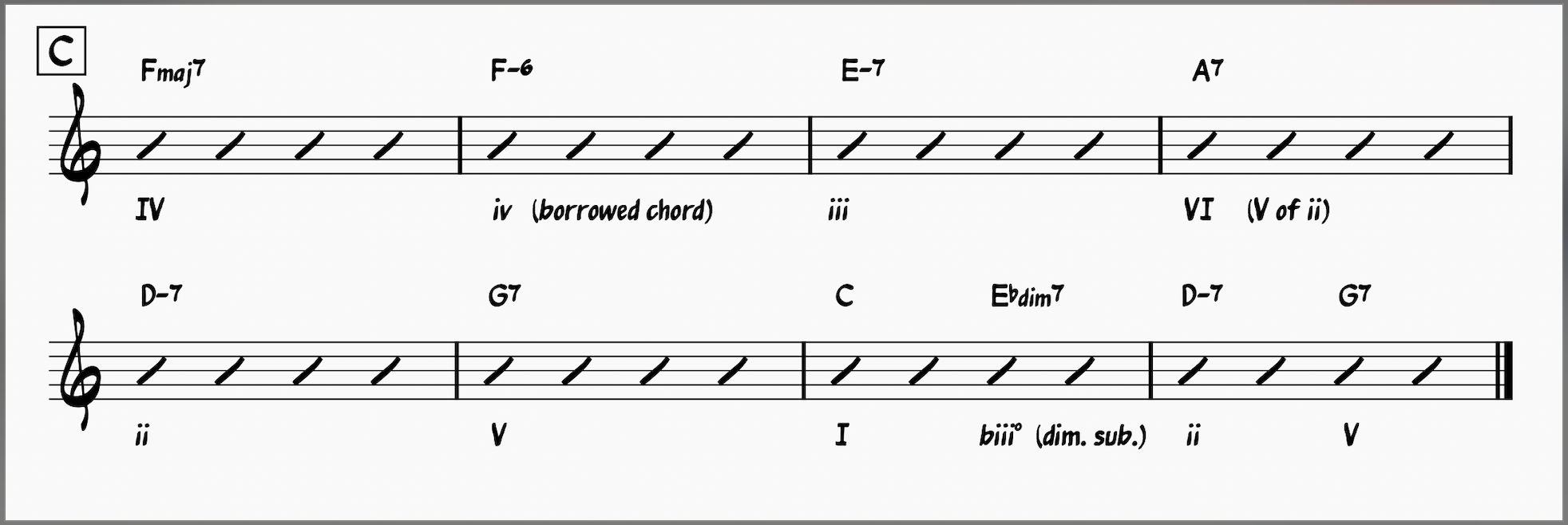
The C section uses a borrowed chord from the parallel minor key of C minor. As mentioned earlier, the F-6 is the iv chord in the key of C minor. The first four chords in this section are IV-iv-iii-VI. The A7, or VI chord, is a V of ii chord.
In our last four bars, we have a ii-V-I and, after that, a very common jazz turnaround—a I-biii°7-ii-V. This turnaround utilizes a chromatic approach chord.
When you play a diminished seventh chord off of the flat 3rd scale degree, you get some of the same chord tones as a vi chord. Ebdim7 and A-7 share an A and a C. The other notes are each a half step away from notes in our target chord D-7, the ii chord in our “vi”-ii-V-I.
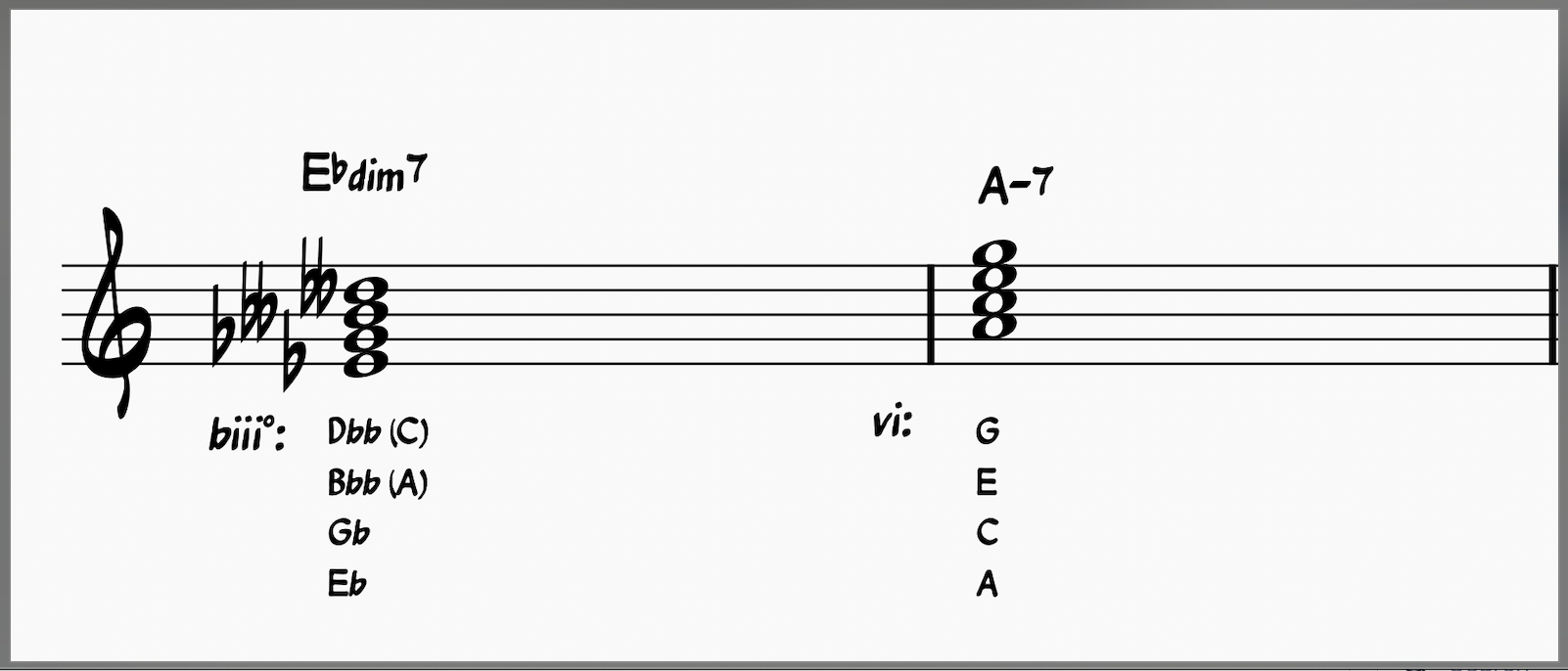
This diminished chromatic approach chord already contains an A and a C and resolves nicely to a D-7.
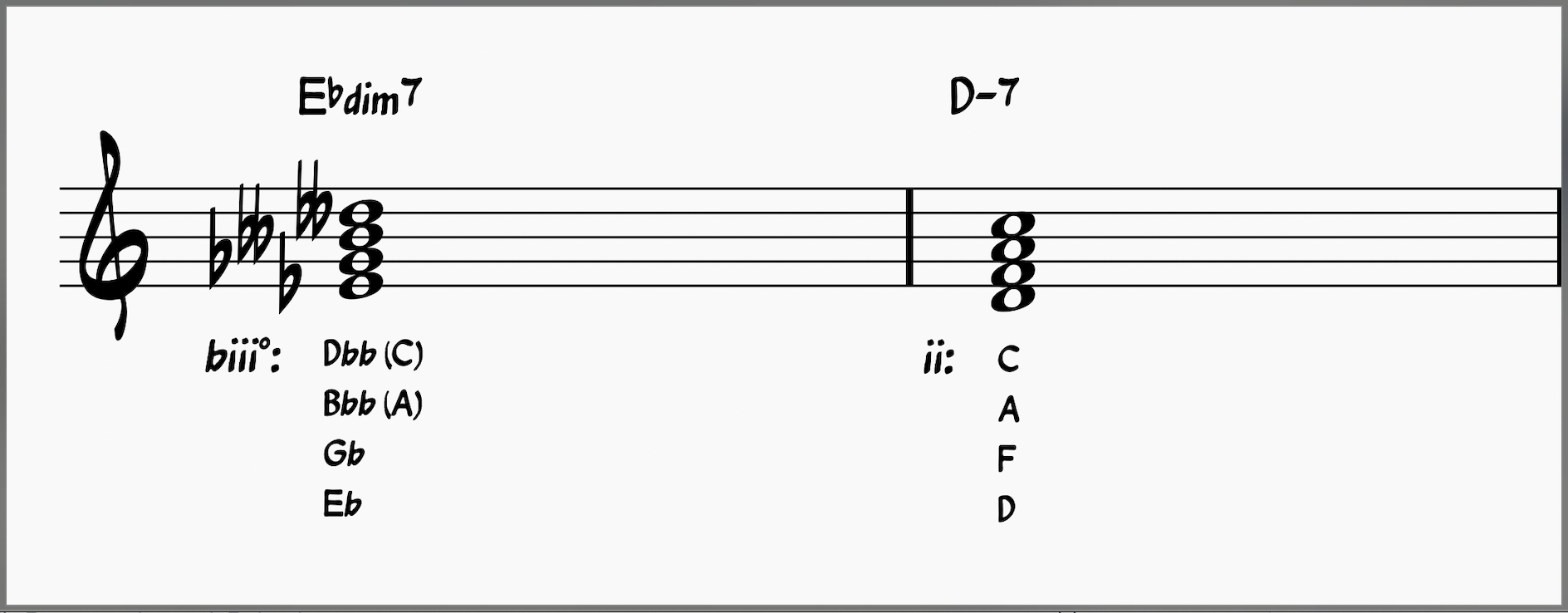
Essentially, this progression is a I-vi-ii-V but with a diminished twist in place of the vi chord!
Check out this article for more on jazz chord progressions, and this one to learn more about chord substitutions.

All Of Me Jazz Improvisation Crash Course
It’s time to solo over All of Me! When first learning a tune, it’s important to go through the form and think about each chord’s relationship to the tonal center. If a chord is diatonic (or one of the seven chords in a key), you can use the major scale and associated modes, adding non-diatonic tones to taste.
However, if the chord is non-diatonic, you have to decide how you want to convey the non-diatonic harmony. “All of Me” is roughly 50% diatonic chords, 48% secondary dominants, and 2% borrowed chords (this is not a literal breakdown!).
Seasoned jazz students will map out their scale options over a tune’s form. This process, called “scale mapping,” helps improvisers lay out their options in a logical, easy-to-follow format when practicing.
We can use C major and its modes for half of the tune. However, we must get creative with the other chords. Let’s first look at C major’s modes, followed by non-diatonic scales we can use for the other chords.
Diatonic Scales (For Diatonic Chords)
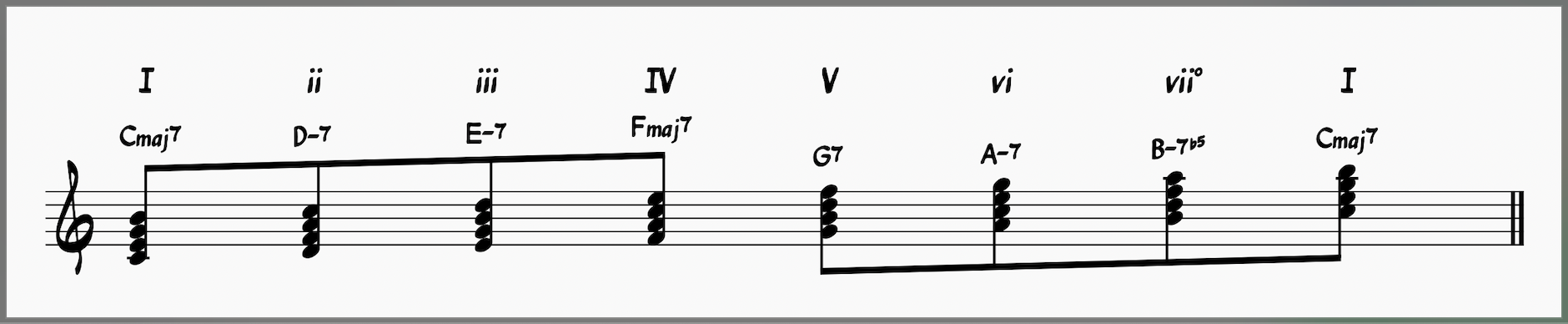
- viiø – B Locrian [B-C-D-E-F-G-A-B]
- vi – A Aeolian [A-B-C-D-E-F-G-A]
- V – G Mixolydian [G-A-B-C-D-E-F-G]
- IV – F Lydian [F-G-A-B-C-D-E-F]
- iii – E Phrygian [E-F-G-A-B-C-D-E]
- ii – D Dorian [D-E-F-G-A-B-C-D]
- I – C Ionian [C-D-E-F-G-A-B-C]
For more on modes, check out our major scale modes guide.
Non-Diatonic Scales (For Non-Diatonic Chords)
For the secondary dominants, you want to consider what note changes when a non-dominant diatonic chord is changed into a dominant. For minor seventh chords, the third becomes major, creating a dominant chord.
In “All of Me,” the secondary dominants we encounter are all derived from minor seventh chords:
- D-7 → D7 – II
- E-7 → E7 – III
- A-7 → A7 – VI
For the most part, we’ll need scales containing a minor seventh and a major third, implying the Mixolydian mode. However, jazz musicians often alter dominant chords—especially secondary dominants that resolve minor, and this happens a lot in “All of Me.”
Here are four scale options you can play over the secondary dominant chords in “All of Me.” I’ll also include a diminished scale for the one diminished chord in the tune.
When looking at the scale degrees in the images below, our starting point will be the Mixolydian scale, so we’ll label the seventh scale degree “7,” counting the minor seventh as the assumed starting point.
- E-F#-G#-A-B-C#-D-E
- 1-2-3-4-5-6-7
Mixolydian b6 (Fifth Mode of Melodic Minor)

The Mixolydian b6 scale is the fifth mode of the melodic minor scale. It has a major third, a minor seventh, and a minor 6th (the C). I like this scale over the E7s in this tune because it contains the C natural, which brings this non-diatonic scale closer to the tonal center of C major.
You can play an A Mixolydian b6 scale over the A7s, too, as this would give you an F natural instead of an F#.
Altered or Super-Lociran Scale (Seventh Mode of Melodic Minor)
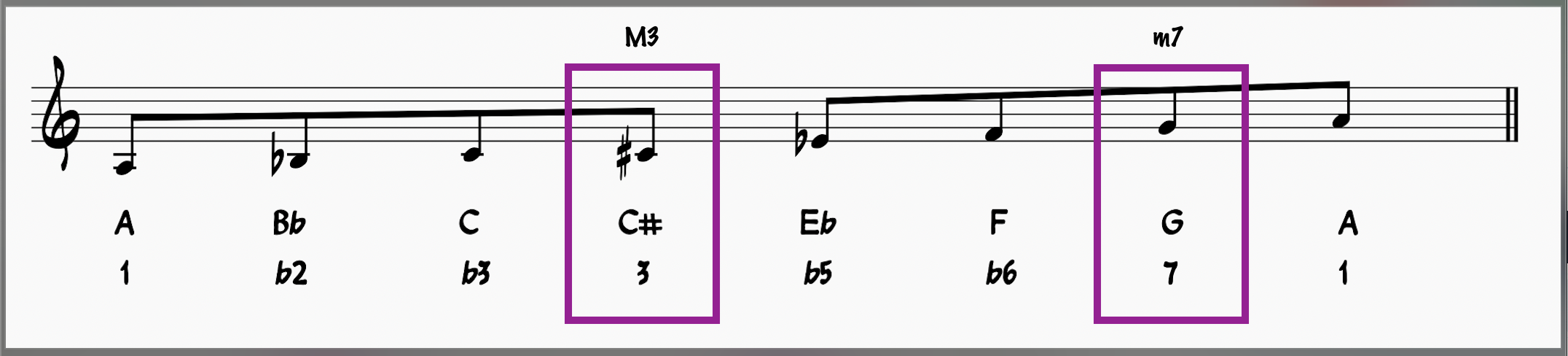
The Altered or Super-Locrian scale is the seventh mode of the melodic minor scale. It contains a major third and minor seventh and some altered chord tones. This scale works well over the E7s and A7s in this tune.
In addition to a major third and minor seventh, it has the following altered tones:
- b9 (Bb)
- #9 (C)
- #11/b5 (Eb)
- #5/b13 (F)
Lydian Dominant (Fourth Mode of Melodic Minor)
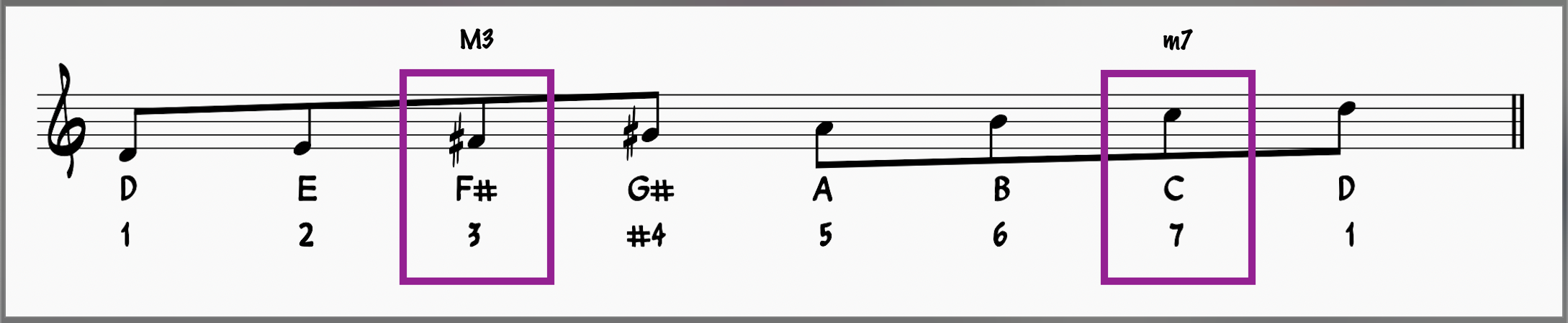
The Lydian Dominant scale is the fourth mode of melodic minor and works well over dominant II chords. That’s why I’ve chosen this scale for the D7 chords in the tune. This scale also has a #4 scale degree, which sounds nice on dominant II chords or other dominant chords with a natural 9th/#11 extension.
Whole Tone Scale
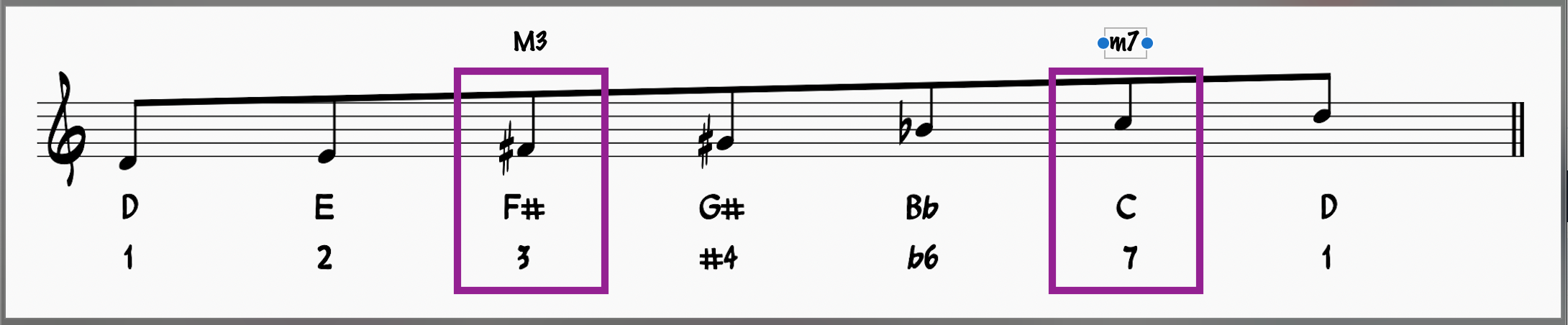
The whole tone scale is hexatonic (containing six notes), and its scale formula comprises whole steps. This is another great option for dominant II chords like the D7s in “All of Me.”
Whole/Half Diminished
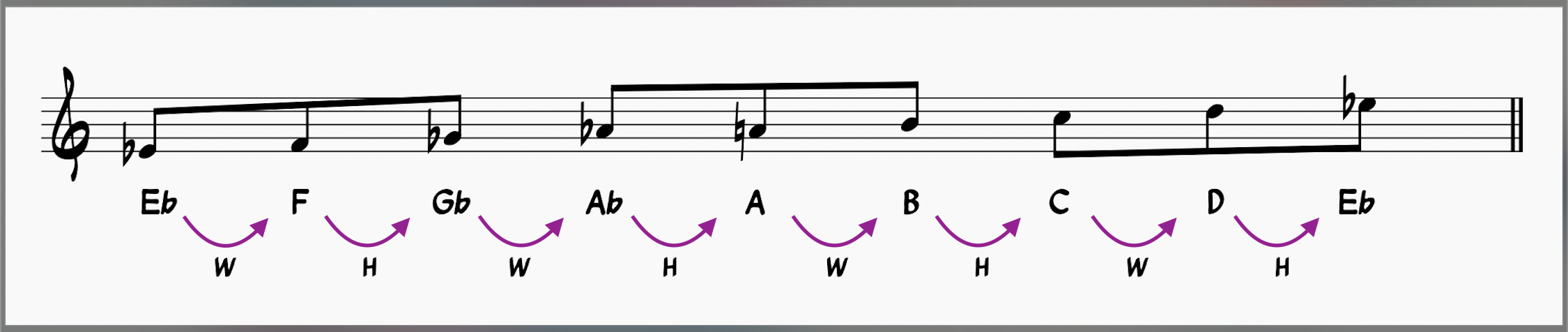
Finally, we need a scale that works over our Ebdim7 chord in the last section! Let’s use a whole-half diminished scale, one of two types of diminished scales. The whole/half diminished scale is made of alternating whole steps and half steps.
The other is half-whole, as you might have guessed.
Check out these articles for more information on—
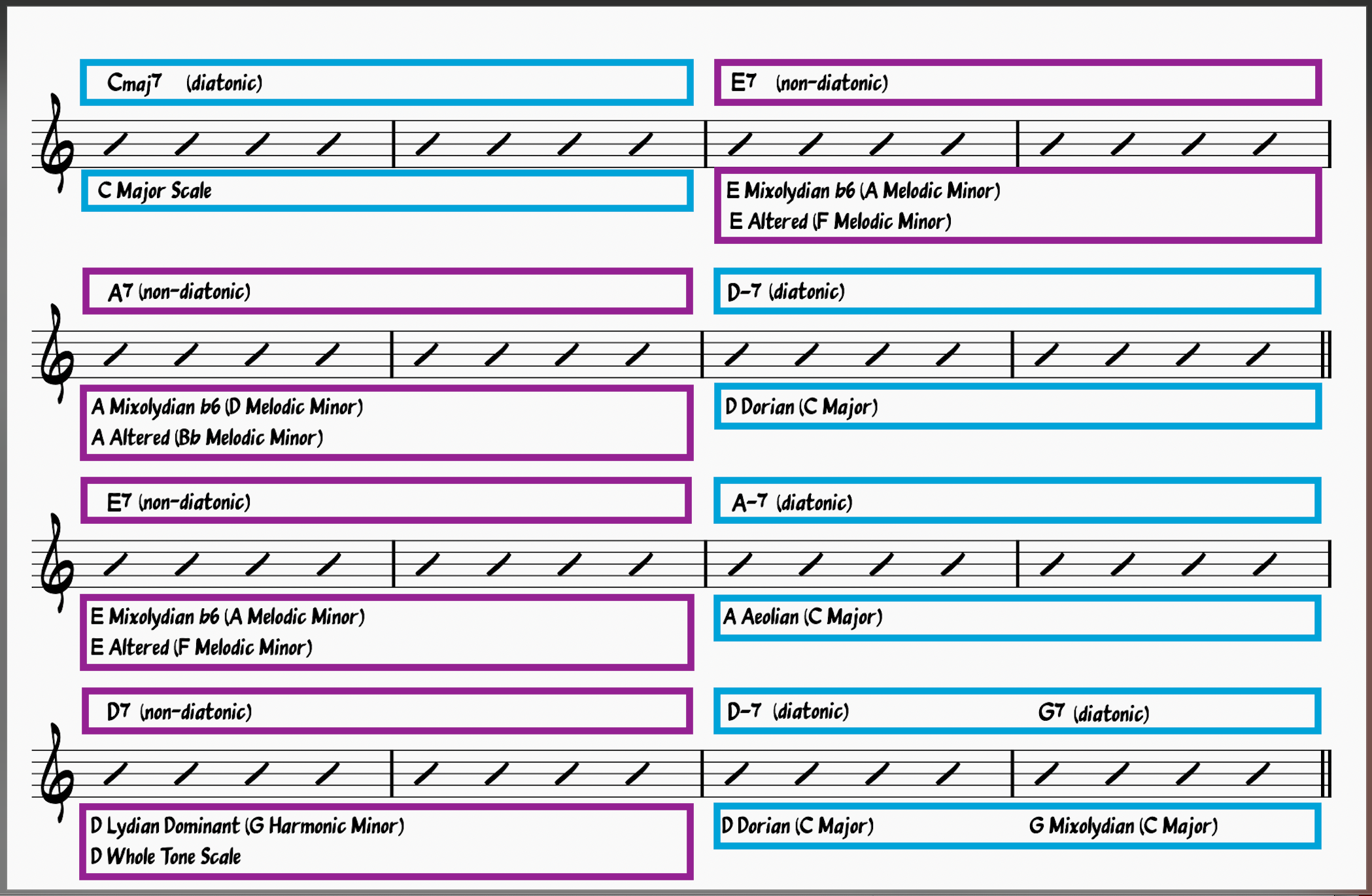
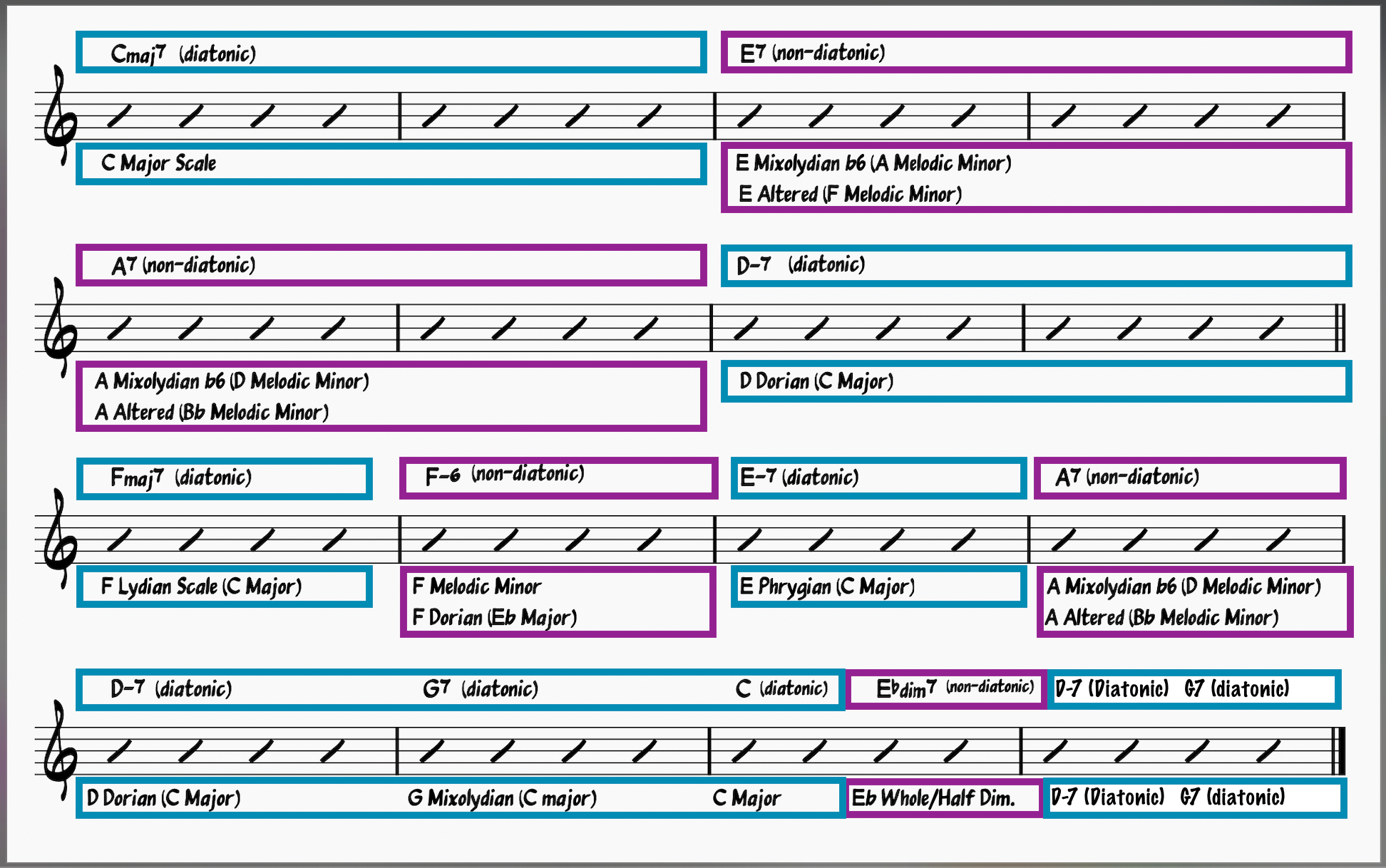
Now we’re ready for our scale maps! You’ll see the diatonic chords labeled in blue and the non-diatonic chords labeled in magenta. Beneath each line, I’ve given scale options for you to try over the form.
All Of Me Jazz Scale Map (First Half)
All Of Me Jazz Scale Map (Second Half)
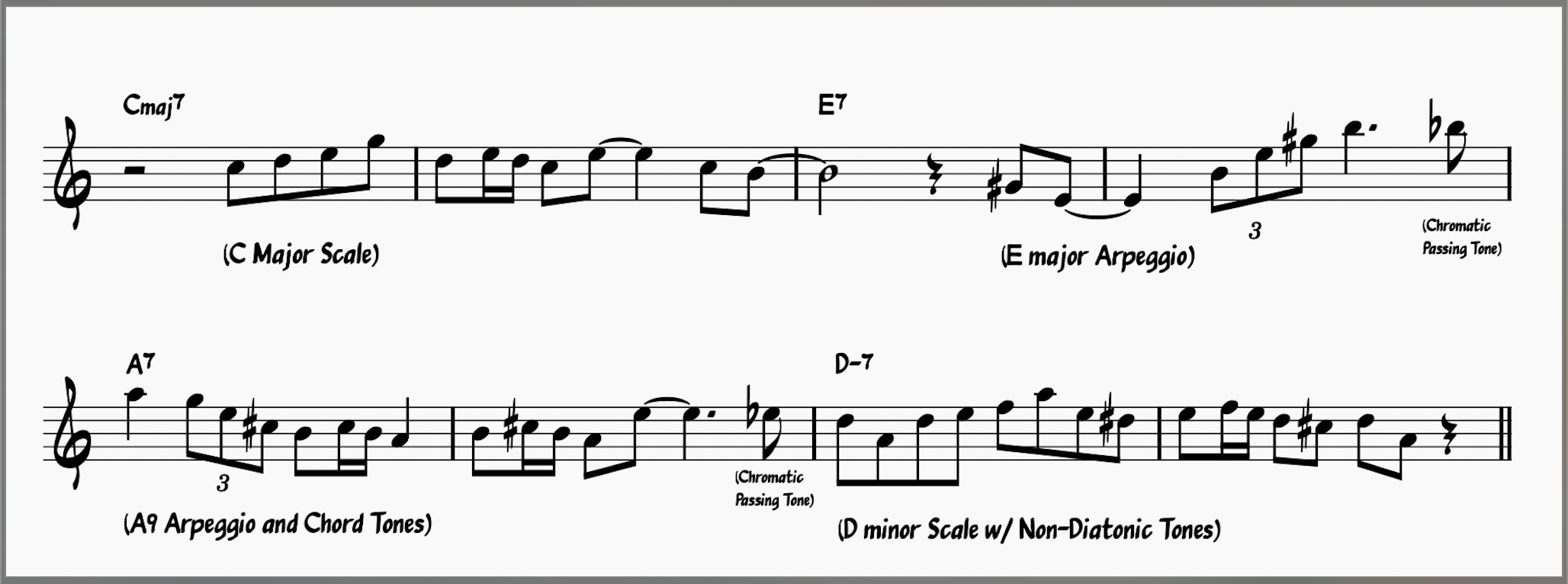
All Of Me Jazz Etude
Learn this eight-bar etude over the first section of “All of Me.”
Check out this article for more jazz licks and this one for more on jazz language.
Check out this article for a more comprehensive breakdown of improvisational concepts over “All of Me.”
All Of Me Jazz Recordings You Should Check Out
Listening to your favorite jazz artist’s unique rendition of a classic jazz standard is one of the most rewarding aspects of being a jazz fan. Check out these incredible variations of this classic jazz standard.
Which performance is your favorite?
Ella Fitzgerald
Billie Holiday
Want to learn more about Billie Holiday and Ella Fitzgerald? Check out this article on the best jazz musicians of all time.
Frank Sinatra
Want to learn more about Frank Sinatra and his incredible discography? Check out this article on Frank Sinatra songs.
Louis Armstrong
Want to learn more about the iconic Louis Armstrong? Check out our article on the best trumpet players of all time.
Charlie Parker
Want to learn more about saxophone player Charlie Parker? Check out our list of the best jazz saxophonists.
Django Reinhardt
Want to learn more about guitar player Django Reinhardt? Check out our article on the best jazz guitarists of all time!
Oscar Peterson
Check out this article to learn more about piano player Oscar Peterson and other jazz piano players.
Take Your Jazz Playing To The Next Level—Join The Learn Jazz Standards Inner Circle!
Want to take your jazz chops to the next level? The Learn Jazz Standards Inner Circle helps members accelerate their jazz playing and theory skills. Want to learn how?
Improve in 30 days or less. Join The Inner Circle.