If you’ve ever listened to Afro-Cuban jazz, salsa, or even New Orleans second-line grooves, you’ve probably felt the powerful pulse of clave. But what exactly is clave rhythm, and why should jazz musicians care?
In this article, we’ll break down everything you need to know about clave. We’ll cover:
- What the clave rhythm is.
- Where clave rhythmic patterns come from.
- What clave rhythms sound like.
- What makes clave distinct from other Caribbean and Latin-American styles of music
- And—most importantly—how to incorporate it into your jazz playing to expand your rhythmic vocabulary and strengthen your groove.
Rhythm is an essential and often overlooked part of the average jazz student’s journey! Be a cut above average and take your jazz chops to the next level with the Learn Jazz Standards Inner Circle. The Inner Circle has everything you need to master jazz rhythmic patterns and level up!
Improve in 30 days or less. Join the Inner Circle.
Table of Contents
What Does Clave Mean?
In Spanish, clave means “key,” and in Afro-Cuban music, it’s exactly that. Clave is the key to the rhythm. It’s not just a pattern you play on wood blocks—it’s a time-feel and a rhythmic structure that underpins entire genres of Latin music.
Clave helps organize rhythmic phrases and aligns (or contrasts) with melodic and harmonic ideas. In jazz, clave offers a way to infuse the genre with Latin grooves.
History of the Clave Rhythm
Clave rhythms trace their roots back to West Africa. As African musical traditions were brought to the Americas through the transatlantic slave trade, they merged with Spanish and Caribbean influences, especially in Cuba.
By the 19th century, these rhythmic systems had crystallized into formalized patterns like son clave and rumba clave, which became foundational in Cuban traditional music and popular music. Later, clave rhythms filtered into jazz through figures like Dizzy Gillespie, Chano Pozo, Machito, and Mario Bauzá.
Afro-Cuban jazz (sometimes called Cubop) emerged as an explosive hybrid of bebop and Cuban rhythm in the 1940s. Today, clave-based playing remains a vital tool for any jazz musician interested in rhythmic depth and stylistic fluency.
History of Clave in Jazz
The fusion of clave rhythms with jazz began in earnest in the 1940s, when bebop pioneers in New York started to collaborate with Cuban percussionists.
The turning point came in 1947 when trumpeter Dizzy Gillespie joined forces with Cuban conguero Chano Pozo, creating a revolutionary blend of modern jazz harmony with Afro-Cuban rhythm.
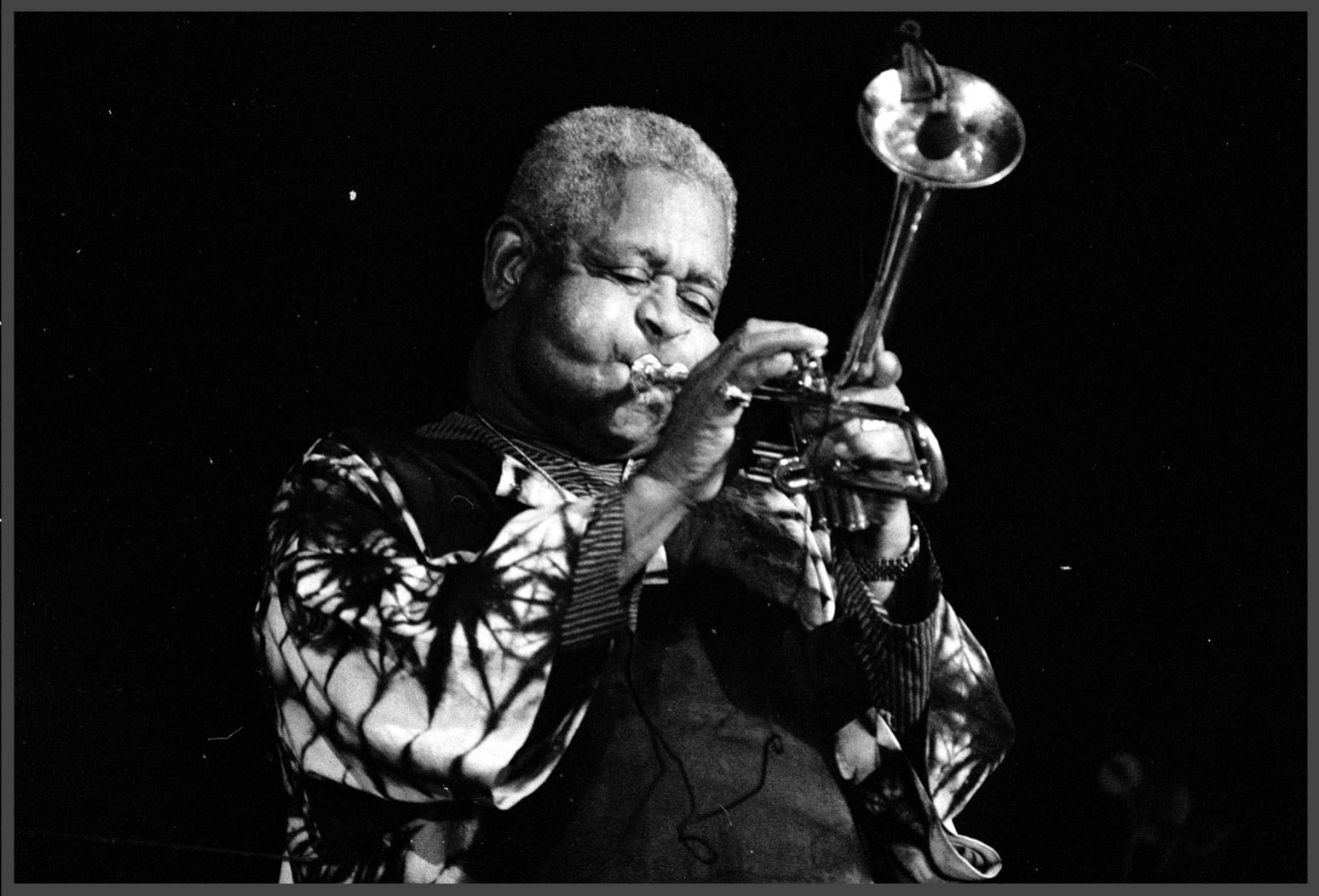
image source: Wikimedia Commons
Their composition “Manteca” is widely regarded as one of the first bona fide Afro-Cuban jazz pieces, and it’s built around a 2-3 clave rhythm (even though there isn’t a clear clave instrument playing the 2-3 clave).
At the heart of this new style—often called Cubop—was the clave rhythm. Cuban clave rhythms dictated the phrasing of melodies, the accents of the rhythm section, and even the arc of improvised solos.
Cuban musicians like Machito, Mario Bauzá, and Mongo Santamaría brought an authentic clave-based rhythmic foundation, while American jazz musicians added harmonic complexity and improvisational language.
Through the 1950s and 60s, the clave made its way into recordings by Art Blakey, Cal Tjader, Herbie Mann, and Kenny Dorham. Pianist Eddie Palmieri and vibraphonist Tito Puente helped solidify the language of Latin jazz as a genre of its own, where an understanding of clave was essential.
Today, clave remains a critical element in Latin jazz, Brazilian jazz, and even modern straight-ahead settings. Knowing how to play with the clave rather than against it can elevate your sense of groove, timing, and interaction in a band setting, especially if you’re playing with percussion instruments.
Check out this article on the best jazz trumpet players for more on Dizzy Gillespie.
Clave Instruments vs Clave Rhythmic Patterns
Let’s clear up a common confusion.
Clave can refer to the Cuban clave rhythms as well as the hardwood sticks often used to play them.
Clave (instrument)
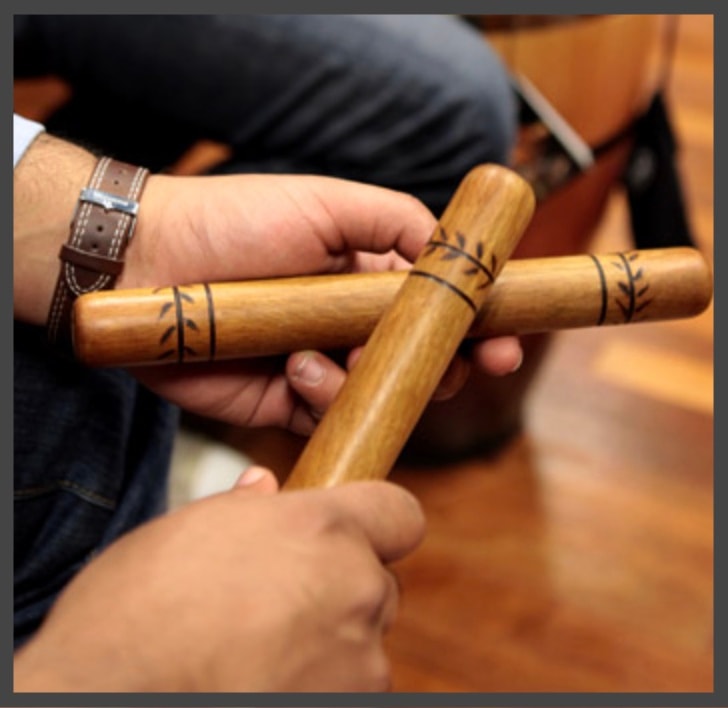
image source: Wikimedia Commons
The clave instrument consists of two wooden sticks struck together to produce clave rhythms.
Clave (rhythmic pattern)

The clave rhythmic pattern is a repeating rhythmic pattern that demarcates the passage of musical time in Afro-Cuban music. Clave can be implied across several instruments, even if no one is literally playing the wooden sticks.
Yes, you can play clave without playing the claves. The classic recording of “Manteca,” shared above, doesn’t feature the clave instrument, but strongly implies the 2-3 Son clave with its layers of percussion and melodic structure (more on Son clave below).
Cuban Clave and Western Music Theory
Clave organically developed outside of Western music theory concepts. Traditional musical concepts like clave weren’t the academic inventions of Western-trained musicians—instead, these concepts developed from rich musical traditions rooted in performance and oral tradition.
We can explain and understand rhythmic concepts like clave through the lens of standard Western notation, but that understanding isn’t superior. Clave patterns set the musical framework of Afro-Cuban music in the way that time signatures and measures structure Western musical pieces.
We can translate clave patterns onto the staff, but this is a kind of distillation in the same way that any musical notation is a distillation of the actual performance and playing of music. That being said, we can pretty accurately represent clave patterns on the staff. Here’s how they work.
The Clave Feel in Western Music Theory Terms
Clave patterns can be noted in different time signatures, but for this article, we’ll stick to 4/4 time as it is most familiar to Western-trained musicians. Note, however, that clave can be played with a triple pulse and notated in 6/8 or 12/8, or it can be played with a duple pulse and notated in 2/4 or 4/4.
Clave Notated in 4/4 (Duple Pulse)

Clave Notated in 12/8 (Triple Pulse)
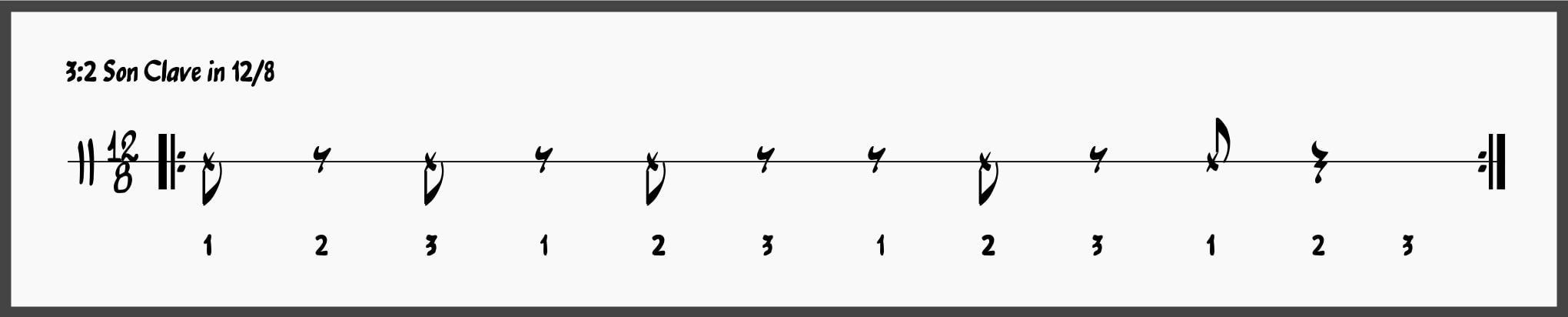
For our purposes, the clave rhythm plays with the rhythmic contrast between a measure of three accented beats and a measure of two accented beats, when translated for 4/4 time.
Therefore, the clave pattern is a two-measure rhythmic pattern that serves as the pulse and structure of Afro-Cuban music (and other types of Latin music). We can label the side with three beats the three-side of the clave and the side with two beats the two-side of the clave.
Antecedent and consequent are sometimes used to describe the first group and the second group, respectively.

These two “sides” rhythmically contrast with one another and, when taken together, constitute a whole unit of rhythmic time. Remember, Western music theory isn’t the only way to understand clave patterns. We’re taking one system of understanding to explain another system that evolved separately.
Son Clave and Rumba Clave—Two Types of Cuban Clave Rhythms in Jazz Music
There are two primary types of clave rhythms used in Afro-Cuban music and Latin jazz:
- Son Clave
- Rumba Clave
Each comes in two versions: 3:2 and 2:3. These numbers refer to the order of rhythmic groupings. For our examples, each grouping, either two accented beats or three accented beats, will sit across two measures.
Son Clave Rhythm
The son clave is the most commonly used clave in jazz and salsa. Here’s how the 3-2 son clave looks and sounds.
3:2 Son Clave
With a 3:2 son clave, the first bar has three accented beats and the second bar has two.

The 2-3 son clave simply flips the order of accented groupings. Now the first measure has two beats and the second measure has three. Here is the 2:3 son clave.
2:3 Son Clave

Rumba Clave Rhythm
The rumba clave is almost the same pattern, except it has a slight difference in the group of three beats. With the rumba clave, the last beat in the grouping of three occurs on an upbeat instead of the downbeat. This intensifies the syncopated feel of the clave groove.
3:2 Rumba Clave

2:3 Rumba Clave

The rumba clave is often used in guaguancó and other folkloric Cuban styles, but you’ll also hear it in jazz interpretations of Afro-Cuban forms. Jazz musicians need to be able to distinguish and switch between these two clave feels.
Mixing Clave Patterns
In modern Latin music and jazz, there isn’t a need to stay consistent with a particular clave feel throughout a whole performance. Sometimes, musicians will alternate between 3:2 and 2:3 clave patterns. It isn’t unheard of to mix son and rumba clave within the same performance, either.
Mixed Son Clave (3:2; 2:3)

Here, we start with a 3:2 son clave and finish on a 2:3 son clave.
Mixed Son Clave (2:3; 3:2)

This example is the opposite of the previous example. We start with a 2:3 son clave and finish on a 3:2 son clave.
Mixed Rumba Clave (3:2; 2:3)

Here we have a mixed 3:2; 2:3 rumba clave pattern.
Mixed Rumba Clave (2:3; 3:2)

In this example, we see the inverse of the previous example. We have a 2:3; 3:2 rumba clave pattern.
You can come up with other patterns by mixing son and rumba clave in the same set!
Clave and Brazilian Music—What About Bossa Nova?
While clave is central to Afro-Cuban and Caribbean styles, Brazilian music follows a different (albeit related) rhythmic logic. That said, it’s just as important to understand if you’re exploring Latin rhythms in jazz.
Bossa nova, samba, and baião, all forms of Brazilian music, don’t rely on a fixed 2-bar clave pattern the same way Afro-Cuban music does.
Instead, they’re built on composite rhythms created by layering percussion instruments (like the surdo, tamborim, agogô, and pandeiro) with syncopated guitar and bass figures.
So What’s the Connection?
- Both Afro-Cuban and Brazilian styles emphasize syncopation, polyrhythm, and rhythmic tension/release.
- In jazz contexts, Brazilian grooves are often interpreted with a quasi-clave feel—meaning you still need to be aware of where rhythmic accents fall, even if they don’t match son or rumba clave precisely.
- The bossa nova guitar pattern, famously played by João Gilberto, uses steady eighth-note syncopations that “float” across the bar line, creating a relaxed but rhythmically rich texture.
This rhythmic tension between a steady bass pulse and syncopated chord hits is similar in spirit to clave, even though the structure differs.
Check out this article to learn more about Bossa Nova and Bossa Nova chord progressions.
Why It Matters for Jazz Musicians
Understanding the differences between Afro-Cuban and Brazilian rhythmic traditions is crucial. They aren’t interchangeable “Latin” grooves. Each has its own set of rules, instruments, phrasing styles, and performance practices.
Mastering both will massively expand your rhythmic flexibility and stylistic range—not just as a soloist, but as a rhythm section player too.
Check out this article on jazz rhythms for more information.
Why You Should Incorporate Latin Rhythms Into Your Playing
If you want to level up your rhythmic vocabulary, start learning clave-based grooves. Here’s why:
- Deepens your time-feel: Clave teaches rhythmic layering, tension and release, and syncopation.
- Expands stylistic fluency: Latin jazz, bossa nova, samba, and Afro-Cuban styles are essential branches of the jazz tree.
- Improves comping and solo phrasing: Clave structures help you phrase more intentionally, especially over Latin grooves or straight-eighth feels.
- Enhances group communication: Knowing clave lets you lock in with percussionists, bassists, and rhythm section players who are playing within that rhythmic tradition.
Practice Clave Patterns This Way!
Start with a metronome set to a moderate tempo (120 bpm). Each click represents beats 1, 2, 3, and 4.
- Clap and count 3:2 and 2:3 son clave rhythms.
- Clap and count 3:2 and 2:3 rumba clave rhythms.
- Tap each clave rhythm with your left hand, while playing steady quarternotes with your right.
- Switch hands and play the clave with your right hand while keeping the beat with your left.
Next, cut the tempo of the metronome in half (60 bpm)! Now, each click represents beats 2 and 4, but the “tempo” of the exercise remains the same. You have less rhythmic information and are now responsible for keeping track of beats 1 and 3.
- Clap and count 3:2 and 2:3 son clave rhythms.
- Clap and count 3:2 and 2:3 rumba clave rhythms.
- Tap each clave rhythm with your left hand, while playing steady quarternotes with your right.
- Switch hands and play the clave with your right hand while keeping the beat with your left.
Finally, cut the tempo of the metronome in half again (30 bpm). Now, each click represents beat 2 only! You are responsible for beats 1, 3, and 4. This will be the most challenging version of this exercise.
- Clap and count 3:2 and 2:3 son clave rhythms.
- Clap and count 3:2 and 2:3 rumba clave rhythms.
- Tap each clave rhythm with your left hand, while playing steady quarternotes with your right.
- Switch hands and play the clave with your right hand while keeping the beat with your left.
Now it’s time to take these exercises to your instrument!
Take Your Rhythm Skills to the Next Level—Join the Inner Circle!
Rhythmic fluency is a lifelong journey, and clave is a powerful tool to turn your rhythm chops pro. If you want to supercharge your jazz practice, gain access to valuable step-by-step courses, and surround yourself with a passionate community of jazz lovers, join the Learn Jazz Standards Inner Circle.
The Inner Circle has everything you need to take your jazz playing to the next level.
Improve in 30 days or less. Join the Inner Circle.