In contemporary jazz, every jazz drummer must have jazz comping chops on the hi-hat cymbals. Though quality hi-hat chops are an important element of well-rounded jazz drumming, other music genres don’t emphasize left-foot improvisational technique.
If you are coming to jazz from other genres like rock or funk, you’ll need to develop your hi-hat cymbal technique to play jazz drums effectively, improvise rhythms, and interact musically with other jazz musicians.
So, where should you begin?
This article will review three coordination exercises to help free your left foot from its usual role as a simple timekeeper. We’ll help you keep the beat and set the stage for incorporating hi-hat cymbals into your improvisational arsenal.
If you are getting into jazz drumming, the best thing you can do to internalize the jazz language and accelerate your jazz drum chops is to learn jazz standards. Jazz standards contain everything you need to learn jazz.
You should prioritize learning melodies and understanding the basics of jazz theory, even if you only ever intend to play the drums. Your potential as a jazz drummer expands exponentially as you learn about harmony and melody.
The Learn Jazz Standards Inner Circle is designed to help musicians like you learn how jazz works by studying jazz standards. With numerous courses, masterclasses, workshops, and monthly jazz standard deep dives, you’ll have everything you need to level up your jazz chops.
Take your jazz musicianship (and jazz drumming) to the next level. Join the Inner Circle.
Table of Contents
A Brief History of Hi-Hat Cymbals and Jazz Drumming
In jazz drumming, the use of the hi-hat cymbals has evolved.
In the early years (early 20th century), time feel was mostly played on the hi-hat instead of the ride cymbal or on the snare drum (like New Orleans style).
However, the bebop era changed the way drummers interacted with their drumsets.
As bebop developed, the ride cymbal became the primary timekeeping part of the drumset, while the hi-hats were primarily used to accent beats 2 and 4. In this system, the snare and bass drum (two voices) would create the improvisational conversation.
However, as time passed, jazz drumming pioneers would spread the conversation to the hi-hat. During the late bebop and post-bop eras, jazz drummers incorporated the left foot into their improv, making the hi-hat an important third voice.
Jazz drummers like Roy Haynes, Max Roach, Elvin Jones, Tony Williams, and Jack DeJohnette brought hi-hat cymbal technique and expression to new levels. They made comping rhythms on the hi-hat part of every jazz drummer’s regular vocabulary.
Hi-hat cymbals evolved from mere timekeeping tools to another source for the rhythmic development of jazz comping on the drum set.
Nowadays, using the hi-hat cymbals or third voice as part of the comping and soloing language is standard practice for every modern jazz drummer in the scene.
To learn more about how the jazz drum sound evolved, check out our article on why jazz drums sound the way they do.
Coordination Exercises To Boost Experience on the Hi-Hats
These coordination exercises are designed to help you use the hi-hats as the third voice when jazz comping on the drumset.
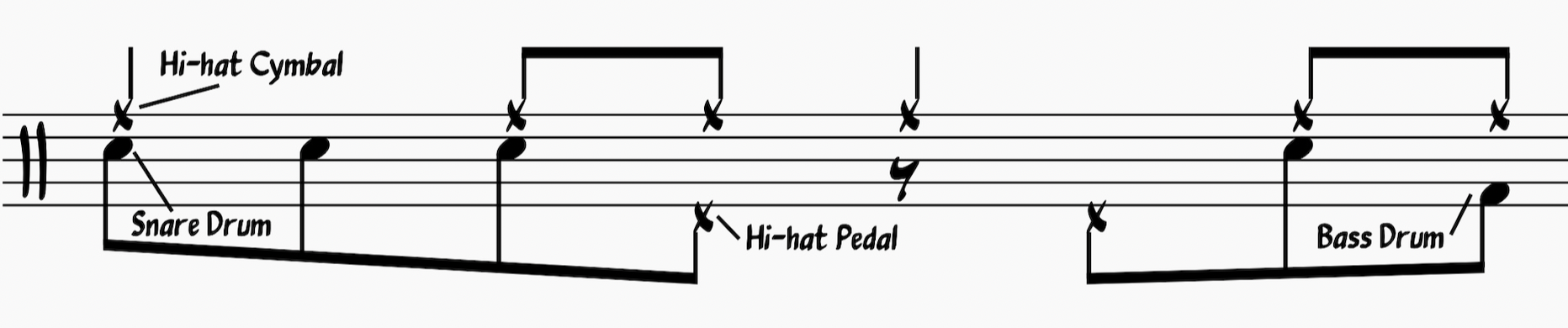
For drummers who aren’t used to reading drum music on the staff, here is a key:
Quick tips for reading music on drumset:
- Solid noteheads are used for drums. You’ll see the snare drum notated on concert C and the bass drum notated on concert F in the image above.
- Drummers use an X sign to show cymbal hits. Here, the hi-hat pedal, which closes the top cymbal and bottom cymbal, is on concert D, and the stick hit to the hi-hats is represented by an X on F.
Let’s start with the first exercise:
Basic Hi-Hat Cymbals Coordination Exercise 1: Establishing The Pattern
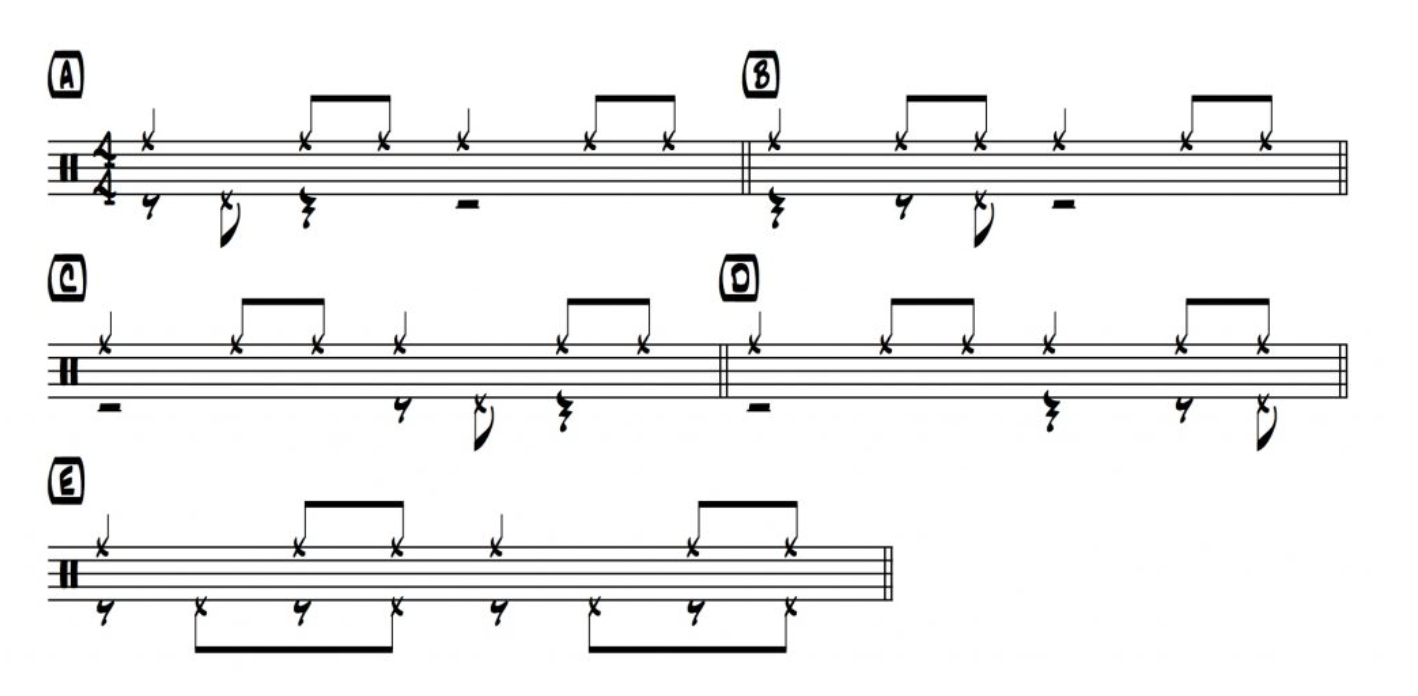
For this exercise, we will focus on getting familiar with playing the hi-hat on all the upbeats while keeping a smooth and consistent jazz ride pattern on the right hand (or left if you’re lefty).
- The next step is to combine the different bars. For instance: Bar (A) + Bar (D) or Bar (B) + Bar (E).
- You can make longer phrases, like 4-bar phrases. For example: Bar (A) + Bar (D) + Bar (B) + Bar (C).
- Also, you can combine two or more bars into one bar. For example, the First half of Bar (A) + the Second half of Bar (D)
Once you are comfortable playing these exercises, I would encourage you to add “four on the floor,” which means to feather the bass drum pedal on all four quarter notes.
Now, let’s add a second voice, the snare.
Basic Hi-Hat Cymbals Coordination Exercise 2: Adding the Second Voice
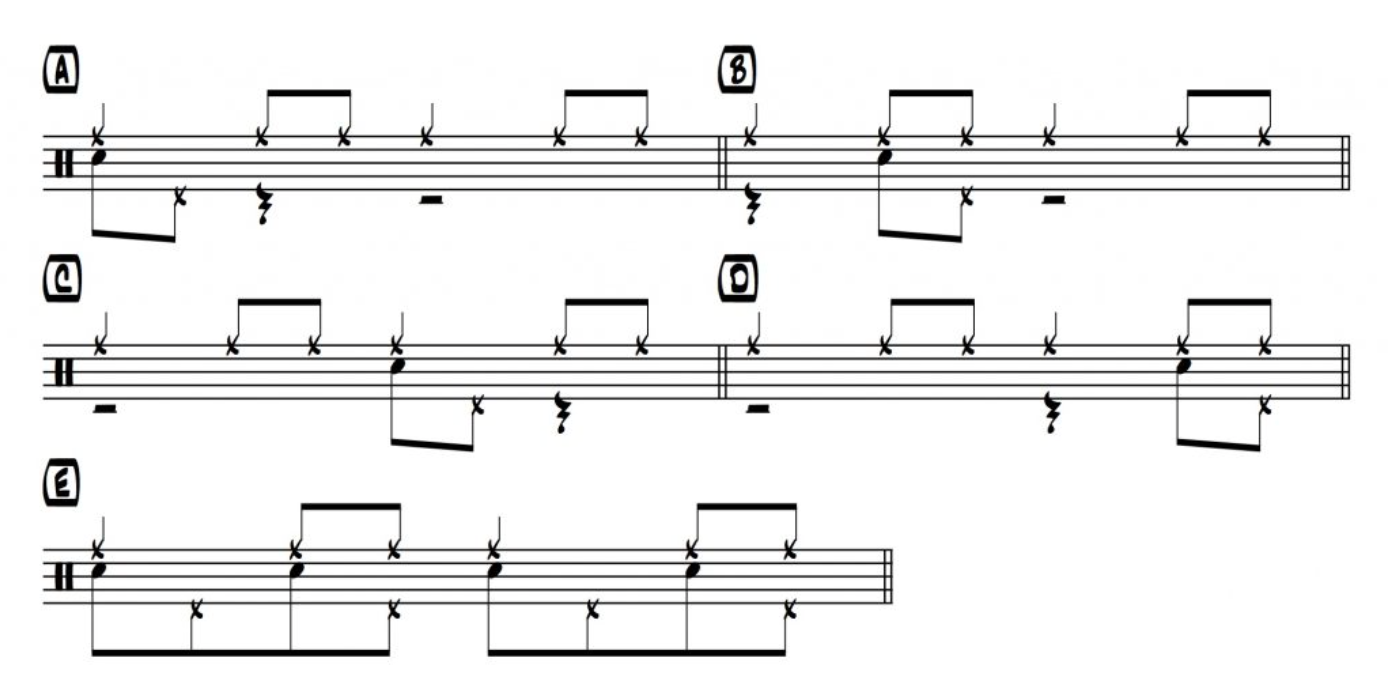
In exercise 2, we’ll add a snare hit in the downbeat right before the hi-hat. So, if you did the previous exercise, you should be fine doing this one.
We will follow all the same steps we did in exercise 1.
- We are going to combine bars in two bars and four bars phrases,
- We can incorporate several bars into one bar.
- We can add the “four on the floor” by feathering the bass drum pedal.
Exercise 3: Developing Exercises 1 and 2
Finally, let’s combine the previous exercises with the jazz drumming vocabulary we already know to play some new phrases that help you develop that third voice on the hi-hat cymbals.
Bars A Through D:
Here are four measures you can combine in different ways:
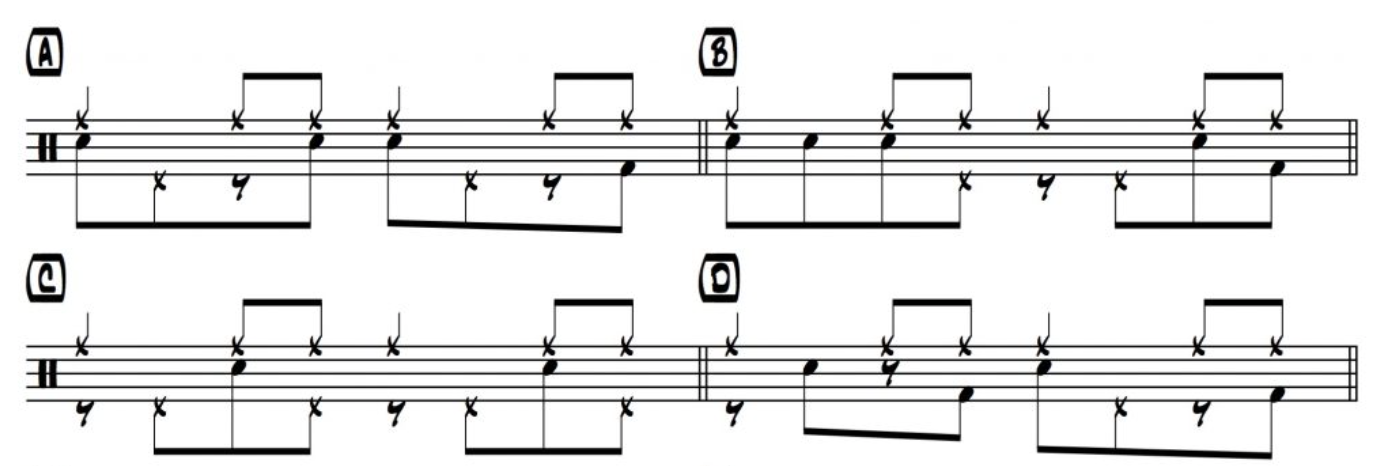
Try [A to B], [A to C], and [A to D]
Try [B to A], [B to C], and [B to D]
Try [C to A], [C to B], and [C to D]
Try [D to A], [D to B], and [D to C]
Try making four-measure phrases, too.
Bars E Through H:
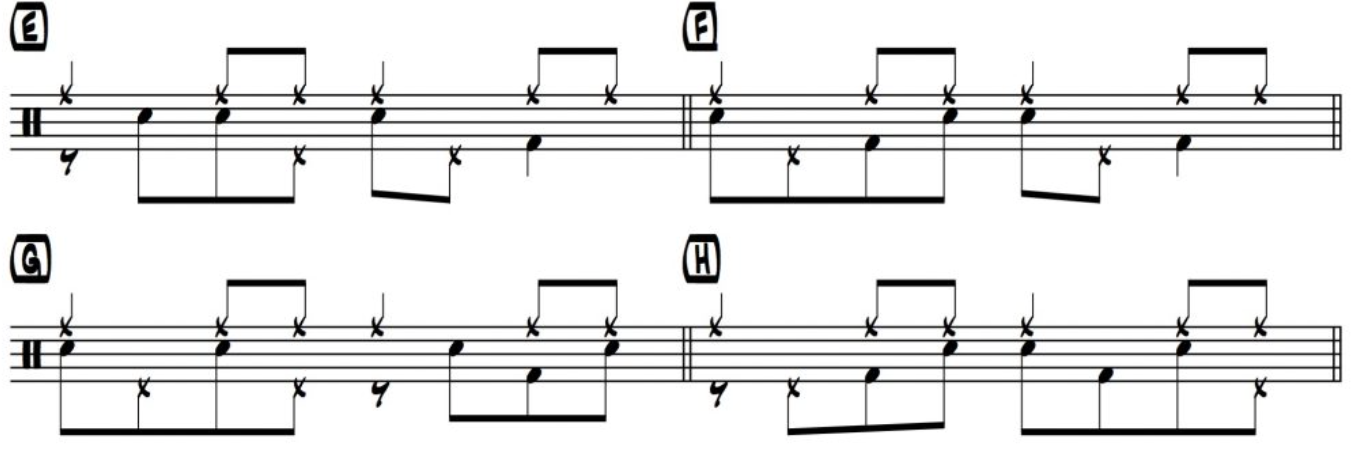
Here are an additional four measures to learn and combine:
Combinations Using Bars A Through H
Try taking phrases from A-D and E-H and connect them in different combinations:
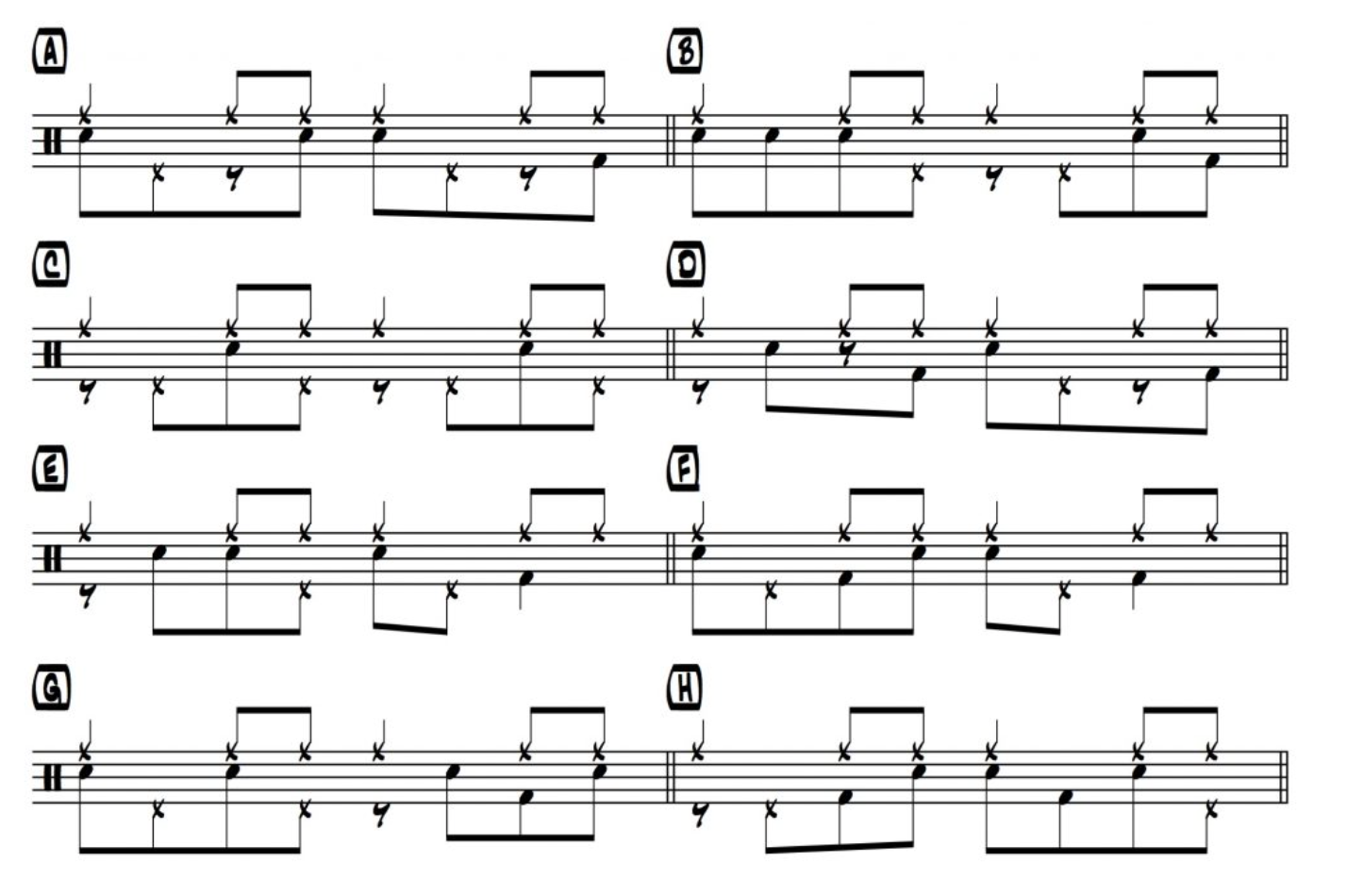
Combining all these different phrases in various orders will give you plenty to work on as you develop coordination on the hi-hats. For more drumming tips and exercises, check out how to practice rudiments musically.
Take Your Jazz Chops to the Next Level. Join the Inner Circle.
Learn Jazz Standards is dedicated to helping musicians become the best jazz players they can be. If you are a drummer who wants to learn more about jazz theory and improvisation, you should check out what the Learn Jazz Standards Inner Circle offers.
The Inner Circle is designed to help musicians develop their jazz chops and music theory knowledge and expand their jazz tune repertoire.
If you are a drummer who is just getting into jazz, then check out all that the Inner Circle has to offer you.