
The blues scale is a useful tool musicians use to capture the unique tonal qualities of the blues. However, it isn’t the only useful tool in the toolbox. Depending on what you try to do, there may be even better options for infusing your playing with the sound of the blues.
In this article, we will not only cover the major and minor blues scales, but we’ll also look at other scale options that will help you capture the blue note in your playing!
We’ll explore:
- What makes the blues sound like “the blues”
- How to use the major and minor blues scale
- How to use pentatonic scales to capture the sound of the blues
- How to use heptatonic (seven-note) scales like the Mixolydian scale to play the blues
- How to use octatonic (eight-note) scales like the bebop dominant scale
- Plus, we’ll uncover history and context along the way!
If you like what you read and want to dig deeper into studying jazz, then you need to check out the Learn Jazz Standards Inner Circle! The Inner Circle helps you unlock your jazz potential by providing the tools to master jazz theory, improve your chops, and learn jazz standards.
Whether you play piano, trumpet, jazz guitar, or any instrument, the Inner Circle has the courses, materials, masterclasses, workshops, and community you need to reach your jazz potential.
Come see what the Inner Circle is all about.
Now, on with the article! Use the table of contents to go directly to the scales!
Table of Contents
What Makes The Blues Sound Like The Blues?
You can probably think of several songs that contain bluesy elements—whether it’s an emotionally charged guitar solo or a powerful, stirring verse. But have you ever thought about the specific characteristics that make the blues iconic?
Before digging into the different types of major and minor blues scales, let’s first figure out the elements that make the blues unique.
The “Blue” Note
Western music functions on a twelve-tone system of equal temperament. Under this system, an octave is divided into twelve equal parts. These twelve tones, represented by half steps, function as the smallest meaningful pieces of harmonic information in Western music theory.
However, a half-step contains even smaller intervals within it.
Non-Western music frequently incorporates semitones (or microtones) throughout. From the ragas of India to the maqam scales of Arabic music, microtonal music is much more common on the world stage.
Microtonalism is also a common feature of blues music, which was heavily influenced by the musical traditions of enslaved peoples from West Africa who carried their musical traditions across the Atlantic.
Therefore, “blue notes” are pitches outside the rigid twelve-tone system.
The most common blue notes are the flatted third, flatted fifth, and flatted seventh degrees of the major scale. These notes sit outside the rigid twelve-tone system, creating tension, dissonance, and a sense of longing or sadness.
Tempered instruments, such as the fretted guitar or a piano, have fixed pitches (though guitarists will bend their strings to remedy this… just ask B.B. King or Stevie Ray Vaughan). To hit those blue notes, many blues scales will employ the adjacent pitches around them.
The result is chromaticism. For example, the major blues scale contains a minor third and a major third interval. The minor blues scale has both a flat fifth and a perfect fifth interval (more on these down below).
Check out this article for more on musical intervals like the major third or the perfect fifth.
Other Elements That Make The Blues Iconic
What else makes the blues iconic?
Standard 12-Bar Form
Another characteristic of the blues is its regular form. The typical structure of a blues song is the 12-bar blues, though there are always variations and adaptations. In traditional blues, the twelve-bar form is lyrically divided into three sections.
The first two lines are often identical, and the third line brings a resolution. This tradition can be found in jazz blues heads, where the melody is broken into three four-bar phrases. The first two phrases are often the same, and the last is different.
Note that the 12-bar blues isn’t completely universal. Some blues songs are 16 bars, 24 bars, or longer.
Call and Response
Another iconic characteristic of the blues is the element of call-and-response. The call-and-response interaction between performers can be traced back to the work songs and religious music of enslaved peoples in the United States.
Originally, the call-and-response was between a song leader and a group of people. However, any combination of instruments and voices can reproduce the call-and-response element, especially during solo sections.
Themes Of Sadness and Melancholy
Blues lyrics usually contain themes of sorrow, hardship, betrayal, unrequited love, and other struggles. However, it’s not all about sadness—there are also many blues songs about overcoming challenges, celebrating life, and embracing humor.
Instrumentation
Instruments like the acoustic guitar, electric guitar, and harmonica have become closely associated with the blues. Guitars, banjos, and other stringed instruments were particularly popular in the American South during the late 19th century when the blues began to mature.
Rhythmic Feel
The blues uses a swing or shuffle rhythm that is intentionally uneven. The shuffle beat would go on to be extremely influential in early rock music, and we all know the significance of swing!
Harmonic Simplicity
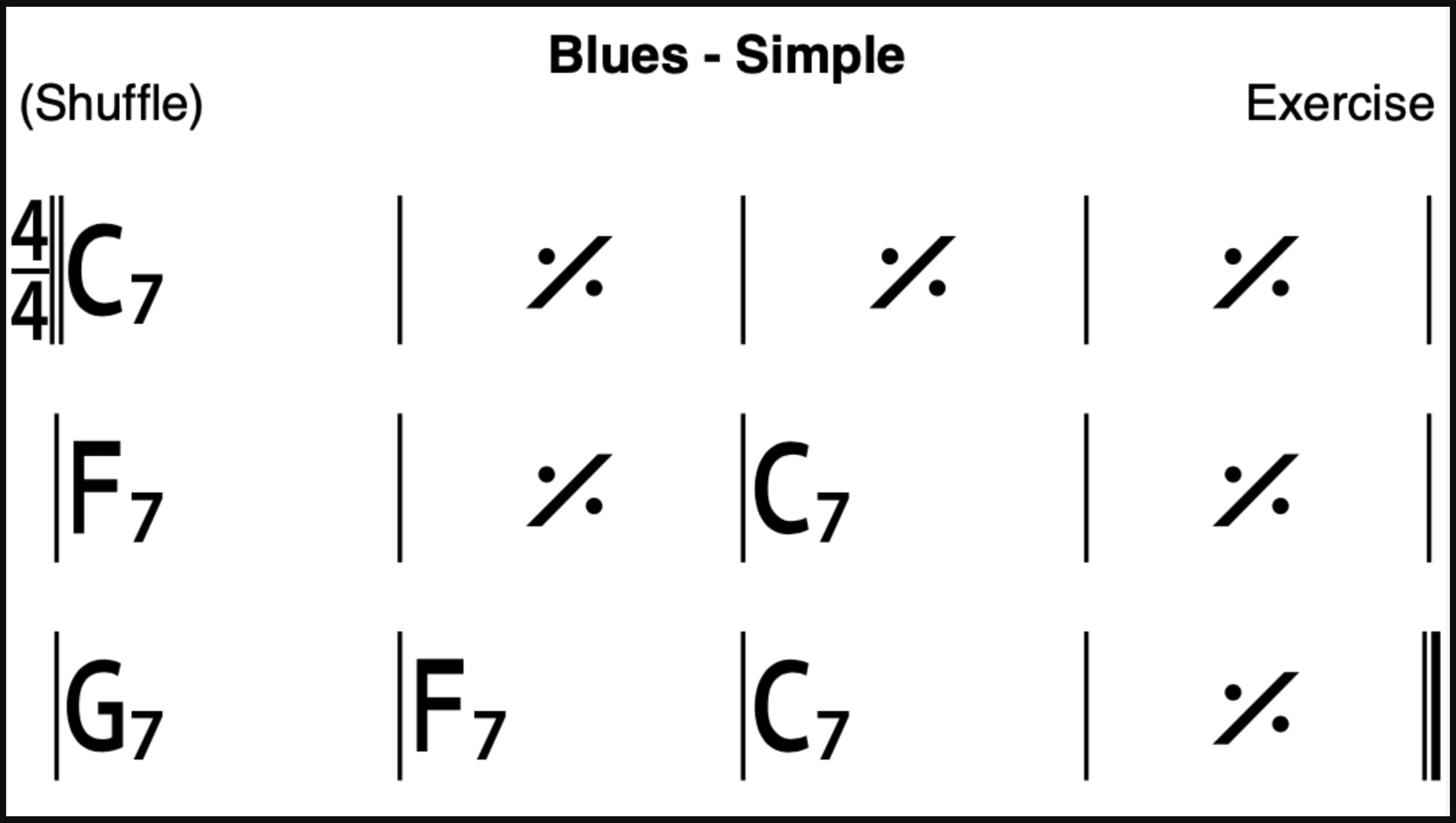
The chord progressions found in blues music are extremely simple. A simple blues uses only three chords—
- the I chord
- the IV chord
- the V chord
Check out a simple blues right here:
Check out this post on blues chord progressions to learn more about the different versions of the blues.
How Many Different Types Of Blues Scales Are There?
Apart from the literal blues scale, there are many other types of scales players use to capture a blues sound in their playing. Before going into the actual major blues scale and minor blues scale, let’s look at other scales.
Musicians have identified and categorized numerous types of scales over the years. In this section, we’ll look at some of the bluesier scales musicians use when improvising. We’ll start with the iconic major and minor blues scales, then move on to other cool scales that contain that bluesy sound.
However, there is something very important to keep in mind.
When it comes to learning scales, you can lose the forest for the trees when you spend too much time thinking about all the categorizations and groupings of notes.
The blues is much more than the sequence of notes found in the blues scale!
It’s important to keep the concept of scales separate from the concept of playing music.
While it’s very important to practice playing scales, the scales themselves are not inherently musical. In a sense, the creation and study of scales were retroactive. It came after the actual creation of musical art.
This is especially true for the blues.
Using music theory, musicians have analyzed blues music to distill its essence down into sequences of notes. This makes it easier to study blues music from a theoretical standpoint—you can play both the ♭3 and ♮3 in a scale to get that blues sound.
However, sequences of six, seven, or eight-note scales are not the blues.
Try to keep this in mind when learning the following minor and major blues scales. The best way to learn the blues (or any music) is to transcribe and analyze what musicians actually play.
To use an analogy, scales are like the paint painters use to create visual art. Paint contributes to forming the image, but the paint itself is not the final image. It’s the use of paint that makes the painting. It’s the same with scales.
1. Basic Hexatonic Blues Scales (The Literal Blues Scale)
The basic blues scales—the minor blues scale and the major blues scale—are hexatonic (meaning they have six notes) scales that look almost identical to common pentatonic scales, except they have an additional note.
- Hexa = Six
- Tonic = Tones or Notes
The major and minor blues scales work well over dominant chords.
Minor Blues Scale in 12 Keys
This is the most commonly recognized blues scale. You can think of this blues scale as a minor pentatonic scale with an added flat fifth (or blue note). The added note is a chromatic note placed between two scale degrees—the 4th and the 5th.
The notes for a C minor blues scale would be C, Eb, F, Gb, G, Bb, and back to C.
- Rt, ♭3, 4, ♭5, 5, ♭7, Rt
- C, Eb, F, Gb, G, Bb, C
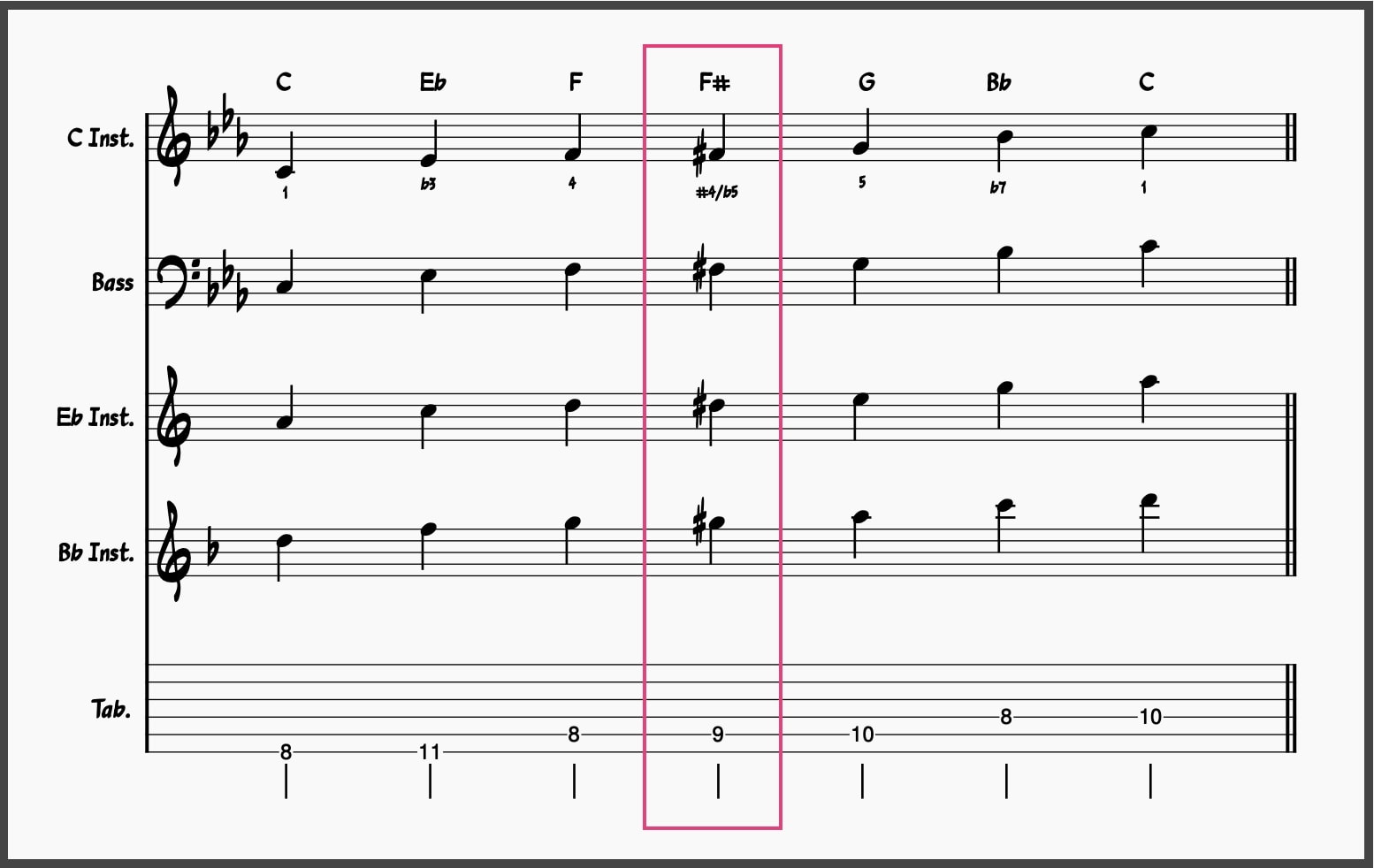
Notice the chromatic passing tone marked off in purple. Let’s look at the minor blues scale in different keys. Also, guitar players should take note of the minor blues scale shapes used! The shape will stay the same, but where we play it and which strings we use will change depending on the key.
F Minor Blues Scale:
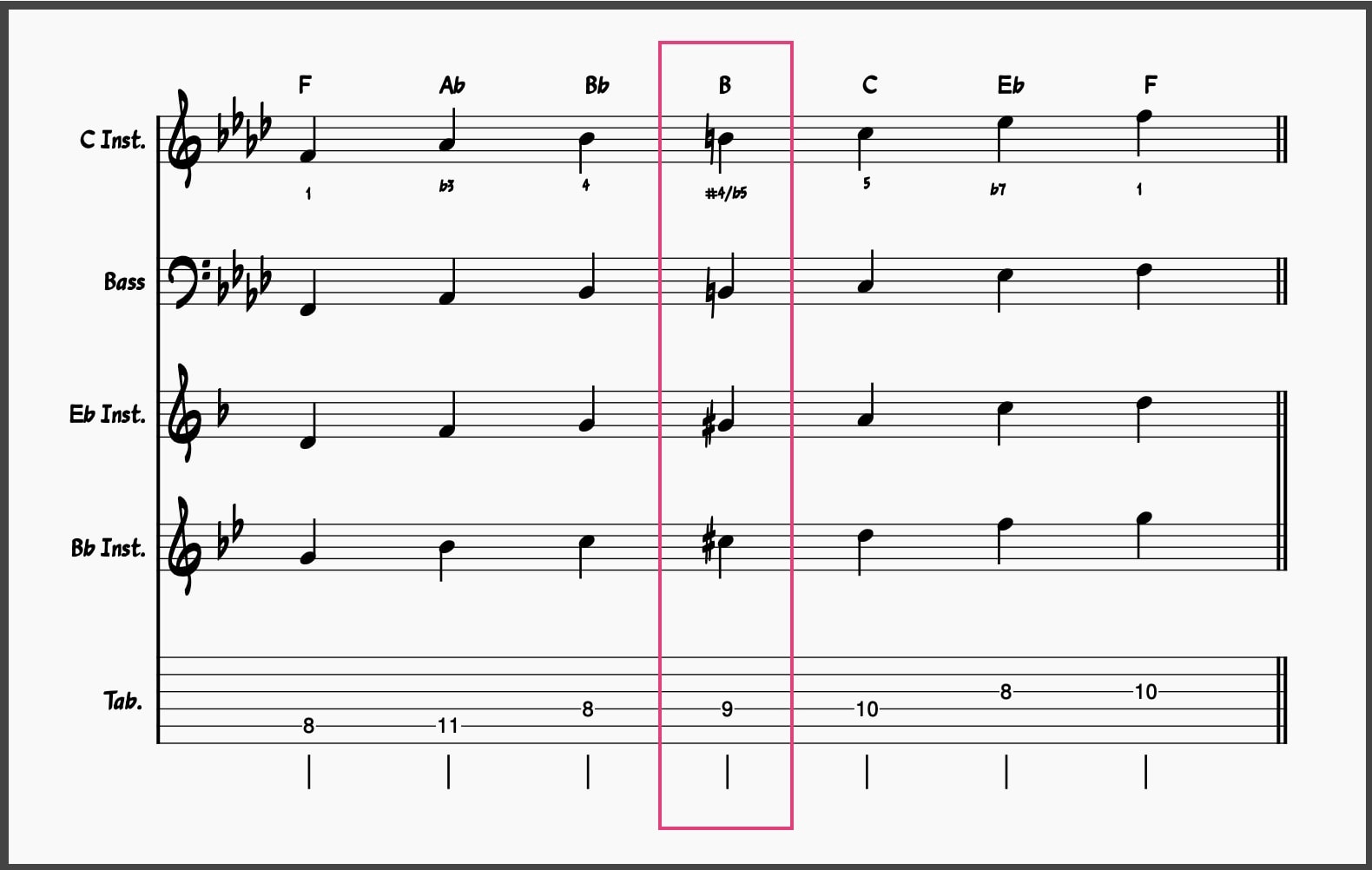
The notes for an F minor blues scale would be F, Ab, Bb, B, C, Eb, F.
- Rt, ♭3, 4, ♭5, 5, ♭7, Rt
- F, Ab, Bb, B, C, Eb, F
Bb Minor Blues Scale:
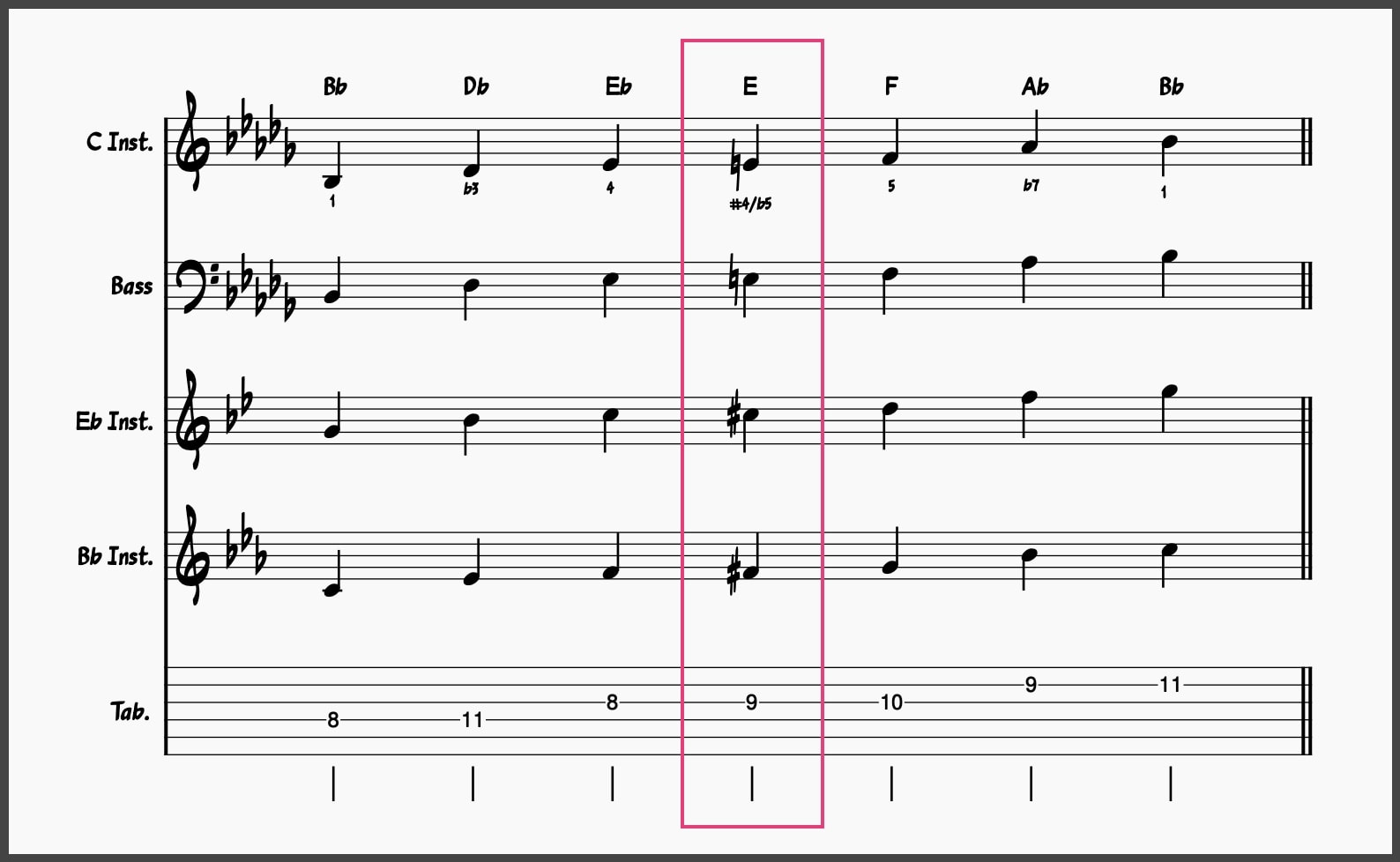
The notes for a Bb minor blues scale would be Bb, Db, Eb, E, F, Ab, Bb.
- Rt, ♭3, 4, ♭5, 5, ♭7, Rt
- Bb, Db, Eb, E, F, Ab, Bb
Eb Minor Blues Scale:
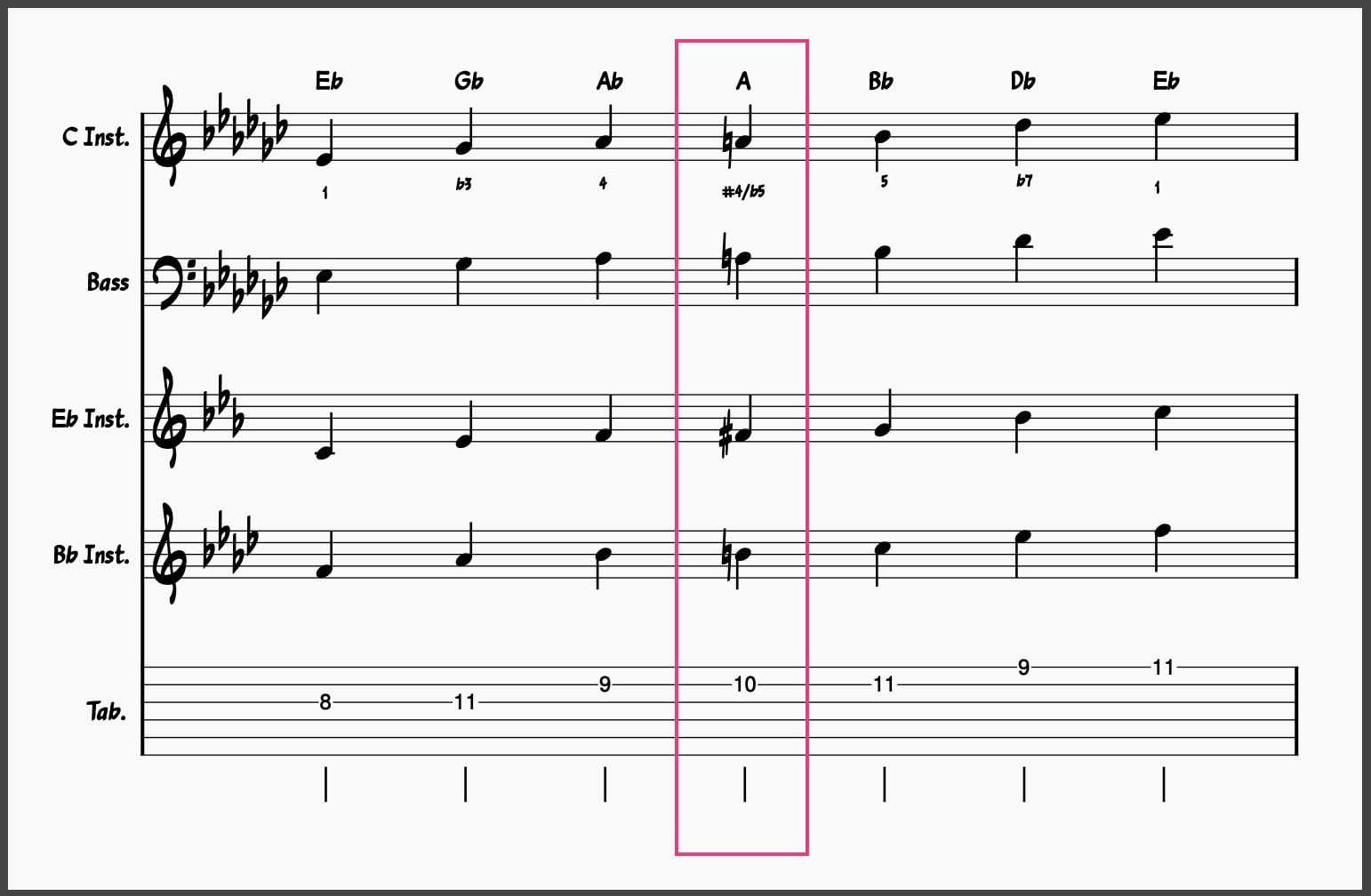
The notes for an Eb minor blues scale would be Eb, Gb, Ab, A, Bb, Db, Eb.
- Rt, ♭3, 4, ♭5, 5, ♭7, Rt
- Eb, Gb, Ab, A, Bb, Db, Eb
Ab Minor Blues Scale
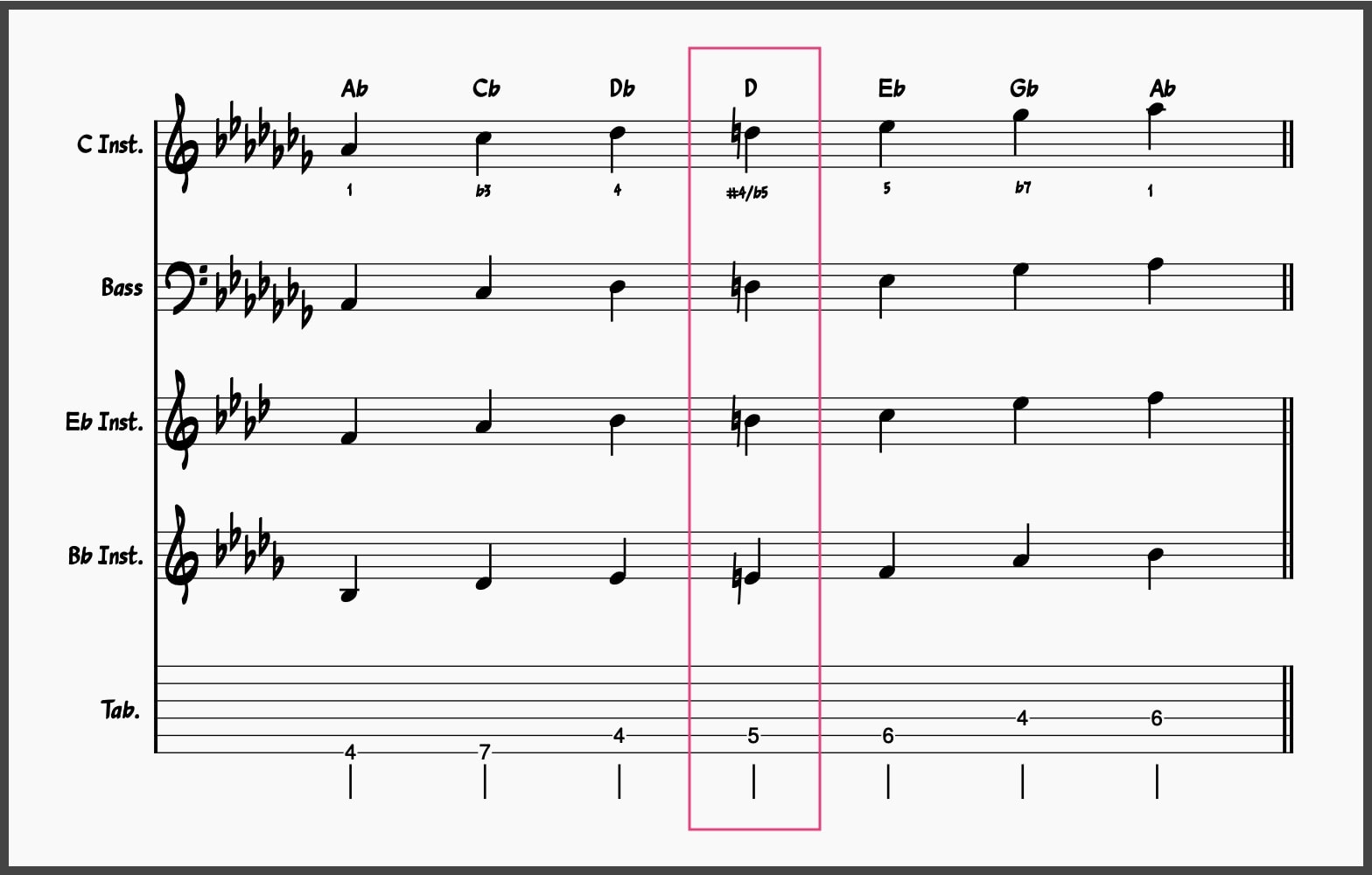
The notes for an Ab minor blues scale would be Ab, Cb, Db, D, Eb, Gb, Ab.
- Rt, ♭3, 4, ♭5, 5, ♭7, Rt
- Ab, Cb, Db, D, Eb, Gb, Ab
C# Minor Blues Scale
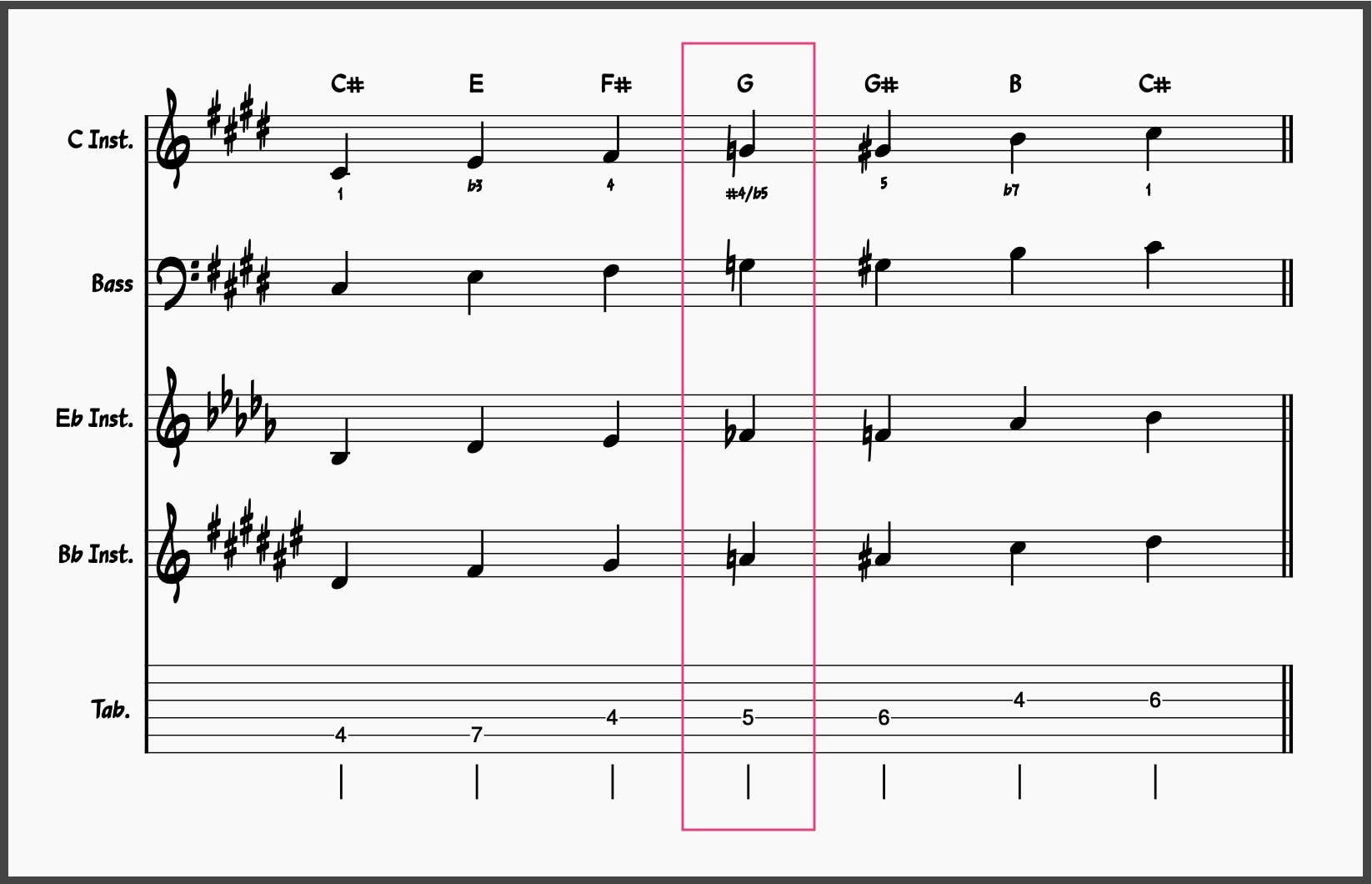
The notes for a C# minor blues scale would be C#, E, F#, G, G#, B, and back to C#.
- Rt, ♭3, 4, ♭5, 5, ♭7, Rt
- C#, E, F#, G, G#, B, C#
F# Minor Blues Scale
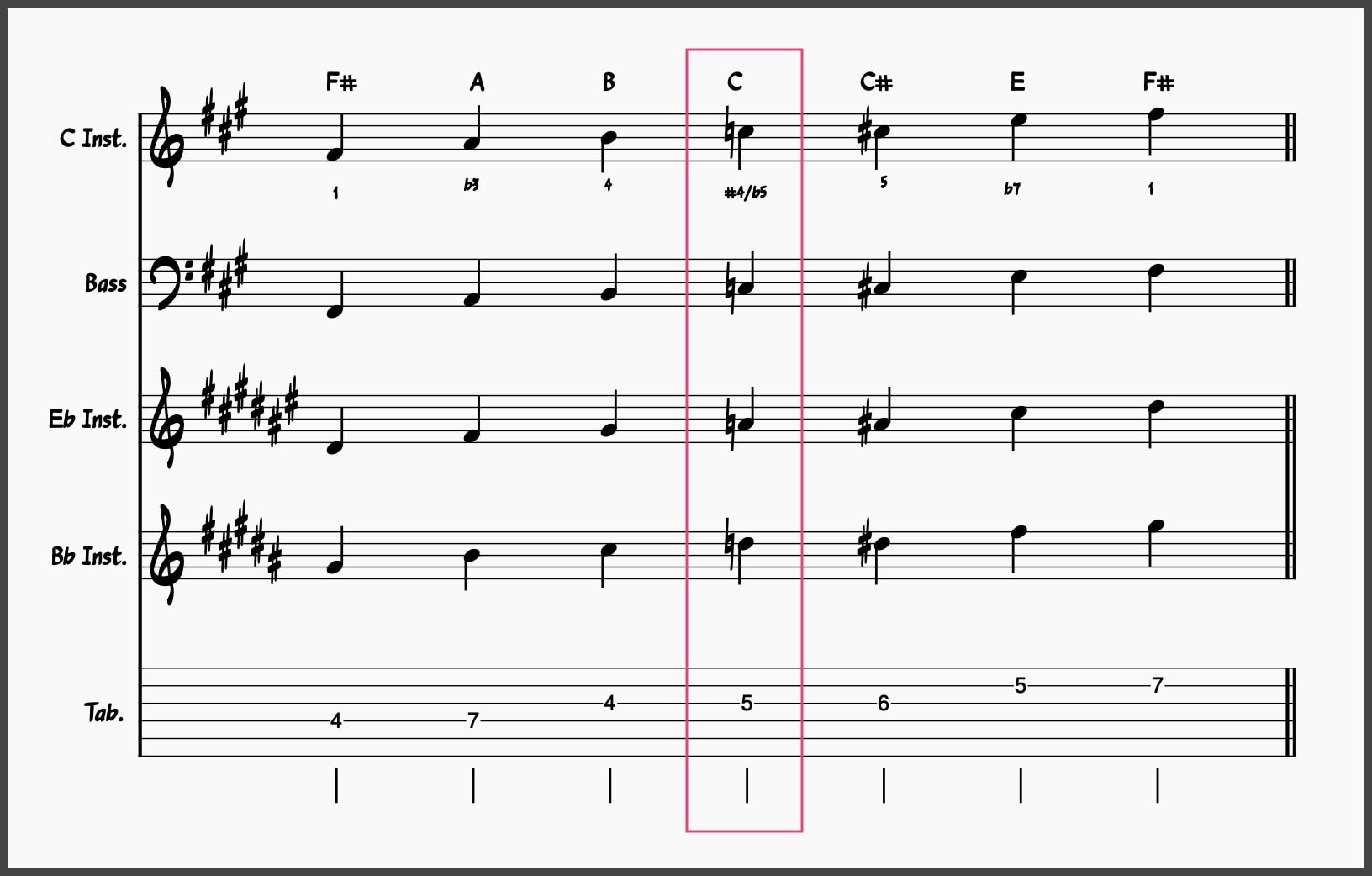
The notes for a F# minor blues scale would be F#, A, B, C, C#, E, and F#.
- Rt, ♭3, 4, ♭5, 5, ♭7, Rt
- F#, A, B, C, C#, E, and F#
B Minor Blues Scale
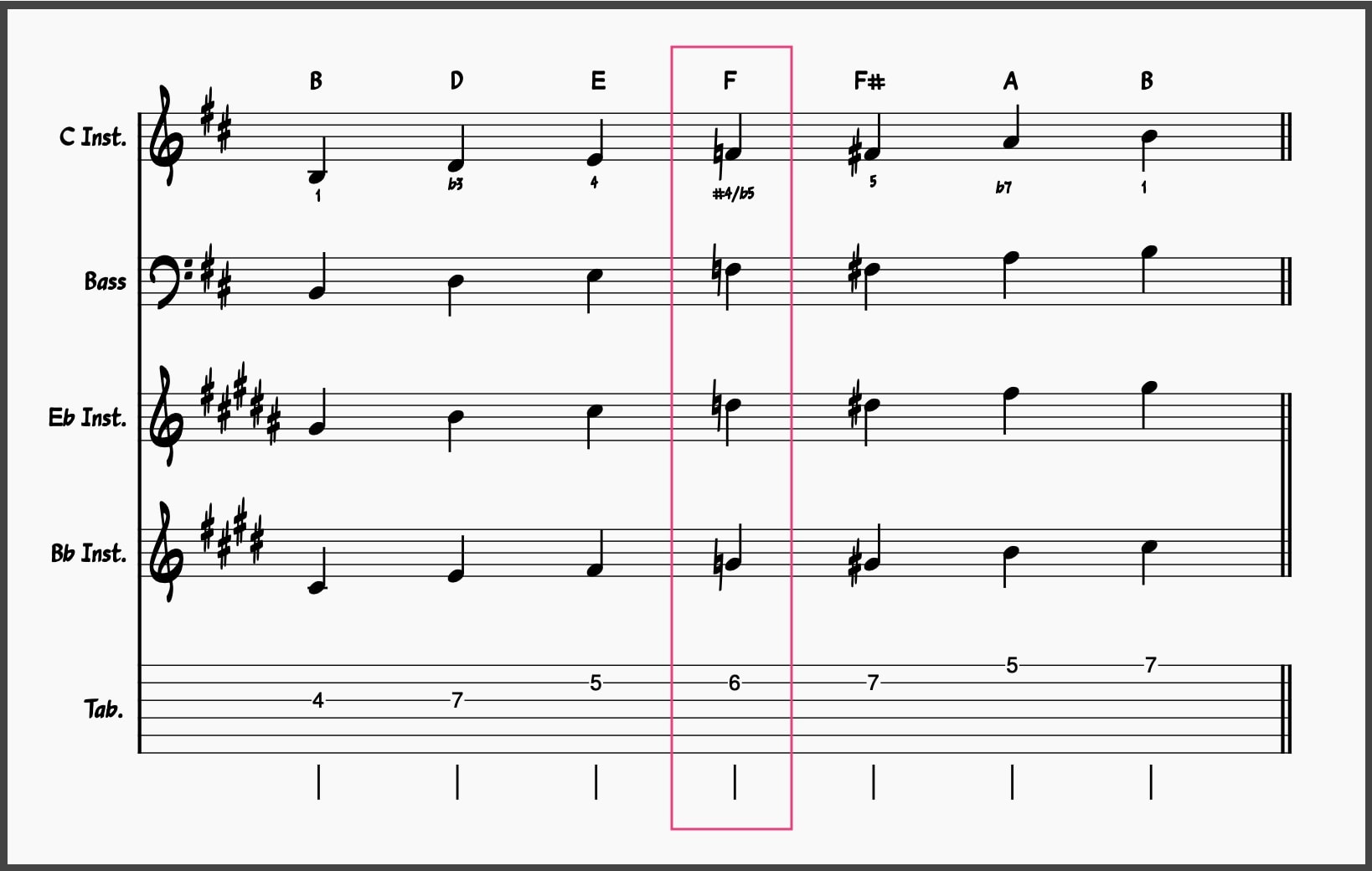
The notes for a B minor blues scale would be B, D, E, F, F#, A, and B.
- Rt, ♭3, 4, ♭5, 5, ♭7, Rt
- B, D, E, F, F#, A, and B
E Minor Blues Scale
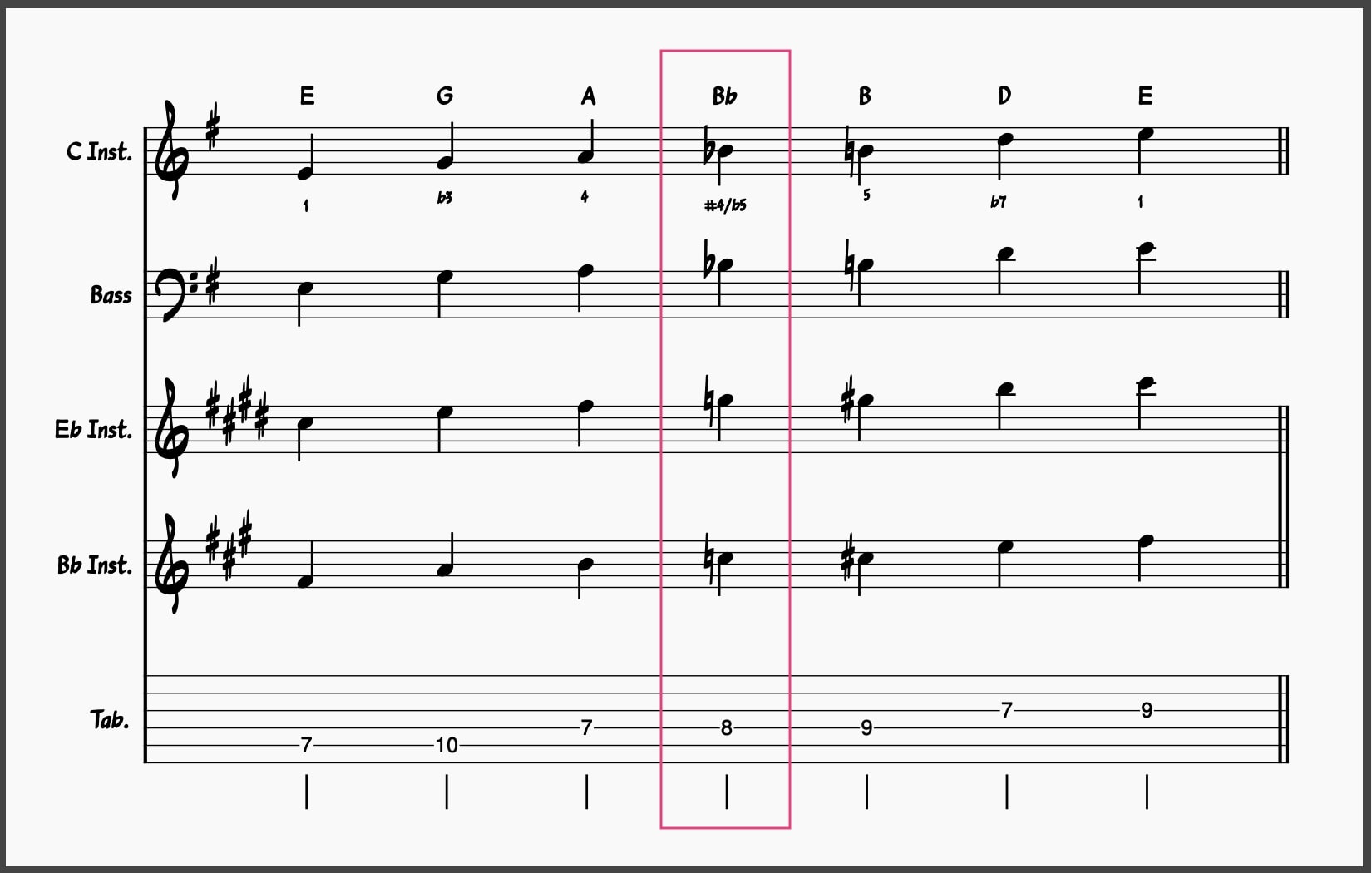
The notes for an E minor blues scale would be E, G, A, Bb, B, D, and E.
- Rt, ♭3, 4, ♭5, 5, ♭7, Rt
- E, G, A, Bb, B, D, and E
A Minor Blues Scale
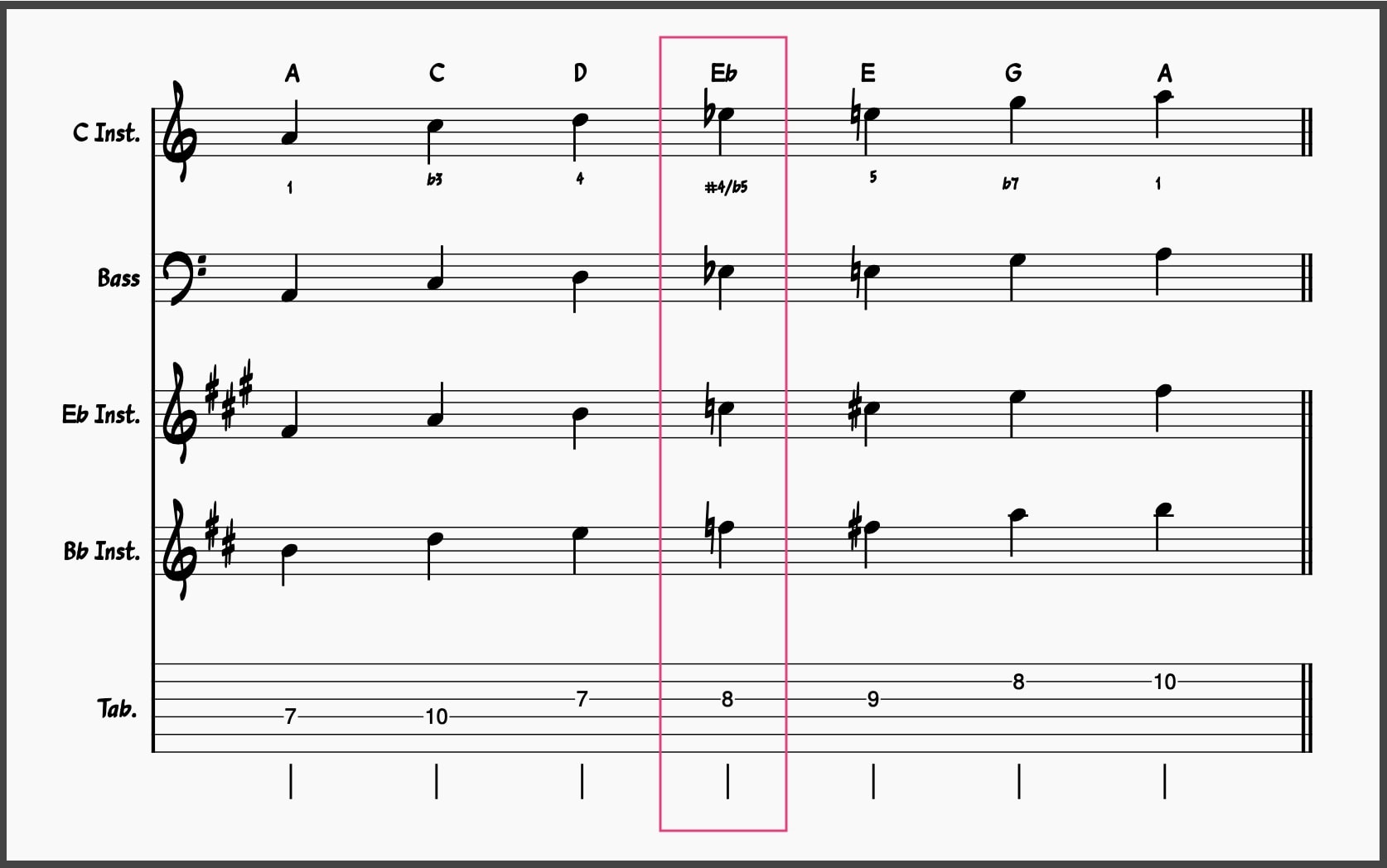
The notes for an A minor blues scale would be A, C, D, Eb, E, G, and A.
- Rt, ♭3, 4, ♭5, 5, ♭7, Rt
- A, C, D, Eb, E, G, and A
D Minor Blues Scale
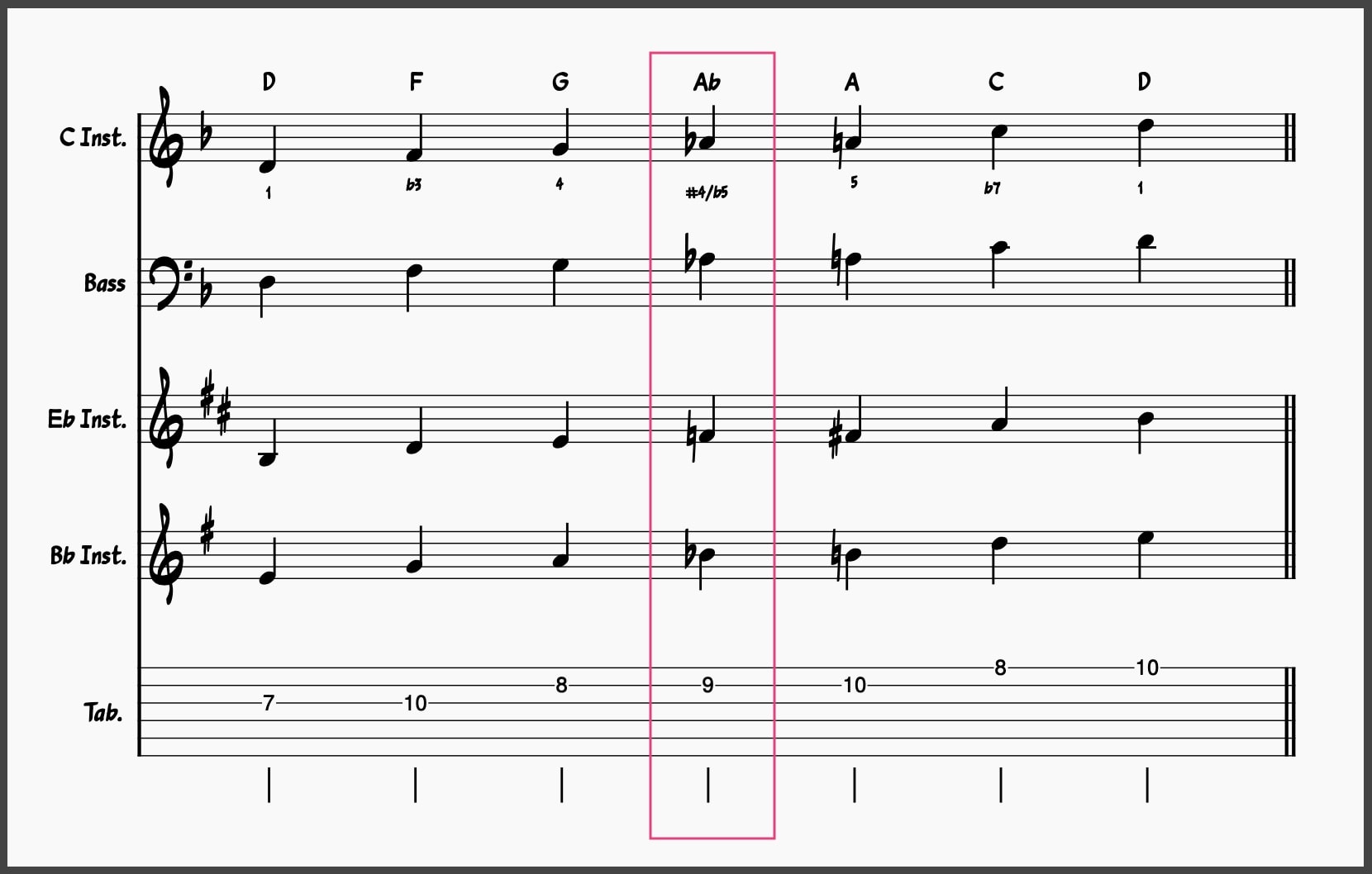
The notes for a D minor blues scale would be D, F, G, Ab, A, C, and D.
- Rt, ♭3, 4, ♭5, 5, ♭7, Rt
- D, F, G, Ab, A, C, and D
G Minor Blues Scale
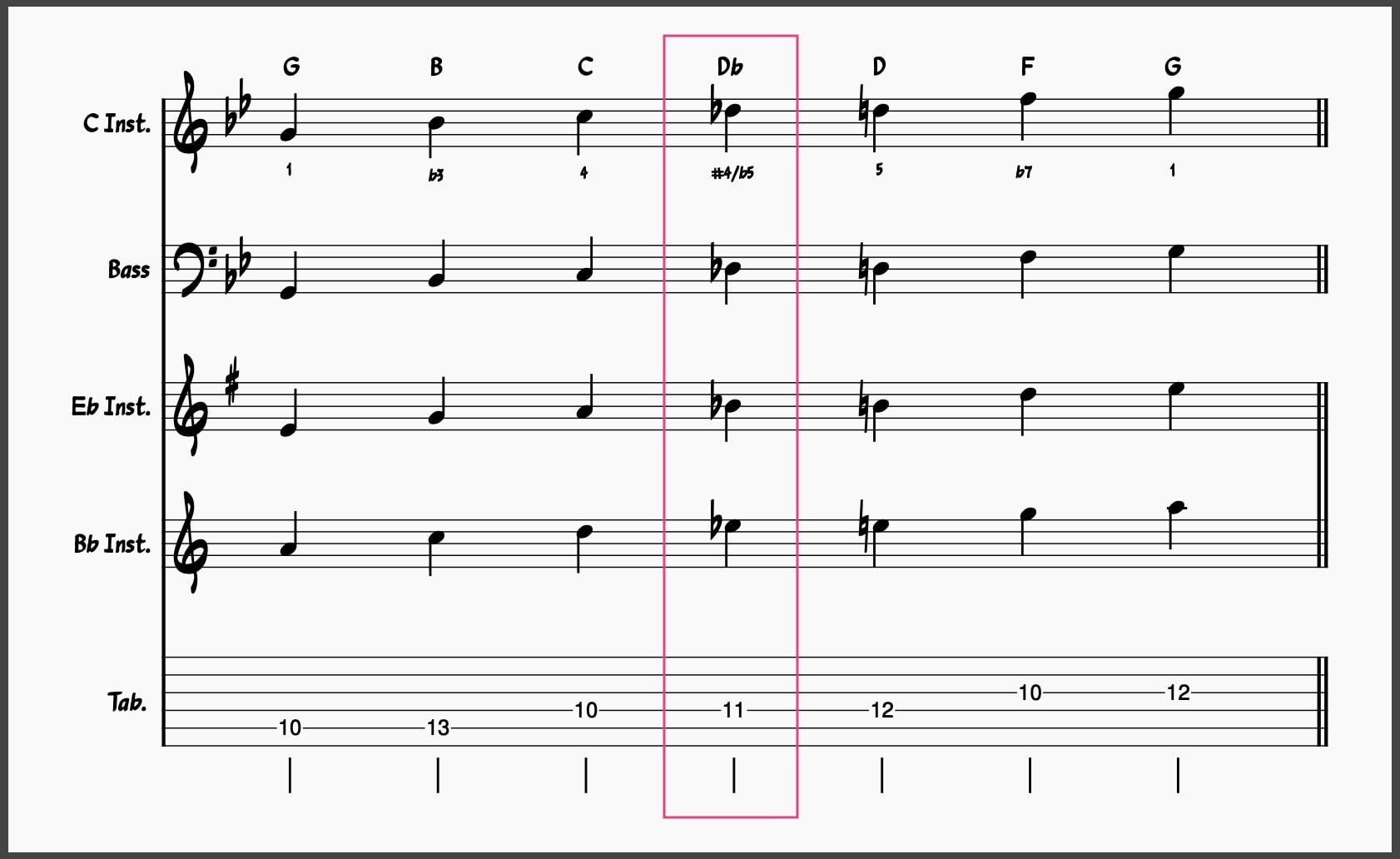
The notes for a G minor blues scale would be G, Bb, C, Db, D, F, and G.
- Rt, ♭3, 4, ♭5, 5, ♭7, Rt
- G, Bb, C, Db, D, F, and G
We’ve just learned the minor blues scale in all 12 keys! Let’s move on to the other blues scale—the major blues scale.
[elementor-template id=”192927″
Major Blues Scale in All 12 Keys
The C major blues scale can be thought of as a C major pentatonic scale with an added sharp second or flat third. The added note is a chromatic note placed between two scale degrees—the 2nd and the 3rd.
The scale formula is C, D, Eb, E, G, A, and C.
- Rt, 2,♭3, 3, 5, 6, Rt
- C, D, Eb, E, G, A, C
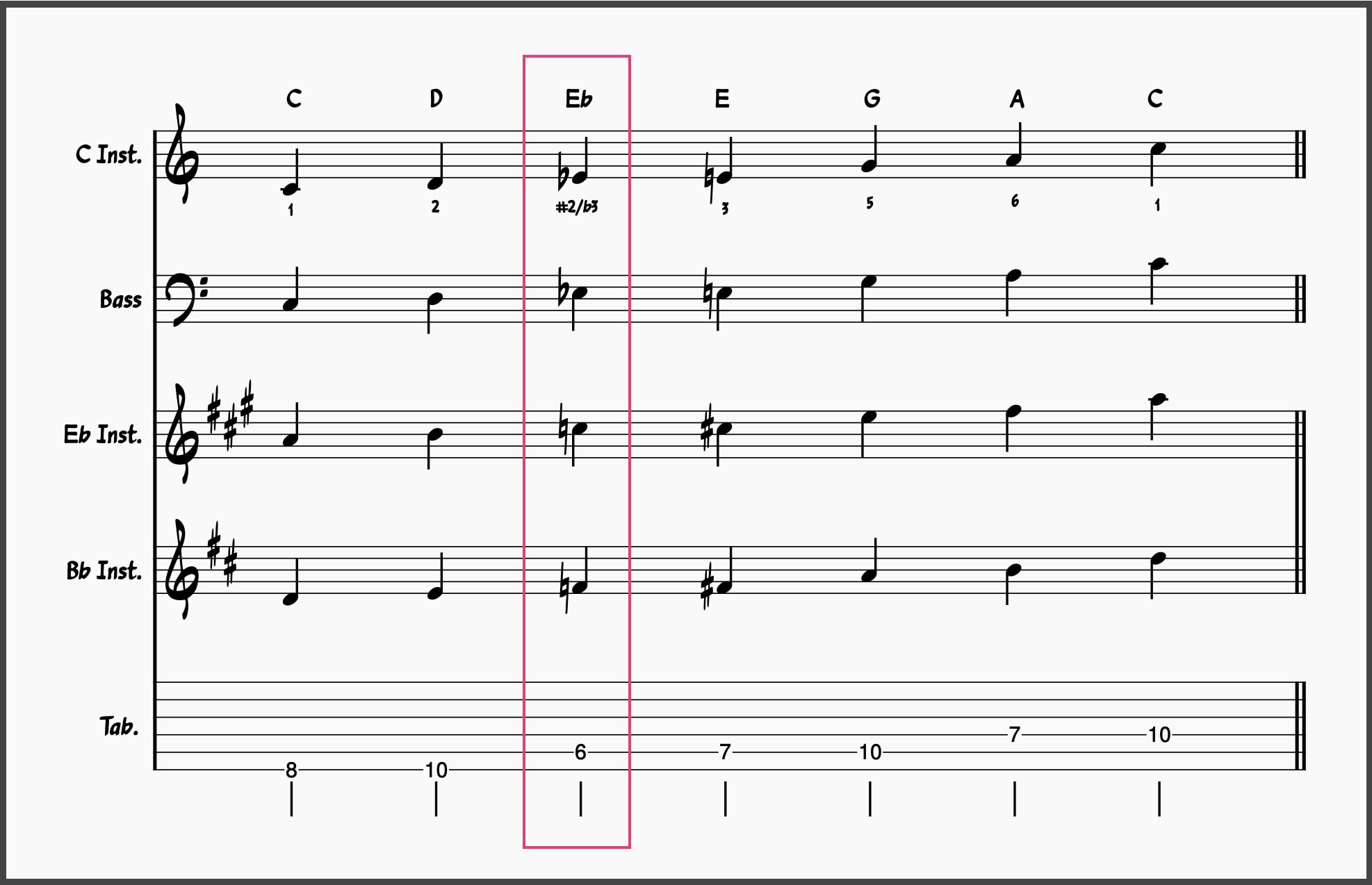
Let’s explore major blues scales in all 12 keys:
F Major Blues Scale
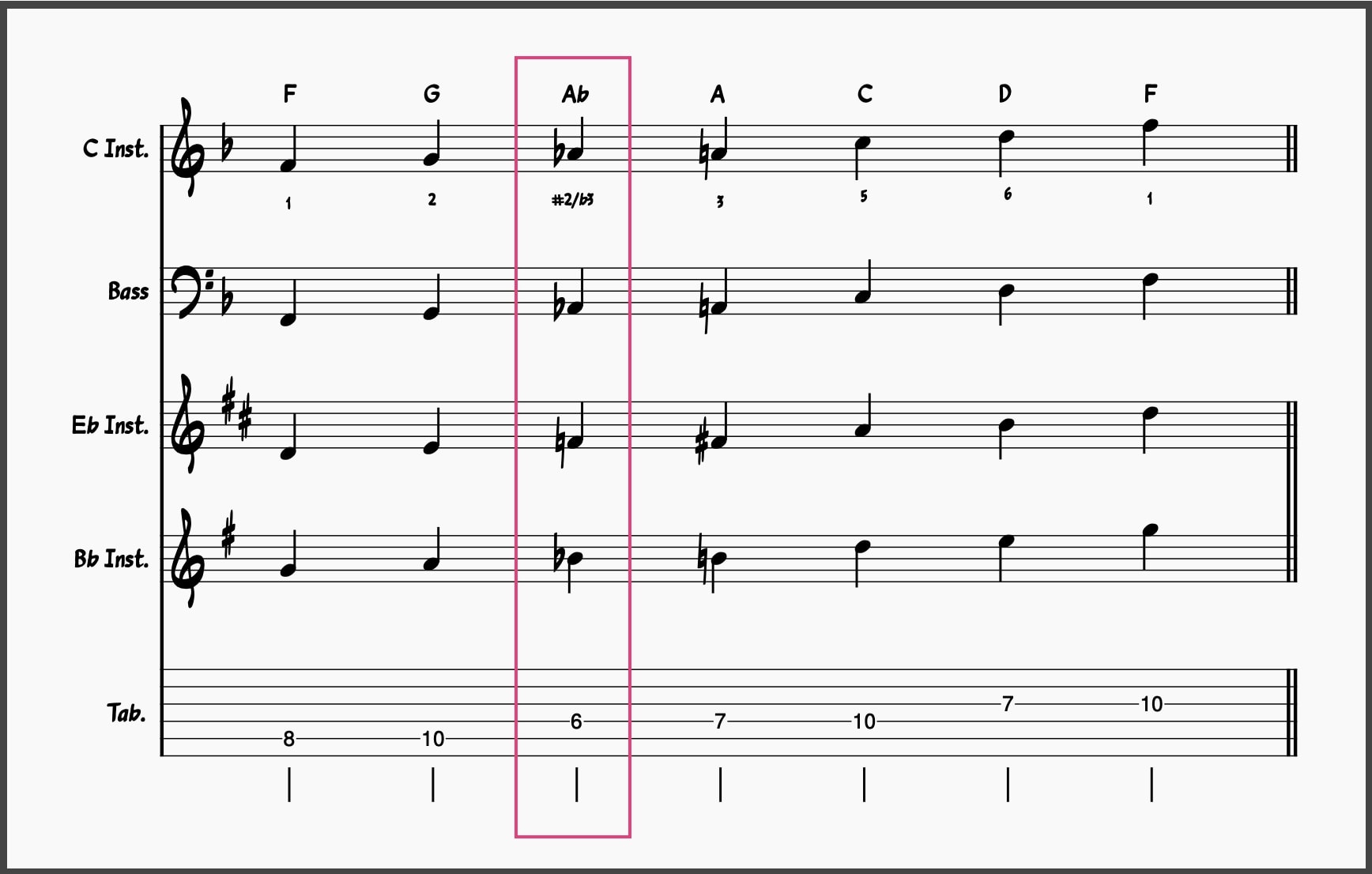
The major blues scale formula is F, G, Ab, A, C, D, and F.
- Rt, 2,♭3, 3, 5, 6, Rt
- F, G, Ab, A, C, D, and F
Bb Major Blues Scale
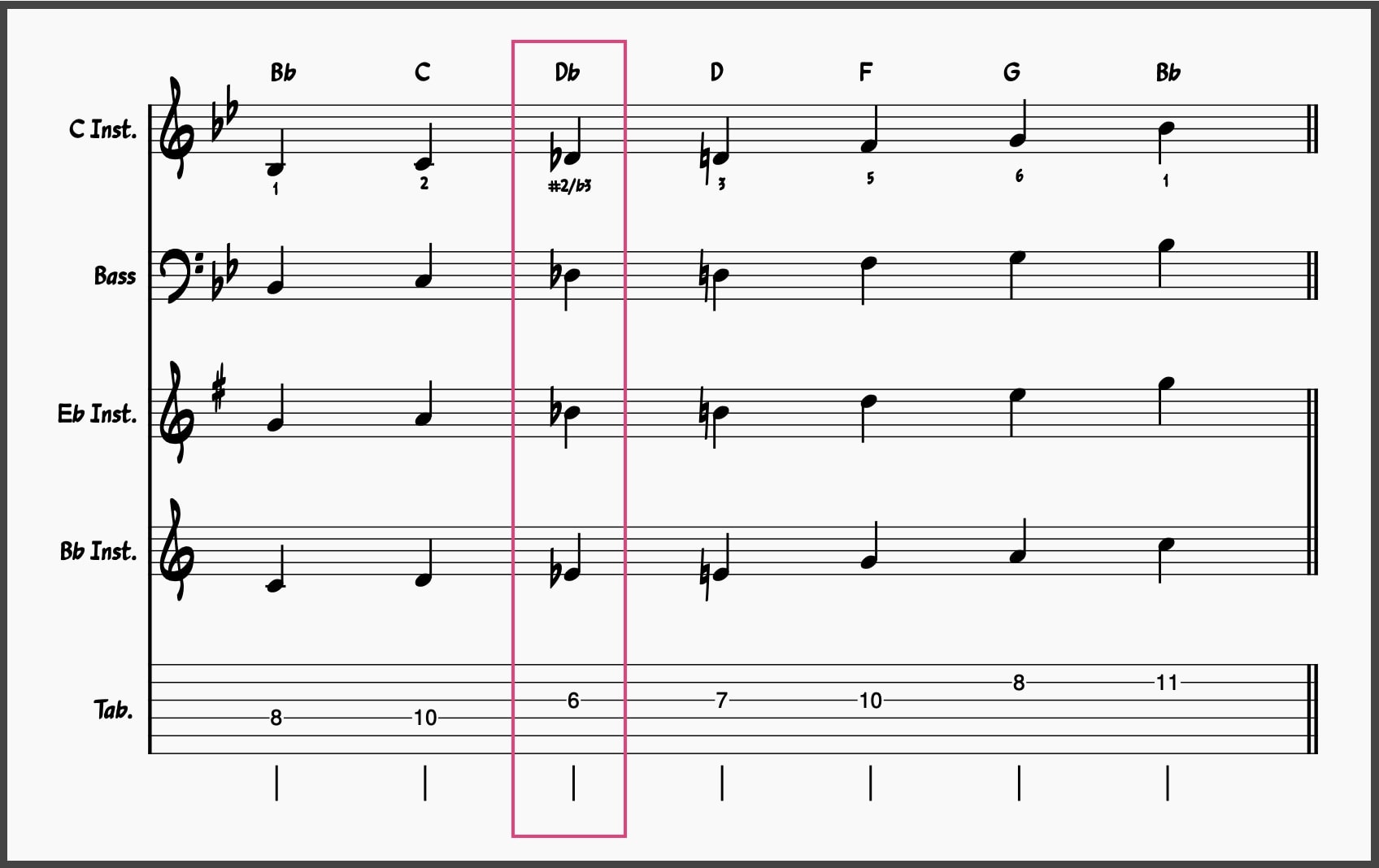
The Bb major blues scale formula is Bb, C, Db, D, F, G, and Bb.
- Rt, 2,♭3, 3, 5, 6, Rt
- Bb, C, Db, D, F, G, and Bb
Eb Major Blues Scale
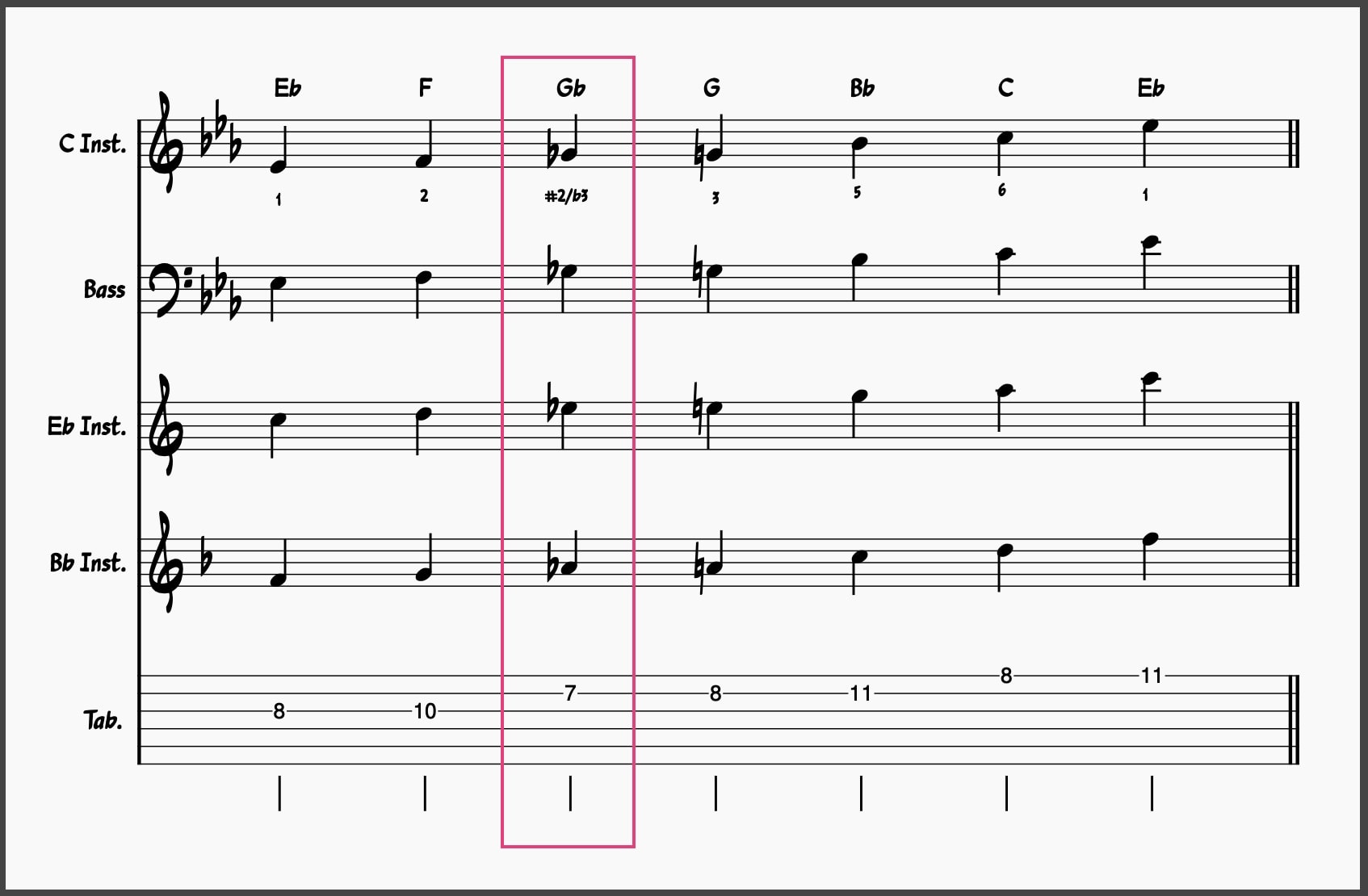
The Eb major blues scale formula is Eb, F, Gb, G, Bb, C, and Eb.
- Rt, 2,♭3, 3, 5, 6, Rt
- Eb, F, Gb, G, Bb, C, and Eb
Ab Major Blues Scale
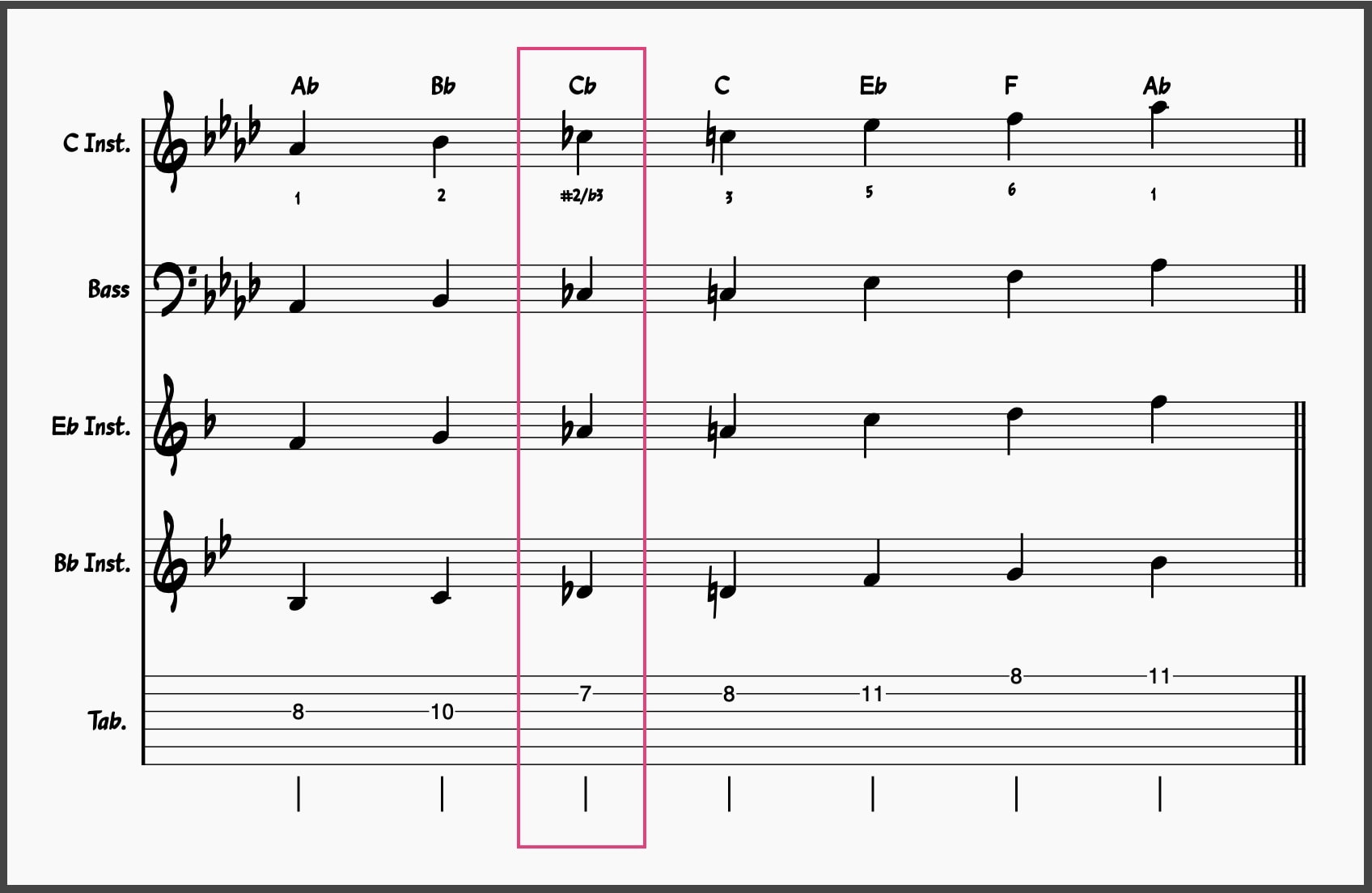
The Ab major blues scale formula is Ab, Bb, Cb, C, Eb, F, and Ab.
- Rt, 2,♭3, 3, 5, 6, Rt
- Ab, Bb, Cb, C, Eb, F, and Ab
Db Major Blues Scale
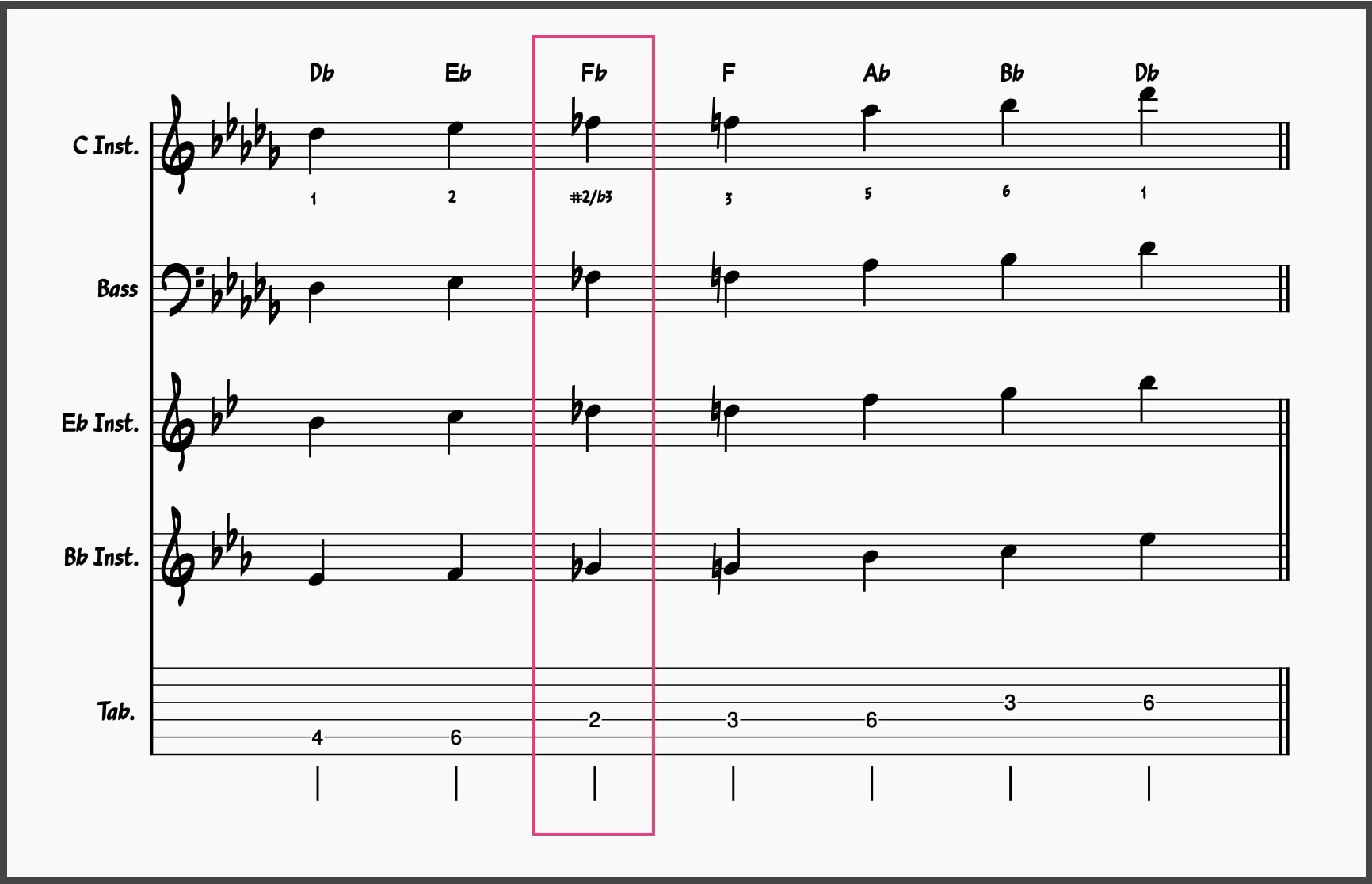
The Db major blues scale formula is Db, Eb, Fb, F, Ab, Bb, and Db.
- Rt, 2,♭3, 3, 5, 6, Rt
- Db, Eb, Fb, F, Ab, Bb, and Db
F# Major Blues Scale
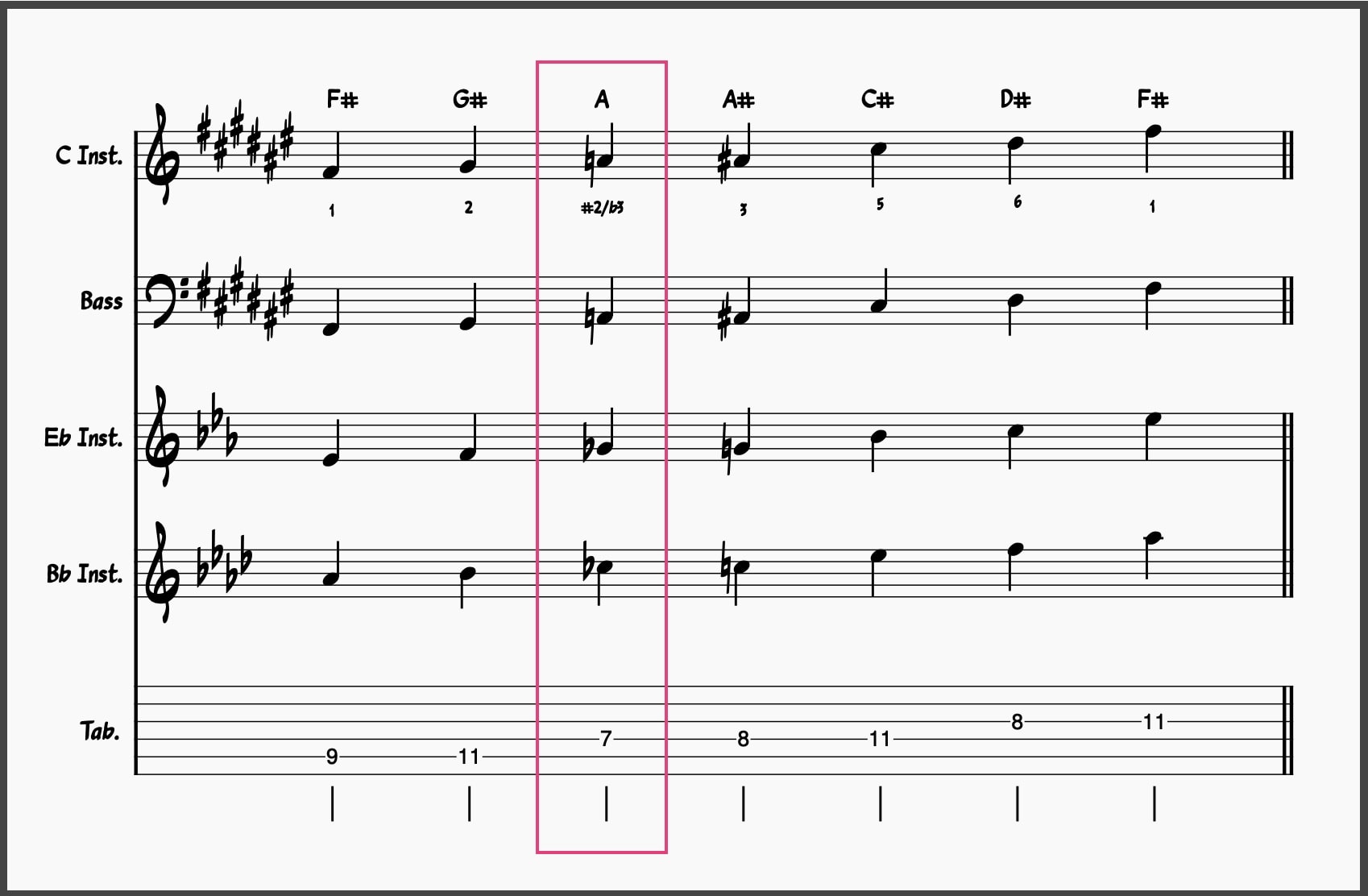
The F# major blues scale formula is F#, G#, A, A#, C#, D#, and F#.
- Rt, 2,♭3, 3, 5, 6, Rt
- F#, G#, A, A#, C#, D#, and F#
B Major Blues Scale
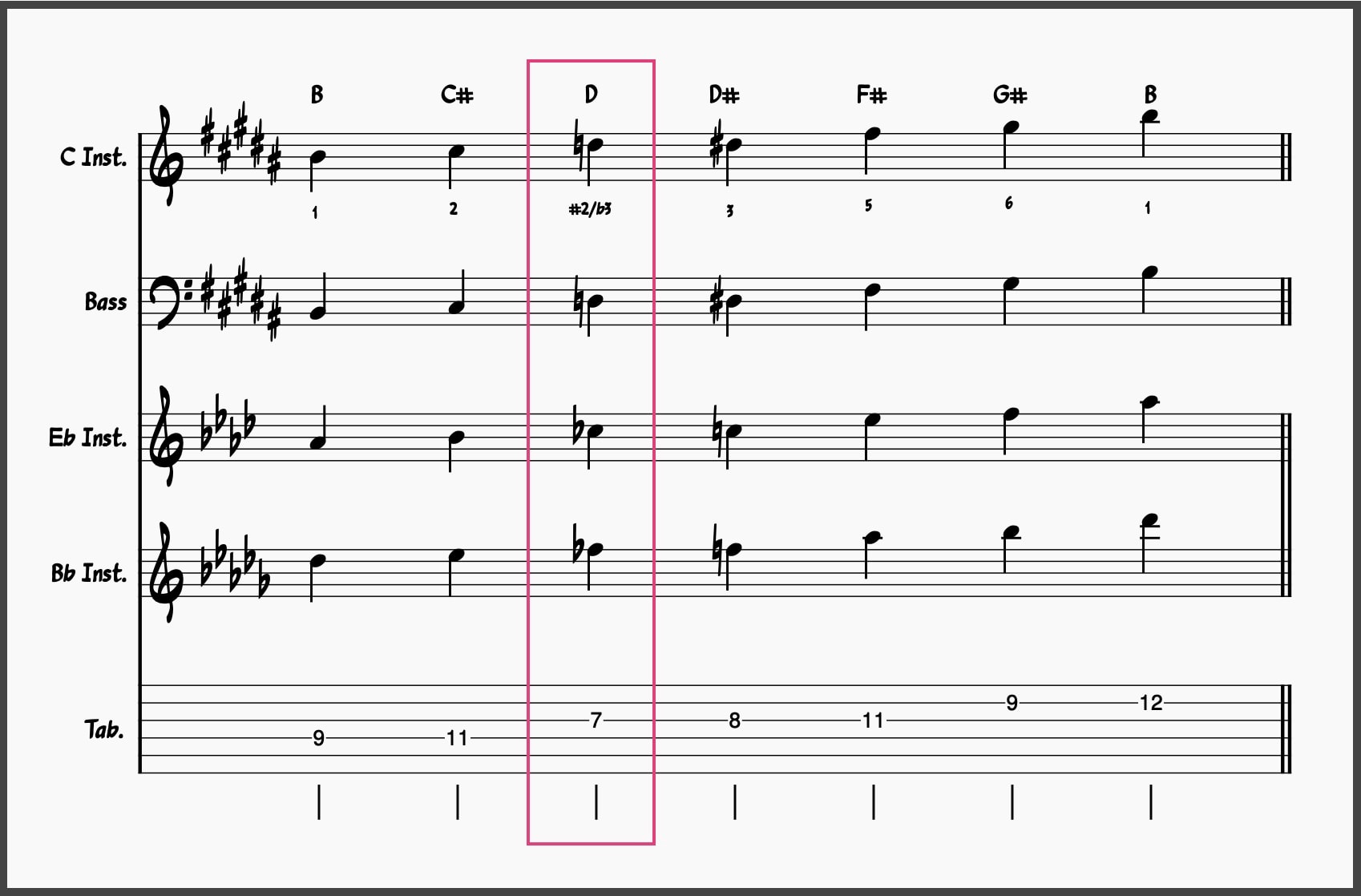
The B major blues scale formula is B, C#, D, D#, F#, G#, and B.
- Rt, 2,♭3, 3, 5, 6, Rt
- B, C#, D, D#, F#, G#, and B
E Major Blues Scale
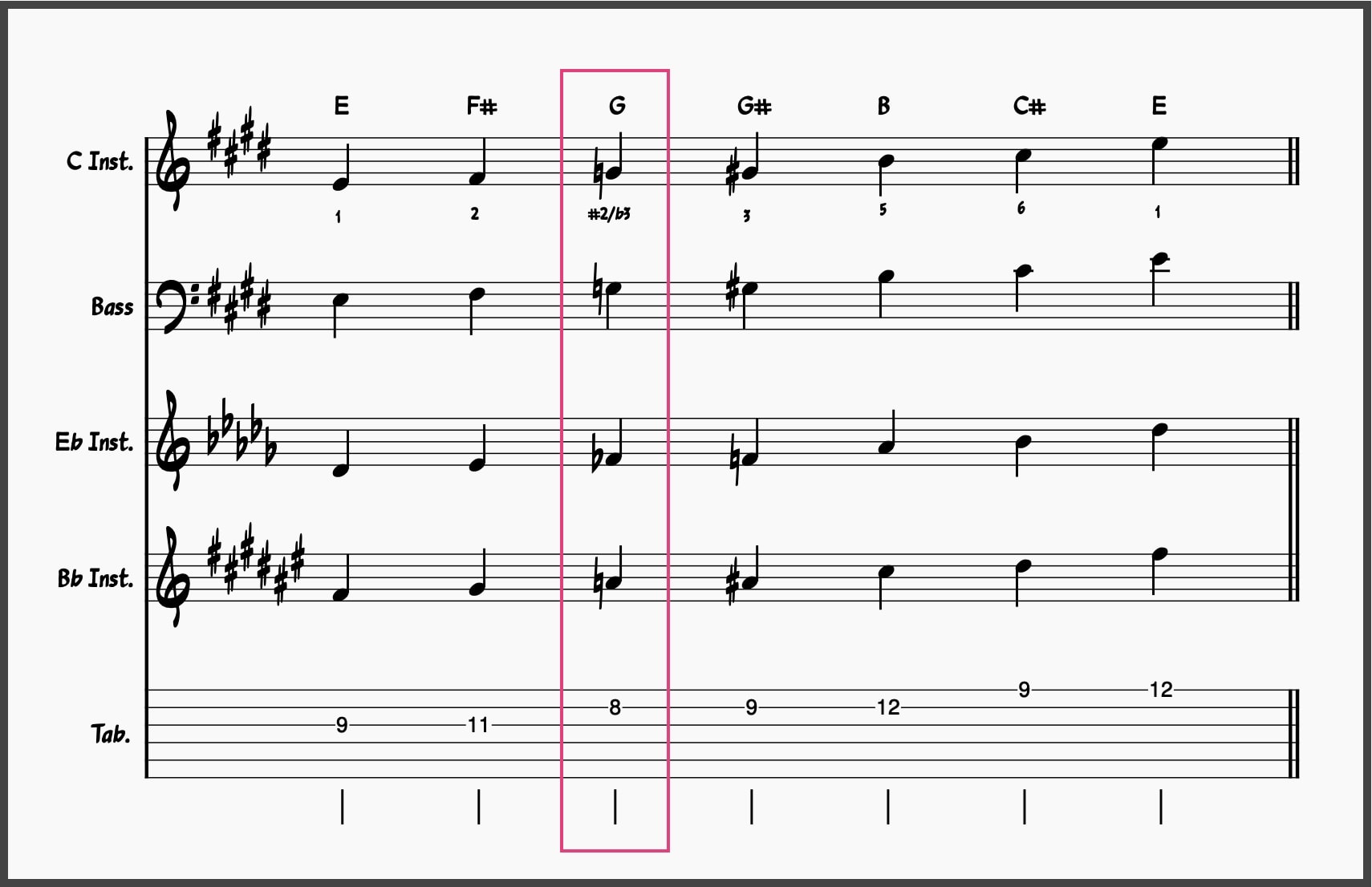
The E major blues scale formula is E, F#, G, G#, B, C#, and E.
- Rt, 2,♭3, 3, 5, 6, Rt
- E, F#, G, G#, B, C#, and E
A Major Blues Scale
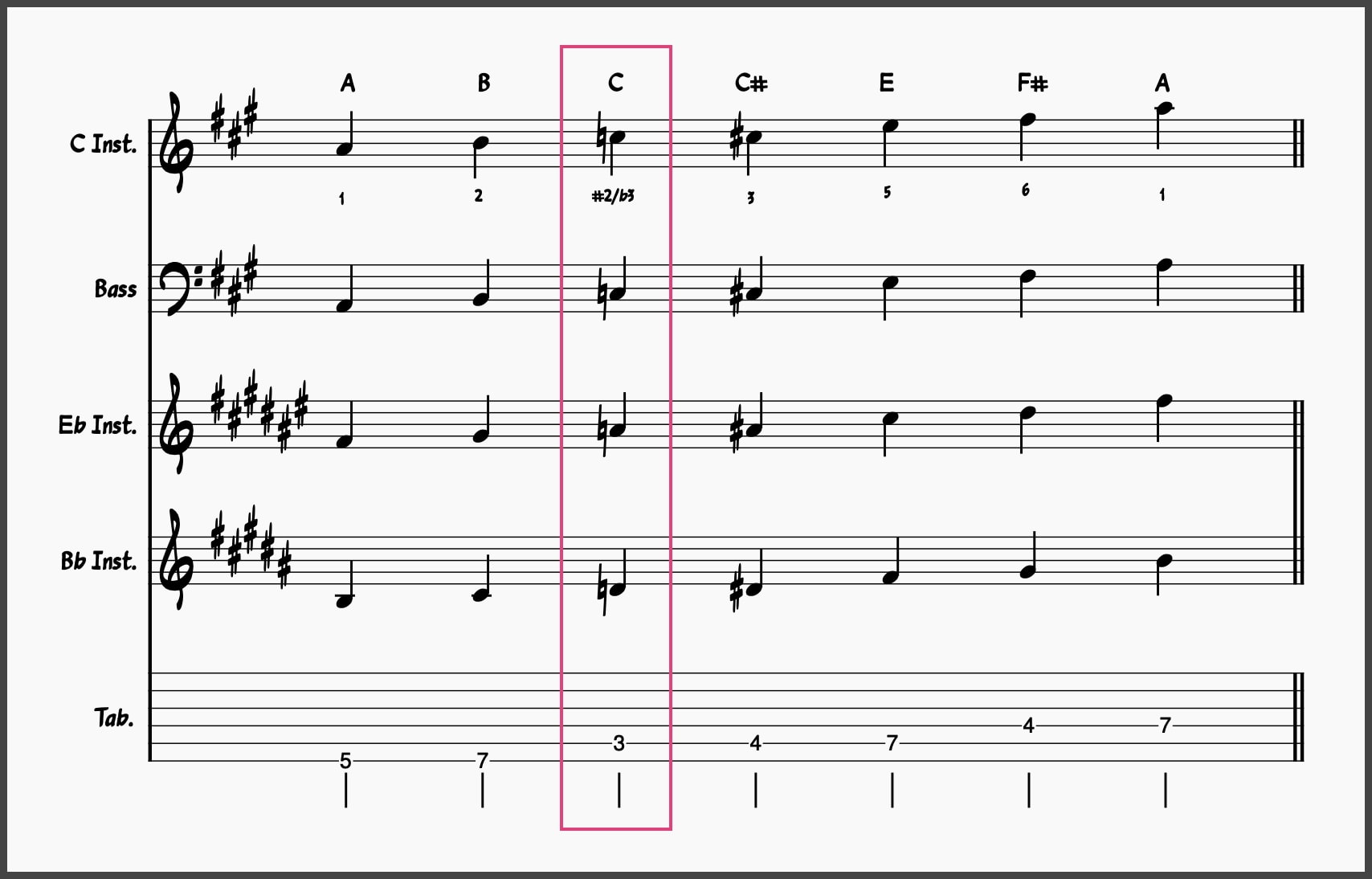
The A major blues scale formula is A, B, C, C#, E, F#, and A.
- Rt, 2,♭3, 3, 5, 6, Rt
- A, B, C, C#, E, F#, and A
D Major Blues Scale
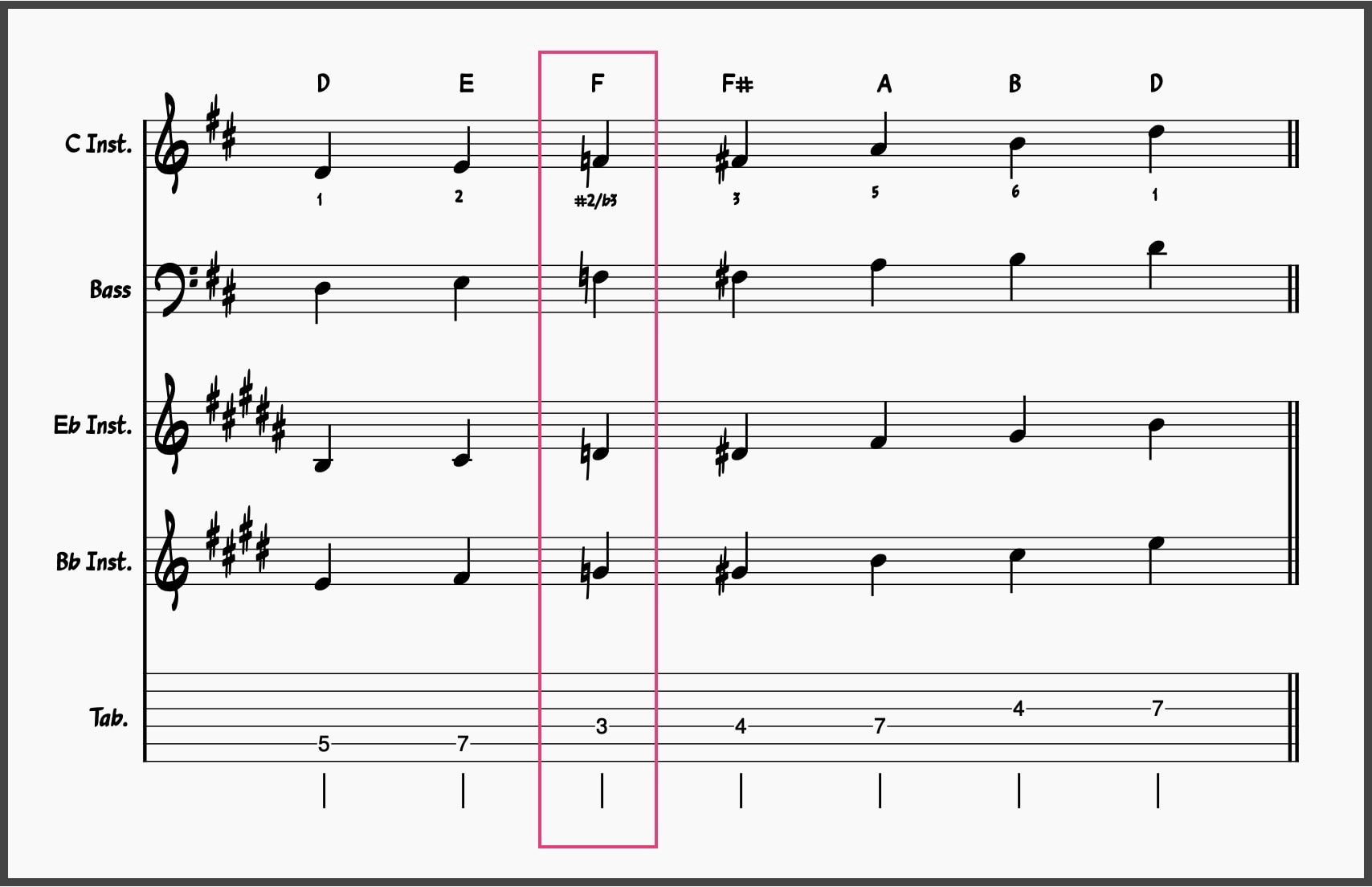
The D major blues scale formula is D, E, F, F#, A, B, and D.
- Rt, 2,♭3, 3, 5, 6, Rt
- D, E, F, F#, A, B, and D
G Major Blues Scale
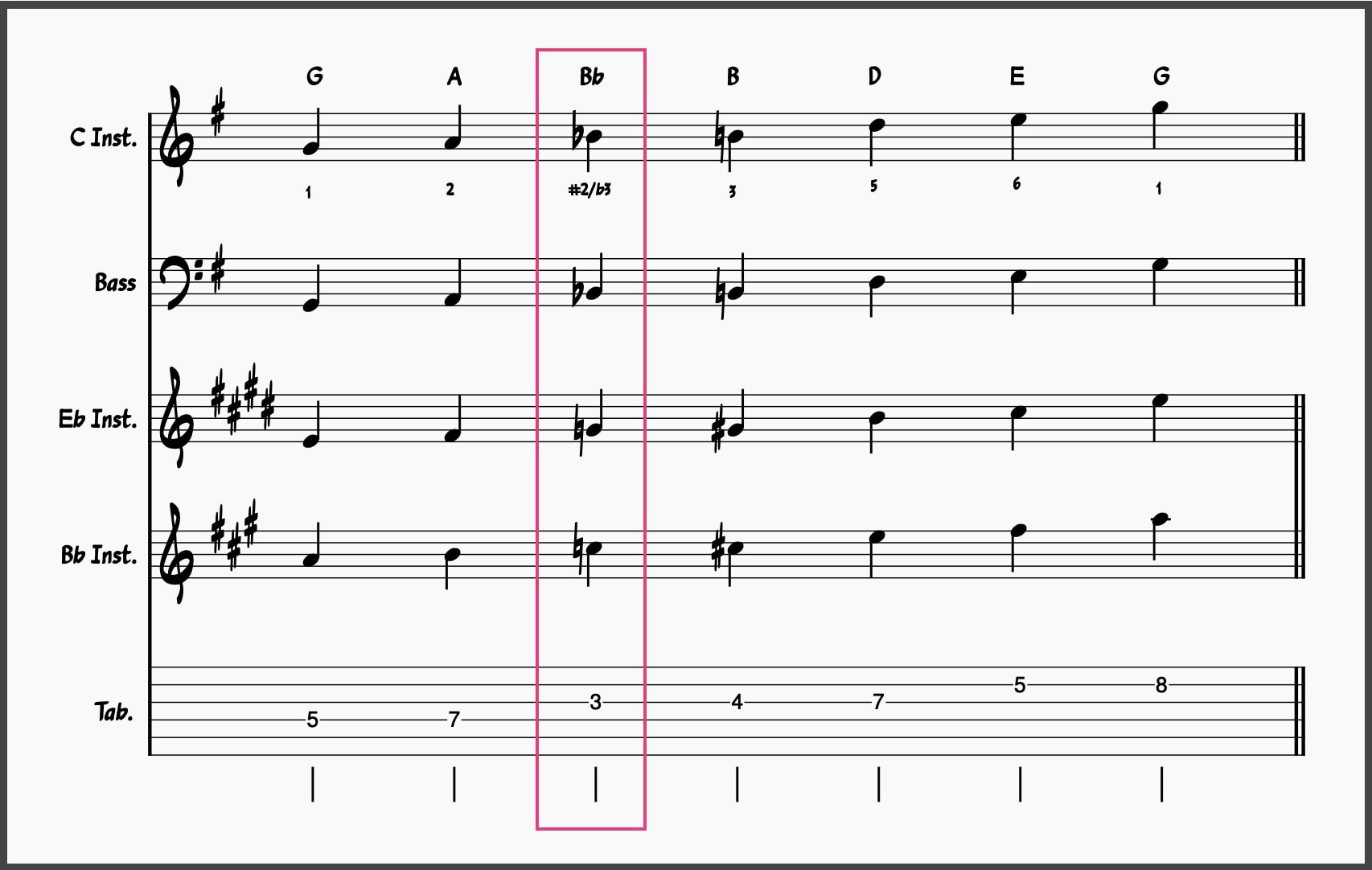
The G major blues scale formula is G, A, Bb, B, D, E, and G.
- Rt, 2,♭3, 3, 5, 6, Rt
- G, A, Bb, B, D, E, and G
Be sure to take the minor blues scale and major blues scale through all keys!
Apart from blues scales, improvisers use many other types of scales to infuse the sound of the blues into their solos.
2. Using Pentatonic Scales Over The Blues
The pentatonic scale is highly versatile and is used in many different genres. Among guitarists, it’s most commonly associated with rock guitar solos.
Traditional pentatonic scales contain no half-steps and have fewer notes than the major scale and its modes. Because the pentatonic scale is a five-note scale with no half steps, it has many applications, including the blues.
- Penta = Five
- Tonic = Tones or Notes
Though not strictly a “blues scale,” you’ll definitely hear the major and minor pentatonic scales when listening to the blues. Players may switch between the major and minor pentatonic scales to take advantage of each scale’s different chord tones.
Major Pentatonic Scale
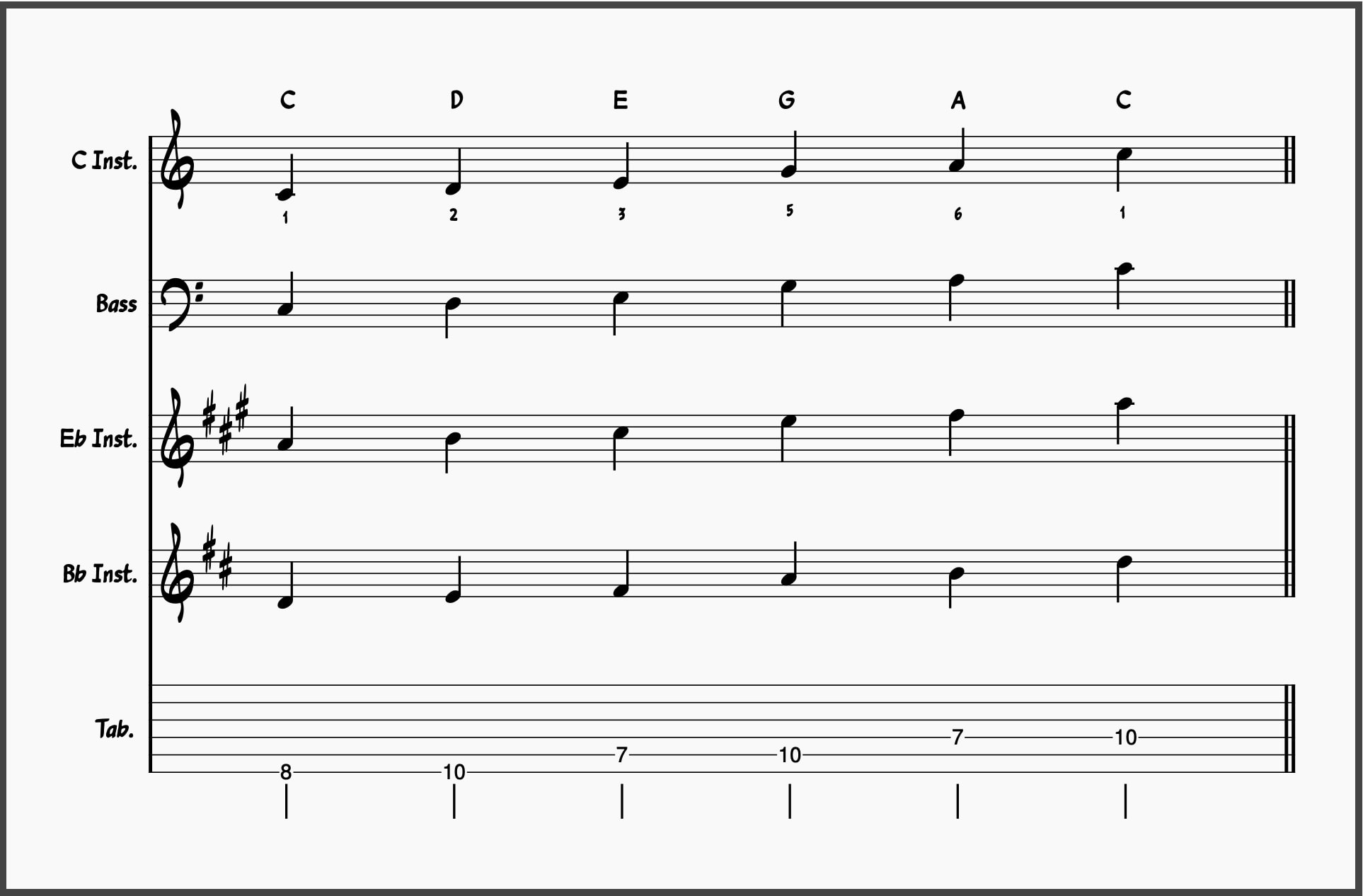
The major pentatonic scale is kind of like a shell of the major scale (Ionian Mode). It contains some basic intervallic information from the major scale, but is incomplete. Harmonically, it has a major triad (Rt. 3rd, 5th, or C, E, G in this case) and a major 6th and 9th interval.
- Rt., 2, 3, 5, 6, Rt.
- C, D, E, G, A. C
Minor Pentatonic Scale
The minor pentatonic scale is kind of like a shell of the minor scale (Aeolian mode). In relation to a C7 chord, a C minor pentatonic scale contains the root, the minor third, the fourth, the fifth, and the flat seventh.
- Rt.,♭3, 4th, 5th, 7th, Rt.
- C, Eb, F, G, Bb, and C
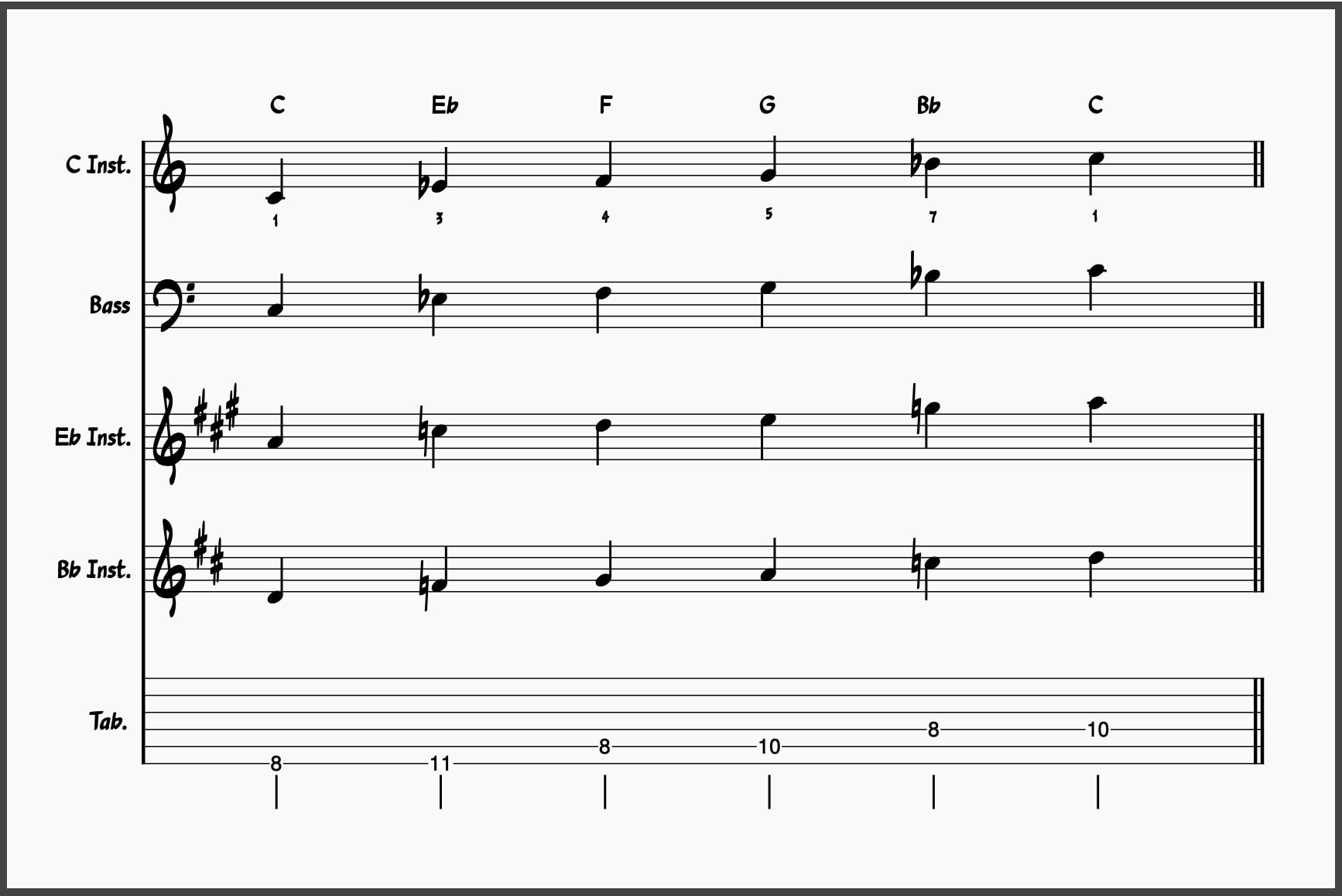
Usually, you’d play this scale over a minor chord, but the minor 3rd here helps to portray that blue note and sound really good over dominant chords.
Be sure to play these pentatonic scale shapes in all 12 keys!
Check out this article for more on how to play pentatonic scales.
3. Seven Note (Heptatonic) Blues Scales
Here are some common seven-note blues scales improvisers use to infuse their licks with a bluesy sound.
Mixolydian Scale (Fifth Mode of the Major Scale)
The fifth mode of the major scale works over dominant seventh chords because it is a major scale with a flat seventh instead of a major seventh interval. This scale will work over the harmony since the blues chord progression is made of dominant chords.
Despite being functional, the Mixolydian scale lacks the “blue notes” to evoke the blues. Each scale degree is diatonic, so there isn’t any additional flavor.
The formula for a C Mixolydian scale is:
- Rt., 2, 3, 4, 5, 6,♭7, Rt.
- C, D, E, F, G, A, Bb, Rt.
It’s the fifth mode of the F major scale.
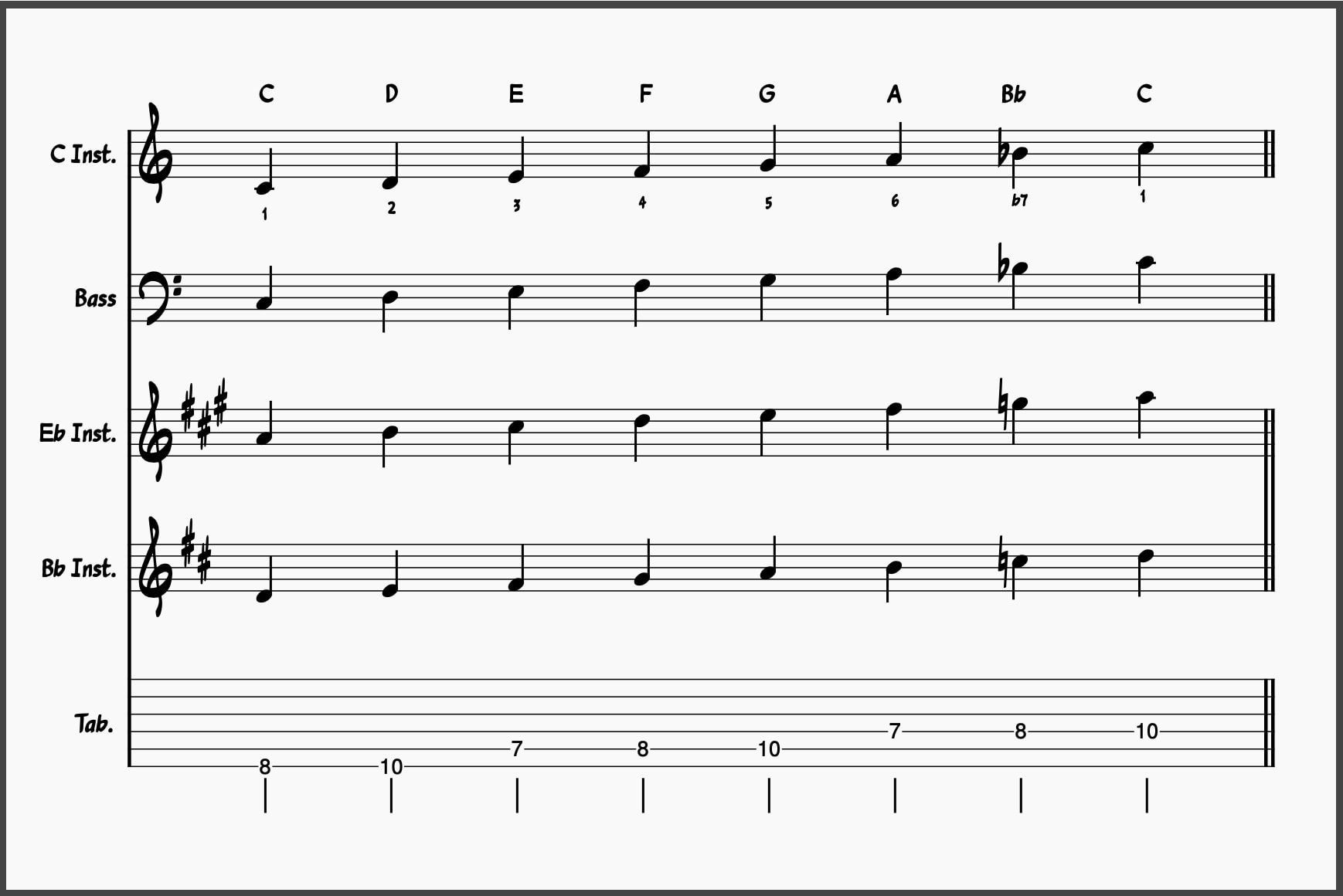
For more on the modes of the major scale, check out our Guide to Modes in Music.
Lydian Dominant Scale (Fourth Mode of the Melodic Minor Scale)
The Lydian dominant scale is often used in jazz improvisation. It is usually played over dominant chords with a #11. It is almost a regular Mixolydian scale, but it has a raised fourth scale degree. This blues scale option adds a brighter sound to your blues licks.
The formula for a C Lydian Dominant scale is:
- Rt., 2, 3, 4, 5, 6,♭7, Rt
- C, D, E, F#, G, A, Bb, C
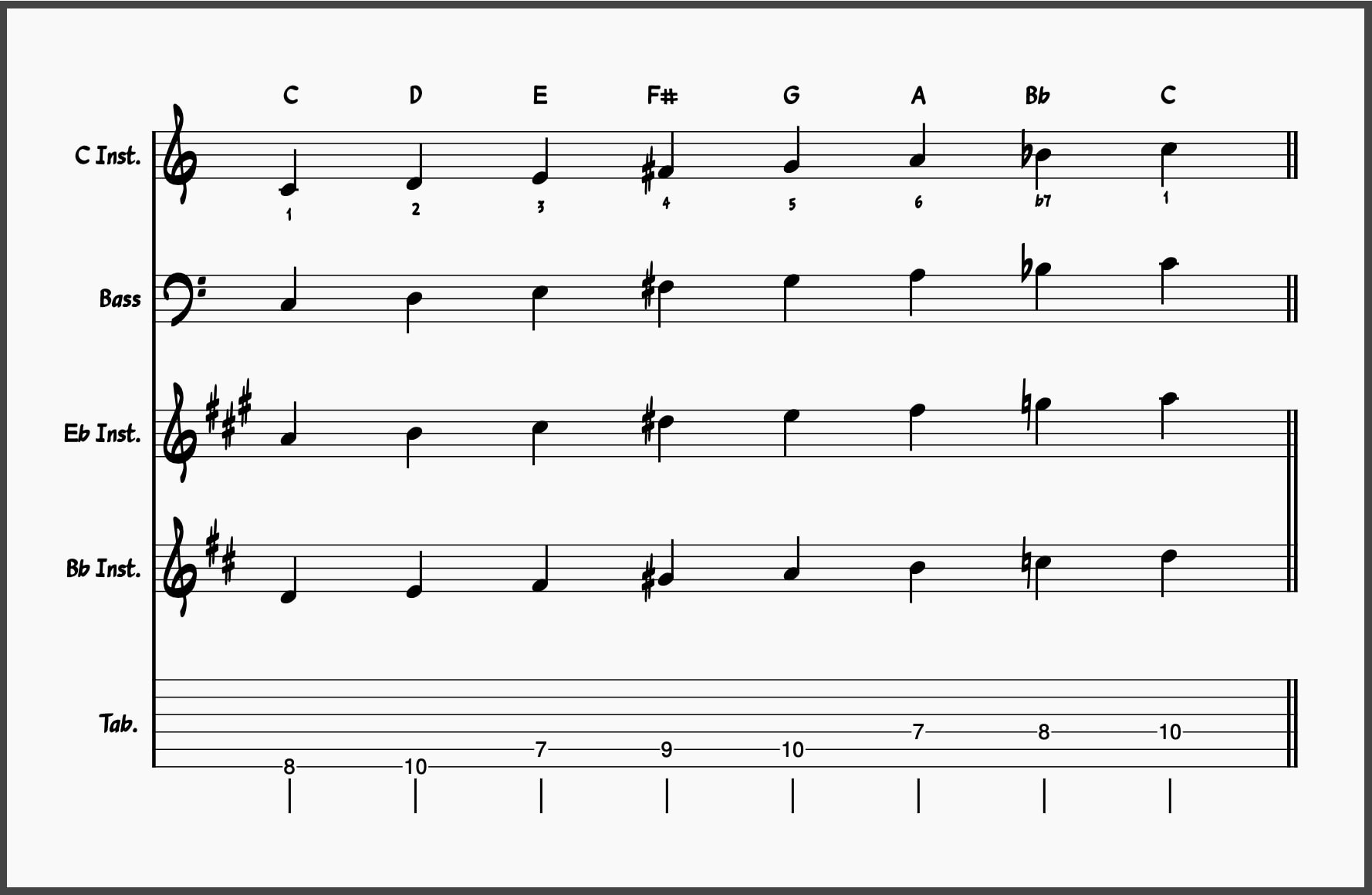
For more on the melodic minor scale, check out our article on the modes of the melodic minor scale.
“Country” Blues Scale
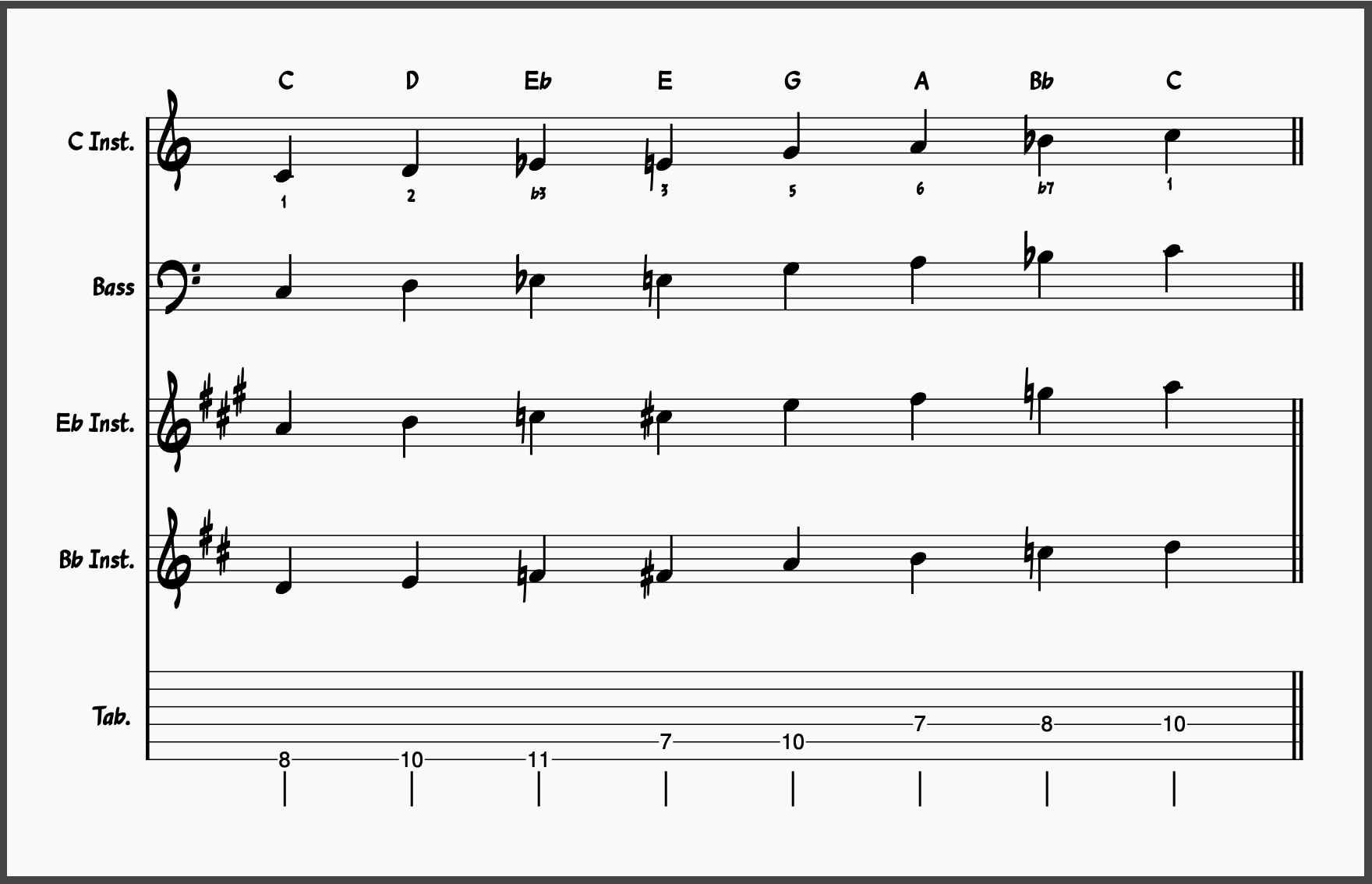
This is a variation on the major blues scale, often associated with country-blues guitarists. The C country blues scale formula is the root note, 2,♭3, 3, 5, 6,♭7.
A C major country blues scale would be spelled C, D, D#, E, G, A, and Bb.
Essentially, it’s the major blues scale with an added flat seventh:
4. Bebop Dominant Scale
Bebop scales are eight-note scales (octatonic) that take a regular major scale mode and insert a chromatic passing tone. The bebop dominant scale uses the Mixolydian mode and inserts a natural 7th in between the flat seventh and the root.
The scale formula would be:
- Rt.,♮7, ♭7, 6, 5, 4, 3, 2, Rt.
- C, B, Bb, A, G, F, E, D, C
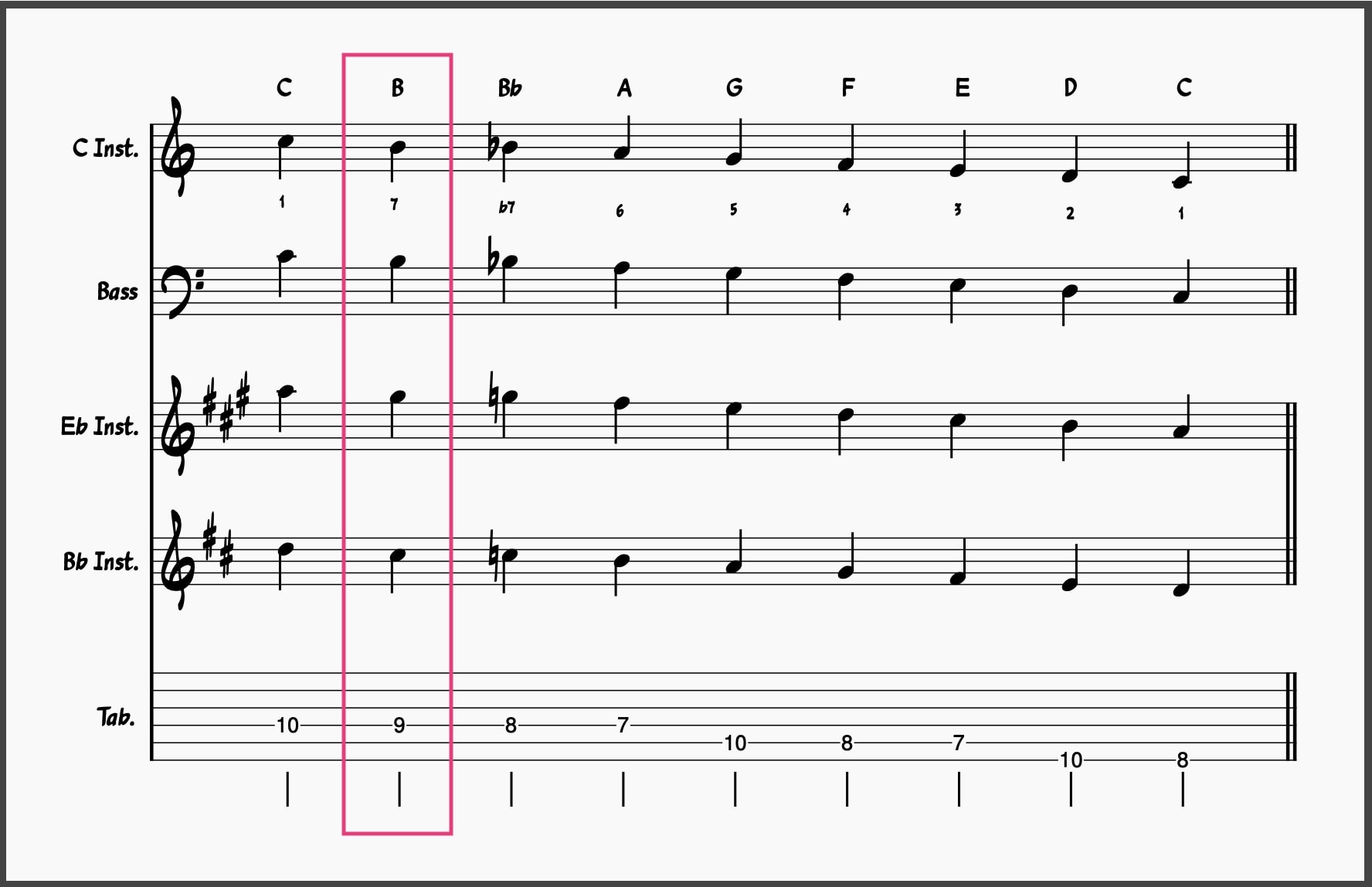
The bebop scale is usually presented in descending rather than ascending form.
The important thing to keep in mind is that the natural 7th should never fall on a downbeat. It should only be played as a chromatic passing tone between the root and the flat 7th. The image above presents the scale in quarter notes, but it is usually played in successive 8th notes.
Check out this article to learn more about bebop scales.
5. “Super” Blues Scale (Frankenstein Scale)
We’ve already been through the official blues scales that you can use. However, as we mentioned above, a blues scale is not blues music. There isn’t one “official” blues scale (despite there being two scales with that name—the major blues scale and the minor blues scale).
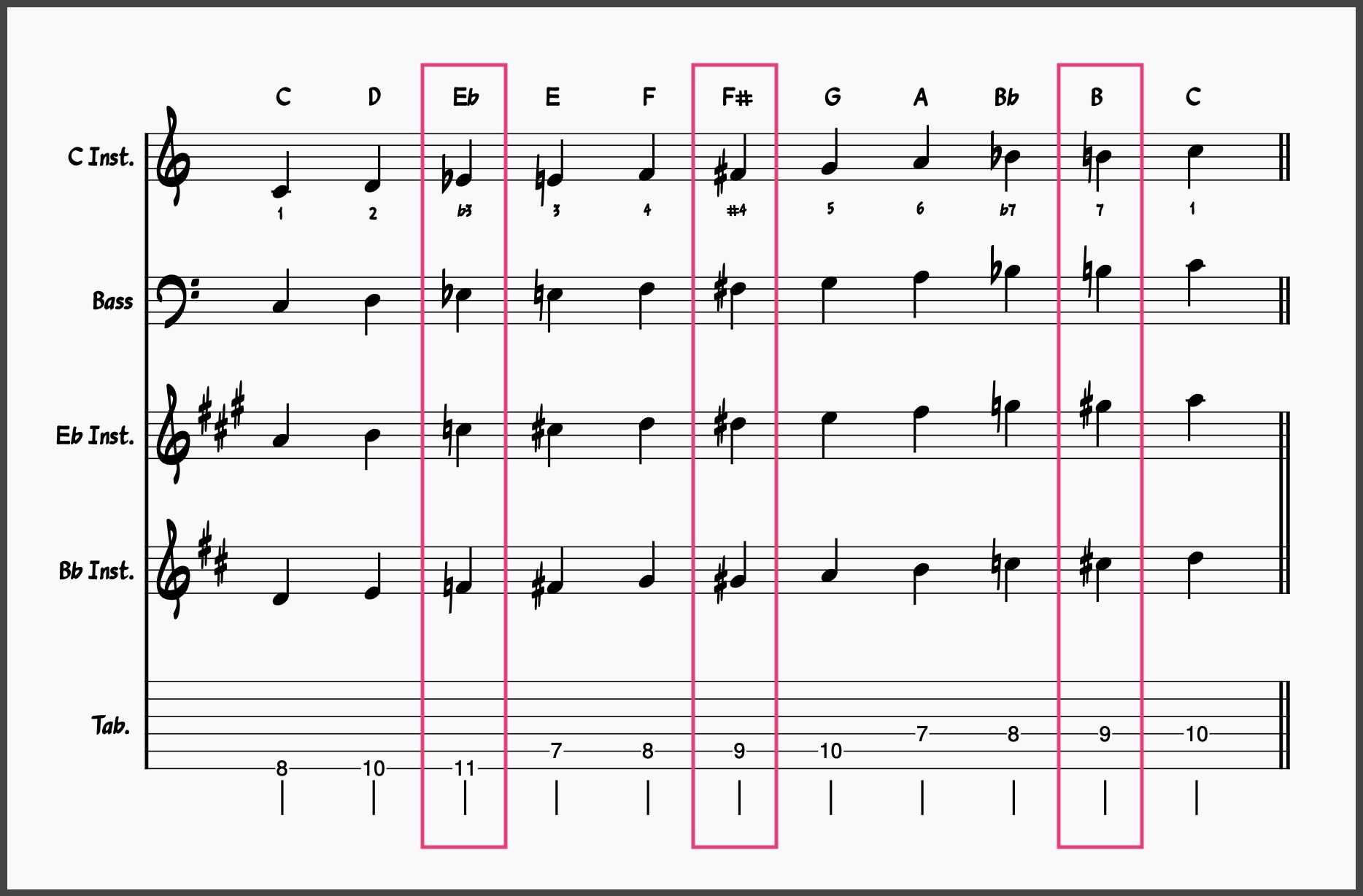
We can combine elements from many of them to create longer blues scales that encompass all the desired blue notes and passing tones. The following scale is like a Frankenstein scale, because it takes bluesy elements from the above scales and condenses them into one bluesy package.
Super Blues Scale
This Frankenstein scale takes the minor blues scale and adds the major third and natural seventh back in. Like the bebop dominant scale, it’s vitally important that you treat the natural 7th as a chromatic passing tone, only playing it on upbeats.
Check out this Frankenstein blues scale:
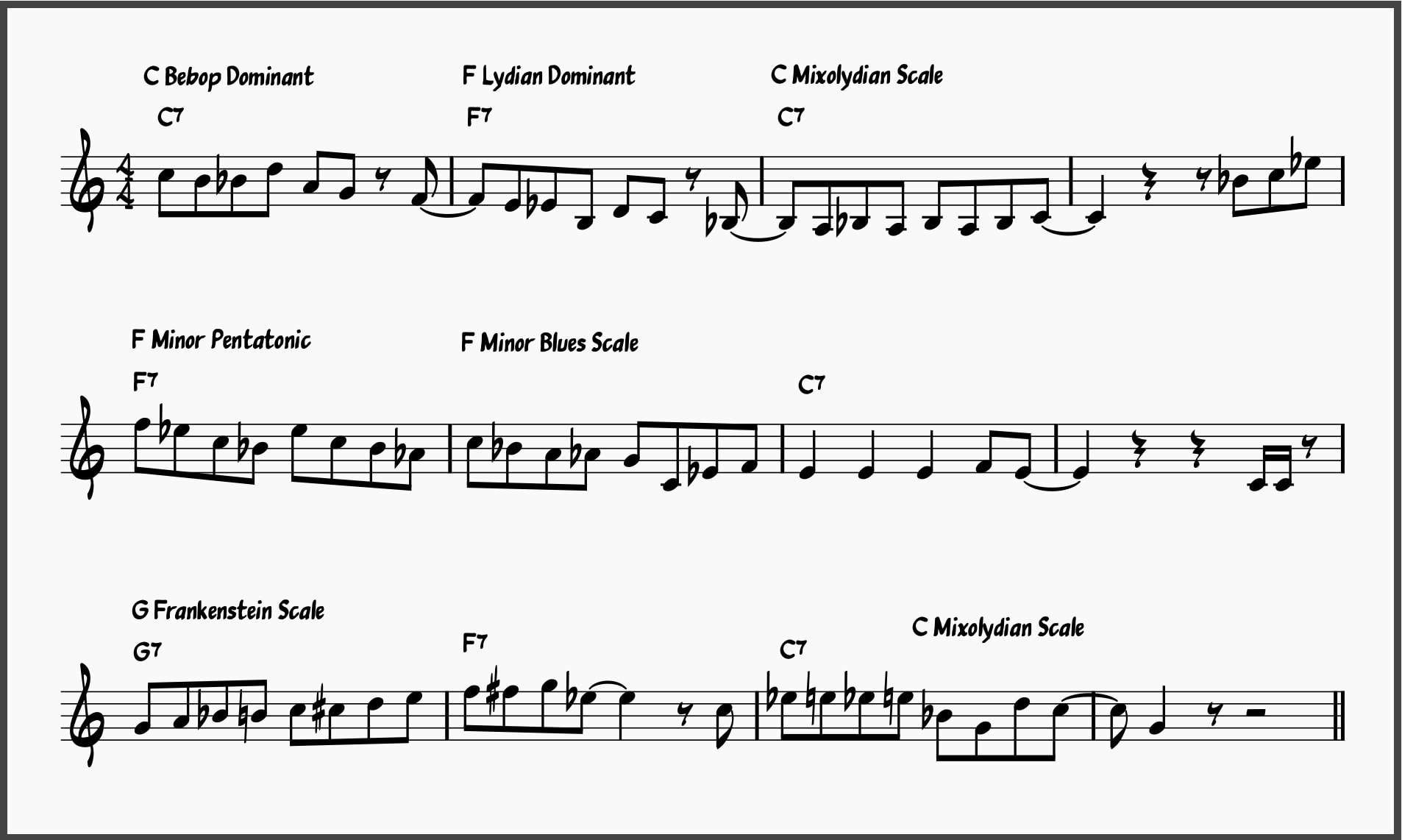
Blues Scale Exercises: Solo Over C Blues Using Different Blues Scales
The following solo uses some of the many blues scales we’ve discussed in this article. Some of them could be more than one scale, depending on how you look at it. I’ve broken it into three four-bar sections.
Blues Solo Bars 1-4
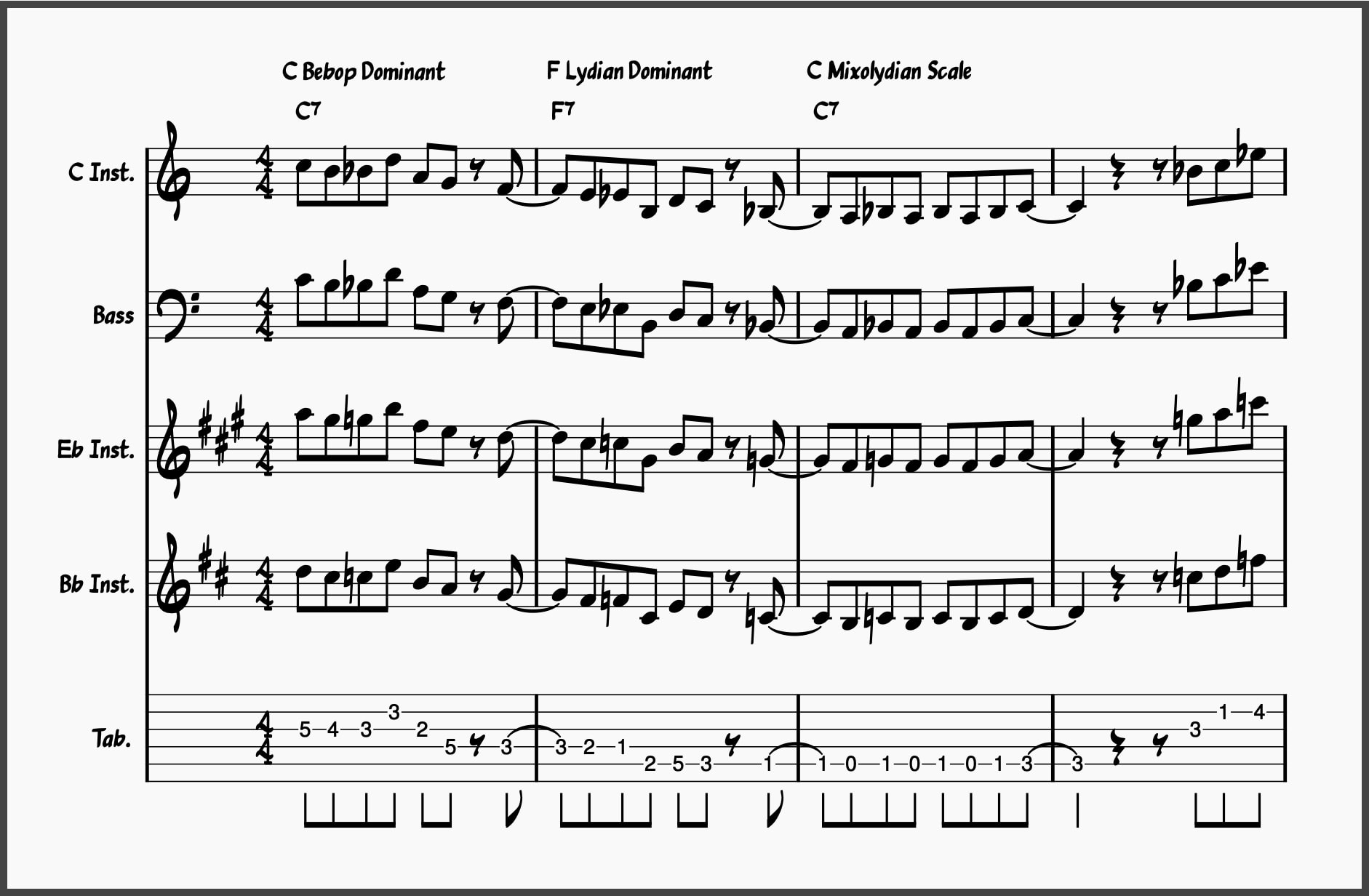
This segment of the blues solo contains the C Bebop Dominant scale, F Lydian Dominant scale, and the C Mixolydian scale.
Blues Solo Bars 5-8
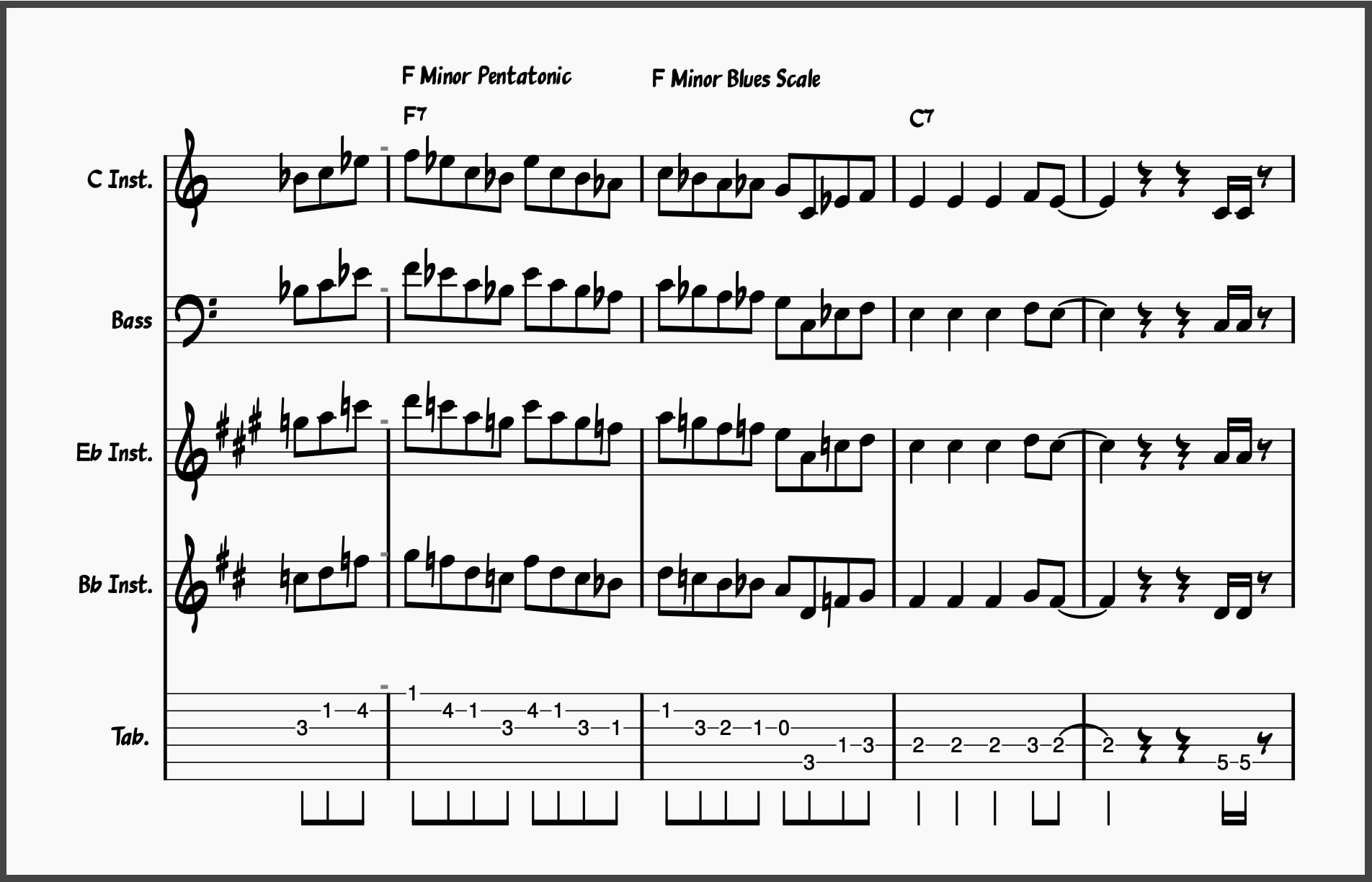
This segment of the blues solo contains the F minor pentatonic scale and the F minor blues scale.
Blues Solo Bars 9-12
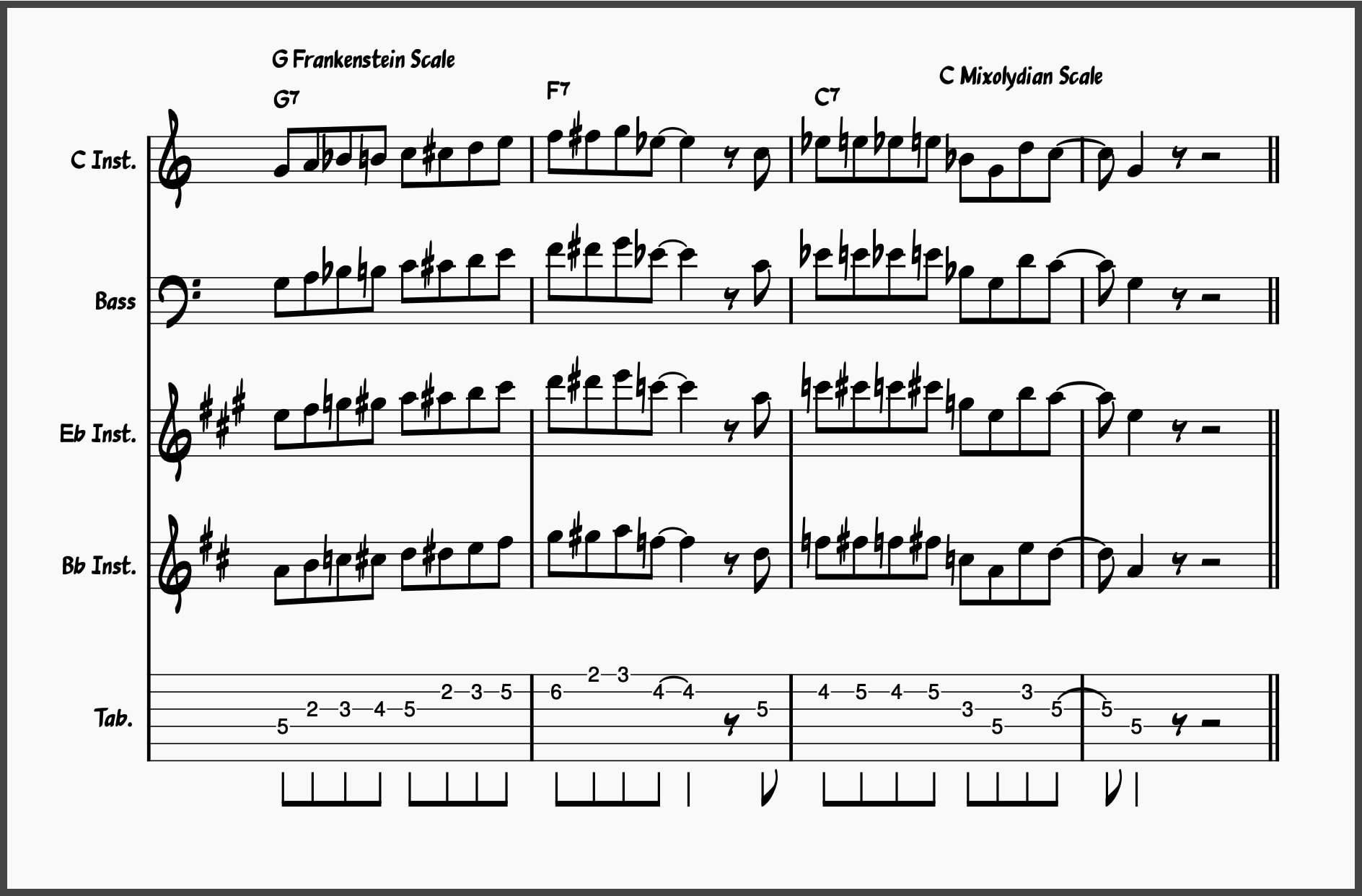
This section of the blues solo contains the G Frankenstein scale and the C Mixolydian scale.
Here is this blues solo in its entirety! Be sure to practice playing it over a C blues backing track.
Listening Exercise! Blues Solo Analysis
image source: Wikimedia Commons
After learning that blues solo, let’s analyze what makes something bluesy.
There are so many factors that make a line or lick sound bluesy. Listen to one of your favorite jazz musicians improvise over a blues and consider all of the following playing characteristics:
- Timbre: What is the tone quality of the notes? Harsh? Brittle? Smooth? Fuzzy?
- Dynamics: How loud or soft are the lines and phrases?
- Pitch Bending: Do the pitches move or slide in relation to the key or tonal center?
- Rhythm: What kind of phrasing or rhythms are present?
- Time-Feel: How do the notes sit in the space created by other musicians?
- Space: How does the musician use silence or rests to emphasize what they do play?
- Motivic Development: What musical themes or statements does the musician develop and elaborate on?
- Call-and-Response: How does the musician interact with or react to other musicians?
- Emotional Expressivity: How does the musician articulate their phrases?
Check out Kenny Burrell’s pivotal album Midnight Blue (1963) if you need a listening recommendation. Nearly every song is a blues, and those that aren’t technically following the blues form are still dripping with blues phrasing and vocabulary!
Ready to Become a Jazz Blues Master? Join the Learn Jazz Standards Inner Circle.
Want to sound like your favorite jazz player but don’t know how to get there? Are you trying to improve your lead guitar playing or improvising skills on piano, saxophone, or other jazz instruments?
If so, you should check out the Learn Jazz Standards Inner Circle.
When you join the Inner Circle, you’ll get access to over ten years of jazz education resources, from jazz improvisation workshops and masterclasses to in-depth jazz standard studies and instrument-specific courses.
Improve in 30 days or less. Join the Inner Circle!